Species · Birds · Extinct
Stresemann's Bristlefront Merulaxis stresemanni
The scientific name of the Stresemann's Bristlefront is Merulaxis stresemanni. It is an extinct species of bird in the family Rhinocryptidae (tapaculo), order Passeriformes. The name dates from 1960.
- Scientific name
- Merulaxis stresemanni Sick, 1960
- Common name
- Stresemann's Bristlefront
- Genus
- Merulaxis
- Family
- Rhinocryptidae (Tapaculo)
- Order
- Passeriformes
- Class
- Aves
- Red List category
- CR Critically Endangered
- Name status
- accepted in the Catalogue of Life
Overview
Merulaxis stresemanni is endemic to Brazil and has a confirmed range restricted to the Mata do Passarinho Reserve, which spans the Minas Gerais and Bahia state border. It is a 20 cm bird distinguished by a long tail and long, pointed forehead bristles.
Written 26 November 2026 from the sources listed below. Each statement was checked against the passage it cites; statements that could not be supported were removed.
Similar species
The slaty bristlefront is the sister species of Stresemann's Bristlefront and is significantly more common.[1][2]
Appearance
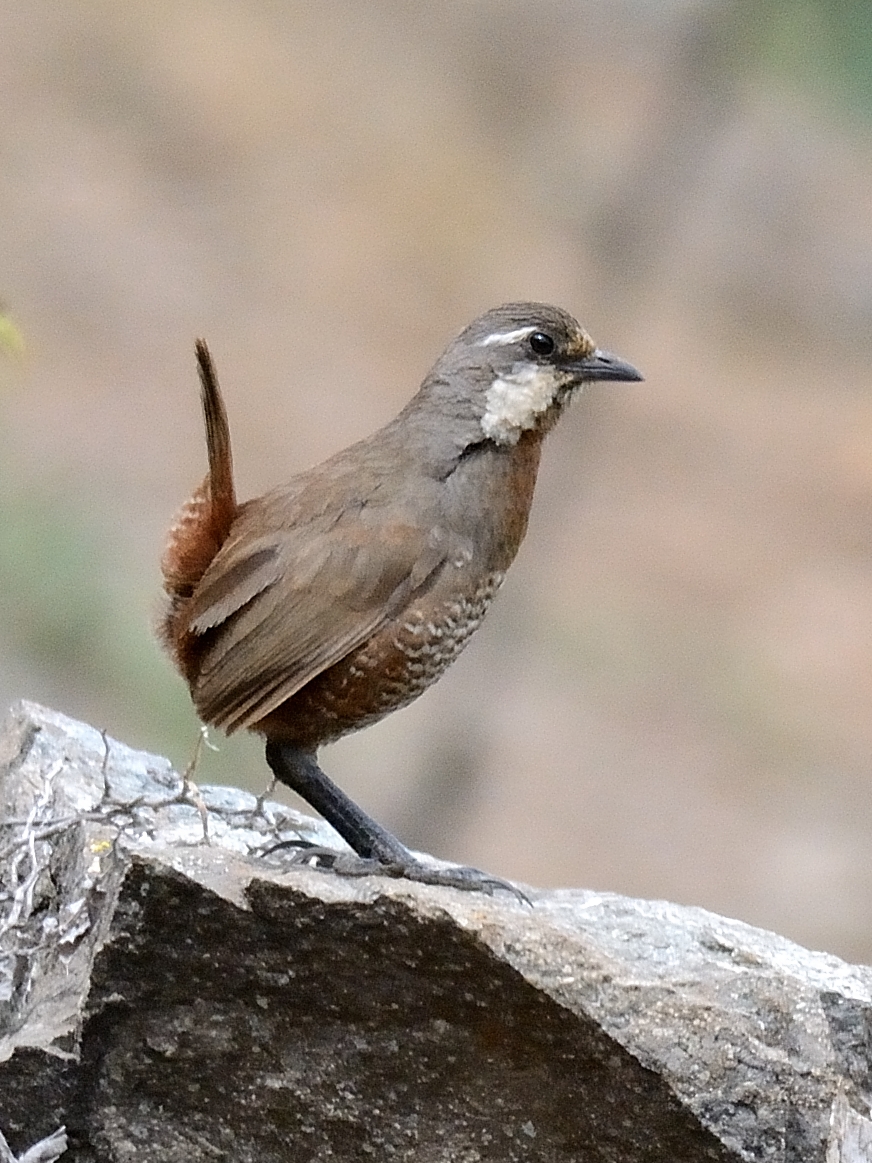
Stresemann's Bristlefront is medium-sized, measures 20 cm in length, and has a long tail and distinctive forehead bristles. The bristles are long and pointed.[3][4][5]
Adult males are slaty gray, with dark rufous-chestnut coloration on the rump, uppertail-coverts, and vent.[6]
Adult females are cinnamon-brown above, with a duskier tail, and bright cinnamon below.[7]
Habitat
The species inhabits the heavily fragmented Atlantic Forest biome of eastern Brazil. Its confirmed range is restricted to the Mata do Passarinho Reserve, which spans the Minas Gerais and Bahia state border.[8][9]
It occupies moist lowland forest, particularly areas with dense understory and thick leaf litter.[10]
Diet
The species has been observed foraging near fallen tree trunks, apparently searching for arthropods.[11]
Behaviour
Stresemann's Bristlefront is cryptic and ground-dwelling, with secretive habits.[12]
Its song begins with clicks followed by a trill and is lower-pitched than that of the closely related slaty bristlefront. The species readily responds to playback.[13][14][15]
Reproduction and life cycle
The first documented nest site was a tunnel estimated to be 1.8 metres long. The nest itself has not been described.[16][17]
Conservation
Stresemann's Bristlefront is classified as Critically Endangered. Its estimated global population is fewer than 50 mature individuals.[18][19]
The American Bird Conservancy estimated that the global population contained no more than 15 individuals in 2013.[20]
The Mata do Passarinho Reserve was expanded by 766 acres in 2015. The species was most recently assessed for the IUCN Red List in 2020.[21][22]
Classification of the Stresemann's Bristlefront
| Kingdom | Animalia |
|---|---|
| Phylum | Chordata |
| Subphylum | Vertebrata |
| Infraphylum | Gnathostomata |
| Parvphylum | Osteichthyes |
| Megaclass | Tetrapoda |
| Class | Aves (Bird) |
| Order | Passeriformes (Passerine) |
| Family | Rhinocryptidae (Tapaculo) |
| Genus | Merulaxis (Bristlefronts) |
| Species | Merulaxis stresemanni Sick, 1960 |
Where the Stresemann's Bristlefront is found
Checklists place Merulaxis stresemanni in South America.
Range as the checklists state it
South America
A number beside a place is its count of GBIF occurrence records. A place without a number comes from a checklist alone. Records show where a species has been observed or collected, which can include escapes and vagrants.
Common names
English
- Stresemann's Bristlefront
Names in 24 other languages
- Catalan
- tapacul emplomallat de Stresemann
- Chinese
- 巴西鬚額雀, 斯氏须额窜鸟
- Croatian
- kudravočela strmorepka
- Czech
- štidlák Stresemannův
- Danish
- Bahia Børstefjæs, Stresemanns Børstefjæs
- Dutch
- Stresemanns Tapaculo
- Esperanto
- stresemana tapakulo
- Finnish
- isosukastapakulo
- French
- Mérulaxe de Stresemann
- German
- Nördlicher Stirnhaubentapaculo, Stirnhaubentapaculo, Stresemann-Tapaculo, Stresemanntapaculo
- Hungarian
- bahiai sörtéstapakúló
- Italian
- Frontericcia di Stresemann, Frontesetolosa di Stresemann
- Japanese
- ookebitaiotatedori, オオケビタイオタテドリ
- Lithuanian
- šiaurinis medyninis topakulas
- Norwegian
- bahiabørstepanne
- Polish
- kominiarek śniady
- Portuguese
- Bigodudo-baiano, entufado-baiano, tapaculo-entufado-baiano
- Russian
- Веерохвостый щетинколоб, Древесный топаколо Штреземанна, Жестколобка Штреземанна, Топаколо Штреземанна
- Slovak
- tapakulo štetinatý
- Spanish
- Macuquiño de Stresemann
- Swedish
- bahiaborstpanna
- Turkish
- Stresemann Tapakolası
- Ukrainian
- макуквіно великий
- Welsh
- aelwrychog Stresemann
Related species
-
 Slaty BristlefrontMerulaxis ater
-
 Chucao TapaculoScelorchilus rubecula
-
 Black-throated Huet-huetPteroptochos tarnii
-
 Moustached TurcaPteroptochos megapodius
-
 Magellanic TapaculoScytalopus magellanicus
-
 Ocellated TapaculoAcropternis orthonyx
-
 Crested GallitoRhinocrypta lanceolata
-
 Blackish TapaculoScytalopus latrans
Compare
Questions and answers
What is the scientific name of the Stresemann's Bristlefront?
The scientific name of the Stresemann's Bristlefront is Merulaxis stresemanni. Written with its author, the full name is Merulaxis stresemanni Sick, 1960.
Which family does the Stresemann's Bristlefront belong to?
Merulaxis stresemanni belongs to the family Rhinocryptidae, in the order Passeriformes and the class Aves.
What is the conservation status of the Stresemann's Bristlefront?
The IUCN Red List category recorded for Merulaxis stresemanni is Critically Endangered (CR).
Why is Stresemann's bristlefront so rare?
Its habitat is heavily fragmented, and approximately 90% of the original Atlantic Forest cover in the region has been cleared. Habitat fragmentation, logging, and agricultural encroachment threaten the species despite legal protections.[9][23][24]
Is Stresemann's bristlefront extinct?
No. It is classified as Critically Endangered, with an estimated global population of fewer than 50 mature individuals.[18][19]
What does a Stresemann's bristlefront look like?
It is a medium-sized bird measuring 20 cm in length, with a long tail and long, pointed forehead bristles. Adult males are slaty gray with dark rufous-chestnut coloration on the rump, uppertail-coverts, and vent, while adult females are cinnamon-brown above, with a duskier tail, and bright cinnamon below.[3][4][6][7][5]
Sources
Passages the profile rests on
- The slaty bristlefront is the sister species of Stresemann's bristlefront. Source passage: “Stresemann's bristlefront and the slaty bristlefront (Merulaxis ater) are sister species” — English Wikipedia
- The slaty bristlefront is significantly more common than Stresemann's bristlefront. Source passage: “the latter being significantly more common.” — English Wikipedia
- The species is medium-sized, has a long tail, and possesses distinctive forehead bristles. Source passage: “Stresemann's bristlefront is a medium-sized, long-tailed bird with distinctive forehead bristles.” — English Wikipedia
- The species measures 20 cm in length. Source passage: “It measures 20 cm (7.9 in) long.” — English Wikipedia
- The species has long, pointed bristles on its forehead. Source passage: “The namesake features are long, pointed bristles on the forehead.” — English Wikipedia
- Adult males are slaty gray with dark rufous-chestnut coloration on the rump, uppertail-coverts, and vent. Source passage: “The male is all slaty gray with a dark rufous-chestnut rump, uppertail-coverts, and vent.” — English Wikipedia
- Adult females are cinnamon-brown above, have a duskier tail, and are bright cinnamon below. Source passage: “The female is cinnamon-brown above, with a duskier tail, and is bright cinnamon below.” — English Wikipedia
- Its confirmed range is restricted to the Mata do Passarinho Reserve, which spans the Minas Gerais and Bahia state border. Source passage: “its current confirmed range is now restricted to a single protected site: the Mata do Passarinho Reserve (also known as the Songbird Forest Reserve), which straddles the border between the states of Minas Gerais and Bahia.” — English Wikipedia
- The species inhabits the heavily fragmented Atlantic Forest biome of eastern Brazil. Source passage: “The Stresemann's bristlefront is endemic to the heavily fragmented Atlantic Forest biome of eastern Brazil.” — English Wikipedia
- The species occupies moist lowland forest, particularly areas with dense understory and thick leaf litter. Source passage: “The species inhabits moist lowland forest, especially in areas characterized by dense understory and thick leaf litter.” — English Wikipedia
- The species has been observed foraging near fallen tree trunks, apparently searching for arthropods. Source passage: “it has been observed to forage near fallen tree trunks, seemingly for arthropods.” — English Wikipedia
- The species is cryptic and ground-dwelling, with secretive habits. Source passage: “The Stresemann's bristlefront is a cryptic and ground-dwelling species with secretive habits” — English Wikipedia
- The species' song begins with clicks followed by a trill. Source passage: “The Stresemann's bristlefront song starts with clicks followed by a trill.” — English Wikipedia
- The species' song is lower-pitched than that of the closely related slaty bristlefront. Source passage: “It is similar to that of the closely related slaty bristlefront but lower pitched.” — English Wikipedia
- The species readily responds to playback. Source passage: “It readily responds to playback.” — English Wikipedia
- The first documented nest site was a tunnel estimated to be 1.8 metres long. Source passage: “The first known Stresemann's bristlefront nest site was a tunnel estimated to be 6 ft (1.8 m) long.” — English Wikipedia
- The nest itself has not been described. Source passage: “The nest itself was not described.” — English Wikipedia
- The species is classified as Critically Endangered. Source passage: “It is classified as Critically Endangered by the International Union for Conservation of Nature (IUCN).” — English Wikipedia
- The estimated global population is fewer than 50 mature individuals. Source passage: “The global population is estimated to number fewer than 50 mature individuals” — English Wikipedia
- The American Bird Conservancy estimated that the global population contained no more than 15 individuals in 2013. Source passage: “In 2013, American Bird Conservancy estimated the world population to be 15 or fewer individuals.” — English Wikipedia
- The Mata do Passarinho Reserve was expanded by 766 acres in 2015. Source passage: “In 2015, the reserve was expanded by an additional 766 acres (3.10 km2)” — English Wikipedia
- The species was most recently assessed for the IUCN Red List in 2020. Source passage: “Stresemann's Bristlefront Merulaxis stresemanni has most recently been assessed for The IUCN Red List of Threatened Species in 2020.” — iucnredlist.org
- Approximately 90% of the original Atlantic Forest cover in the region has been cleared. Source passage: “Approximately 90% of the original forest cover in the region has been cleared” — English Wikipedia
- Habitat fragmentation, logging, and agricultural encroachment threaten the species despite legal protections. Source passage: “ongoing threats from habitat fragmentation, logging, and agricultural encroachment continue to jeopardize the species' survival.” — English Wikipedia
Data
- Catalogue of Life, 2026-10-16 XR cc by
- Wikidata CC0
- Within the Catalogue of Life, this name comes from The Integrated Taxonomic Information System cc0
References
- Sick, & Helmut. (1960). Zur Systematik und Biologie der Bürzelstelzer (Rhinocryptidae), speziell Brasiliens. Journal Für Ornithologie, Vol. 101. where the name was published
- Fish and Wildlife Service, U. S. (2004). Endangered and Threatened Wildlife and Plants; Annual Notice of Findings on Resubmitted Petitions for Foreign Species; Annual Description of Progress on Listing Actions. Federal Register, Vol. 69, No. 99.
- Gill, Frank, & and Minturn Wright. (2006). Birds of the World: Recommended English Names.
This species in other databases
Page built on 29 November 2026. See how the catalog is made and all sources and licences.
Cite this page
ScientificNames.org. (2026). Merulaxis stresemanni (Stresemann's Bristlefront). Retrieved November 29, 2026, from https://scientificnames.org/species/merulaxis-stresemanni
“Merulaxis stresemanni (Stresemann's Bristlefront).” ScientificNames.org, 2026, scientificnames.org/species/merulaxis-stresemanni. Accessed 29 Nov. 2026.
ScientificNames.org. “Merulaxis stresemanni (Stresemann's Bristlefront).” Accessed November 29, 2026. https://scientificnames.org/species/merulaxis-stresemanni.
@misc{scientificnames_merulaxis_stresemanni_stresemanns_bristlefront,
  author = {{ScientificNames.org}},
  title = {Merulaxis stresemanni (Stresemann's Bristlefront)},
  year = {2026},
  url = {https://scientificnames.org/species/merulaxis-stresemanni},
  note = {Accessed 2026-11-29}
}