Species · Mammals
Banana Bat Musonycteris harrisoni
The scientific name of the Banana Bat is Musonycteris harrisoni. It is a species of mammal in the family Phyllostomidae (new world leaf-nosed bats), order Chiroptera. The name dates from 1960.
- Scientific name
- Musonycteris harrisoni Schaldach & McLaughlin, 1960
- Common name
- Banana Bat
- Genus
- Musonycteris
- Family
- Phyllostomidae (New World Leaf-nosed Bats)
- Order
- Chiroptera
- Class
- Mammalia
- Red List category
- VU Vulnerable
- Recorded in
- 1 country
- Name status
- accepted in the Catalogue of Life
Overview
The Banana Bat is endemic to Mexico and occurs in Colima, Guerrero, Jalisco, Mexico, and Morelos. The Banana Bat is distinguished by its extremely long rostrum, which averages more than half the greatest length of its skull.
Written 26 November 2026 from the sources listed below. Each statement was checked against the passage it cites; statements that could not be supported were removed.
Appearance
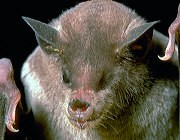
It has an extremely long rostrum, small rounded ears, and a relatively short tail. The rostrum accounts for approximately half the length of its skull.[1][2]
The Banana Bat has a complete uropatagium that encloses its short tail and small cheek teeth with reduced lingual elements. Its tongue has a long, conical ridge of papillae that increases its surface area.[3][4][5]
Its head and body measure 70–79 mm in length, its tail measures 8–12 mm, and its forearm measures 41–43 mm. One measured individual had a tongue 76 mm long.[6][7][8][9]
Habitat
The Banana Bat inhabits subtropical or tropical dry shrubland. It occurs in arid thorn forests and tropical deciduous forests along the coast and in the Balsas River Basin.[10][11]
Banana Bats have been recorded roosting in culverts and caves and have been captured in banana groves.[12][13]
Its habitat has a dry season from November through May and a summer rainy season from July through October.[14]
Diet
It has been recorded visiting at least 14 pollen-producing plant species during an annual cycle. It also uses cultivated banana plants that do not produce pollen.[15][16]
Pollen provides a reliable source of protein. The Banana Bat consumes pollen during grooming rather than directly from flower anthers and incidentally consumes insects while feeding on nectar.[17][18][19]
Behaviour
The Banana Bat is nocturnal and uses specialized hovering flight to feed from flowers. It roosts in small groups and does not hibernate.[20][21][22][23]
The Banana Bat has been recorded as a year-round resident in a study area despite variation in floral resources. Recaptured individuals were always found less than one kilometer from their initial capture locations.[24][25]
Reproduction and life cycle
The Banana Bat has separate male and female sexes. Reproductively active males have been captured during spring and summer, while pregnant females have been captured in late summer and fall.[26][27][28]
A study recorded eight lactating females captured between mid-March and mid-April during the dry season. Females captured between July and September showed no signs of advanced pregnancy or lactation.[29][30]
A juvenile Banana Bat was captured in August.[31]
Conservation
The Banana Bat is listed as endangered in the first document and considered vulnerable by the IUCN according to the second document. Habitat loss is identified as a threat.[32][33][34]
The Mexican Ministry of Ecology considers the Banana Bat a treatment species.[35]
Uses
The Banana Bat is an important pollinator of plant species throughout its range, including banana plants. It also serves as a pollinator for C. grandiflora.[36][37][38]
Classification of the Banana Bat
| Kingdom | Animalia |
|---|---|
| Phylum | Chordata |
| Subphylum | Vertebrata |
| Infraphylum | Gnathostomata |
| Parvphylum | Osteichthyes |
| Megaclass | Tetrapoda |
| Class | Mammalia (Mammal) |
| Subclass | Theria |
| Infraclass | Eutheria |
| Order | Chiroptera (Bat) |
| Suborder | Yangochiroptera |
| Superfamily | Noctilionoidea |
| Family | Phyllostomidae (New World Leaf-nosed Bats) |
| Subfamily | Glossophaginae |
| Tribe | Choeronycterini (Tailless Bats) |
| Subtribe | Choeronycterina (Long-tailed Bats) |
| Genus | Musonycteris (Banana Bat) |
| Species | Musonycteris harrisoni Schaldach & McLaughlin, 1960 |
Where the Banana Bat is found
Checklists and occurrence records place Musonycteris harrisoni in 1 country across North America. GBIF holds 148 georeferenced records of it.
Countries
Regions and cities with the most records
- Colima, Mexico 67
- Jalisco, Mexico 23
- Michoacán, Mexico 23
- Guerrero, Mexico 11
- Tecomán, Mexico 9
- Cihuatlán, Mexico 8
- Manzanillo, Mexico 7
- Técpan de Galeana, Mexico 5
- Ciudad de Villa de Álvarez, Mexico 4
- Colima, Mexico 4
- México, Mexico 3
- Zumpango del Río, Mexico 3
Range as the checklists state it
Middle America
A number beside a place is its count of GBIF occurrence records. A place without a number comes from a checklist alone. Records show where a species has been observed or collected, which can include escapes and vagrants.
Common names
English
- Banana Bat
- Banana Bat.
Names in 8 other languages
- Czech
- glosofága banánová
- Dutch
- Bananenvleermuis
- Finnish
- colimankuonoleikko
- German
- Bananenfledermaus
- Japanese
- バナナシタナガコウモリ
- Polish
- Bananówek meksykański
- Russian
- Банановый листонос
- Spanish
- Murciélago platanero
Related species
-
 Common Vampire BatDesmodus rotundus
-
 Honduran White BatEctophylla alba
-
 Spectral BatVampyrum spectrum
-
 Hairy-legged Vampire BatDiphylla ecaudata
-
 Big-eared Woolly BatChrotopterus auritus
-
 Seba's Short-tailed BatCarollia perspicillata
-
 Lesser Long-nosed BatLeptonycteris yerbabuenae
-
 Wrinkle-faced BatCenturio senex
Compare
Questions and answers
What is the scientific name of the Banana Bat?
The scientific name of the Banana Bat is Musonycteris harrisoni. Written with its author, the full name is Musonycteris harrisoni Schaldach & McLaughlin, 1960.
Which family does the Banana Bat belong to?
Musonycteris harrisoni belongs to the family Phyllostomidae, in the order Chiroptera and the class Mammalia.
Where is the Banana Bat found?
Checklists and occurrence records place Musonycteris harrisoni in 1 country: Mexico.
What is the conservation status of the Banana Bat?
The IUCN Red List category recorded for Musonycteris harrisoni is Vulnerable (VU).
What other names does the Banana Bat have?
Musonycteris harrisoni is also known in English as Banana Bat..
Are bananas pollinated by bats?
The Banana Bat is an important pollinator of banana plants.[37]
Sources
Passages the profile rests on
- The banana bat has an extremely long rostrum, small rounded ears, and a relatively short tail. Source passage: “with an extremely long rostrum, small rounded ears, and a short tail.” — English Wikipedia
- The rostrum accounts for approximately half the length of the banana bat's skull. Source passage: “The rostrum makes up approximately half the length of the skull.” — English Wikipedia
- The banana bat has a complete uropatagium that encloses its short tail. Source passage: “The uropatagium is complete and encloses a relatively short tail.” — animaldiversity.org
- The banana bat has small cheek teeth with reduced lingual elements. Source passage: “Cheek teeth are small and show a reduction of the lingual elements” — animaldiversity.org
- The banana bat's tongue has a long, conical ridge of papillae that increases its surface area. Source passage: “The tongue has a long, conical ridge of papillae. This adds to the surface area of the tongue” — animaldiversity.org
- The banana bat's head and body measure 70–79 mm in length. Source passage: “Head and body length is 70 to 79 mm” — animaldiversity.org
- The banana bat's tail measures 8–12 mm in length. Source passage: “tail length is 8 to 12 mm” — animaldiversity.org
- The banana bat's forearm measures 41–43 mm in length. Source passage: “forearm length is 41 to 43 mm.” — animaldiversity.org
- One measured banana bat had a tongue 76 mm long. Source passage: “The tongue of one individual measured 76 mm from the gape of the jaw to the outstretched tip.” — English Wikipedia
- The banana bat inhabits subtropical or tropical dry shrubland. Source passage: “Its natural habitat is subtropical or tropical dry shrubland.” — English Wikipedia
- The banana bat occurs in arid thorn forests and tropical deciduous forests along the coast and in the Balsas River Basin. Source passage: “Banana bats seem to be restricted to arid thorn and tropical deciduous forest along the coast and in the Balsas River Basin.” — animaldiversity.org
- Banana bats have been recorded roosting in culverts and caves. Source passage: “found roosting in culverts and caves” — animaldiversity.org
- Banana bats have been captured in banana groves. Source passage: “These bats have been captured in banana groves” — animaldiversity.org
- The banana bat's habitat has a dry season from November through May and a summer rainy season from July through October. Source passage: “These habitats have a remarkably dry season from November to May and a marked summer rainy season from July to October.” — animaldiversity.org
- The banana bat has been recorded visiting at least 14 pollen-producing plant species during an annual cycle. Source passage: “Based on 84 pollen findings, M. harrisoni visited at least 14 pollen-producing plant species during an annual cycle.” — English Wikipedia
- The banana bat also uses cultivated banana plants that do not produce pollen. Source passage: “these bats were using the cultivated bananas (Musa) that did not produce any pollen.” — English Wikipedia
- Pollen provides the banana bat with a reliable source of protein. Source passage: “Pollen is the only reliable source of protein in the bat’s diet.” — animaldiversity.org
- The banana bat consumes insects incidentally while feeding on nectar. Source passage: “Insects are incidentally consumed with nectar.” — animaldiversity.org
- The banana bat consumes pollen during grooming rather than directly from flower anthers. Source passage: “They consume the pollen during grooming. They do not eat the flower’s anther or consume the pollen directly off the anthers” — animaldiversity.org
- The banana bat uses specialized hovering flight to feed from flowers. Source passage: “Another adaptation for nectar feeding is that these bats have a specialized hovering flight to feed on flowers.” — English Wikipedia
- The banana bat is nocturnal. Source passage: “They are nocturnal and roost in small groups.” — animaldiversity.org
- The banana bat roosts in small groups. Source passage: “They are nocturnal and roost in small groups.” — animaldiversity.org
- The banana bat does not hibernate. Source passage: “They do not hibernate.” — animaldiversity.org
- The banana bat has been recorded as a year-round resident in a study area despite variation in floral resources. Source passage: “M. harrisoni was a year-round resident in the study area” — English Wikipedia
- Recaptured banana bats were always found less than one kilometer from their initial capture locations. Source passage: “Recaptures of study animals were always less than 1 km apart” — English Wikipedia
- The banana bat has separate male and female sexes. Source passage: “gonochoric/gonochoristic/dioecious (sexes separate)” — animaldiversity.org
- Reproductively active male banana bats have been captured during spring and summer. Source passage: “Reproductively active males have been captured in spring and summer.” — animaldiversity.org
- Pregnant female banana bats have been captured in late summer and fall. Source passage: “Pregnant females have been captured in late summer and fall” — animaldiversity.org
- A study recorded eight lactating female banana bats captured between mid-March and mid-April during the dry season. Source passage: “eight lactating females were caught in the dry season between mid-March and mid-April.” — English Wikipedia
- Female banana bats captured between July and September showed no signs of advanced pregnancy or lactation. Source passage: “Females caught between July and September showed no signs of advanced pregnancy or lactation” — English Wikipedia
- A juvenile banana bat was captured in August. Source passage: “a juvenile was captured in August” — animaldiversity.org
- The banana bat is listed as endangered in the first document. Source passage: “The banana bat (Musonycteris harrisoni) is an endangered species of bat” — English Wikipedia
- The banana bat is considered vulnerable by the IUCN according to the second document. Source passage: “they are considered vulnerable by the IUCN.” — animaldiversity.org
- Habitat loss is identified as a threat to the banana bat. Source passage: “It is threatened by habitat loss.” — English Wikipedia
- The Mexican Ministry of Ecology considers the banana bat a treatment species. Source passage: “The Mexican Ministry of Ecology considers banana bats a “treatment species”” — animaldiversity.org
- Banana bats are considered important pollinators of plant species throughout their range. Source passage: “Banana bats are important pollinators of plant species throughout their range.” — animaldiversity.org
- The banana bat is an important pollinator of banana plants and other plant species. Source passage: “Trumpet-nosed bats are important pollinators of bananas and other species of plants.” — animaldiversity.org
- The banana bat serves as a pollinator for C. grandiflora. Source passage: “M. harrisoni serves as a pollinator for C. grandiflora.” — English Wikipedia
Data
- Catalogue of Life, 2026-10-16 XR cc by
- Global Biodiversity Information Facility CC BY 4.0
- Wikidata CC0
- GeoNames CC BY 4.0
- Within the Catalogue of Life, this name comes from The Integrated Taxonomic Information System cc0
References
- Los Angeles Cty. Mus. Contrib. Sci. vol.37 p.3 where the name was published
- Hall, & Raymond, E. (1981). The Mammals of North America, Vols. I and II, 2nd Ed.
- Wilson, Don E., and DeeAnn M. Reeder, eds. (1993). Mammal Species of the World: A Taxonomic and Geographic Reference, 2nd Ed., 3rd Printing.
- Wilson, Don E., and F. Russell Cole. (2000). Common Names of Mammals of the World.
- Simmons, Nancy B. / Wilson, Don E., and DeeAnn M. Reeder, eds. (2005). Order Chiroptera. Mammal Species of the World: A Taxonomic and Geographic Reference, 3rd Ed., Vols. 1 & 2.
- Wilson, D. E., and R. A. Mittermeier, eds. (2019). Handbook of the Mammals of the World. Vol. 9: Bats.
This species in other databases
Page built on 28 November 2026. See how the catalog is made and all sources and licences.
Cite this page
ScientificNames.org. (2026). Musonycteris harrisoni (Banana Bat). Retrieved November 28, 2026, from https://scientificnames.org/species/musonycteris-harrisoni
“Musonycteris harrisoni (Banana Bat).” ScientificNames.org, 2026, scientificnames.org/species/musonycteris-harrisoni. Accessed 28 Nov. 2026.
ScientificNames.org. “Musonycteris harrisoni (Banana Bat).” Accessed November 28, 2026. https://scientificnames.org/species/musonycteris-harrisoni.
@misc{scientificnames_musonycteris_harrisoni_banana_bat,
  author = {{ScientificNames.org}},
  title = {Musonycteris harrisoni (Banana Bat)},
  year = {2026},
  url = {https://scientificnames.org/species/musonycteris-harrisoni},
  note = {Accessed 2026-11-28}
}