Species · Birds
Brown-winged Whistling Thrush Myophonus castaneus
The scientific name of the Brown-winged Whistling Thrush is Myophonus castaneus. It is a species of bird in the family Muscicapidae (old world flycatcher), order Passeriformes. The name dates from 1880.
- Scientific name
- Myophonus castaneus R. G. W. Ramsay, 1880
- Common name
- Brown-winged Whistling Thrush
- Genus
- Myophonus
- Family
- Muscicapidae (Old World Flycatcher)
- Order
- Passeriformes
- Class
- Aves
- Red List category
- LC Least Concern
- Recorded in
- 1 country
- Name status
- accepted in the Catalogue of Life

Overview
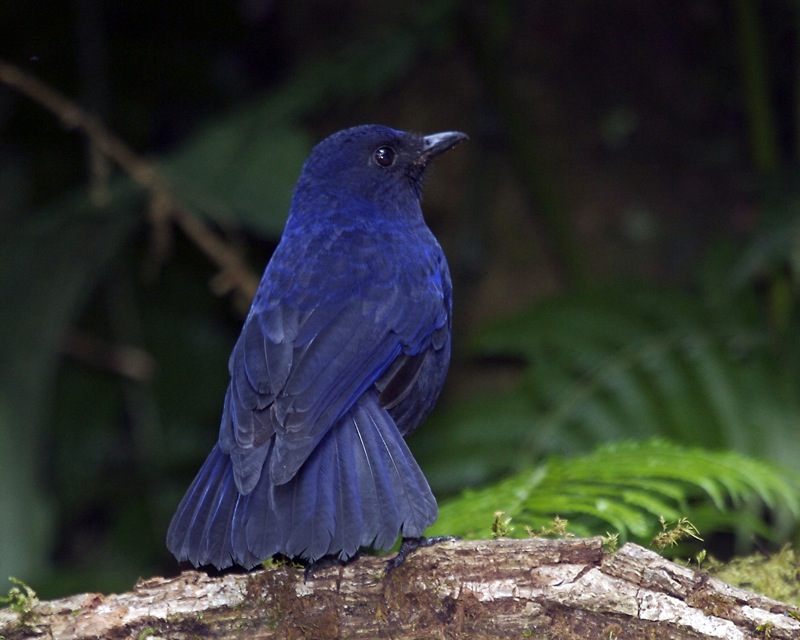
The Brown-winged Whistling Thrush is a bird in the family Muscicapidae, order Passeriformes, class Aves, and genus Myophonus. The species is endemic to the Indonesian island of Sumatra. Adult males have dark blue heads, breasts and shoulders, with chestnut plumage elsewhere.
Written 27 November 2026 from the sources listed below. Each statement was checked against the passage it cites; statements that could not be supported were removed.
Habitat
The Brown-winged Whistling Thrush inhabits montane forests at elevations between 400 and 1,500 metres above sea level. It is usually found near streams.[1][2]
The species typically occupies the middle and subcanopy layers of the forest.[3]
Behaviour
The Brown-winged Whistling Thrush produces a loud whistling call and a harsh grating call.[4][5]
Conservation
The species is believed to be declining because of deforestation. It was most recently assessed for the IUCN Red List of Threatened Species in 2024.[6][7]
Similar species
The Brown-winged Whistling Thrush was formerly often grouped with the Javan whistling thrush and Bornean whistling thrush under the name Sunda whistling thrush.[8]
It is now often treated as distinct from the Javan and Bornean whistling thrushes based on plumage and measurement differences. The Bornean and Javan whistling thrushes do not have chestnut coloration.[9][10]
Appearance
Adult males have dark blue heads, breasts and shoulders, with chestnut plumage elsewhere. Adult females and immature individuals are predominantly dull chestnut-brown and have a blue shoulder patch.[11][12]
The species has a black bill, and its legs and feet are dark brown. Its bill is more slender than those of the Bornean and Javan whistling thrushes.[13][14][15]
The Brown-winged Whistling Thrush measures approximately 25 centimetres in length. The average depth of its bill is 7.3 millimetres.[16][17]
Classification of the Brown-winged Whistling Thrush
| Kingdom | Animalia |
|---|---|
| Phylum | Chordata |
| Subphylum | Vertebrata |
| Infraphylum | Gnathostomata |
| Parvphylum | Osteichthyes |
| Megaclass | Tetrapoda |
| Class | Aves (Bird) |
| Order | Passeriformes (Passerine) |
| Family | Muscicapidae (Old World Flycatcher) |
| Genus | Myophonus (Whistling Thrush) |
| Species | Myophonus castaneus R. G. W. Ramsay, 1880 |
Where the Brown-winged Whistling Thrush is found
Checklists and occurrence records place Myophonus castaneus in 1 country. GBIF holds 484 georeferenced records of it.
Countries
Regions and cities with the most records
- Jambi, Indonesia 271
- Aceh, Indonesia 33
- Sungai Penuh, Indonesia 21
- Berastagi, Indonesia 10
- Kabanjahe, Indonesia 9
- Lampung, Indonesia 6
- Solok, Indonesia 6
- Meulaboh, Indonesia 3
A number beside a place is its count of GBIF occurrence records. A place without a number comes from a checklist alone. Records show where a species has been observed or collected, which can include escapes and vagrants.
Common names
English
- Brown-winged Whistling Thrush
- Brown-winged Whistling-Thrush
- Chestnut-winged Whistling-thrush
- Sumatran Whistling-Thrush
- Sumatran Whistling Thrush
Names in 22 other languages
- Catalan
- griva xiuladora castanya
- Chinese
- 栗翅紫嘯鶇, 褐翅啸鸫
- Croatian
- sumatranski kamenjar
- Danish
- Kastanje Fløjtedrossel
- Dutch
- Sumatraanse Fluitlijster
- Esperanto
- kaŝtana miofono
- French
- Arrenga à dos brun
- German
- Sumatrapfeifdrossel
- Indonesian
- Ciung-batu Kecil Sumatera, Ciung-batu kecil-sumatera
- Italian
- Tordo fischiatore alicastane
- Japanese
- クリバネルリチョウ
- Lithuanian
- sumatrinė mėlynpaukštė
- Norwegian
- brunplystretrost
- Polish
- gwizdokos kasztanowaty
- Portuguese
- tordo-assobiador-castanho
- Russian
- Каштановокрылая синяя птица
- Serbian
- Drozd zviždač sa Sumatre
- Slovak
- hvízdač hnedokrídly
- Spanish
- Arrenga castaño
- Swedish
- kastanjevisseltrast
- Turkish
- Sumatra Kahverengi Islıkçı Bülbülü
- Ukrainian
- аренга каштанова
Synonyms
5 other scientific names have been used for this species and are now treated as synonyms of Myophonus castaneus.
- Myiophoneus castaneus Wardlaw-Ramsay, RG, 1880
- Myiophoneus glaucinus castaneus Wardlaw-Ramsay, RG, 1880
- Myiophonus glaucinus castaneus Wardlaw-Ramsay, RG, 1880
- Myophoneus glaucinus castaneus Wardlaw-Ramsay, RG, 1880
- Myophonus glaucinus castaneus Wardlaw-Ramsay, RG, 1880
Related species
-
 Malabar Whistling ThrushMyophonus horsfieldii
-
 Chinese Whistling ThrushMyophonus caeruleus
-
 Taiwan Whistling ThrushMyophonus insularis
-
 Sri Lanka Whistling ThrushMyophonus blighi
-
 Javan Whistling ThrushMyophonus glaucinus
-
 Bornean Whistling ThrushMyophonus borneensis
-
 Shiny Whistling ThrushMyophonus melanurus
-
 Malaysian Whistling ThrushMyophonus robinsoni
Compare
Questions and answers
What is the scientific name of the Brown-winged Whistling Thrush?
The scientific name of the Brown-winged Whistling Thrush is Myophonus castaneus. Written with its author, the full name is Myophonus castaneus R. G. W. Ramsay, 1880.
Which family does the Brown-winged Whistling Thrush belong to?
Myophonus castaneus belongs to the family Muscicapidae, in the order Passeriformes and the class Aves.
Where is the Brown-winged Whistling Thrush found?
Checklists and occurrence records place Myophonus castaneus in 1 country: Indonesia.
What is the conservation status of the Brown-winged Whistling Thrush?
The IUCN Red List category recorded for Myophonus castaneus is Least Concern (LC).
What other names does the Brown-winged Whistling Thrush have?
Myophonus castaneus is also known in English as Brown-winged Whistling-Thrush, Chestnut-winged Whistling-thrush, Sumatran Whistling-Thrush and Sumatran Whistling Thrush.
Sources
Passages the profile rests on
- The species inhabits montane forests at elevations between 400 and 1,500 metres above sea level. Source passage: “It occurs in montane forest from 400 to 1500 metres above sea-level.” — English Wikipedia
- The species is usually found near streams. Source passage: “It is usually found near streams” — English Wikipedia
- The species typically occupies the middle and subcanopy layers of the forest. Source passage: “typically keeps to the middle and subcanopy layers of the forest.” — English Wikipedia
- The species produces a loud whistling call. Source passage: “It has a loud whistling call” — English Wikipedia
- The species also produces a harsh grating call. Source passage: “and a harsh grating call.” — English Wikipedia
- The species is believed to be declining because of deforestation. Source passage: “is believed to be declining as a result of deforestation.” — English Wikipedia
- The species was most recently assessed for the IUCN Red List of Threatened Species in 2024. Source passage: “has most recently been assessed for The IUCN Red List of Threatened Species in 2024.” — iucnredlist.org
- The species was formerly often grouped with the Javan whistling thrush and Bornean whistling thrush under the name Sunda whistling thrush. Source passage: “In the past, it has often been lumped together with the Javan whistling thrush (M. glaucinus) and Bornean whistling thrush (M. borneensis) as the "Sunda whistling thrush" (M. glaucinus)” — English Wikipedia
- The species is now often treated as distinct from the Javan and Bornean whistling thrushes based on plumage and measurement differences. Source passage: “it is now often regarded as a separate species based on differences in plumage and measurements.” — English Wikipedia
- The Bornean and Javan whistling thrushes do not have chestnut coloration. Source passage: “The Bornean and Javan whistling thrushes lack any chestnut coloration.” — English Wikipedia
- Adult males have dark blue heads, breasts and shoulders, with chestnut plumage elsewhere. Source passage: “The adult male has a dark blue head, breast and shoulders with the rest of the plumage being chestnut.” — English Wikipedia
- Adult females and immature individuals are predominantly dull chestnut-brown and have a blue shoulder patch. Source passage: “The adult female and immature are mostly dull chestnut-brown with a blue patch on the shoulder.” — English Wikipedia
- The species has a black bill. Source passage: “The black bill has an average depth of 7.3 millimetres” — English Wikipedia
- Its legs and feet are dark brown. Source passage: “The legs and feet are dark brown.” — English Wikipedia
- Its bill is more slender than those of the Bornean and Javan whistling thrushes. Source passage: “slenderer than the bills of the Bornean and Javan whistling thrushes.” — English Wikipedia
- The species measures approximately 25 centimetres in length. Source passage: “It is about 25 centimetres long.” — English Wikipedia
- The average depth of its bill is 7.3 millimetres. Source passage: “The black bill has an average depth of 7.3 millimetres” — English Wikipedia
Data
- Catalogue of Life, 2026-10-16 XR cc by
- Global Biodiversity Information Facility CC BY 4.0
- Wikidata CC0
- GeoNames CC BY 4.0
- Wikimedia Commons per image; credit shown with each image
- Within the Catalogue of Life, this name comes from The Integrated Taxonomic Information System cc0
This species in other databases
Page built on 27 November 2026. See how the catalog is made and all sources and licences.
Cite this page
ScientificNames.org. (2026). Myophonus castaneus (Brown-winged Whistling Thrush). Retrieved November 27, 2026, from https://scientificnames.org/species/myophonus-castaneus
“Myophonus castaneus (Brown-winged Whistling Thrush).” ScientificNames.org, 2026, scientificnames.org/species/myophonus-castaneus. Accessed 27 Nov. 2026.
ScientificNames.org. “Myophonus castaneus (Brown-winged Whistling Thrush).” Accessed November 27, 2026. https://scientificnames.org/species/myophonus-castaneus.
@misc{scientificnames_myophonus_castaneus_brown_winged_whistling_thrush,
  author = {{ScientificNames.org}},
  title = {Myophonus castaneus (Brown-winged Whistling Thrush)},
  year = {2026},
  url = {https://scientificnames.org/species/myophonus-castaneus},
  note = {Accessed 2026-11-27}
}