Species · Birds
Malaysian Whistling Thrush Myophonus robinsoni
The scientific name of the Malaysian Whistling Thrush is Myophonus robinsoni. It is a species of bird in the family Muscicapidae (old world flycatcher), order Passeriformes. The name dates from 1905.
- Scientific name
- Myophonus robinsoni Ogilvie-Grant, 1905
- Common name
- Malaysian Whistling Thrush
- Genus
- Myophonus
- Family
- Muscicapidae (Old World Flycatcher)
- Order
- Passeriformes
- Class
- Aves
- Red List category
- NT Near Threatened
- Recorded in
- 2 countries
- Name status
- accepted in the Catalogue of Life

Overview
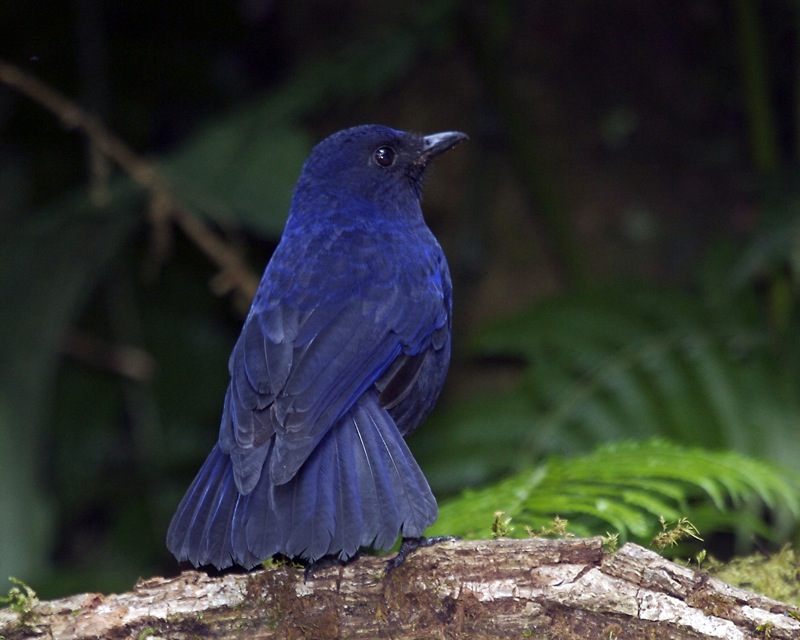
Myophonus robinsoni is endemic to the Malay Peninsula and occurs in the highlands of the Main Range in central peninsular Malaysia. Adult males are predominantly black-blue, with deep purplish-blue parts of the head and a metallic-blue patch on the lesser coverts.
Written 27 November 2026 from the sources listed below. Each statement was checked against the passage it cites; statements that could not be supported were removed.
Habitat
The Malaysian Whistling Thrush inhabits montane forests and is usually found near streams. It occurs at elevations of approximately 750–1,750 metres.[1][2][3]
Its historical distribution extended from the Cameron Highlands to the Genting Highlands. Since 1980, it has been recorded with certainty only at Fraser's Hill.[4][5]
Appearance
The species measures 25–26 centimetres in length, and adult individuals weigh approximately 87–105 grams. Male wing length ranges from 14 to 15 centimetres, while female wing length is approximately 13 centimetres.[6][7][8][9]
Adult males are predominantly black-blue, with parts of the head deep purplish-blue and a metallic-blue patch on the lesser coverts. Females are slightly browner and smaller than males, although the sexes have very similar appearances.[10][11][12][13][14]
Juveniles have a sootier appearance than adults.[15]
Diet
The species probably feeds on insects.[16]
Behaviour
Its song contains both flute-like and scratchy notes.[17]
Reproduction and life cycle
Breeding has been observed in March and September. The clutch contains one or two eggs, which are bluish-grey with pinkish-brown speckles.[18][19][20]
The nest is constructed from dried plant material and has a half-cup shape.[21]
Conservation
The Malaysian Whistling Thrush is classified as Near Threatened on the IUCN Red List. Its mature population is estimated at 2,500–9,999 individuals, and its total population at 3,500–15,000 individuals.[22][23][24]
The population is suspected to be decreasing. Habitat destruction and degradation from agricultural conversion are identified as potential threats.[25][26]
Classification of the Malaysian Whistling Thrush
| Kingdom | Animalia |
|---|---|
| Phylum | Chordata |
| Subphylum | Vertebrata |
| Infraphylum | Gnathostomata |
| Parvphylum | Osteichthyes |
| Megaclass | Tetrapoda |
| Class | Aves (Bird) |
| Order | Passeriformes (Passerine) |
| Family | Muscicapidae (Old World Flycatcher) |
| Genus | Myophonus (Whistling Thrush) |
| Species | Myophonus robinsoni Ogilvie-Grant, 1905 |
Where the Malaysian Whistling Thrush is found
Checklists and occurrence records place Myophonus robinsoni in 2 countries. GBIF holds 833 georeferenced records of it.
Countries
Regions and cities with the most records
- Raub, Malaysia 800
- Kuala Kubu Baharu, Malaysia 796
- Pahang, Malaysia 765
- Selangor, Malaysia 58
- Tanjong Malim, Malaysia 9
- Hulu Yam Lama, Malaysia 7
- Hulu Langat, Malaysia 5
- Ampang, Malaysia 4
- Bangsar, Malaysia 4
- Bukit Bintang, Malaysia 4
- Bukit Kerinchi, Malaysia 4
- Cheras, Malaysia 4
- Desa Petaling, Malaysia 4
- Kuala Lumpur, Malaysia 4
- Kuchai Lama, Malaysia 4
- SS2, Malaysia 4
- Seputeh, Malaysia 4
- Sri Petaling, Malaysia 4
- Taman Desa, Malaysia 4
- Taman Melawati, Malaysia 4
- Taman OUG, Malaysia 4
- Ulu Kelang, Malaysia 4
- Wangsa Maju, Malaysia 4
- Bandar Country Homes, Malaysia 3
- Bandar Sri Damansara, Malaysia 3
- Bandar Utama, Malaysia 3
- Batu Caves, Malaysia 3
- Desa Parkcity, Malaysia 3
- Kepong, Malaysia 3
- Mont Kiara, Malaysia 3
- Petaling Jaya, Malaysia 3
- Rawang, Malaysia 3
- Selayang Baru Utara, Malaysia 3
- Sentul, Malaysia 3
- Serendah, Malaysia 3
- Setapak, Malaysia 3
A number beside a place is its count of GBIF occurrence records. A place without a number comes from a checklist alone. Records show where a species has been observed or collected, which can include escapes and vagrants.
Common names
English
- Malaysian Whistling Thrush
- Malay Whistling-thrush
- Malayan Whistling Thrush
- Malayan Whistling-Thrush
- Malaysian Whistling-thrush
Names in 26 other languages
- Catalan
- griva xiuladora malaia
- Chinese
- 馬來紫嘯鶇, 马来啸鸫
- Croatian
- malezijski kamenjar
- Czech
- modravec malajský
- Danish
- Malay Fløjtedrossel
- Dutch
- Maleise Fluitlijster
- Esperanto
- malajzia miofono
- Finnish
- malakanjokirastas
- French
- Arrenga de Robinson
- German
- Malaienpfeifdrossel
- Hungarian
- maláj fütyülőrigó
- Italian
- Tordo fischiatore di Malesia
- Japanese
- マラヤルリチョウ, マレールリチョウ
- Lithuanian
- malajinė mėlynpaukštė
- Malay
- Burung Murai Tiong Batu
- Norwegian
- malayplystretrost
- Polish
- gwizdokos malajski
- Portuguese
- tordo-assobiador-de-malaca, tordo-assobiador-malaio
- Russian
- Малайская синяя птица
- Serbian
- Malajski drozd zviždač
- Slovak
- hvízdač malajský
- Spanish
- Arrenga malayo
- Swedish
- Malajvisseltrast, malackavisseltrast
- Thai
- นกเอี้ยงถ้ำมลายู
- Turkish
- Malay Islıkçı Bülbülü
- Ukrainian
- аренга малазійська
Synonyms
5 other scientific names have been used for this species and are now treated as synonyms of Myophonus robinsoni.
- Myiophoneus robinsoni Ogilvie-Grant, WR, 1905
- Myiophoneus robinsoni robinsoni Collar & Andrew (1988)
- Myiophonus robinsoni Ogilvie-Grant, 1905
- Myiophonus robinsoni robinsoni Collar et al. (1994)
- Myophoneus robinsoni Ogilvie-Grant, WR, 1905
Related species
-
 Malabar Whistling ThrushMyophonus horsfieldii
-
 Chinese Whistling ThrushMyophonus caeruleus
-
 Taiwan Whistling ThrushMyophonus insularis
-
 Sri Lanka Whistling ThrushMyophonus blighi
-
 Javan Whistling ThrushMyophonus glaucinus
-
 Brown-winged Whistling ThrushMyophonus castaneus
-
 Bornean Whistling ThrushMyophonus borneensis
-
 Shiny Whistling ThrushMyophonus melanurus
Compare
Questions and answers
What is the scientific name of the Malaysian Whistling Thrush?
The scientific name of the Malaysian Whistling Thrush is Myophonus robinsoni. Written with its author, the full name is Myophonus robinsoni Ogilvie-Grant, 1905.
Which family does the Malaysian Whistling Thrush belong to?
Myophonus robinsoni belongs to the family Muscicapidae, in the order Passeriformes and the class Aves.
Where is the Malaysian Whistling Thrush found?
Checklists and occurrence records place Myophonus robinsoni in 2 countries: Malaysia and Thailand.
What is the conservation status of the Malaysian Whistling Thrush?
The IUCN Red List category recorded for Myophonus robinsoni is Near Threatened (NT).
What other names does the Malaysian Whistling Thrush have?
Myophonus robinsoni is also known in English as Malay Whistling-thrush, Malayan Whistling Thrush, Malayan Whistling-Thrush and Malaysian Whistling-thrush.
Sources
Passages the profile rests on
- The species inhabits montane forests. Source passage: “Its natural habitat is montane forests.” — English Wikipedia
- The species is usually found near streams. Source passage: “It is usually found near streams.” — English Wikipedia
- The species occurs at elevations of approximately 750–1,750 metres. Source passage: “It is situated at elevations of about 750–1,750 m (2,460–5,740 ft) in central peninsular Malaysia.” — English Wikipedia
- Its historical distribution extended from the Cameron Highlands to the Genting Highlands. Source passage: “The Malaysian whistling thrush historically ranged from the Cameron Highlands to the Genting Highlands.” — English Wikipedia
- The species has been recorded with certainty only at Fraser's Hill since 1980. Source passage: “Since 1980, it has been trapped and recorded with certainty only in Fraser's Hill.” — English Wikipedia
- The species measures 25–26 centimetres in length. Source passage: “Its length is 25–26 cm (9.8–10.2 in).” — English Wikipedia
- Adult individuals weigh approximately 87–105 grams. Source passage: “Its weight is 87–105 g (3.1–3.7 oz).” — English Wikipedia
- Male wing length ranges from 14 to 15 centimetres. Source passage: “The length of the wings of the male is 14–15 cm (5.5–5.9 in).” — English Wikipedia
- Female wing length is approximately 13 centimetres. Source passage: “The wing length of the female is 13 cm (5.1 in).” — English Wikipedia
- Adult males are predominantly black-blue in colour. Source passage: “The male is mostly black-blue.” — English Wikipedia
- Parts of the male's head are deep purplish-blue. Source passage: “Parts of the head are deep purplish-blue.” — English Wikipedia
- The male has a metallic-blue patch on its lesser coverts. Source passage: “There is a patch of metallic blue in the lesser coverts.” — English Wikipedia
- Females are slightly browner and smaller than males. Source passage: “The female is slightly browner and slightly smaller.” — English Wikipedia
- The male and female have very similar appearances. Source passage: “The male and female are very similar.” — English Wikipedia
- Juveniles have a sootier appearance than adults. Source passage: “The juvenile is sootier.” — English Wikipedia
- The species probably feeds on insects. Source passage: “Its diet is probably insects.” — English Wikipedia
- Its song contains both flute-like and scratchy notes. Source passage: “Its song contains "fluty and scratchy notes".” — English Wikipedia
- Breeding has been observed in March and September. Source passage: “Breeding has been observed in March and September.” — English Wikipedia
- The clutch contains one or two eggs. Source passage: “The clutch size is 1–2 eggs.” — English Wikipedia
- The eggs are bluish-grey with pinkish-brown speckles. Source passage: “The eggs are bluish-grey with pinkish-brown specks.” — English Wikipedia
- The nest is constructed from dried plant material and has a half-cup shape. Source passage: “The nest is built of dried plant material and is in a half-cup shape.” — English Wikipedia
- The mature population is estimated at 2,500–9,999 individuals. Source passage: “The species' population is estimated at 2500–9999 mature” — English Wikipedia
- The total population is estimated at 3,500–15,000 individuals. Source passage: “and 3500–15000 total individuals.” — English Wikipedia
- The species is classified as Near Threatened on the IUCN Red List. Source passage: “the IUCN Red List of Threatened Species has listed it as near threatened.” — English Wikipedia
- The population is suspected to be decreasing. Source passage: “The population is suspected to be decreasing.” — English Wikipedia
- Habitat destruction and degradation from agricultural conversion are identified as potential threats. Source passage: “may be threatened by habitat destruction and degradation caused by conversion of forest to agricultural land” — English Wikipedia
Data
- Catalogue of Life, 2026-10-16 XR cc by
- Global Biodiversity Information Facility CC BY 4.0
- Wikidata CC0
- GeoNames CC BY 4.0
- Wikimedia Commons per image; credit shown with each image
- Within the Catalogue of Life, this name comes from The Integrated Taxonomic Information System cc0
This species in other databases
Page built on 29 November 2026. See how the catalog is made and all sources and licences.
Cite this page
ScientificNames.org. (2026). Myophonus robinsoni (Malaysian Whistling Thrush). Retrieved November 29, 2026, from https://scientificnames.org/species/myophonus-robinsoni
“Myophonus robinsoni (Malaysian Whistling Thrush).” ScientificNames.org, 2026, scientificnames.org/species/myophonus-robinsoni. Accessed 29 Nov. 2026.
ScientificNames.org. “Myophonus robinsoni (Malaysian Whistling Thrush).” Accessed November 29, 2026. https://scientificnames.org/species/myophonus-robinsoni.
@misc{scientificnames_myophonus_robinsoni_malaysian_whistling_thrush,
  author = {{ScientificNames.org}},
  title = {Myophonus robinsoni (Malaysian Whistling Thrush)},
  year = {2026},
  url = {https://scientificnames.org/species/myophonus-robinsoni},
  note = {Accessed 2026-11-29}
}