Species · Birds
Taiwan Whistling Thrush Myophonus insularis
The scientific name of the Taiwan Whistling Thrush is Myophonus insularis. It is a species of bird in the family Muscicapidae (old world flycatcher), order Passeriformes. The name dates from 1863.
- Scientific name
- Myophonus insularis Gould, 1863
- Common name
- Taiwan Whistling Thrush
- Genus
- Myophonus
- Family
- Muscicapidae (Old World Flycatcher)
- Order
- Passeriformes
- Class
- Aves
- Red List category
- LC Least Concern
- Recorded in
- 2 countries
- Name status
- accepted in the Catalogue of Life

Overview
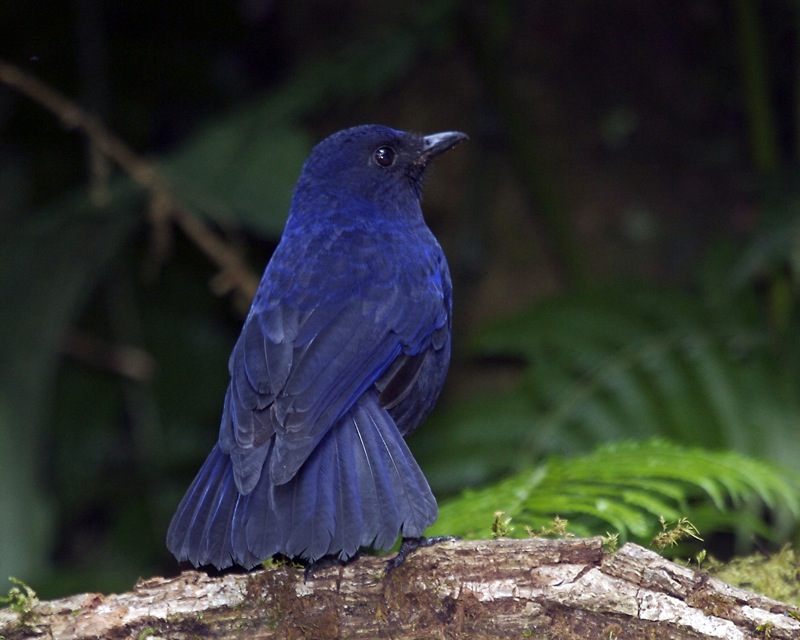
Myophonus insularis is endemic to Taiwan and mainly inhabits broadleaf forests between lowland areas and 2,100 metres above sea level. It is predominantly blackish-blue, with deep red eyes and a sharp whistling call.
Written 26 November 2026 from the sources listed below. Each statement was checked against the passage it cites; statements that could not be supported were removed.
Conservation
The IUCN classifies the Taiwan Whistling Thrush as Least Concern. Its breeding population is estimated at 10,000–100,000 pairs.[1][2]
The population is suspected to be declining because of habitat destruction. The species was removed from Taiwan's schedule of protected species in 2008.[3][4]
Appearance
The Taiwan Whistling Thrush measures 28–30 centimetres in length, and its wings measure 15–16 centimetres. Its plumage is predominantly blackish-blue, with some navy blue or metallic blue feathers.[5][6][7][8]
Its underparts are blackish, and some underwing coverts have white bases. Its neck, breast and flanks have a scaled appearance.[9][10][11]
Its eyes are deep red, while its lores, bill and legs are black. Male and female individuals have similar plumage.[12][13]
Juveniles have dull blackish plumage with a bluish tinge and a yellowish gape.[14][15]
Habitat
The Taiwan Whistling Thrush is endemic to Taiwan and inhabits subtropical or tropical moist montane forests. It occurs at elevations reaching 2,700 metres.[16][17][18]
The species has increasingly been observed in urban areas in recent years.[19]
Diet
The Taiwan Whistling Thrush feeds on shrimp, earthworms, insects, frogs, reptiles and fish. Its diet mainly includes invertebrates, frogs and lizards.[20][21]
The species obtains food by foraging in or near streams. Barn swallow eggs and chicks have also been documented as food items.[22][23]
Behaviour
The Taiwan Whistling Thrush is most active around dawn and dusk. It jumps among rocks in forest streams and frequently opens and closes its tail while perched on rocks.[24][25][26]
Its call is a sharp whistle described as screee. Its song consists of loud, melodious whistles.[27][28]
A Taiwan Whistling Thrush individual attacked all five active barn swallow nests on one street in Taipei.[29]
Reproduction and life cycle
The Taiwan Whistling Thrush is monogamous. Its breeding season extends from late March to early September, during which it produces two broods.[30][31][32]
Nests are commonly constructed in holes in rocks or trees, and the species also builds nests in human-made structures. Nest materials include twigs, roots, stems and moss.[33][34][35]
Each clutch contains two to four pinkish eggs marked with brownish or greyish patterns. The female incubates the eggs for approximately 12–14 days.[36][37][38][39]
Both parents feed the nestlings. Young birds leave the nest at approximately 21 days of age.[40][41]
Similar species
The Taiwan Whistling Thrush was formerly treated as a subspecies of the Malabar whistling thrush. The species is monotypic.[42][43]
Classification of the Taiwan Whistling Thrush
| Kingdom | Animalia |
|---|---|
| Phylum | Chordata |
| Subphylum | Vertebrata |
| Infraphylum | Gnathostomata |
| Parvphylum | Osteichthyes |
| Megaclass | Tetrapoda |
| Class | Aves (Bird) |
| Order | Passeriformes (Passerine) |
| Family | Muscicapidae (Old World Flycatcher) |
| Genus | Myophonus (Whistling Thrush) |
| Species | Myophonus insularis Gould, 1863 |
Where the Taiwan Whistling Thrush is found
Checklists and occurrence records place Myophonus insularis in 2 countries. GBIF holds 49,177 georeferenced records of it.
Countries
Regions and cities with the most records
- Taiwan, Taiwan 20,965
- Banqiao, Taiwan 13,235
- Neihu, Taiwan 12,563
- Taipei, Taiwan 12,147
- Xizhi, Taiwan 11,949
- Shulin, Taiwan 10,417
- New Taipei City, Taiwan 9,699
- Keelung, Taiwan 7,630
- Sanxia, Taiwan 6,862
- Taipei, Taiwan 5,213
- Yingge, Taiwan 4,775
- Danshui, Taiwan 3,103
- Daxi, Taiwan 2,845
- Bade, Taiwan 2,691
- Sanzhi, Taiwan 2,567
- Lugu, Taiwan 2,446
- Zhushan, Taiwan 2,277
- Neili, Taiwan 1,848
- Zhudong, Taiwan 1,817
- Yilan, Taiwan 1,619
- Taoyuan, Taiwan 1,500
- Xiulin, Taiwan 1,312
- Puli, Taiwan 1,256
- Chiayi City, Taiwan 715
- Toufen, Taiwan 631
- Miaoli, Taiwan 564
- Linnei, Taiwan 556
- Hualien City, Taiwan 546
- Hsinchu, Taiwan 404
- Zhongxing New Village, Taiwan 395
- Wufeng, Taiwan 389
- Taichung, Taiwan 363
- Douliu, Taiwan 357
- Caotun, Taiwan 335
- Taitung, Taiwan 309
- Zhubei, Taiwan 301
A number beside a place is its count of GBIF occurrence records. A place without a number comes from a checklist alone. Records show where a species has been observed or collected, which can include escapes and vagrants.
Common names
English
- Taiwan Whistling Thrush
- Formosan Whistling-Thrush
- Taiwan Whistling-Thrush
Names in 24 other languages
- Catalan
- griva xiuladora de Taiwan
- Chinese
- 台湾紫啸鸫, 台灣紫嘯鶇, 紫嘯鶇, 臺灣紫嘯鶇
- Croatian
- tajvanski kamenjar
- Czech
- modravec tchajwanský
- Danish
- Taiwan Fløjtedrossel
- Dutch
- Formosafluitlijster, Taiwanfluitlijster
- Esperanto
- tajvana miofono
- Finnish
- taiwaninjokirastas
- French
- Arrenga de Taiwan, Arrenga de Taïwan
- German
- Formosapfeifdrossel, Taiwanpfeifdrossel
- Hungarian
- tajvani fütyülőrigó
- Italian
- Tordo fischiatore di Taiwan, Tordo zufolatore di Taiwan
- Japanese
- ルリチョウ
- Lithuanian
- taivaninė mėlynpaukštė
- Norwegian
- taiwanplystretrost
- Polish
- gwizdokos wyspowy
- Portuguese
- tordo-assobiador-da-formosa
- Russian
- Тайваньская синяя птица
- Serbian
- Tajvanski drozd zviždač
- Slovak
- hvízdač modrý
- Spanish
- Arrenga de Formosa
- Swedish
- taiwanvisseltrast
- Turkish
- Tayvan Islıkçı Bülbülü
- Ukrainian
- аренга тайванська
Synonyms
3 other scientific names have been used for this species and are now treated as synonyms of Myophonus insularis.
- Myiophoneus insularis Gould, J, 1863
- Myiophonus insularis Gould, 1863
- Myophoneus insularis Gould, J, 1863
Related species
-
 Malabar Whistling ThrushMyophonus horsfieldii
-
 Chinese Whistling ThrushMyophonus caeruleus
-
 Sri Lanka Whistling ThrushMyophonus blighi
-
 Javan Whistling ThrushMyophonus glaucinus
-
 Brown-winged Whistling ThrushMyophonus castaneus
-
 Bornean Whistling ThrushMyophonus borneensis
-
 Shiny Whistling ThrushMyophonus melanurus
-
 Malaysian Whistling ThrushMyophonus robinsoni
Compare
Questions and answers
What is the scientific name of the Taiwan Whistling Thrush?
The scientific name of the Taiwan Whistling Thrush is Myophonus insularis. Written with its author, the full name is Myophonus insularis Gould, 1863.
Which family does the Taiwan Whistling Thrush belong to?
Myophonus insularis belongs to the family Muscicapidae, in the order Passeriformes and the class Aves.
Where is the Taiwan Whistling Thrush found?
Checklists and occurrence records place Myophonus insularis in 2 countries: Taiwan and China.
What is the conservation status of the Taiwan Whistling Thrush?
The IUCN Red List category recorded for Myophonus insularis is Least Concern (LC).
What other names does the Taiwan Whistling Thrush have?
Myophonus insularis is also known in English as Formosan Whistling-Thrush and Taiwan Whistling-Thrush.
Sources
Passages the profile rests on
- The IUCN classifies the species as Least Concern. Source passage: “The International Union for Conservation of Nature has assessed M. insularis to be of least concern.” — English Wikipedia
- The breeding population is estimated at 10,000–100,000 pairs. Source passage: “Its population is estimated at 10,000 to 100,000 breeding pairs” — English Wikipedia
- The population is suspected to be declining because of habitat destruction. Source passage: “is suspected to be decreasing due to habitat destruction.” — English Wikipedia
- The species was removed from Taiwan's schedule of protected species in 2008. Source passage: “but was removed from the list in 2008.” — English Wikipedia
- The species measures 28–30 centimetres in length. Source passage: “Its length is 28 to 30 cm (11 to 12 in).” — English Wikipedia
- Its wings measure 15–16 centimetres in length. Source passage: “The wings are 15 to 16 cm (5.9 to 6.3 in) long.” — English Wikipedia
- The species is predominantly blackish-blue. Source passage: “It is mostly blackish-blue.” — English Wikipedia
- Some of its feathers are navy blue or metallic blue. Source passage: “Some feathers are navy blue or metallic blue.” — English Wikipedia
- Some underwing coverts have white bases. Source passage: “Some underwing coverts have white bases.” — English Wikipedia
- Its underparts are blackish. Source passage: “The underparts are blackish.” — English Wikipedia
- Its neck, breast and flanks have a scaled appearance. Source passage: “Its neck, breast and flanks are scaled.” — English Wikipedia
- Its eyes are deep red, while its lores, bill and legs are black. Source passage: “Its eyes are deep red, and its lores, bill and legs are black.” — English Wikipedia
- Male and female individuals have similar plumage. Source passage: “The two sexes are alike.” — English Wikipedia
- Juveniles have dull blackish plumage with a bluish tinge. Source passage: “The juvenile is dull blackish, with a bluish tinge.” — English Wikipedia
- Juveniles have a yellowish gape. Source passage: “The gape of the juvenile is yellowish.” — English Wikipedia
- The Taiwan whistling-thrush is endemic to Taiwan. Source passage: “This thrush is endemic to Taiwan.” — English Wikipedia
- The species inhabits subtropical or tropical moist montane forests. Source passage: “Its natural habitat is subtropical or tropical moist montane forests.” — English Wikipedia
- The species occurs at elevations reaching 2,700 metres. Source passage: “It is found at elevations of up to 2,700 m (8,900 ft).” — English Wikipedia
- The species has increasingly been observed in urban areas in recent years. Source passage: “in recent years there have been increasing observations of Taiwan whistling thrushes in urban areas” — pmc.ncbi.nlm.nih.gov
- The species feeds on shrimp, earthworms, insects, frogs, reptiles and fish. Source passage: “The diet consists of shrimp, earthworms, insects, frogs, reptiles, and fish” — English Wikipedia
- Its diet mainly includes invertebrates, frogs and lizards. Source passage: “The Taiwan whistling thrush mainly feeds on invertebrates, frogs, and lizards” — pmc.ncbi.nlm.nih.gov
- The species obtains food by foraging in or near streams. Source passage: “obtained by foraging in or near streams.” — English Wikipedia
- Barn swallow eggs and chicks have been documented as food items for the species. Source passage: “the Taiwan whistling thrush might treat barn swallow chicks and eggs as a new food resource.” — pmc.ncbi.nlm.nih.gov
- The species is most active around dawn and dusk. Source passage: “Activity is greatest at dawn and dusk.” — English Wikipedia
- The species jumps among rocks in forest streams. Source passage: “It jumps among rocks in forest streams.” — English Wikipedia
- Individuals frequently open and close their tails while perched on rocks. Source passage: “It often opens and closes its tail when it is sitting on a rock.” — English Wikipedia
- Its call is a sharp whistle described as screee. Source passage: “Its call is a sharp whistle, described as screee.” — English Wikipedia
- Its song consists of loud, melodious whistles. Source passage: “Its song is loud and melodious whistles.” — English Wikipedia
- A Taiwan whistling-thrush individual attacked all five active barn swallow nests on one street in Taipei. Source passage: “Potentially the same Taiwan whistling thrush was observed again to attack all of the five active nests of this street on June 4th.” — pmc.ncbi.nlm.nih.gov
- The species is monogamous. Source passage: “The Taiwan whistling thrush is monogamous.” — English Wikipedia
- Its breeding season extends from late March to early September. Source passage: “The breeding season is from late March to early September.” — English Wikipedia
- The species produces two broods during each breeding season. Source passage: “There are two broods each breeding season.” — English Wikipedia
- Nests are commonly constructed in holes in rocks or trees. Source passage: “Nests are usually built in holes in rocks or trees.” — English Wikipedia
- The species also builds nests in human-made structures. Source passage: “Nests are also built in human structures.” — English Wikipedia
- Nest materials include twigs, roots, stems and moss. Source passage: “They are made of twigs, roots, stems and moss.” — English Wikipedia
- Each clutch contains two to four eggs. Source passage: “There are 2 to 4 eggs in a clutch.” — English Wikipedia
- The eggs are pinkish and marked with brownish or greyish patterns. Source passage: “The eggs are pinkish with brownish or greyish marks.” — English Wikipedia
- The female is responsible for incubating the eggs. Source passage: “The female incubates the eggs.” — English Wikipedia
- Egg incubation lasts approximately 12–14 days. Source passage: “Incubation takes about 12 to 14 days.” — English Wikipedia
- Both parents feed the nestlings. Source passage: “Both parents feed the nestlings.” — English Wikipedia
- Young birds leave the nest at approximately 21 days of age. Source passage: “Chicks leave the nest after about 21 days.” — English Wikipedia
- The species was formerly treated as a subspecies of the Malabar whistling thrush. Source passage: “It was formerly considered a subspecies of the Malabar whistling thrush (Myophonus horsfieldii).” — English Wikipedia
- The species is monotypic. Source passage: “The species is monotypic.” — English Wikipedia
Data
- Catalogue of Life, 2026-10-16 XR cc by
- Global Biodiversity Information Facility CC BY 4.0
- Wikidata CC0
- GeoNames CC BY 4.0
- Wikimedia Commons per image; credit shown with each image
- Within the Catalogue of Life, this name comes from The Integrated Taxonomic Information System cc0
This species in other databases
Page built on 27 November 2026. See how the catalog is made and all sources and licences.
Cite this page
ScientificNames.org. (2026). Myophonus insularis (Taiwan Whistling Thrush). Retrieved November 27, 2026, from https://scientificnames.org/species/myophonus-insularis
“Myophonus insularis (Taiwan Whistling Thrush).” ScientificNames.org, 2026, scientificnames.org/species/myophonus-insularis. Accessed 27 Nov. 2026.
ScientificNames.org. “Myophonus insularis (Taiwan Whistling Thrush).” Accessed November 27, 2026. https://scientificnames.org/species/myophonus-insularis.
@misc{scientificnames_myophonus_insularis_taiwan_whistling_thrush,
  author = {{ScientificNames.org}},
  title = {Myophonus insularis (Taiwan Whistling Thrush)},
  year = {2026},
  url = {https://scientificnames.org/species/myophonus-insularis},
  note = {Accessed 2026-11-27}
}