Species · Mammals
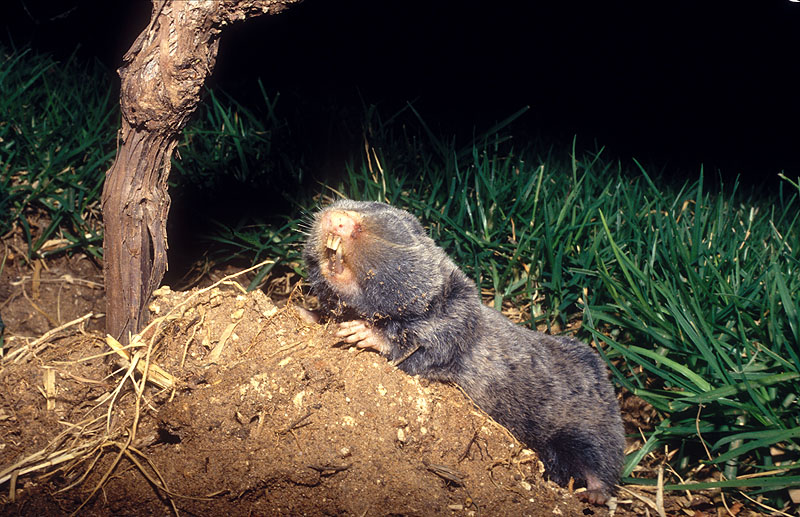
Anatolian Blind Mole-rat Nannospalax xanthodon
The scientific name of the Anatolian Blind Mole-rat is Nannospalax xanthodon. It is a species of mammal in the family Spalacidae (spalacids), order Rodentia. The name dates from 1840.
- Scientific name
- Nannospalax xanthodon (Nordman, 1840)
- Common name
- Anatolian Blind Mole-rat
- Genus
- Spalax
- Family
- Spalacidae (Spalacids)
- Order
- Rodentia
- Class
- Mammalia
- Red List category
- LC Least Concern
- Recorded in
- 2 countries
- Name status
- provisionally accepted in the Catalogue of Life

Overview
The Anatolian Blind Mole-rat is a medium-sized mole. The species occurs in Armenia, Georgia, Greece, Iran, and Turkey. Its taxonomy is complicated by low morphological variation and high chromosomal variation, with twenty-eight chromosomal races known as of 2016.
Written 26 November 2026 from the sources listed below. Each statement was checked against the passage it cites; statements that could not be supported were removed.
Appearance
Adults measure between 143 and 248 millimetres in length and weigh between 130 and 522 grams. Males are larger than females.[1][2][3]
Habitat
The species commonly inhabits dry steppe environments and also occurs in fields and mountainous environments. It occurs at elevations reaching 3,000 metres.[4][5][6]
Diet
The Anatolian Blind Mole-rat feeds on plant bulbs, roots, and tubers encountered while digging.[7]
Behaviour
The species stores food in underground burrows. Food caches in its burrows can weigh up to 10 kilograms.[8][9]
Its primary predators include owls and the eastern imperial eagle.[10]
Reproduction and life cycle
The species breeds once annually, and the gestation period lasts 26 days. Females give birth to between one and six offspring per litter.[11][12][13]
Newborn offspring weigh approximately 9 grams.[14]
Conservation
The Anatolian Blind Mole-rat is classified as Least Concern on the IUCN Red List because of its wide geographical range.[15]
Classification of the Anatolian Blind Mole-rat
| Kingdom | Animalia |
|---|---|
| Phylum | Chordata |
| Subphylum | Vertebrata |
| Infraphylum | Gnathostomata |
| Parvphylum | Osteichthyes |
| Megaclass | Tetrapoda |
| Class | Mammalia (Mammal) |
| Subclass | Theria |
| Infraclass | Eutheria |
| Order | Rodentia (Rodent) |
| Suborder | Myomorpha (Mice) |
| Superfamily | Muroidea |
| Family | Spalacidae (Spalacids) |
| Subfamily | Spalacinae |
| Genus | Spalax (Greater Blind Mole Rats) |
| Species | Nannospalax xanthodon (Nordman, 1840) |
This name was added to the Catalogue of Life from a contributing dataset by automated merging and has not yet been reviewed by its editors.
Where the Anatolian Blind Mole-rat is found
Checklists and occurrence records place Nannospalax xanthodon in 2 countries. GBIF holds 49 georeferenced records of it.
Countries
Regions and cities with the most records
Range as the checklists state it
Global
A number beside a place is its count of GBIF occurrence records. A place without a number comes from a checklist alone. Records show where a species has been observed or collected, which can include escapes and vagrants.
Common names
English
- Anatolian Blind Mole-rat
- Anatolian Blind Mole Rate
- Nehring's Blind Mole Rat
Names in 8 other languages
- Czech
- slepec Nehringův
- Finnish
- kaukasuksensokkomyllikäs
- French
- Spalax d'Anatolie
- Greek
- Τυφλοπόντικας του Nehring
- Italian
- Spalace di Nehring
- Polish
- ślepiec anatolijski
- Russian
- Слепыш Неринга
- Turkish
- Körfare
Synonyms
3 other scientific names have been used for this species and are now treated as synonyms of Nannospalax xanthodon.
- Spalax munzuri Coşkun, 2004
- Spalax typhlus xanthodon Nordmann, 1840
- Spalax xanthodon Nordman, 1840
Related species
-
 Lesser Blind Mole-ratSpalax leucodon
-
 Middle East Blind Mole-ratSpalax ehrenbergi
-
 Giant Blind Mole-ratSpalax giganteus
-
 Greater Blind Mole-ratSpalax microphthalmus
-
 Sandy Blind Mole-ratSpalax arenarius
- Mehely's Blind Mole-ratSpalax antiquus
- Bukovina Blind Mole-ratSpalax graecus
-
 Podolsk Blind Mole-ratSpalax zemni
Compare
Questions and answers
What is the scientific name of the Anatolian Blind Mole-rat?
The scientific name of the Anatolian Blind Mole-rat is Nannospalax xanthodon. Written with its author, the full name is Nannospalax xanthodon (Nordman, 1840).
Which family does the Anatolian Blind Mole-rat belong to?
Nannospalax xanthodon belongs to the family Spalacidae, in the order Rodentia and the class Mammalia.
Where is the Anatolian Blind Mole-rat found?
Checklists and occurrence records place Nannospalax xanthodon in 2 countries: Georgia and Turkey.
What is the conservation status of the Anatolian Blind Mole-rat?
The IUCN Red List category recorded for Nannospalax xanthodon is Least Concern (LC).
What other names does the Anatolian Blind Mole-rat have?
Nannospalax xanthodon is also known in English as Anatolian Blind Mole Rate and Nehring's Blind Mole Rat.
What do blind mole rats eat?
The Anatolian Blind Mole-rat feeds on plant bulbs, roots, and tubers encountered while digging.[7]
What does a spalax eat?
The Anatolian Blind Mole-rat feeds on plant bulbs, roots, and tubers encountered while digging.[7]
Sources
Passages the profile rests on
- Adults measure between 143 and 248 millimetres in length. Source passage: “between 143 millimetres (5.6 in) and 248 millimetres (9.8 in) long.” — English Wikipedia
- Adults weigh between 130 and 522 grams. Source passage: “It weighs between 130 grams (4.6 oz) to 522 grams (18.4 oz).” — English Wikipedia
- Males are larger than females. Source passage: “It is sexually dimorphic, with the males larger than the females.” — English Wikipedia
- The species commonly inhabits dry steppe environments. Source passage: “They are common in dry steppe within their range” — English Wikipedia
- The species occurs in fields and mountainous environments. Source passage: “can be found in fields and mountains” — English Wikipedia
- The species occurs at elevations reaching 3,000 metres. Source passage: “at an altitude of up to 3,000 metres (9,800 ft).” — English Wikipedia
- The species feeds on plant bulbs, roots, and tubers encountered while digging. Source passage: “It feeds on plants that it finds while digging, such as bulbs, roots, and tubers.” — English Wikipedia
- The species stores food in underground burrows. Source passage: “It stores food within its burrows” — English Wikipedia
- Food caches in the species' burrows can weigh up to 10 kilograms. Source passage: “with caches up to 10 kilograms (22 lb).” — English Wikipedia
- The species' primary predators include owls and the eastern imperial eagle. Source passage: “Its primary predators are birds, including owls and the eastern imperial eagle.” — English Wikipedia
- The species breeds once annually. Source passage: “They breed once per year” — English Wikipedia
- The gestation period lasts 26 days. Source passage: “with a 26 day gestational period.” — English Wikipedia
- Females give birth to between one and six offspring per litter. Source passage: “Females give birth to 1-6 babies” — English Wikipedia
- Newborn offspring weigh approximately 9 grams. Source passage: “of about 9 grams (0.32 oz).” — English Wikipedia
- The species is classified as Least Concern on the IUCN Red List because of its wide geographical range. Source passage: “It is considered a species of least concern by the IUCN Red List due to its wide range.” — English Wikipedia
- The species occurs in Armenia, Georgia, Greece, Iran, and Turkey. Source passage: “It is found in Armenia, Georgia, Greece, Iran and Turkey.” — English Wikipedia
Data
- Catalogue of Life, 2026-10-16 XR cc by
- Global Biodiversity Information Facility CC BY 4.0
- Wikidata CC0
- GeoNames CC BY 4.0
- Wikimedia Commons per image; credit shown with each image
- Within the Catalogue of Life, this name comes from The IUCN Red List of Threatened Species cc by
This species in other databases
Page built on 29 November 2026. See how the catalog is made and all sources and licences.
Cite this page
ScientificNames.org. (2026). Nannospalax xanthodon (Anatolian Blind Mole-rat). Retrieved November 29, 2026, from https://scientificnames.org/species/nannospalax-xanthodon
“Nannospalax xanthodon (Anatolian Blind Mole-rat).” ScientificNames.org, 2026, scientificnames.org/species/nannospalax-xanthodon. Accessed 29 Nov. 2026.
ScientificNames.org. “Nannospalax xanthodon (Anatolian Blind Mole-rat).” Accessed November 29, 2026. https://scientificnames.org/species/nannospalax-xanthodon.
@misc{scientificnames_nannospalax_xanthodon_anatolian_blind_mole_rat,
  author = {{ScientificNames.org}},
  title = {Nannospalax xanthodon (Anatolian Blind Mole-rat)},
  year = {2026},
  url = {https://scientificnames.org/species/nannospalax-xanthodon},
  note = {Accessed 2026-11-29}
}