Species · Ferns and allies
Basket Fern Nephrolepis pectinata
The scientific name of the Basket Fern is Nephrolepis pectinata. It is a species of fern or lycophyte in the family Nephrolepidaceae (macho ferns), order Polypodiales.
- Scientific name
- Nephrolepis pectinata (Willd.) Schott
- Common name
- Basket Fern
- Genus
- Nephrolepis
- Family
- Nephrolepidaceae (Macho Ferns)
- Order
- Polypodiales
- Class
- Polypodiopsida
- Recorded in
- 18 countries
- Name status
- accepted in the Catalogue of Life
Overview
Wikidata describes Nephrolepis pectinata as “species of plant”.
Classification of the Basket Fern
| Kingdom | Plantae |
|---|---|
| Subkingdom | Pteridobiotina |
| Phylum | Tracheophyta |
| Class | Polypodiopsida (Fern) |
| Order | Polypodiales |
| Family | Nephrolepidaceae (Macho Ferns) |
| Genus | Nephrolepis (Sword Ferns) |
| Species | Nephrolepis pectinata (Willd.) Schott |
Where the Basket Fern is found
Checklists and occurrence records place Nephrolepis pectinata in 18 countries across North America and South America. GBIF holds 2,753 georeferenced records of it.
Countries
- Bolivia 31
- Brazil 379
- Colombia 210
- Costa Rica 379
- Cuba 44
- Dominican Republic 25
- Ecuador 473
- Guatemala 68
- Guyana 4
- Haiti 7
- Honduras 30
- Jamaica 178
- Mexico 235
- Nicaragua 33
- Panama 92
- Peru 538
- United States 4
- Venezuela 23
Regions and cities with the most records
- Pasco, Peru 173
- Zamora Chinchipe, Ecuador 70
- Puntarenas Province, Costa Rica 68
- Chiapas, Mexico 61
- Alajuela Province, Costa Rica 55
- Galápagos, Ecuador 47
- Cuzco Department, Peru 46
- Napo, Ecuador 43
- San José, Costa Rica 38
- Veracruz, Mexico 38
- Cartago Province, Costa Rica 37
- Morona-Santiago Province, Ecuador 35
- Bahia, Brazil 34
- Pastaza Province, Ecuador 33
- Santa Catarina, Brazil 33
- Amazonas, Peru 31
- Antioquia, Colombia 29
- Espírito Santo, Brazil 29
- Oaxaca, Mexico 28
- Junin, Peru 26
- Limón Province, Costa Rica 26
- Goiás, Brazil 25
- San Martín Department, Peru 25
- Chocó, Colombia 22
- Alta Verapaz, Guatemala 21
- Caquetá, Colombia 21
- Guanacaste Province, Costa Rica 20
- Pichincha, Ecuador 20
- San José, Costa Rica 20
- Carchi, Ecuador 18
- La Paz Department, Bolivia 13
- Minas Gerais, Brazil 13
- Cotopaxi, Ecuador 12
- Kingston, Jamaica 12
- Loreto, Peru 12
- Teziutlan, Mexico 12
1 more country has a few records outside this range
These countries hold a few records of Nephrolepis pectinata but lie outside the range the checklists give for it. Such records are often zoo or garden specimens, museum material or vagrants, so the species is not counted as occurring there.
Range as the checklists state it
Mexico (Chiapas, Oaxaca, Puebla, Veracruz); Guatemala; Honduras; Costa Rica; Isla del Coco; Panama; Cuba; Jamaica; Hispaniola (Haiti, Dominican Republic); Colombia (Antioquia, Boyacá, Caquetá, Chocó, Cundinamarca, Nariño, Norte de Santander, Putumayo, Santander); Venezuela (Amazonas, Bolívar, Táchira); Guyana; Ecuador; Galápagos; Peru; Bolivia (La Paz); Brazil (Amazonas, Bahia, Espírito Santo, Goiás, Maranhão, Minas Gerais, Mato Grosso, Pernambuco, Paraná, Rio de Janeiro, Rondônia, Rio Grande do Sul, Santa Catarina, São Paulo)
A number beside a place is its count of GBIF occurrence records. A place without a number comes from a checklist alone. Records show where a species has been observed or collected, which can include escapes and vagrants.
Common names
English
- Basket Fern
- Toothed Sword Fern
Names in 1 other language
- Polish
- nerczyłusk ząbkowany
Synonyms
12 other scientific names have been used for this species and are now treated as synonyms of Nephrolepis pectinata.
- Aspidium cordifolium var. pectinatum (Schott) Farw.
- Nephrodium schkuhrii Link
- Nephrolepis cisneiriana Glaz. ex A.Samp.
- Nephrolepis cisneiriana var. obtusata Sodiro
- Nephrolepis cisneiriana var. occidentalis Kuhn
- Nephrolepis cisneiriana var. pectinata (Willd.) Baker
- Nephrolepis cordifolia var. pectinata (Schott) Baker
- Nephrolepis exaltata var. pectinata (Willd.) Kuntze
- Nephrolepis schkuhrii (Link) Fée
- Aspidium pectinatum Willd. ambiguous synonym
- Aspidium trapezoides Schkuhr ambiguous synonym
- Nephrodium pectinatum (Willd.) Link ambiguous synonym
Related species
-
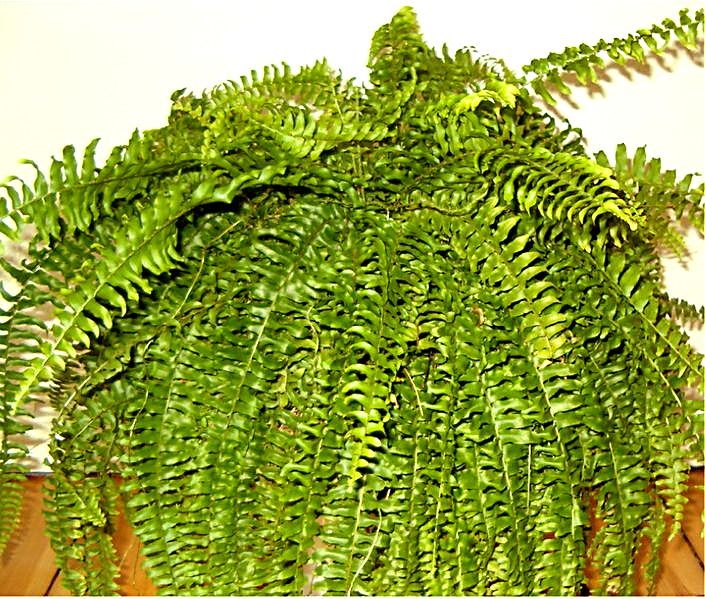 Boston FernNephrolepis exaltata
-
 Tuberous Sword FernNephrolepis cordifolia
-
 Large Sword FernNephrolepis biserrata
-
 Kimberly Queen FernNephrolepis obliterata
- Asian Sword FernNephrolepis brownii
- Fishtail SwordfernNephrolepis falcata
- Scaly SwordfernNephrolepis hirsutula
- Streamside SwordfernNephrolepis rivularis
Compare
Questions and answers
What is the scientific name of the Basket Fern?
The scientific name of the Basket Fern is Nephrolepis pectinata. Written with its author, the full name is Nephrolepis pectinata (Willd.) Schott.
Which family does the Basket Fern belong to?
Nephrolepis pectinata belongs to the family Nephrolepidaceae, in the order Polypodiales and the class Polypodiopsida.
Where is the Basket Fern found?
Checklists and occurrence records place Nephrolepis pectinata in 18 countries, including Peru, Ecuador, Brazil, Costa Rica, Mexico and Colombia.
What other names does the Basket Fern have?
Nephrolepis pectinata is also known in English as Toothed Sword Fern.
Sources
Data
- Catalogue of Life, 2026-10-16 XR cc by
- Global Biodiversity Information Facility CC BY 4.0
- Wikidata CC0
- GeoNames CC BY 4.0
- Within the Catalogue of Life, this name comes from Checklist of Ferns and Lycophytes of the World cc by
References
- Schott. Gen. Fil. [Schott] t. 3 (1834). where the name was published
This species in other databases
- Catalogue of Life 4723X
- Wikidata Q17048243
- iNaturalist 282539
- World Flora Online wfo-0001109177
- GRIN 25203
Page built on 24 November 2026. See how the catalog is made and all sources and licences.
Cite this page
ScientificNames.org. (2026). Nephrolepis pectinata (Basket Fern). Retrieved November 24, 2026, from https://scientificnames.org/species/nephrolepis-pectinata
“Nephrolepis pectinata (Basket Fern).” ScientificNames.org, 2026, scientificnames.org/species/nephrolepis-pectinata. Accessed 24 Nov. 2026.
ScientificNames.org. “Nephrolepis pectinata (Basket Fern).” Accessed November 24, 2026. https://scientificnames.org/species/nephrolepis-pectinata.
@misc{scientificnames_nephrolepis_pectinata_basket_fern,
  author = {{ScientificNames.org}},
  title = {Nephrolepis pectinata (Basket Fern)},
  year = {2026},
  url = {https://scientificnames.org/species/nephrolepis-pectinata},
  note = {Accessed 2026-11-24}
}