Species · Ferns and allies
Boston Fern Nephrolepis exaltata
The scientific name of the Boston Fern is Nephrolepis exaltata. It is a species of fern or lycophyte in the family Nephrolepidaceae (macho ferns), order Polypodiales.
- Scientific name
- Nephrolepis exaltata (L.) Schott
- Common name
- Boston Fern
- Genus
- Nephrolepis
- Family
- Nephrolepidaceae (Macho Ferns)
- Order
- Polypodiales
- Class
- Polypodiopsida
- Red List category
- LC Least Concern
- Recorded in
- 41 countries
- Name status
- accepted in the Catalogue of Life
Overview
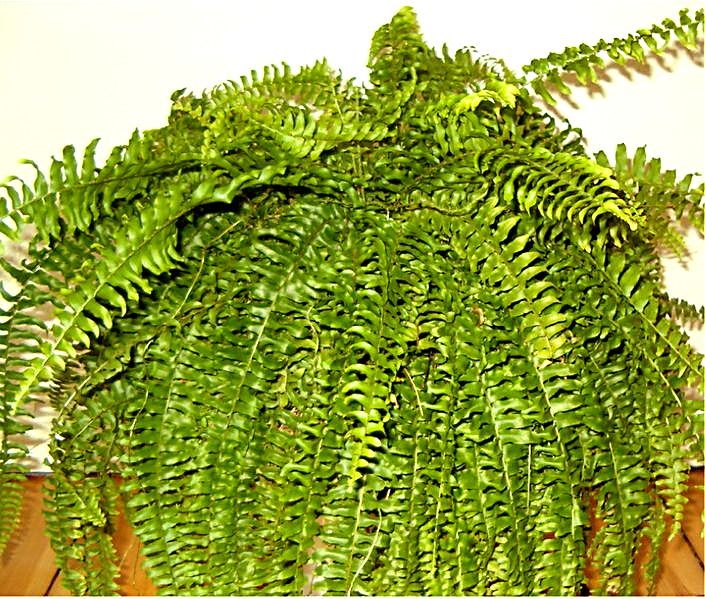
The Boston fern (Nephrolepis exaltata) is a fern with generally erect fronds, although some cultivated forms have arching fronds. It commonly inhabits humid forests, swamps and floodplains, where it grows terrestrially or as an epiphyte. It has alternate, generally deltoid pinnae, rounded sori and spores with warty and wrinkled surfaces.
Written 24 November 2026 from the sources listed below. Each statement was checked against the passage it cites; statements that could not be supported were removed.
Appearance
The Boston fern has alternate, generally deltoid pinnae arranged along its fronds. Its leaves are linear to lanceolate, with slightly serrated margins.[1][2]
Its sori are rounded, and its spores have warty and wrinkled surfaces. The indusia are rounded or horseshoe-shaped.[3][4][5]
The species develops a slender, tuberous underground rhizome. Its petiole bears sparse to moderate pale or reddish-brown scales.[6][7]
The plant typically reaches 40–90 centimetres in height, although exceptional specimens reach 1.5 metres. Its fronds measure 50–250 centimetres long and 6–15 centimetres wide.[8][9]
Individual pinnae are generally 2–8 centimetres long. The leaflets can reach 120 millimetres in length and 23 millimetres in width.[10][11]
Habitat
The Boston fern commonly inhabits humid forests and swamps. It frequently occurs in moist, shady locations, including floodplains.[12][13]
The species grows terrestrially or as an epiphyte. It also grows epiphytically on Sabal palmetto.[14][15]
In Florida, the species occurs in swamps and wet hammocks across the central and southern peninsula.[16]
Behaviour
Outdoors, the Boston fern prefers partial or full shade. Indoors, it responds best to bright filtered light.[17][18]
When indoor relative humidity falls below approximately 80%, the plant requires misting. Among commonly cultivated ferns, it is particularly tolerant of drought.[19][20]
The plant can recover and produce new growth in spring after appearing dead during frost periods.[21]
Reproduction and life cycle
The Boston fern is commonly propagated by dividing its rooted runners. Named cultivars do not produce true spores.[22][23]
Uses
The Boston fern is widely cultivated as a houseplant, particularly in hanging baskets. The species is described as non-toxic and safe for pets.[24][25]
Similar species
Nephrolepis cordifolia is frequently confused with Nephrolepis exaltata. Nephrolepis cordifolia and Nephrolepis multiflora resemble the Boston fern in appearance.[26][27]
Conservation
The Boston fern is classified as an invasive alien plant in South Africa. In some South African provinces, it is legally required to be eradicated.[28][29]
In other South African provinces, permits are required for activities including importing, possessing, cultivating, breeding, selling or buying the species.[30]
Classification of the Boston Fern
| Kingdom | Plantae |
|---|---|
| Subkingdom | Pteridobiotina |
| Phylum | Tracheophyta |
| Class | Polypodiopsida (Fern) |
| Order | Polypodiales |
| Family | Nephrolepidaceae (Macho Ferns) |
| Genus | Nephrolepis (Sword Ferns) |
| Species | Nephrolepis exaltata (L.) Schott |
Where the Boston Fern is found
Checklists and occurrence records place Nephrolepis exaltata in 41 countries across Africa, Europe, North America, Oceania and South America. GBIF holds 3,258 georeferenced records of it.
Countries where it is native or its origin is not stated
- Bahamas 13
- Bermuda 51
- Bolivia 5
- Bonaire, Saint Eustatius and Saba 3
- Brazil 464
- British Virgin Islands 3
- Canada 6
- Colombia 55
- Costa Rica 18
- Cuba 81
- Dominica 8
- Dominican Republic 30
- Ecuador 11
- French Guiana 6
- Grenada 7
- Guadeloupe 9
- Guatemala 13
- Guyana 6
- Haiti 17
- Honduras 15
- Jamaica 171
- Martinique 3
- Nicaragua 9
- Panama 22
- Peru 9
- Puerto Rico 85
- Saint Vincent and the Grenadines 8
- Suriname 5
- Trinidad and Tobago 13
- U.S. Virgin Islands 16
- United States 1,867
- Venezuela 7
Countries where it has been introduced
- Algeria
- Australia 20
- Mexico 113
- Morocco 1
- Portugal 67
- Saint Helena 5
- Seychelles 9
- Tanzania 6
- Zimbabwe 1
Regions and cities with the most records
- Florida, United States 446
- Hawaii, United States 157
- Coimbra, Portugal 52
- Coimbra, Portugal 52
- São Paulo, Brazil 44
- Veracruz, Mexico 40
- Kendall, United States 36
- Pearl City, United States 36
- Honolulu, United States 33
- Tampa, United States 32
- Brandon, United States 31
- Coral Gables, United States 29
- Flagami, United States 28
- California, United States 27
- Little Havana, United States 27
- Town 'n' Country, United States 27
- Allapattah, United States 25
- Fountainebleau, United States 25
- Miami, United States 25
- Hialeah, United States 24
- Tamiami, United States 24
- Doral, United States 23
- East Honolulu, United States 22
- Miami Beach, United States 22
- North Miami, United States 21
- Kendale Lakes, United States 20
- Clearwater, United States 19
- Cutler Bay, United States 19
- Homestead, United States 19
- Pinellas Park, United States 19
- Carol City, United States 18
- Coconut Creek, United States 18
- Lakeland, United States 18
- Largo, United States 18
- Margate, United States 18
- Miami Gardens, United States 18
30 more countries have a few records outside this range
These countries hold a few records of Nephrolepis exaltata but lie outside the range the checklists give for it. Such records are often zoo or garden specimens, museum material or vagrants, so the species is not counted as occurring there.
- Belgium 4
- China 9
- Cook Islands 5
- Fiji 5
- Finland 5
- France 21
- French Polynesia 25
- Germany 19
- Hong Kong 7
- India 26
- Indonesia 33
- Italy 8
- Japan 32
- Kenya 3
- Macao 23
- Micronesia 7
- Nepal 4
- New Caledonia 3
- New Zealand 5
- Nigeria 13
- Papua New Guinea 10
- Philippines 9
- Pitcairn 4
- Reunion 3
- South Africa 80
- Spain 52
- Sri Lanka 20
- Sweden 3
- Taiwan 12
- Vanuatu 3
A number beside a place is its count of GBIF occurrence records. A place without a number comes from a checklist alone. Records show where a species has been observed or collected, which can include escapes and vagrants.
Common names
English
- Boston Fern
- Boston Sword Fern
- Sword Fern
- Fishbone Fern
- Niʻaniʻau
- Southern Sword Fern
Names in 17 other languages
- Afrikaans
- swaardvaring
- Chinese
- 波士頓腎蕨, 肾蕨,圆羊齿, 魚骨芒
- Czech
- ledviník ztepilý
- Danish
- Nyrebregne
- Finnish
- Kaarisulkasaniainen
- French
- Fougère d'intérieur, Fougère de Boston
- Hebrew
- שרך בוסטון
- Hungarian
- Szobapáfrány
- Lithuanian
- Ilgalapis inkstpapartis
- Polish
- nefrolepis wyniosły, nerczyłusk wyniosły
- Portuguese
- Samambaia-Americana, Samambaia-Espada
- Russian
- Нефролепис возвышенный
- Slovak
- nefrolepka vznešená
- Spanish
- helecho Boston
- Swedish
- spjutbräken
- Thai
- เฟิร์นใบมะขามบอสตัน
- Turkish
- Aşk Merdiveni
Subspecies and varieties
- Nephrolepis exaltata subsp. exaltata subspecies
- Nephrolepis exaltata subsp. hawaiiensis subspecies
Related species
-
 Tuberous Sword FernNephrolepis cordifolia
-
 Large Sword FernNephrolepis biserrata
-
 Kimberly Queen FernNephrolepis obliterata
- Asian Sword FernNephrolepis brownii
- Fishtail SwordfernNephrolepis falcata
- Scaly SwordfernNephrolepis hirsutula
- Basket FernNephrolepis pectinata
- Streamside SwordfernNephrolepis rivularis
Compare
Questions and answers
What is the scientific name of the Boston Fern?
The scientific name of the Boston Fern is Nephrolepis exaltata. Written with its author, the full name is Nephrolepis exaltata (L.) Schott.
Which family does the Boston Fern belong to?
Nephrolepis exaltata belongs to the family Nephrolepidaceae, in the order Polypodiales and the class Polypodiopsida.
Where is the Boston Fern found?
Checklists and occurrence records place Nephrolepis exaltata in 41 countries, including United States, Brazil, Jamaica, Puerto Rico, Cuba and Colombia.
What is the conservation status of the Boston Fern?
The IUCN Red List category recorded for Nephrolepis exaltata is Least Concern (LC).
What other names does the Boston Fern have?
Nephrolepis exaltata is also known in English as Boston Sword Fern, Sword Fern, Fishbone Fern, Niʻaniʻau and Southern Sword Fern.
Do sword ferns like sun or shade?
Outdoors, the Boston fern prefers partial or full shade. Indoors, it responds best to bright filtered light.[17][18]
Is sword fern invasive?
The Boston fern is classified as an invasive alien plant in South Africa. In some South African provinces, eradication is legally required, while other provinces require permits for specified activities involving the species.[28][29][30]
Does sword fern spread?
The Boston fern is commonly propagated by dividing its rooted runners.[22]
Sources
Passages the profile rests on
- Nephrolepis exaltata has alternate, generally deltoid pinnae arranged along its fronds. Source passage: “with alternate pinnae (the small "leaflets" on either side of the midrib), each pinna being 2–8 centimetres (0.79–3.15 in) long. The pinnae are generally deltoid” — English Wikipedia
- The leaf margins are slightly serrated, and the leaves have a linear to lanceolate shape. Source passage: “The edges appear slightly serrate, linear to lanceolate and glandular.” — English Wikipedia
- The sori of this species are rounded. Source passage: “The sori are rounded.” — English Wikipedia
- Its spores have warty and wrinkled surfaces. Source passage: “The spores are warty and wrinkled.” — English Wikipedia
- The indusia are rounded or horseshoe-shaped. Source passage: “Lastly, the indusia are rounded to horseshoe-shaped.” — plant-directory.ifas.ufl.edu
- The species develops a slender, tuberous underground rhizome. Source passage: “Nephrolepis exaltata forms an underground rhizome that is slim and tuberous.” — English Wikipedia
- The petiole bears sparse to moderate pale or reddish-brown scales. Source passage: “The petiole is sparse to moderate, with pale to reddish-brown scales of a single color” — plant-directory.ifas.ufl.edu
- The plant typically reaches 40–90 centimetres in height, with exceptional specimens reaching 1.5 metres. Source passage: “This evergreen plant can reach as high as 40–90 centimetres (16–35 in), and in extreme cases up to 1.5 metres (4 ft 11 in).” — English Wikipedia
- Its fronds measure 50–250 centimetres long and 6–15 centimetres wide. Source passage: “The fronds of Nephrolepis exaltata are 50–250 centimetres (20–98 in) long and 6–15 centimetres (2.4–5.9 in) broad” — English Wikipedia
- Individual pinnae are generally 2–8 centimetres long. Source passage: “each pinna being 2–8 centimetres (0.79–3.15 in) long.” — English Wikipedia
- The leaflets can reach 120 millimetres in length and 23 millimetres in width. Source passage: “up to 4.8 inches (120 mm) long and up to 0.9 inches (23 mm) wide.” — English Wikipedia
- The species commonly inhabits humid forests and swamps. Source passage: “The fern is common in humid forests and swamps” — English Wikipedia
- It frequently occurs in moist, shady locations, including swamps and floodplains. Source passage: “N. exaltata thrives in moist, shady locations and is found frequently in swamps and floodplains.” — English Wikipedia
- The species can grow either terrestrially or as an epiphyte. Source passage: “The plant can grow both terrestrially and as an epiphyte.” — English Wikipedia
- It grows epiphytically on Sabal palmetto. Source passage: “It grows epiphytically on the Sabal palmetto.” — English Wikipedia
- In Florida, the species occurs in swamps and wet hammocks across the central and southern peninsula. Source passage: “Nephrolepis exaltata is commonly found in swamps and wet hammocks throughout the central and southern peninsula.” — plant-directory.ifas.ufl.edu
- Outdoors, the species prefers partial or full shade. Source passage: “The plant prefers partial shade or full shade outdoors” — English Wikipedia
- Indoors, the species responds best to bright filtered light. Source passage: “it doesn't grow in shade when indoors and responds best to bright filtered light.” — English Wikipedia
- Among commonly cultivated ferns, the Boston fern is particularly tolerant of drought. Source passage: “Of the common cultivated ferns, the Boston fern is the most tolerant to drought.” — English Wikipedia
- The plant requires misting indoors when relative humidity falls below approximately 80%. Source passage: “when grown as a house plant, it is necessary to mist the plant when relative humidity falls below around 80%.” — English Wikipedia
- The species can recover and produce new growth in spring after appearing dead during frost periods. Source passage: “Although the fern may appear totally dead during periods of frost, it will re-emerge in the spring.” — English Wikipedia
- The species is commonly propagated by dividing its rooted runners. Source passage: “The plant is usually propagated by division of the rooted runners” — English Wikipedia
- Named cultivars do not produce true spores. Source passage: “as named cultivars will not produce true spores.” — English Wikipedia
- Nephrolepis exaltata is widely cultivated as a houseplant, particularly in hanging baskets. Source passage: “Nephrolepis exaltata is a very popular house plant, often grown in hanging baskets or similar conditions.” — English Wikipedia
- The species is described as non-toxic and safe for pets. Source passage: “It is safe for pets as it is known to be non-toxic.” — English Wikipedia
- Nephrolepis cordifolia is frequently confused with Nephrolepis exaltata. Source passage: “A related species, Nephrolepis cordifolia (Tuberous sword fern), is frequently confused with this sword fern” — English Wikipedia
- Nephrolepis cordifolia and Nephrolepis multiflora resemble Nephrolepis exaltata in appearance. Source passage: “Tuberous sword fern (Nephrolepis cordifolia) and Asian sword fern (Nephrolepis multiflora) are similar in appearance to the native sword fern and giant sword fern.” — plant-directory.ifas.ufl.edu
- Nephrolepis exaltata is classified as an invasive alien plant in South Africa. Source passage: “Nephrolepis exaltata is classified as an invasive alien plant in South Africa.” — English Wikipedia
- In some South African provinces, the species is legally required to be eradicated. Source passage: “In some provinces it must be eradicated by law.” — English Wikipedia
- In other South African provinces, permits are required for activities including importing, possessing, cultivating, breeding, selling or buying the species. Source passage: “In others, a permit is required to import, possess, grow, breed, move, sell, buy or accept one as a gift.” — English Wikipedia
Data
- Catalogue of Life, 2026-10-16 XR cc by
- Global Biodiversity Information Facility CC BY 4.0
- Wikidata CC0
- GeoNames CC BY 4.0
- Wikimedia Commons per image; credit shown with each image
- Within the Catalogue of Life, this name comes from Checklist of Ferns and Lycophytes of the World cc by
References
- (L.) Schott. where the name was published
This species in other databases
- Catalogue of Life 4722Q
- Wikidata Q136883
- iNaturalist 130866
- World Flora Online wfo-0001109173
- GRIN 25202
Page built on 24 November 2026. See how the catalog is made and all sources and licences.
Cite this page
ScientificNames.org. (2026). Nephrolepis exaltata (Boston Fern). Retrieved November 24, 2026, from https://scientificnames.org/species/nephrolepis-exaltata
“Nephrolepis exaltata (Boston Fern).” ScientificNames.org, 2026, scientificnames.org/species/nephrolepis-exaltata. Accessed 24 Nov. 2026.
ScientificNames.org. “Nephrolepis exaltata (Boston Fern).” Accessed November 24, 2026. https://scientificnames.org/species/nephrolepis-exaltata.
@misc{scientificnames_nephrolepis_exaltata_boston_fern,
  author = {{ScientificNames.org}},
  title = {Nephrolepis exaltata (Boston Fern)},
  year = {2026},
  url = {https://scientificnames.org/species/nephrolepis-exaltata},
  note = {Accessed 2026-11-24}
}