Species · Insects
Nialaphodius nigrita
Nialaphodius nigrita has no English name on record in the checklists used here. It is a species of insect in the family Scarabaeidae (dung beetles), order Coleoptera. The name dates from 1801.
- Scientific name
- Nialaphodius nigrita (Fabricius, 1801)
- Genus
- Nialaphodius
- Family
- Scarabaeidae (Dung Beetles)
- Order
- Coleoptera
- Class
- Insecta
- Recorded in
- 44 countries
- Name status
- accepted in the Catalogue of Life

Overview
The species occurs in the Nearctic, Neotropical, and Afrotropical regions, including Florida, Georgia, South Carolina, Texas, Belize, Brazil, Mexico, Angola, Kenya, Madagascar, and other listed locations. Adults have a strongly convex body, a densely punctate head, and a pronotum with fine and coarse punctures but no posterior marginal line.
Written 27 November 2026 from the sources listed below. Each statement was checked against the passage it cites; statements that could not be supported were removed.
Appearance
Adults have a strongly convex body and a densely punctate head. The pronotum bears fine and coarse punctures and lacks a posterior marginal line along its posterior margin.[1][2]
Adult beetles measure approximately 3.5–5.5 mm in length.[3]
Habitat
The species has been collected in pasture regions containing Urochloa brizantha. Specimens have also been collected in cattle dung.[4][5]
Classification of Nialaphodius nigrita
| Kingdom | Animalia |
|---|---|
| Phylum | Arthropoda |
| Subphylum | Hexapoda |
| Class | Insecta (Insect) |
| Order | Coleoptera (Beetle) |
| Suborder | Polyphaga |
| Series | Staphyliniformia |
| Superfamily | Scarabaeoidea |
| Family | Scarabaeidae (Dung Beetles) |
| Subfamily | Aphodiinae |
| Tribe | Aphodiini |
| Subtribe | Aphodiina |
| Genus | Nialaphodius |
| Species | Nialaphodius nigrita (Fabricius, 1801) |
Where Nialaphodius nigrita is found
Checklists and occurrence records place Nialaphodius nigrita in 44 countries across Africa, Asia, North America and South America. GBIF holds 353 georeferenced records of it.
Countries
- Angola
- Belize
- Benin
- Bolivia 2
- Brazil 57
- Burkina Faso
- Burundi
- Cameroon
- Chad
- Chile
- Colombia 18
- Dominican Republic 8
- Ecuador 2
- El Salvador
- Gambia 1
- Georgia
- Ghana 1
- Guadeloupe 13
- Honduras
- Ivory Coast
- Kenya 1
- Madagascar 34
- Malawi 2
- Martinique 14
- Mayotte 3
- Mexico 87
- Nicaragua 3
- Niger
- Panama 1
- Paraguay 1
- Peru 1
- Puerto Rico 20
- Reunion 3
- Rwanda
- Senegal 1
- Seychelles
- South Africa 7
- Sudan
- Suriname
- Tanzania
- U.S. Virgin Islands 6
- United States 66
- Venezuela
- Zambia 1
Regions and cities with the most records
- Veracruz, Mexico 44
- Florida, United States 24
- Texas, United States 17
- Mayagüez, Puerto Rico 12
- Jalisco, Mexico 11
- Ducos, Martinique 10
- Fort-de-France, Martinique 10
- Le Lamentin, Martinique 10
- Les Abymes, Guadeloupe 10
- Saint-Joseph, Martinique 10
- Baie-Mahault, Guadeloupe 9
- Chiapas, Mexico 9
- Le François, Martinique 9
- Channelview, United States 8
- Deer Park, United States 8
- Houston, United States 8
- Pasadena, United States 8
- Pearland, United States 8
- Pointe-à-Pitre, Guadeloupe 8
- Sainte-Marie, Martinique 8
- South Houston, United States 8
- Autlán de Navarro, Mexico 7
- Le Gosier, Guadeloupe 7
- Le Moule, Guadeloupe 7
- Le Robert, Martinique 7
- Mato Grosso, Brazil 7
- La Trinité, Martinique 6
- Palenque, Mexico 6
- Saint Croix, U.S. Virgin Islands 6
- Sainte-Anne, Guadeloupe 6
- San Andres y Providencia, Colombia 6
- Georgia, United States 5
- North West, South Africa 5
- Zeerust, South Africa 4
- Córdoba, Colombia 3
- Dzaoudzi, Mayotte 3
Range as the checklists state it
Nearctic(USA:Florida, Georgia, South Carolina, Texas), Neotropical(Belize, Bolivia, Brazil:Amazonas, Bahia, Distrito Federal, Espírito Santo, Maranhão, Mato Grosso, Mato Grosso do Sul, Minas Gerais, Rio de Janeiro, Rondônia, Roraima, São Paulo, Chile, Colombia, Ecuador, El Salvador, Grenadines, Honduras, Martinique, Mexico:Chiapas, Durango, Guerrero, Hidalgo, Jalisco, Nyarit, Oaxaca, Querétaro, Quintana Roo, San Luis Potosí, Sonora, Veracruz, Yucatán, Panama, Paraguay, Peru, Puerto Rico, Saint Vincent, Suriname, Venezuela), Afrotropical(Angola, Benin, Burkina Faso, Burundi, Cameroon, Chad, Gambia, Ghana, Ivory Coast, Kenya, Malawi, Niger, Republic Democratic Congo, Republic of Guinea, Rwanda, Senegal, Sudan, Tanzania, Zambia), Cape Verde Islands, Madagascar, Mascarene, Seychelles
A number beside a place is its count of GBIF occurrence records. A place without a number comes from a checklist alone. Records show where a species has been observed or collected, which can include escapes and vagrants.
Synonyms
11 other scientific names have been used for this species and are now treated as synonyms of Nialaphodius nigrita.
- Aphodius (Pharaphodius) pervicax Balthasar, 1942
- Aphodius binominatus Schmidt, 1907
- Aphodius cuniculus Chevrolat, 1865
- Aphodius expertus Harold, 1871
- Aphodius granarius guadeloupensis Fleutiaux & Sallé, 1889
- Aphodius nigrita Fabricius, 1801
- Aphodius nigritulus Boheman, 1857
- Aphodius paivanus Wollaston, 1867
- Aphodius tenebrosus Dejean, 1833
- Aphodius vestiarius Horn, 1870
- Aphodius tuberifrons Fairmaire, 1903 ambiguous synonym
Related species
- Nialaphodius calidus
-
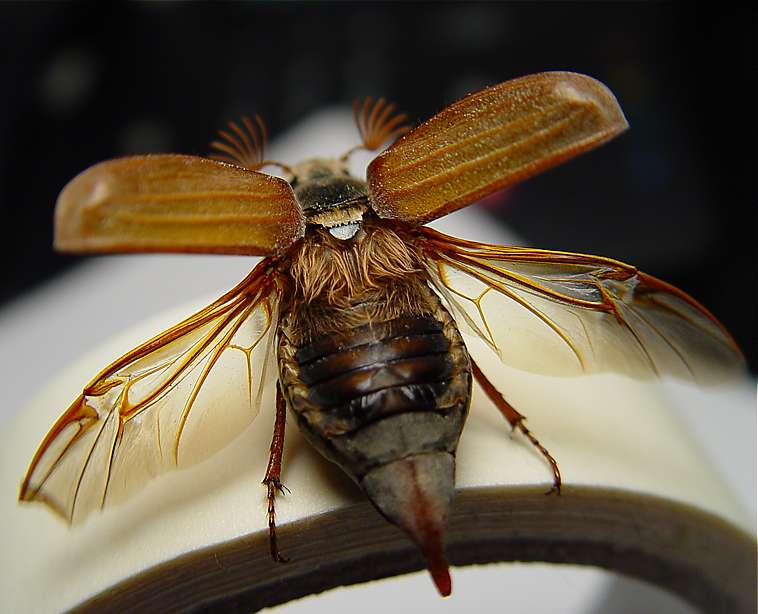 CockchaferMelolontha melolontha
-
 Hercules BeetleDynastes (Dynastes) hercules
-
 Japanese BeetlePopillia japonica
-
 Japanese Rhinoceros BeetleTrypoxylus dichotomus
-
 Sacred ScarabScarabaeus sacer
-
 Figeater BeetleCotinis (Cotinis) mutabilis
-
 Atlas BeetleChalcosoma atlas
Compare
Sources
Passages the profile rests on
- Adults have a strongly convex body and a densely punctate head. Source passage: “The body is strongly convex and the head is densely punctate.” — English Wikipedia
- The pronotum bears fine and coarse punctures and lacks a posterior marginal line along its posterior margin. Source passage: “The pronotum has punctures of two sizes (fine and coarse) and a posterior margin without a posterior marginal line.” — English Wikipedia
- Adult beetles measure approximately 3.5–5.5 mm in length. Source passage: “Adults reach a length of about 3.5–5.5 mm (0.14–0.22 in).” — English Wikipedia
- The species has been collected in pasture regions containing Urochloa brizantha. Source passage: “Specimens have been collected in Urochloa brizantha pasture regions in cattle dung.” — English Wikipedia
- Specimens of the species have been collected in cattle dung. Source passage: “Specimens have been collected in Urochloa brizantha pasture regions in cattle dung.” — English Wikipedia
Data
- Catalogue of Life, 2026-10-16 XR cc by
- Global Biodiversity Information Facility CC BY 4.0
- Wikidata CC0
- GeoNames CC BY 4.0
- Wikimedia Commons per image; credit shown with each image
- Within the Catalogue of Life, this name comes from World Scarabaeidae Database cc by
References
- Dellacasa, G., Bordat, P., & Dellacasa, M. (2001). A revisional essay of world genus-group taxa of Aphodiinae (Coleoptera: Aphodiidae). Memorie Della Società Entomologica Italiana, Genova 79:1-482. https://archive.org/download/revisionalessayv792dell/revisionalessayv792dell.pdf Link where the name was published
This species in other databases
Page built on 29 November 2026. See how the catalog is made and all sources and licences.
Cite this page
ScientificNames.org. (2026). Nialaphodius nigrita. Retrieved November 29, 2026, from https://scientificnames.org/species/nialaphodius-nigrita
“Nialaphodius nigrita.” ScientificNames.org, 2026, scientificnames.org/species/nialaphodius-nigrita. Accessed 29 Nov. 2026.
ScientificNames.org. “Nialaphodius nigrita.” Accessed November 29, 2026. https://scientificnames.org/species/nialaphodius-nigrita.
@misc{scientificnames_nialaphodius_nigrita,
  author = {{ScientificNames.org}},
  title = {Nialaphodius nigrita},
  year = {2026},
  url = {https://scientificnames.org/species/nialaphodius-nigrita},
  note = {Accessed 2026-11-29}
}