Species · Birds
Long-tailed Potoo Nyctibius aethereus
The scientific name of the Long-tailed Potoo is Nyctibius aethereus. It is a species of bird in the family Nyctibiidae (potoo), order Nyctibiiformes. The name dates from 1820.
- Scientific name
- Nyctibius aethereus (zu Wied-Neuwied, 1820)
- Common name
- Long-tailed Potoo
- Genus
- Nyctibius
- Family
- Nyctibiidae (Potoo)
- Order
- Nyctibiiformes
- Class
- Aves
- Red List category
- LC Least Concern
- Recorded in
- 11 countries
- Name status
- accepted in the Catalogue of Life

Overview
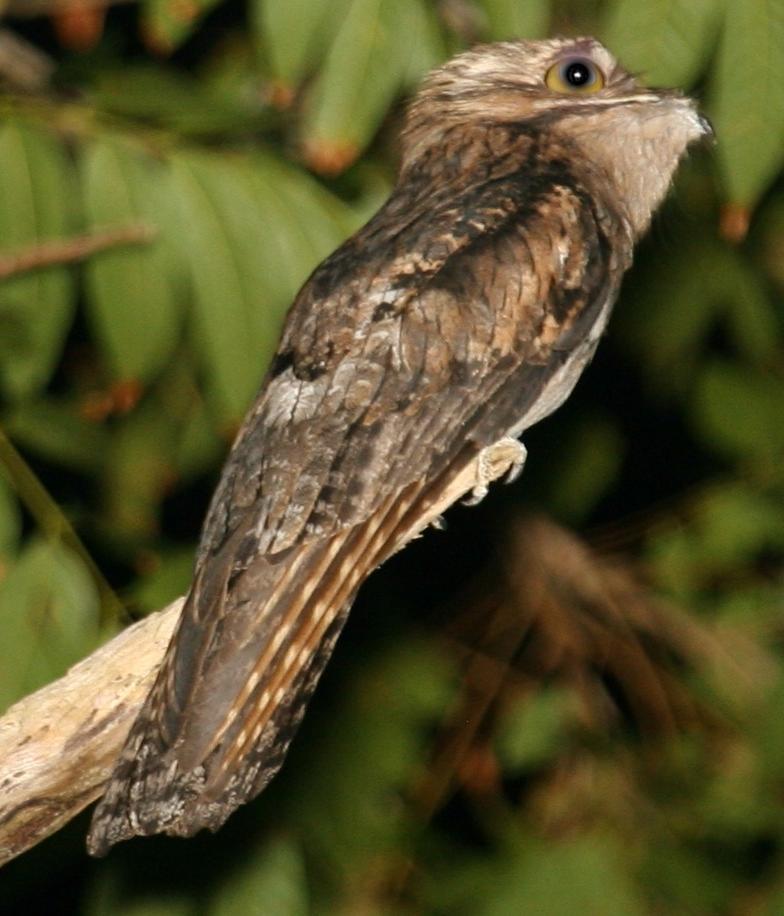
The Long-tailed Potoo is a bird with three recognized subspecies: N. a. aethereus, N. a. chocoensis, and N. a. longicaudatus. It inhabits subtropical or tropical moist lowland forests across mainland South America, except Chile and Uruguay. It is distinguished by its long graduated tail, predominantly rusty-brown plumage, streaked underparts, pale shoulder patch, and whitish moustache.
Written 26 November 2026 from the sources listed below. Each statement was checked against the passage it cites; statements that could not be supported were removed.
Appearance
Adults measure between 42 and 58 cm in length and weigh between 280 and 447 g. The species has a long graduated tail and predominantly rusty-brown plumage with streaked underparts, a pale shoulder patch, and a whitish moustache.[1][2][3]
The nominate subspecies has tawny-brown upperparts. Its crown and nape have buff spots, speckles, and blackish-brown streaks, while its graduated brown tail has tawny-buff barring and brown streaks or vermiculation.[4][5][6]
The nominate subspecies has a tawny face and buffish moustache, with generally brown wings marked by broad, pale-tawny bars. Its chin and throat are grayish-buff.[7][8][9]
The nominate subspecies has brown breast and flanks marked with buff speckles, blackish-brown streaks, and bold contrasting spots. Its lower belly is buff with brown streaks and vermiculation.[10][11]
The subspecies N. a. longicaudatus is generally smaller than the nominate subspecies and often has more tawny-brown plumage, particularly on the breast. N. a. chocoensis is smaller and darker than N. a. longicaudatus, with larger, bolder black upperpart streaks and a chestnut-leaning brown base color.[12][13]
Habitat
The Long-tailed Potoo inhabits subtropical or tropical moist lowland forests and the interiors of lowland tropical evergreen forests. It is usually found between the understory and subcanopy.[14][15][16]
The species occupies forests ranging from relatively dry to very wet conditions.[17]
The nominate subspecies occurs at elevations reaching 1,200 m in the Atlantic Forest region. Subspecies occurring outside the Atlantic Forest reach elevations of up to 700 m in Ecuador and 750 m in Peru.[18][19]
Diet
The documented diet includes termites, moths, and beetles.[20]
Behaviour
The Long-tailed Potoo is nocturnal. It catches flying insects in short flights launched from a perch.[21][22]
During the day, it roosts, usually on dead stubs or branches up to 20 m above the ground. When approached at its daytime roost, it stretches its body vertically and remains motionless.[23][24]
The species sings mostly at night, particularly on moonlit nights. Its vocalizations consist of a series of owl-like hoots or woof notes.[25][26]
Reproduction and life cycle
The species does not construct a conventional nest. It lays a single egg in a depression or bend on a stump or branch.[27]
One active nest was recorded in Paraguay from late August through November. Nesting was reported in French Guiana between July and September.[28][29]
Conservation
The Long-tailed Potoo is classified as Least Concern by the IUCN. Its population is unknown and believed to be decreasing.[30][31]
Increasing deforestation in Amazonia is identified as a threat to the widely distributed subspecies N. a. longicaudatus. The Atlantic Forest habitat of the nominate subspecies has been reduced to remnants.[32][33]
Classification of the Long-tailed Potoo
| Kingdom | Animalia |
|---|---|
| Phylum | Chordata |
| Subphylum | Vertebrata |
| Infraphylum | Gnathostomata |
| Parvphylum | Osteichthyes |
| Megaclass | Tetrapoda |
| Class | Aves (Bird) |
| Order | Nyctibiiformes (Potoo) |
| Family | Nyctibiidae (Potoo) |
| Genus | Nyctibius (Potoos) |
| Species | Nyctibius aethereus (zu Wied-Neuwied, 1820) |
Where the Long-tailed Potoo is found
Checklists and occurrence records place Nyctibius aethereus in 11 countries across South America. GBIF holds 2,820 georeferenced records of it.
Countries
- Argentina 113
- Bolivia 119
- Brazil 639
- Colombia 75
- Ecuador 642
- French Guiana 39
- Guyana 204
- Paraguay 31
- Peru 917
- Suriname 23
- Venezuela 18
Regions and cities with the most records
- Madre de Dios, Peru 599
- Orellana Province, Ecuador 265
- Sucumbíos, Ecuador 237
- San Martín Department, Peru 162
- Mato Grosso, Brazil 159
- Rio de Janeiro, Brazil 159
- Loreto, Peru 129
- Napo, Ecuador 124
- La Banda, Peru 108
- Misiones, Argentina 108
- Potaro-Siparuni, Guyana 105
- Cachoeiras de Macacu, Brazil 103
- La Paz Department, Bolivia 89
- Upper Takutu-Upper Essequibo, Guyana 88
- Espírito Santo, Brazil 86
- Puerto Iguazú, Argentina 68
- Tambopata, Peru 46
- Amazonas, Brazil 44
- Paraná, Brazil 43
- Foz do Iguaçu, Brazil 42
- Presidente Franco, Paraguay 41
- Itatiaia, Brazil 36
- Resende, Brazil 36
- Pará, Brazil 34
- Acre, Brazil 33
- Puerto Maldonado, Peru 32
- Santa Teresa, Brazil 27
- São Pedro, Brazil 25
- Teresópolis, Brazil 25
- Fundão, Brazil 24
- Amazonas Department, Colombia 23
- Boca Suno, Ecuador 23
- Sipaliwini District, Suriname 23
- Castelo, Brazil 21
- Vargem Alta, Brazil 19
- Bahia, Brazil 17
Range as the checklists state it
South America
A number beside a place is its count of GBIF occurrence records. A place without a number comes from a checklist alone. Records show where a species has been observed or collected, which can include escapes and vagrants.
Common names
English
- Long-tailed Potoo
Names in 27 other languages
- Arabic
- بوتو طويل الذيل
- Catalan
- nictibi cuallarg
- Chinese
- 長尾林鴟, 长尾钩嘴夜鹰
- Czech
- potu dlouhoocasý
- Danish
- Langhalet Potu
- Dutch
- Wigstaartreuzennachtzwaluw
- Esperanto
- longvosta niktibio
- Estonian
- pikksaba-tüükasorr
- Finnish
- pyrstöpökkelökehrääjä
- French
- Ibijau à longue queue
- German
- Langschwanz-Tagschläfer, Langschwanztagschläfer
- Hungarian
- hosszúfarkú álmosmadár
- Italian
- Nittibio codalunga
- Japanese
- オナガタチヨタカ
- Korean
- 긴꼬리포투
- Lithuanian
- ilgauodegis didlėlys
- Norwegian
- langhalepotu
- Polish
- nocolot wielkosterny
- Portuguese
- Mãe-da-lua-parda, nictíbio-rabilongo, urutau-pardo
- Russian
- Длиннохвостый исполинский козодой, Длиннохвостый лесной козодой, Длиннохвостый уратао
- Serbian
- Dugorepi potu
- Slovak
- lelkovec dlhochvostý
- Spanish
- Nictibio colilargo, Nictibio de Cola Larga, Urutaú coludo
- Swedish
- långstjärtad poto
- Turkish
- Uzun Kuyruklu Putu, Uzunkuyruk Poto
- Ukrainian
- поту довгохвостий
- Welsh
- potŵ cynffonhir
Synonyms
One other scientific name has been used for this species and is now treated as a synonym of Nyctibius aethereus.
- Caprimulgus aethereus zu Wied-Neuwied, 1820
Subspecies and varieties
- Nyctibius aethereus aethereus subspecies
- Nyctibius aethereus chocoensis subspecies
- Nyctibius aethereus longicaudatus subspecies
Related species
-
 Great PotooNyctibius grandis
-
 Common PotooNyctibius griseus
-
 Northern PotooNyctibius jamaicensis
-
 Andean PotooNyctibius maculosus
-
 White-winged PotooNyctibius leucopterus
- Rufous PotooPhyllaemulor bracteatus
Compare
Questions and answers
What is the scientific name of the Long-tailed Potoo?
The scientific name of the Long-tailed Potoo is Nyctibius aethereus. Written with its author, the full name is Nyctibius aethereus (zu Wied-Neuwied, 1820).
Which family does the Long-tailed Potoo belong to?
Nyctibius aethereus belongs to the family Nyctibiidae, in the order Nyctibiiformes and the class Aves.
Where is the Long-tailed Potoo found?
Checklists and occurrence records place Nyctibius aethereus in 11 countries, including Peru, Ecuador, Brazil, Guyana, Bolivia and Argentina.
What is the conservation status of the Long-tailed Potoo?
The IUCN Red List category recorded for Nyctibius aethereus is Least Concern (LC).
What do potoo birds eat?
The documented diet of the Long-tailed Potoo includes termites, moths, and beetles.[20]
Sources
Passages the profile rests on
- The species has a long graduated tail and predominantly rusty-brown plumage with streaked underparts, a pale shoulder patch, and a whitish moustache. Source passage: “Large potoo with a long graduated tail. Mostly rusty brown with streaked underparts, a conspicuous pale shoulder patch, and a whitish moustache.” — ebird.org
- Adults measure between 42 and 58 cm in length. Source passage: “The long-tailed potoo is 42 to 58 cm (17 to 23 in) long” — English Wikipedia
- Adults weigh between 280 and 447 g. Source passage: “weighs 280 to 447 g (9.9 to 15.8 oz).” — English Wikipedia
- The nominate subspecies has tawny-brown upperparts. Source passage: “The nominate subspecies' upperparts are tawny brown.” — English Wikipedia
- The crown and nape of the nominate subspecies have buff spots, speckles, and blackish-brown streaks. Source passage: “The crown and nape have buff spots and speckles and blackish brown streaks.” — English Wikipedia
- The nominate subspecies has a graduated brown tail with tawny-buff barring and brown streaks or vermiculation. Source passage: “The tail is graduated and overall brown, with tawny buff barring and brown streaks or vermiculation.” — English Wikipedia
- The nominate subspecies has a tawny face and a buffish moustache. Source passage: “Much of the face is tawny and it has a buffish "moustache".” — English Wikipedia
- The nominate subspecies has generally brown wings with broad, pale-tawny bars. Source passage: “The wings are generally brown with broad pale tawny bars.” — English Wikipedia
- The nominate subspecies has grayish-buff chin and throat plumage. Source passage: “The chin and throat are grayish buff.” — English Wikipedia
- The nominate subspecies has brown breast and flanks marked with buff speckles, blackish-brown streaks, and bold contrasting spots. Source passage: “The breast and flanks are brown with buff speckles, blackish brown streaks, and bold buff and blackish brown spots.” — English Wikipedia
- The nominate subspecies has a buff lower belly with brown streaks and vermiculation. Source passage: “The lower belly is buff with brown streaks and vermiculation.” — English Wikipedia
- The subspecies N. a. longicaudatus is generally smaller than the nominate subspecies and often has more tawny-brown plumage, particularly on the breast. Source passage: “N. a. longicaudatus is smaller than the nominate subspecies; often it is a more tawny brown overall and especially on the breast.” — English Wikipedia
- The subspecies N. a. chocoensis is smaller and darker than N. a. longicaudatus, with larger, bolder black upperpart streaks and a chestnut-leaning brown base color. Source passage: “N. a. chocoensis is smaller than longicaudatus but darker. The black streaks on the upperparts are larger and bolder and the brown base color tends towards chestnut.” — English Wikipedia
- The species inhabits subtropical or tropical moist lowland forests. Source passage: “habitat is subtropical or tropical moist lowland forests” — inaturalist.org
- The species inhabits the interiors of lowland tropical evergreen forests. Source passage: “The long-tailed potoo inhabits the interiors of lowland tropical evergreen forests.” — English Wikipedia
- The species is usually found between the understory and subcanopy of forests. Source passage: “It is usually found from the understory to the subcanopy.” — English Wikipedia
- The species occupies forests ranging from relatively dry to very wet conditions. Source passage: “The forests range in humidity from rather dry to very wet.” — English Wikipedia
- The nominate subspecies occurs at elevations reaching 1,200 m in the Atlantic Forest region. Source passage: “In the Atlantic Forest region, the nominate subspecies is found as high as 1,200 m (3,900 ft).” — English Wikipedia
- The subspecies occurring outside the Atlantic Forest reach elevations of up to 700 m in Ecuador and 750 m in Peru. Source passage: “The other subspecies occur at lower elevations, reaching only 700 m (2,300 ft) in Ecuador and 750 m (2,460 ft) in Peru.” — English Wikipedia
- The species' documented diet includes termites, moths, and beetles. Source passage: “its diet has not been detailed but is known to include termites, moths, and beetles.” — English Wikipedia
- The species is nocturnal. Source passage: “The long-tailed potoo is nocturnal.” — English Wikipedia
- The species catches flying insects in short flights launched from a perch. Source passage: “It forages by sallying for flying insects in short flights from a perch” — English Wikipedia
- The species roosts during the day, usually on dead stubs or branches up to 20 m above the ground. Source passage: “The long-tailed potoo roosts during the day, usually on a dead stub or branch up to 20 m (66 ft) above the ground.” — English Wikipedia
- When approached at its daytime roost, the species stretches its body vertically and remains motionless. Source passage: “If approached it stretches its body vertically and freezes.” — English Wikipedia
- The species sings mostly at night, particularly on moonlit nights. Source passage: “and is sung mostly at night and especially on moonlit ones.” — English Wikipedia
- The species produces a series of owl-like hoots or woof notes. Source passage: “a distinctive series of owl-like hoots or woof notes.” — English Wikipedia
- The species does not construct a conventional nest and lays a single egg in a depression or bend on a stump or branch. Source passage: “The species does not make a conventional nest, but lays its single egg on top of a stump or on a branch in a depression or bend.” — English Wikipedia
- One active nest was recorded in Paraguay from late August through November. Source passage: “In Paraguay, one nest was active from late August through November.” — English Wikipedia
- Nesting was reported in French Guiana between July and September. Source passage: “In French Guiana nesting was reported between July and September.” — English Wikipedia
- The species is classified as Least Concern by the IUCN. Source passage: “The IUCN has assessed the long-tailed potoo as being of Least Concern” — English Wikipedia
- The species' population is unknown and believed to be decreasing. Source passage: “though its population is unknown and believed to be decreasing.” — English Wikipedia
- Amazonia's increasing deforestation is identified as a threat to the widely distributed subspecies N. a. longicaudatus. Source passage: “Though N. a. longicaudatus has a very large range, Amazonia is undergoing increasing deforestation.” — English Wikipedia
- The Atlantic Forest habitat of the nominate subspecies has been reduced to remnants. Source passage: “the Atlantic Forest habitat of the nominate subspecies has been reduced to remnants.” — English Wikipedia
- The species occurs in every mainland South American country except Chile and Uruguay. Source passage: “It is found in every mainland South American country except Chile and Uruguay.” — English Wikipedia
Data
- Catalogue of Life, 2026-10-16 XR cc by
- Global Biodiversity Information Facility CC BY 4.0
- Wikidata CC0
- GeoNames CC BY 4.0
- Wikimedia Commons per image; credit shown with each image
- Within the Catalogue of Life, this name comes from The Integrated Taxonomic Information System cc0
References
- Gill, Frank, & and Minturn Wright. (2006). Birds of the World: Recommended English Names.
This species in other databases
Page built on 26 November 2026. See how the catalog is made and all sources and licences.
Cite this page
ScientificNames.org. (2026). Nyctibius aethereus (Long-tailed Potoo). Retrieved November 26, 2026, from https://scientificnames.org/species/nyctibius-aethereus
“Nyctibius aethereus (Long-tailed Potoo).” ScientificNames.org, 2026, scientificnames.org/species/nyctibius-aethereus. Accessed 26 Nov. 2026.
ScientificNames.org. “Nyctibius aethereus (Long-tailed Potoo).” Accessed November 26, 2026. https://scientificnames.org/species/nyctibius-aethereus.
@misc{scientificnames_nyctibius_aethereus_long_tailed_potoo,
  author = {{ScientificNames.org}},
  title = {Nyctibius aethereus (Long-tailed Potoo)},
  year = {2026},
  url = {https://scientificnames.org/species/nyctibius-aethereus},
  note = {Accessed 2026-11-26}
}