Species · Birds
Common Potoo Nyctibius griseus
The scientific name of the Common Potoo is Nyctibius griseus. It is a species of bird in the family Nyctibiidae (potoo), order Nyctibiiformes. The name dates from 1789.
- Scientific name
- Nyctibius griseus (J. F. Gmelin, 1789)
- Common name
- Common Potoo
- Genus
- Nyctibius
- Family
- Nyctibiidae (Potoo)
- Order
- Nyctibiiformes
- Class
- Aves
- Red List category
- LC Least Concern
- Recorded in
- 21 countries
- Name status
- accepted in the Catalogue of Life

Overview
Nyctibius griseus breeds in open woodlands and savannahs and occurs in gallery forests around the Uruguay-Brazil border.
Written 26 November 2026 from the sources listed below. Each statement was checked against the passage it cites; statements that could not be supported were removed.
Appearance
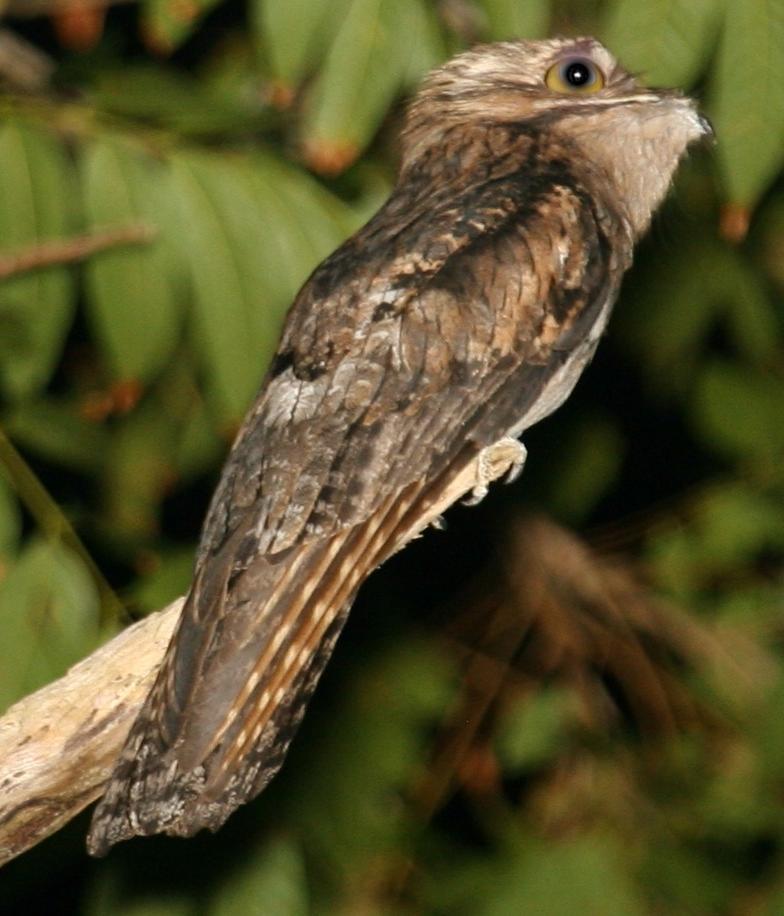
It has unusually large yellow eyes, a wide mouth and a tooth in its upper mandible. Two or three eyelid slits remain open and allow it to see while its eyelids are closed.[1][2][3]
The sexes have similar external appearances and cannot be distinguished by observation.[4]
Habitat
The Common Potoo breeds in open woodlands and savannahs. It occurs in gallery forests around the Uruguay-Brazil border.[5][6]
It generally avoids cooler montane environments and arid habitats. It is rarely observed above 1,900 metres above mean sea level.[7][8][9]
Diet
The Common Potoo is a nocturnal insectivore that captures flies and moths using its wide mouth. It also consumes ants, other hymenopterans, termites, grasshoppers, locusts and crickets, swallowing its prey whole.[10][11][12][13]
Behaviour
When disturbed, it adopts an upright posture with its beak pointing vertically and remains motionless. In response to human disturbance, it may also fly away or open its beak threateningly.[14][15]
The Common Potoo produces a squeaky sound when seized. Its song is melancholic and decreases in pitch and volume.[16][17]
Reproduction and life cycle
The Common Potoo is monogamous. It normally selects a branch stump as its nesting site and does not add nesting material, using a small depression in a tree limb as its nest.[18][19][20]
Nesting stumps are situated between 3 and 15 metres above the ground. The female lays a single white egg marked with lilac spots directly in a depression in a tree limb, and eggs are laid in December.[21][22][23]
Hatchlings have downy plumage with pale brown and white stripes. Their parents feed them by regurgitation.[24][25]
Juveniles begin exercising their wings at approximately 14 days of age. They leave the nest permanently approximately 25 days after hatching.[26][27]
Conservation
The Common Potoo is classified as Least Concern by the IUCN. Its estimated population is at least 500,000 mature individuals.[28][29]
The Common Potoo population is declining, probably because of habitat destruction.[30]
Similar species
The Common Potoo was formerly treated as the same species as the Northern Potoo.[31]
Classification of the Common Potoo
| Kingdom | Animalia |
|---|---|
| Phylum | Chordata |
| Subphylum | Vertebrata |
| Infraphylum | Gnathostomata |
| Parvphylum | Osteichthyes |
| Megaclass | Tetrapoda |
| Class | Aves (Bird) |
| Order | Nyctibiiformes (Potoo) |
| Family | Nyctibiidae (Potoo) |
| Genus | Nyctibius (Potoos) |
| Species | Nyctibius griseus (J. F. Gmelin, 1789) |
Where the Common Potoo is found
Checklists and occurrence records place Nyctibius griseus in 21 countries across North America and South America. GBIF holds 67,561 georeferenced records of it.
Countries
- Argentina 4,512
- Bolivia 869
- Brazil 15,079
- Colombia 16,546
- Costa Rica 7,065
- Ecuador 10,415
- El Salvador 6
- French Guiana 297
- Guatemala 17
- Guyana 496
- Honduras 14
- Jamaica 9
- Mexico 94
- Nicaragua 9
- Panama 3,670
- Paraguay 1,195
- Peru 4,061
- Suriname 247
- Trinidad and Tobago 1,984
- Uruguay 260
- Venezuela 716
Regions and cities with the most records
- Pichincha, Ecuador 5,710
- Valle del Cauca Department, Colombia 5,274
- São Paulo, Brazil 4,564
- Puntarenas Province, Costa Rica 4,163
- Cali, Colombia 2,115
- Misiones, Argentina 2,078
- Paraná, Brazil 1,952
- Puerto Iguazú, Argentina 1,939
- Caldas Department, Colombia 1,897
- Sucumbíos, Ecuador 1,838
- Guacarí, Colombia 1,759
- Guadalajara de Buga, Colombia 1,725
- Alcalde Díaz, Panama 1,705
- Villamaría, Colombia 1,705
- Manizales, Colombia 1,689
- Foz do Iguaçu, Brazil 1,684
- Darien, Colombia 1,657
- Presidente Franco, Paraguay 1,626
- Chinchiná, Colombia 1,598
- Neira, Colombia 1,570
- Madre de Dios, Peru 1,506
- Ciudad del Este, Paraguay 1,457
- Paradise, Trinidad and Tobago 1,434
- Arima, Trinidad and Tobago 1,424
- Tunapuna, Trinidad and Tobago 1,406
- Mato Grosso, Brazil 1,323
- Chilibre, Panama 1,320
- Loreto, Peru 1,298
- Meta Department, Colombia 1,272
- Antioquia, Colombia 1,232
- Jamundí, Colombia 1,226
- Panamá, Panama 1,222
- Yumbo, Colombia 1,150
- Panama City, Panama 1,146
- Alajuela Province, Costa Rica 1,125
- Santander Department, Colombia 1,106
Range as the checklists state it
Middle America
South America
A number beside a place is its count of GBIF occurrence records. A place without a number comes from a checklist alone. Records show where a species has been observed or collected, which can include escapes and vagrants.
Common names
English
- Common Potoo
Names in 27 other languages
- Arabic
- بوتو شائع
- Catalan
- nictibi comú
- Chinese
- 普通林鴟, 灰林鴟, 钩嘴夜鹰
- Croatian
- smeđokrili potu
- Czech
- potu obecný
- Danish
- Potu
- Dutch
- Grijze Reuzennachtzwaluw
- Esperanto
- griza niktibio
- Estonian
- hall-tüükasorr
- Finnish
- harmaapökkelökehrääjä
- French
- Ibijau gris
- German
- Klagetagschläfer, Urutau-Tagschläfer, Urutautagschläfer
- Hungarian
- közönséges álmosmadár
- Italian
- Nittibio comune
- Japanese
- ハイイロタチヨタカ
- Lithuanian
- pilkasis didlėlys
- Norwegian
- fløytepotu
- Polish
- nocolot szary
- Portuguese
- Mãe-da-lua, Urutau, nictíbio-comum, urutau-comum, urutágua
- Russian
- Серый исполинский козодой, Серый лесной козодой, Серый уратао
- Serbian
- Obični potu
- Slovak
- lelkovec urutau
- Spanish
- Bienparado común, Bienparado norteño, Guajojo, Nictibio Común, Nictibio urutaú, Pájaro Urutaú, Urutaú, Urutaú común
- Swedish
- gråpoto
- Turkish
- Bayağı Poto, Urutau Putusu
- Ukrainian
- поту малий
- Welsh
- potŵ cyffredin
Synonyms
One other scientific name has been used for this species and is now treated as a synonym of Nyctibius griseus.
- Caprimulgus griseus J. F. Gmelin, 1789
Subspecies and varieties
- Nyctibius griseus griseus subspecies
- Nyctibius griseus panamensis subspecies
Related species
-
 Great PotooNyctibius grandis
-
 Northern PotooNyctibius jamaicensis
-
 Long-tailed PotooNyctibius aethereus
-
 Andean PotooNyctibius maculosus
-
 White-winged PotooNyctibius leucopterus
- Rufous PotooPhyllaemulor bracteatus
Compare
Questions and answers
What is the scientific name of the Common Potoo?
The scientific name of the Common Potoo is Nyctibius griseus. Written with its author, the full name is Nyctibius griseus (J. F. Gmelin, 1789).
Which family does the Common Potoo belong to?
Nyctibius griseus belongs to the family Nyctibiidae, in the order Nyctibiiformes and the class Aves.
Where is the Common Potoo found?
Checklists and occurrence records place Nyctibius griseus in 21 countries, including Colombia, Brazil, Ecuador, Costa Rica, Argentina and Peru.
What is the conservation status of the Common Potoo?
The IUCN Red List category recorded for Nyctibius griseus is Least Concern (LC).
What is the call of the common potoo?
The Common Potoo has a melancholic song that decreases in pitch and volume. It also produces a squeaky sound when seized.[16][17]
What do potoo birds eat?
Common Potoos eat flies, moths, ants, other hymenopterans, termites, grasshoppers, locusts and crickets. They swallow their prey whole.[11][12][13]
Where do Common Potoos live?
The nominate subspecies occurs in Trinidad and Tobago and throughout mainland South America except Chile, where it has been recorded as a vagrant. The subspecies Nyctibius griseus panamensis occurs from eastern Nicaragua through Costa Rica and Panama to northwestern Peru, including parts of Venezuela, Colombia and Ecuador.[32][33]
Sources
Passages the profile rests on
- The Common Potoo has unusually large yellow eyes and a wide mouth. Source passage: “It is notable for its large, yellow eyes and a wide mouth.” — English Wikipedia
- The Common Potoo has two or three eyelid slits that remain open and allow it to see while its eyelids are closed. Source passage: “The potoo has two or three slits in the eyelid so that it can see when the eyelids are closed; these notches are always open.” — English Wikipedia
- The Common Potoo has an unusually wide mouth and a tooth in its upper mandible. Source passage: “The common potoo has an unusually wide mouth with a tooth in its upper mandible for foraging purposes.” — English Wikipedia
- The sexes have similar external appearances and cannot be distinguished by observation. Source passage: “The sexes appear similar, and cannot be distinguished upon observation.” — English Wikipedia
- The Common Potoo breeds in open woodlands and savannahs. Source passage: “The common potoo is a resident breeder in open woodlands and savannah.” — English Wikipedia
- The Common Potoo occurs in gallery forests around the Uruguay-Brazil border. Source passage: “It has many populations in the gallery forest-type environment around the Uruguayan-Brazilian border.” — English Wikipedia
- The Common Potoo generally avoids cooler montane environments. Source passage: “It avoids cooler montane regions” — English Wikipedia
- The Common Potoo is rarely observed above 1,900 metres above mean sea level. Source passage: “it is rarely observed over 1,900 m (6,200 ft) above mean sea level even in the hottest parts of its range.” — English Wikipedia
- The Common Potoo generally avoids arid habitats. Source passage: “It tends to avoid arid regions” — English Wikipedia
- The Common Potoo is a nocturnal insectivore. Source passage: “This nocturnal insectivore hunts from a perch like a shrike or flycatcher.” — English Wikipedia
- The Common Potoo captures flies and moths using its wide mouth. Source passage: “It uses its wide mouth to capture insects such as flies and moths” — English Wikipedia
- The Common Potoo also consumes ants, other hymenopterans, termites, grasshoppers, locusts, and crickets. Source passage: “but also ants, other hymenopterans, termites, grasshoppers, locusts, and crickets.” — English Wikipedia
- The Common Potoo swallows its prey whole. Source passage: “but swallows its prey whole.” — English Wikipedia
- When disturbed, the Common Potoo adopts an upright posture with its beak pointing vertically and remains motionless. Source passage: “This entails sticking its beak vertically up in the air, closing its eyelids (through which it can still see via slits), and remaining still.” — English Wikipedia
- The Common Potoo can respond to human disturbance by flying away, opening its beak threateningly, or remaining motionless. Source passage: “quickly flying away, intimidation via beak-opening, or remaining still even when being touched.” — English Wikipedia
- The Common Potoo produces a squeaky sound when seized. Source passage: “When seized, this bird produces a squeaky sound not unlike that of a crow.” — English Wikipedia
- The Common Potoo has a melancholic song that decreases in pitch and volume. Source passage: “It has a haunting melancholic song, a BO-OU, BO-ou, bo-ou, bo-ou, bo-ou, bo-ou, bo-ou, bo-ou dropping in both pitch and volume.” — English Wikipedia
- The Common Potoo normally selects a branch stump as its nesting site and does not add nesting material. Source passage: “It normally chooses a branch stump as a nest and adds no sort of decorative or insulative material.” — English Wikipedia
- The Common Potoo nests in a small depression in a tree limb. Source passage: “If breeding, the potoo chooses a stump with a small divot where an egg can be laid.” — English Wikipedia
- The Common Potoo is monogamous. Source passage: “Common potoos are monogamous.” — English Wikipedia
- The Common Potoo selects nesting stumps situated between 3 and 15 metres above the ground. Source passage: “The common potoo chooses a stump 3–15 m (10–50 ft) high to occupy.” — English Wikipedia
- The female Common Potoo lays a single white egg marked with lilac spots directly in a depression in a tree limb. Source passage: “After mating, the female lays a single white egg with lilac spots directly into the depression in a tree limb.” — English Wikipedia
- Common Potoos lay their eggs in December. Source passage: “Potoos lay their eggs in December” — English Wikipedia
- Common Potoo hatchlings have downy plumage with pale brown and white stripes. Source passage: “emerge as downy individuals with pale brown and white stripes.” — English Wikipedia
- Common Potoo parents feed their hatchlings by regurgitation. Source passage: “The hatchling is fed by regurgitation.” — English Wikipedia
- Common Potoo juveniles begin exercising their wings at approximately 14 days of age. Source passage: “Around 14 days old, the juvenile begins wing exercises” — English Wikipedia
- Common Potoo juveniles leave the nest permanently approximately 25 days after hatching. Source passage: “before departing for good about 25 days after hatching.” — English Wikipedia
- The Common Potoo is classified as Least Concern by the IUCN. Source passage: “The IUCN has assessed the common potoo as being of Least Concern.” — English Wikipedia
- The Common Potoo has an estimated population of at least 500,000 mature individuals. Source passage: “a population of at least 500,000 mature individuals.” — English Wikipedia
- The Common Potoo population is declining, probably because of habitat destruction. Source passage: “However, the population is declining, probably due to habitat destruction.” — English Wikipedia
- The Common Potoo was formerly treated as the same species as the Northern Potoo. Source passage: “The common potoo was formerly considered to be conspecific with the northern potoo (Nyctibius jamaicensis).” — English Wikipedia
- The nominate subspecies of the Common Potoo occurs in Trinidad and Tobago and throughout mainland South America except Chile, where it has been recorded as a vagrant. Source passage: “The nominate subspecies of the common potoo is found in Trinidad and Tobago and every mainland South American country except Chile, though it has been recorded in that country as a vagrant.” — English Wikipedia
- The subspecies Nyctibius griseus panamensis occurs from eastern Nicaragua through Costa Rica and Panama to northwestern Peru, including parts of Venezuela, Colombia, and Ecuador. Source passage: “N. g. panamensis is found from eastern Nicaragua south through Costa Rica and Panama and west of the Andes from northwestern Venezuela through Colombia and Ecuador into northwestern Peru.” — English Wikipedia
Data
- Catalogue of Life, 2026-10-16 XR cc by
- Global Biodiversity Information Facility CC BY 4.0
- Wikidata CC0
- GeoNames CC BY 4.0
- Wikimedia Commons per image; credit shown with each image
- Within the Catalogue of Life, this name comes from The Integrated Taxonomic Information System cc0
References
- Banks, R. C., R. W. McDiarmid, and A. L. Gardner. (1987). Checklist of Vertebrates of the United States, the U.S. Territories, and Canada. Resource Publication, No. 166.
- Gill, Frank, & and Minturn Wright. (2006). Birds of the World: Recommended English Names.
This species in other databases
Page built on 27 November 2026. See how the catalog is made and all sources and licences.
Cite this page
ScientificNames.org. (2026). Nyctibius griseus (Common Potoo). Retrieved November 27, 2026, from https://scientificnames.org/species/nyctibius-griseus
“Nyctibius griseus (Common Potoo).” ScientificNames.org, 2026, scientificnames.org/species/nyctibius-griseus. Accessed 27 Nov. 2026.
ScientificNames.org. “Nyctibius griseus (Common Potoo).” Accessed November 27, 2026. https://scientificnames.org/species/nyctibius-griseus.
@misc{scientificnames_nyctibius_griseus_common_potoo,
  author = {{ScientificNames.org}},
  title = {Nyctibius griseus (Common Potoo)},
  year = {2026},
  url = {https://scientificnames.org/species/nyctibius-griseus},
  note = {Accessed 2026-11-27}
}