Species · Birds
White-winged Potoo Nyctibius leucopterus
The scientific name of the White-winged Potoo is Nyctibius leucopterus. It is a species of bird in the family Nyctibiidae (potoo), order Nyctibiiformes. The name dates from 1821.
- Scientific name
- Nyctibius leucopterus (zu Wied-Neuwied, 1821)
- Common name
- White-winged Potoo
- Genus
- Nyctibius
- Family
- Nyctibiidae (Potoo)
- Order
- Nyctibiiformes
- Class
- Aves
- Red List category
- LC Least Concern
- Recorded in
- 7 countries
- Name status
- accepted in the Catalogue of Life

Overview
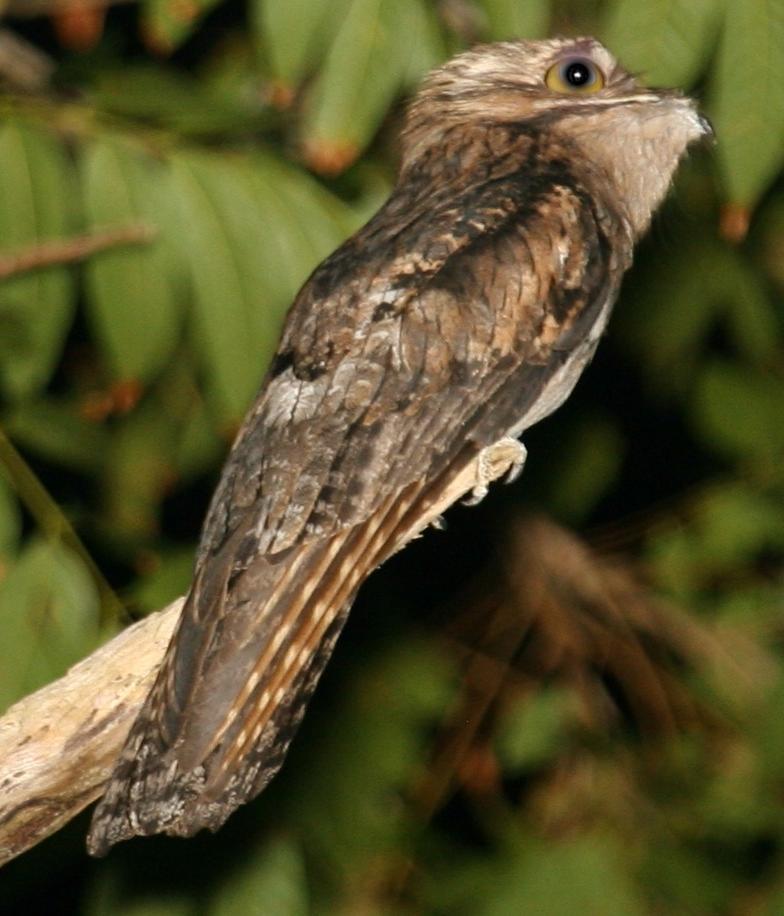
Nyctibius leucopterus occurs in Brazil, French Guiana, Guyana, Peru, Suriname, and Venezuela. It has a large white patch on its secondary wing coverts.
Written 26 November 2026 from the sources listed below. Each statement was checked against the passage it cites; statements that could not be supported were removed.
Appearance
Both forms have dark brown upperparts and lighter brown underparts with darker speckles. The species has a large white patch on its secondary wing coverts, which is a key identification feature.[1][2][3]
Habitat
The Amazonian form inhabits the canopy of mature terra firme rainforest and occurs in mature rainforest growing on white-sand soils. In the early 2000s, researchers recorded the species along the Amazon on poor, non-sandy soils between areas of white-sand forest.[4][5][6]
The eastern form is presumed to inhabit the canopy of Atlantic Forest. The species is probably common in the canopy of terra firme upland forest immediately north of Manaus.[7][8]
Behaviour
The White-winged Potoo is nocturnal, active only at night, uncommon, and rarely seen.[9][10]
The Amazonian form produces a gradually descending, pure-toned song described as haunting and melancholy. It also produces a soft call described as "bweep".[11][12][13]
Diet
The White-winged Potoo captures insect prey by sallying from an exposed perch.[14]
Reproduction and life cycle
The breeding phenology of the White-winged Potoo is unknown. It is presumed to lay a single egg on a high canopy branch.[15][16]
Similar species
The Andean Potoo was formerly classified as a subspecies of the White-winged Potoo. It differs in size, plumage, voice, and elevational distribution.[17][18]
The White-winged Potoo was considered monotypic as of 2021, although its Amazonian form was proposed as a possible separate species.[19]
Conservation
The White-winged Potoo is classified as Least Concern by the IUCN. It was most recently assessed for the IUCN Red List in 2024.[20][21]
The population of the White-winged Potoo is unknown and is thought to be decreasing. Continued destruction of pristine forest is identified as the greatest threat to the species in Amazonia.[22][23][24]
Classification of the White-winged Potoo
| Kingdom | Animalia |
|---|---|
| Phylum | Chordata |
| Subphylum | Vertebrata |
| Infraphylum | Gnathostomata |
| Parvphylum | Osteichthyes |
| Megaclass | Tetrapoda |
| Class | Aves (Bird) |
| Order | Nyctibiiformes (Potoo) |
| Family | Nyctibiidae (Potoo) |
| Genus | Nyctibius (Potoos) |
| Species | Nyctibius leucopterus (zu Wied-Neuwied, 1821) |
Where the White-winged Potoo is found
Checklists and occurrence records place Nyctibius leucopterus in 7 countries across South America. GBIF holds 962 georeferenced records of it.
Countries
Regions and cities with the most records
- Potaro-Siparuni, Guyana 328
- Amazonas, Brazil 199
- Bahia, Brazil 136
- Porto Seguro, Brazil 125
- Santa Cruz Cabrália, Brazil 125
- Novo Airão, Brazil 79
- Sipaliwini District, Suriname 72
- Pará, Brazil 42
- Presidente Figueiredo, Brazil 34
- Upper Takutu-Upper Essequibo, Guyana 34
- Espírito Santo, Brazil 26
- Rondônia, Brazil 21
- Sooretama, Brazil 20
- Loreto, Peru 10
- Kourou, French Guiana 8
- Oiapoque, Brazil 8
- Jaguaré, Brazil 7
- Bolívar, Venezuela 4
- Itacaré, Brazil 4
- Maraú, Brazil 4
- Una, Brazil 4
- Borba, Brazil 3
- Caquetá, Colombia 3
- Careiro, Brazil 3
- Upper Demerara-Berbice, Guyana 3
Range as the checklists state it
South America
A number beside a place is its count of GBIF occurrence records. A place without a number comes from a checklist alone. Records show where a species has been observed or collected, which can include escapes and vagrants.
Common names
English
- White-winged Potoo
Names in 27 other languages
- Arabic
- بوتو أبيض الجناحين
- Catalan
- nictibi alablanc
- Chinese
- 白翅林鴟, 白翅钩嘴夜鹰
- Croatian
- bjelokrili potu
- Czech
- potu bělokřídlý
- Danish
- Hvidvinget Potu
- Dutch
- Gevlekte Reuzennachtzwaluw, Witvleugelreuzennachtzwaluw
- Esperanto
- blankflugila niktibio
- Estonian
- valgetiib-tüükasorr
- Finnish
- valkopökkelökehrääjä
- French
- Ibijau à ailes blanches
- German
- Weißflügel-Tagschläfer, Weißflügeltagschläfer
- Hungarian
- fehérszárnyú álmosmadár
- Italian
- Nittibio alibianche
- Japanese
- ハジロタチヨタカ
- Lithuanian
- baltasparnis didlėlys
- Norwegian
- hvitvingepotu
- Polish
- nocolot białoskrzydły
- Portuguese
- nictíbio-d'asa-branca, urutau-de-asa-branca
- Russian
- Белокрылый исполинский козодой, Белокрылый лесной козодой, Белокрылый уратао
- Serbian
- Belokrili potu
- Slovak
- lelkovec bielokrídly
- Spanish
- Nictibio aliblanco, Nictibio de Ala Blanca, Urutaú aliblanco
- Swedish
- vitvingad poto
- Turkish
- Ak Kanatlı Putu, Akkanat Poto
- Ukrainian
- поту білокрилий
- Welsh
- potŵ adeinwyn
Synonyms
3 other scientific names have been used for this species and are now treated as synonyms of Nyctibius leucopterus.
- Caprimulgus leucopterus Wied, 1821
- Caprimulgus leucopterus zu Wied-Neuwied, 1821
- Nyctibius leucopterus leucopterus Wied-Neuwied, M, 1821
Related species
-
 Great PotooNyctibius grandis
-
 Common PotooNyctibius griseus
-
 Northern PotooNyctibius jamaicensis
-
 Long-tailed PotooNyctibius aethereus
-
 Andean PotooNyctibius maculosus
- Rufous PotooPhyllaemulor bracteatus
Compare
Questions and answers
What is the scientific name of the White-winged Potoo?
The scientific name of the White-winged Potoo is Nyctibius leucopterus. Written with its author, the full name is Nyctibius leucopterus (zu Wied-Neuwied, 1821).
Which family does the White-winged Potoo belong to?
Nyctibius leucopterus belongs to the family Nyctibiidae, in the order Nyctibiiformes and the class Aves.
Where is the White-winged Potoo found?
Checklists and occurrence records place Nyctibius leucopterus in 7 countries, including Brazil, Guyana, Suriname, French Guiana, Peru and Venezuela.
What is the conservation status of the White-winged Potoo?
The IUCN Red List category recorded for Nyctibius leucopterus is Least Concern (LC).
How rare is a potoo?
The White-winged Potoo is uncommon and rarely seen. Its population is unknown.[22][10]
What does the potoo bird eat?
The White-winged Potoo eats insect prey, which it captures by sallying from an exposed perch.[14]
Where does a potoo bird live?
The White-winged Potoo occurs in Brazil, French Guiana, Guyana, Peru, Suriname, and Venezuela.[25]
Sources
Passages the profile rests on
- Both forms have dark brown upperparts and lighter brown underparts with darker speckles. Source passage: “Both forms are dark brown above and lighter brown below, and both parts have darker speckles.” — English Wikipedia
- The species has a large white patch on its secondary wing coverts. Source passage: “The large white patch on the secondary wing coverts give the species its name.” — English Wikipedia
- Large white patches on the wings are a key identification feature of the White-winged Potoo. Source passage: “large white wing patches are key to ...” — ebird.org
- The Amazonian form inhabits the canopy of mature terra firme rainforest. Source passage: “There it inhabits the canopy of mature terra firme rainforest” — English Wikipedia
- The Amazonian form occurs in mature rainforest growing on white-sand soils. Source passage: “including forest on white-sand soils.” — English Wikipedia
- In the early 2000s, researchers recorded the species along the Amazon on poor, non-sandy soils between areas of white-sand forest. Source passage: “In the early 2000s researchers made several sightings along the Amazon on poor but non-sandy soils between areas of white-sand forest.” — English Wikipedia
- The eastern form is presumed to inhabit the canopy of Atlantic Forest. Source passage: “It is not well known but is assumed to inhabit the canopy of the Atlantic Forest.” — English Wikipedia
- The White-winged Potoo is probably common in the canopy of terra firme upland forest immediately north of Manaus. Source passage: “Nyctibius leucopterus is probably common in the can opy of terra firme (upland) forest immediately north of Manaus.” — digitalcommons.usf.edu
- The White-winged Potoo is nocturnal. Source passage: “The white-winged potoo is nocturnal.” — English Wikipedia
- The White-winged Potoo is uncommon and rarely seen, and it is active only at night. Source passage: “Uncommon, rarely seen potoo, active only at night.” — ebird.org
- The Amazonian form produces a gradually descending, pure-toned song. Source passage: “The song of the Amazonian form of white-winged potoo is "a gradually descending, pure-toned 'feeeoooooo'"” — English Wikipedia
- The Amazonian form's song has been described as haunting and melancholy. Source passage: “described as haunting and melancholy.” — English Wikipedia
- The Amazonian form also produces a soft call described as "bweep". Source passage: “It also makes a soft "bweep" call.” — English Wikipedia
- The White-winged Potoo captures insect prey by sallying from an exposed perch. Source passage: “It captures its insect prey by sallying from an exposed perch.” — English Wikipedia
- The breeding phenology of the White-winged Potoo is unknown. Source passage: “The white-winged potoo's breeding phenology is unknown.” — English Wikipedia
- The White-winged Potoo is presumed to lay a single egg on a high canopy branch. Source passage: “It is assumed to lay one egg on a branch high in the canopy in a manner similar to that of other potoos.” — English Wikipedia
- The Andean Potoo was formerly classified as a subspecies of the White-winged Potoo. Source passage: “For a time the Andean potoo (Nyctibius maculosus) was considered a subspecies of the white-winged potoo” — English Wikipedia
- The Andean Potoo differs from the White-winged Potoo in size, plumage, voice, and elevational distribution. Source passage: “but size, plumage, voice, and elevational distribution differentiate them.” — English Wikipedia
- The White-winged Potoo was considered monotypic as of 2021, although its Amazonian form was proposed as a possible separate species. Source passage: “The white-winged potoo is (as of 2021) considered to be monotypic, but the Amazonian form might be a species in its own right.” — English Wikipedia
- The White-winged Potoo is classified as Least Concern by the IUCN. Source passage: “The IUCN has assessed the white-winged potoo as being of Least Concern” — English Wikipedia
- The White-winged Potoo was most recently assessed for the IUCN Red List in 2024. Source passage: “White-winged Potoo Nyctibius leucopterus has most recently been assessed for The IUCN Red List of Threatened Species in 2024.” — iucnredlist.org
- The population of the White-winged Potoo is unknown. Source passage: “though its population is unknown” — English Wikipedia
- The White-winged Potoo population is thought to be decreasing. Source passage: “and thought to be decreasing.” — English Wikipedia
- Continued destruction of pristine forest is identified as the greatest threat to the species in Amazonia. Source passage: “In Amazonia, "the biggest threat comes from continued destruction of pristine forest."” — English Wikipedia
- The White-winged Potoo occurs in Brazil, French Guiana, Guyana, Peru, Suriname, and Venezuela. Source passage: “It is found in Brazil, French Guiana, Guyana, Peru, Suriname, and Venezuela.” — English Wikipedia
Data
- Catalogue of Life, 2026-10-16 XR cc by
- Global Biodiversity Information Facility CC BY 4.0
- Wikidata CC0
- GeoNames CC BY 4.0
- Wikimedia Commons per image; credit shown with each image
- Within the Catalogue of Life, this name comes from The Integrated Taxonomic Information System cc0
References
- Gill, Frank, & and Minturn Wright. (2006). Birds of the World: Recommended English Names.
This species in other databases
Page built on 27 November 2026. See how the catalog is made and all sources and licences.
Cite this page
ScientificNames.org. (2026). Nyctibius leucopterus (White-winged Potoo). Retrieved November 27, 2026, from https://scientificnames.org/species/nyctibius-leucopterus
“Nyctibius leucopterus (White-winged Potoo).” ScientificNames.org, 2026, scientificnames.org/species/nyctibius-leucopterus. Accessed 27 Nov. 2026.
ScientificNames.org. “Nyctibius leucopterus (White-winged Potoo).” Accessed November 27, 2026. https://scientificnames.org/species/nyctibius-leucopterus.
@misc{scientificnames_nyctibius_leucopterus_white_winged_potoo,
  author = {{ScientificNames.org}},
  title = {Nyctibius leucopterus (White-winged Potoo)},
  year = {2026},
  url = {https://scientificnames.org/species/nyctibius-leucopterus},
  note = {Accessed 2026-11-27}
}