Species · Amphibians
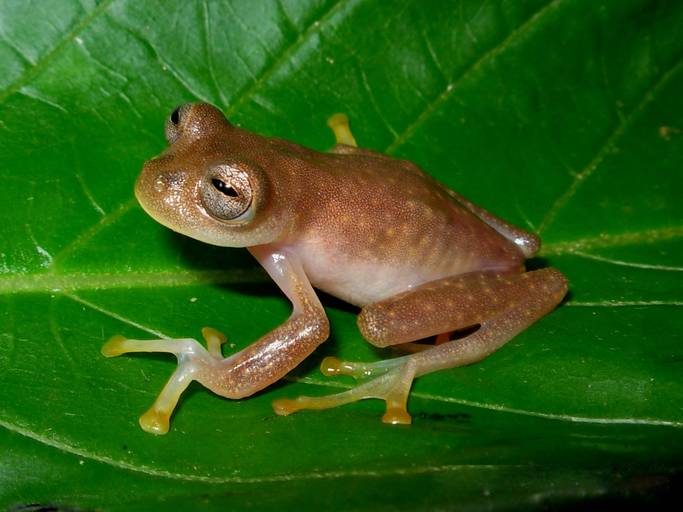
Peru Cochran Frog Nymphargus chancas
The scientific name of the Peru Cochran Frog is Nymphargus chancas. It is a species of amphibian in the family Centrolenidae (glass frog), order Anura. The name dates from 1993.
- Scientific name
- Nymphargus chancas (Duellman & Schulte, 1993)
- Common name
- Peru Cochran Frog
- Genus
- Nymphargus
- Family
- Centrolenidae (Glass Frog)
- Order
- Anura
- Class
- Amphibia
- Red List category
- EN Endangered
- Recorded in
- 1 country
- Name status
- accepted in the Catalogue of Life
Overview
Nymphargus chancas inhabits montane cloud forests near streams at elevations of 1,003–1,430 m above sea level. It has distinct yellow dorsal flecks and can change its coloration rapidly.
Written 27 November 2026 from the sources listed below. Each statement was checked against the passage it cites; statements that could not be supported were removed.
Appearance
The toes are approximately two-thirds webbed. Adult males measure 25–26 mm in snout–vent length.[1][2]
The dorsal coloration ranges from dull yellow green to orange yellow or olive gray, with distinct yellow flecks that can sometimes be large and bright. Individuals can change their coloration rapidly, and some have prominent dorsal ocellations that may fade after capture.[3][4][5][6]
The iris can be pale yellowish-bronze or silvery-white with a faint yellow suffusion.[7]
Habitat
The Peru Cochran Frog inhabits montane cloud forests near streams. Its recorded elevational range is 1,003–1,430 m above sea level.[8][9]
Conservation
The Peru Cochran Frog is classified as Endangered. The Cordillera del Cóndor population is threatened by habitat destruction and pollution associated with mining.[10][11]
Similar species
The species was initially known only from its type locality in Lamas Province, Peru. Its known distribution includes the northern San Martín Region of Peru and extends into the Cordillera del Cóndor in Zamora-Chinchipe Province, Ecuador.[12][13][14]
Classification of the Peru Cochran Frog
| Kingdom | Animalia |
|---|---|
| Phylum | Chordata |
| Subphylum | Vertebrata |
| Infraphylum | Gnathostomata |
| Parvphylum | Osteichthyes |
| Megaclass | Tetrapoda |
| Class | Amphibia (Amphibians) |
| Order | Anura (Frogs) |
| Family | Centrolenidae (Glass Frog) |
| Subfamily | Centroleninae |
| Genus | Nymphargus (Cochran Frogs) |
| Species | Nymphargus chancas (Duellman & Schulte, 1993) |
Where the Peru Cochran Frog is found
Checklists and occurrence records place Nymphargus chancas in 1 country. GBIF holds 3 georeferenced records of it.
Countries
A number beside a place is its count of GBIF occurrence records. A place without a number comes from a checklist alone. Records show where a species has been observed or collected, which can include escapes and vagrants.
Common names
English
- Peru Cochran Frog
Names in 2 other languages
- Czech
- rosněnka peruánská
- Spanish
- Rana de Cristal del Perú
Synonyms
One other scientific name has been used for this species and is now treated as a synonym of Nymphargus chancas.
- Cochranella chancas Duellman & Schulte, 1993
Related species
- Dajomes GlassfrogNymphargus dajomesae
- Bolivian Cochran FrogNymphargus bejaranoi
-
 Cochran FrogNymphargus rosada
-
 Red-spotted GlassfrogNymphargus grandisonae
-
 Napo Cochran FrogNymphargus anomalus
- Trueb's Cochran FrogNymphargus truebae
- Siren GlassfrogNymphargus siren
-
 Pepper GlassfrogNymphargus griffithsi
Compare
Questions and answers
What is the scientific name of the Peru Cochran Frog?
The scientific name of the Peru Cochran Frog is Nymphargus chancas. Written with its author, the full name is Nymphargus chancas (Duellman & Schulte, 1993).
Which family does the Peru Cochran Frog belong to?
Nymphargus chancas belongs to the family Centrolenidae, in the order Anura and the class Amphibia.
Where is the Peru Cochran Frog found?
Checklists and occurrence records place Nymphargus chancas in 1 country: Peru.
What is the conservation status of the Peru Cochran Frog?
The IUCN Red List category recorded for Nymphargus chancas is Endangered (EN).
Sources
Passages the profile rests on
- The toes are approximately two-thirds webbed. Source passage: “The toes are two-thirds webbed.” — English Wikipedia
- Adult males measure 25–26 mm in snout–vent length. Source passage: “Adult males measure 25–26 mm (1.0–1.0 in) in snout–vent length;” — English Wikipedia
- The dorsal coloration ranges from dull yellow green to orange yellow or olive gray. Source passage: “Dorsal coloration varies from dull yellow green to orange yellow or olive gray.” — English Wikipedia
- The dorsum has distinct yellow flecks that can sometimes be large and bright. Source passage: “There are distinct yellow flecks on the dorsum, which can occasionally belarge and bright.” — English Wikipedia
- Individuals can change their coloration rapidly. Source passage: “However, individuals can change their color rapidly.” — English Wikipedia
- Some individuals have prominent dorsal ocellations that may fade after capture. Source passage: “One specimen had prominent occellations that faded after capture.” — English Wikipedia
- The iris can be pale yellowish-bronze or silvery-white with a faint yellow suffusion. Source passage: “The iris can be pale yellowish-bronze, or silvery-white with a faint yellow suffusion.” — English Wikipedia
- This species inhabits montane cloud forests near streams. Source passage: “Nymphargus chancas is an arboreal frog found in montane cloud forests near streams.” — English Wikipedia
- Its recorded elevational range is 1,003–1,430 m above sea level. Source passage: “Its elevational range is 1,003–1,430 m (3,291–4,692 ft) above sea level.” — English Wikipedia
- The conservation status of this species is Endangered. Source passage: “Its conservation status is Endangered.” — English Wikipedia
- The Cordillera del Cóndor population is threatened by habitat destruction and pollution associated with mining. Source passage: “The Cordillera del Cóndor population is threatened by habitat destruction and pollution associated with mining.” — English Wikipedia
- The species was initially known only from its type locality in Lamas Province, Peru. Source passage: “Until recently it was only known from its type locality in the Lamas Province in Peru;” — English Wikipedia
- Its known distribution includes the northern San Martín Region of Peru. Source passage: “it is now known to occur more widely in the northern San Martín Region of Peru,” — English Wikipedia
- Its distribution extends into the Cordillera del Cóndor in Zamora-Chinchipe Province, Ecuador. Source passage: “extending into the Cordillera del Cóndor in Zamora-Chinchipe Province, Ecuador.” — English Wikipedia
Data
- Catalogue of Life, 2026-10-16 XR cc by
- Global Biodiversity Information Facility CC BY 4.0
- Wikidata CC0
- GeoNames CC BY 4.0
- Within the Catalogue of Life, this name comes from The Integrated Taxonomic Information System cc0
This species in other databases
Page built on 29 November 2026. See how the catalog is made and all sources and licences.
Cite this page
ScientificNames.org. (2026). Nymphargus chancas (Peru Cochran Frog). Retrieved November 29, 2026, from https://scientificnames.org/species/nymphargus-chancas
“Nymphargus chancas (Peru Cochran Frog).” ScientificNames.org, 2026, scientificnames.org/species/nymphargus-chancas. Accessed 29 Nov. 2026.
ScientificNames.org. “Nymphargus chancas (Peru Cochran Frog).” Accessed November 29, 2026. https://scientificnames.org/species/nymphargus-chancas.
@misc{scientificnames_nymphargus_chancas_peru_cochran_frog,
  author = {{ScientificNames.org}},
  title = {Nymphargus chancas (Peru Cochran Frog)},
  year = {2026},
  url = {https://scientificnames.org/species/nymphargus-chancas},
  note = {Accessed 2026-11-29}
}