Species · Birds
Indian Grey Hornbill Ocyceros birostris
The scientific name of the Indian Grey Hornbill is Ocyceros birostris. It is a species of bird in the family Bucerotidae (hornbill), order Bucerotiformes. The name dates from 1786.
- Scientific name
- Ocyceros birostris (Scopoli, 1786)
- Common name
- Indian Grey Hornbill
- Genus
- Ocyceros
- Family
- Bucerotidae (Hornbill)
- Order
- Bucerotiformes
- Class
- Aves
- Red List category
- LC Least Concern
- Recorded in
- 3 countries
- Name status
- accepted in the Catalogue of Life

Overview
Ocyceros birostris occurs on the Indian subcontinent, from the Himalayan foothills southwards, with the Indus system forming its western boundary and the Ganges Delta its eastern boundary. It has a short, pointed casque, and males have larger casques than females.
Written 26 November 2026 from the sources listed below. Each statement was checked against the passage it cites; statements that could not be supported were removed.
Appearance
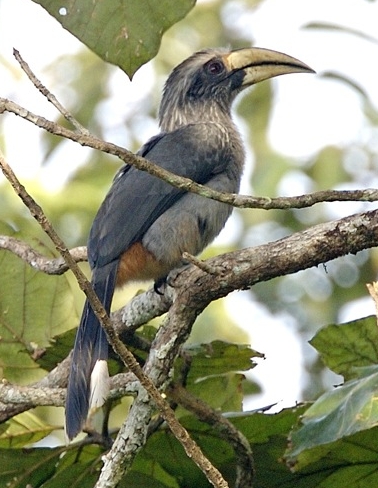
The Indian Grey Hornbill has grey feathers across its body, greyish-brown upperparts, and a light grey or dull white belly. It has a faint pale supercilium, a pale brow, and darker ear coverts.[1][2][3][4]
Its dark brown wing flight feathers have whitish tips, and its tail has a white tip and a dark subterminal band. The species has a red iris and eyelashes on its eyelids.[5][6][7]
The species has a short, pointed casque. Males have larger casques than females, a yellowish culmen and lower mandible, and dark bare skin around the eye.[8][9][10][11]
Females sometimes have pale reddish bare skin around the eye. Their bill is more yellowish, with black coloration on its basal half and casque.[12][13]
Juveniles lack a casque and have dull orange bare skin around the eye.[14]
The Indian Grey Hornbill measures approximately 61 cm in length.[15]
Habitat
The Indian Grey Hornbill inhabits urban areas where large trees are available along avenues. It occurs in cities that retain old avenue trees and is found mainly in plains at elevations up to approximately 610 metres.[16][17][18]
The species occurs on the Indian subcontinent. Its range extends from the Himalayan foothills southwards, with the Indus system forming its western boundary and the Ganges Delta its eastern boundary.[19][20]
The species may undertake local movements in the drier western parts of its range. It has been observed in Dharamsala, Himachal Pradesh, at elevations of approximately 1,500–1,600 metres during May to September.[21][22]
Diet
The Indian Grey Hornbill feeds on fruits of Streblus asper, Cansjera rheedii, Carissa carandas, Grewia tiliaefolia, Lannea coromandelica, Ficus species, Sterculia urens, Securinega leucopyrus, and Thevetia peruviana.[23][24]
Its diet also includes molluscs, scorpions, and insects. The species sometimes eats small birds and also consumes reptiles.[25][26][27]
Behaviour
The Indian Grey Hornbill is mostly arboreal and is commonly observed in pairs. It also occurs in small groups.[28][29]
Its call is a squealing sound resembling that of a black kite. Its flight consists of heavy flapping interspersed with gliding.[30][31]
The species occasionally descends to the ground to collect fallen fruits, dust-bathe, or gather mud pellets for nesting. Its social activities include bill-grappling and aerial jousting.[32][33]
Reproduction and life cycle
The nesting season extends from April through June. Clutches contain between one and five symmetrical white eggs.[34][35]
The species usually nests in hollows of tall trees. Existing nest hollows may be enlarged by excavation.[36][37]
The female seals the nest entrance using excreta and mud pellets supplied by the male, leaving a narrow vertical slit through which he feeds her.[38][39]
The female moults her flight feathers and incubates the eggs inside the nest. The male supplies bark pieces to help remove nest excreta and maintain the nest cavity's microclimate.[40][41]
The female's flight feathers regrow around the time the chicks mature, when the nest is opened.[42]
Conservation
The reintroduced population of Indian Grey Hornbills in Gujarat's Gir forests achieved four consecutive years of successful breeding after disappearing from the area for more than 60 years.[43]
Similar species
The Indian Grey Hornbill has limited range overlap with the Malabar Grey Hornbill of the Western Ghats.[44]
Classification of the Indian Grey Hornbill
| Kingdom | Animalia |
|---|---|
| Phylum | Chordata |
| Subphylum | Vertebrata |
| Infraphylum | Gnathostomata |
| Parvphylum | Osteichthyes |
| Megaclass | Tetrapoda |
| Class | Aves (Bird) |
| Order | Bucerotiformes (Hoopoes) |
| Family | Bucerotidae (Hornbill) |
| Genus | Ocyceros (Asian Gray Hornbills) |
| Species | Ocyceros birostris (Scopoli, 1786) |
Where the Indian Grey Hornbill is found
Checklists and occurrence records place Ocyceros birostris in 3 countries across Asia. GBIF holds 198,410 georeferenced records of it.
Countries
Regions and cities with the most records
- Maharashtra, India 33,737
- Madhya Pradesh, India 33,522
- Karnataka, India 30,134
- Uttarakhand, India 27,914
- Clement Town, India 15,800
- Dehradun, India 15,417
- Rāipur, India 15,365
- Uttar Pradesh, India 11,825
- Pune, India 11,172
- Khadki, India 10,957
- Kharakvasla, India 10,857
- Pimpri-Chinchwad, India 10,728
- Pimpri, India 10,723
- Mysuru, India 10,570
- Hinakallu, India 10,076
- Hutagalli, India 10,073
- Baihar, India 9,821
- Rajasthan, India 9,338
- Malajkhand, India 9,148
- Rijokri, India 8,936
- Sultan Pur, India 8,842
- Mussoorie, India 8,660
- Malakpur Kohi Rangpur, India 8,639
- Aya Nagar, India 8,572
- Kusum Pur, India 8,551
- Saiyad-ul-ajaib, India 8,532
- Delhi Cantonment, India 8,433
- Neb Sarai, India 8,396
- Chhatarpur, India 8,369
- New Delhi, India 8,325
- Shrīrangapattana, India 8,280
- Pul Pehlad, India 8,198
- Tighri, India 8,189
- Chilla Soroda Bāngar, India 8,118
- Dalūpura, India 8,113
- Deoli, India 8,090
Range as the checklists state it
Southern Asia
A number beside a place is its count of GBIF occurrence records. A place without a number comes from a checklist alone. Records show where a species has been observed or collected, which can include escapes and vagrants.
Common names
English
- Indian Grey Hornbill
- Indian Gray Hornbill
- Indian Grey-Hornbill
Names in 31 other languages
- Arabic
- أبو قرن رمادي هندي
- Catalan
- calau gris de l'Índia
- Chinese
- 印度灰犀鳥, 彎嘴灰犀鳥, 灰犀鸟
- Croatian
- indijski kljunorožac
- Czech
- zoborožec klínoocasý
- Danish
- Indisk Gråtoko
- Dutch
- Wigstaarttok
- Esperanto
- hindia bucero
- Estonian
- hõbe-sarvnokk
- Finnish
- intiantoko
- French
- Calao de Gingi
- German
- Indienhornvogel, Indischer Grautoko, Keilschwanztoko
- Hungarian
- indiai szürketokó
- Italian
- Bucero grigio indiano
- Japanese
- インドコサイチョウ
- Kannada
- ಬೂದು ಮಂಗಟ್ಟೆ
- Lithuanian
- indinis tokas
- Malayalam
- നാട്ടുവേഴാമ്പൽ
- Marathi
- राखी शिंगचोचा
- Norwegian
- indiahornfugl
- Polish
- dzioborożec indyjski
- Portuguese
- calau-cinzento-indiano, calau-indiano
- Punjabi
- ਧਨੇਸ਼, ਧਾਨ ਚਿੜਾ
- Russian
- Индийский серый ток
- Serbian
- Indijski sivi kljunorožac
- Slovak
- zobákorožec rohatý
- Spanish
- Cálao gris indio
- Swedish
- indisk näshornsfågel
- Tamil
- சாம்பல் இருவாச்சி
- Turkish
- Hint Gri Boynuzgagası
- Ukrainian
- токо індійський
Synonyms
3 other scientific names have been used for this species and are now treated as synonyms of Ocyceros birostris.
- Buceros birostris Scopoli, 1786
- Tockus birostris Scopoli, GA, 1786
- Tockus birostris pergriseus Koelz, WN, 1939
Related species
-
 Malabar Grey HornbillOcyceros griseus
-
 Sri Lanka Grey HornbillOcyceros gingalensis
-
 Great HornbillBuceros bicornis
-
 Rhinoceros HornbillBuceros rhinoceros
-
 Helmeted HornbillRhinoplax vigil
-
 Oriental Pied HornbillAnthracoceros albirostris
-
 Rufous HornbillBuceros hydrocorax
-
 Southern Red-billed HornbillTockus rufirostris
Compare
Questions and answers
What is the scientific name of the Indian Grey Hornbill?
The scientific name of the Indian Grey Hornbill is Ocyceros birostris. Written with its author, the full name is Ocyceros birostris (Scopoli, 1786).
Which family does the Indian Grey Hornbill belong to?
Ocyceros birostris belongs to the family Bucerotidae, in the order Bucerotiformes and the class Aves.
Where is the Indian Grey Hornbill found?
Checklists and occurrence records place Ocyceros birostris in 3 countries: India, Nepal and Pakistan.
What is the conservation status of the Indian Grey Hornbill?
The IUCN Red List category recorded for Ocyceros birostris is Least Concern (LC).
What other names does the Indian Grey Hornbill have?
Ocyceros birostris is also known in English as Indian Gray Hornbill and Indian Grey-Hornbill.
What is the difference between male and female Indian grey hornbills?
Males have larger casques than females, a yellowish culmen and lower mandible, and dark bare skin around the eye. Females sometimes have pale reddish bare skin around the eye and have a more yellowish bill with black coloration on its basal half and casque.[9][10][11][12][13]
What does a grey hornbill eat?
The Indian Grey Hornbill eats fruits of several plant species, including Streblus asper, Cansjera rheedii, Carissa carandas, Ficus species, and Thevetia peruviana. Its diet also includes molluscs, scorpions, insects, small birds, and reptiles.[23][25][26][27][24]
What do hornbills like to eat?
The Indian Grey Hornbill feeds on fruits of Streblus asper, Cansjera rheedii, Carissa carandas, Grewia tiliaefolia, Lannea coromandelica, Ficus species, Sterculia urens, Securinega leucopyrus, and Thevetia peruviana. It also eats molluscs, scorpions, insects, small birds, and reptiles.[23][25][26][27][24]
Sources
Passages the profile rests on
- The Indian Grey Hornbill has grey feathers across its body and a light grey or dull white belly. Source passage: “It has grey feathers all over the body with a light grey or dull white belly.” — English Wikipedia
- The species has greyish-brown upperparts and a faint pale supercilium. Source passage: “The upper parts are greyish brown and there is a slight trace of a pale supercilium.” — English Wikipedia
- Its ear coverts are darker than the surrounding plumage. Source passage: “The ear coverts are darker.” — English Wikipedia
- The species has a pale brow, a visible casque, and a black-and-yellow bill. Source passage: “A small, grayish-brown hornbill with a pale brow, an obvious casque above the bill (larger in males), and a dual-toned black-and-yellow bill.” — ebird.org
- Its dark brown wing flight feathers have whitish tips. Source passage: “The flight feathers of the wing are dark brown with a whitish tip.” — English Wikipedia
- Its tail has a white tip and a dark subterminal band. Source passage: “The tail has a white tip and a dark subterminal band.” — English Wikipedia
- The species has a red iris and eyelashes on its eyelids. Source passage: “They have a red iris and the eyelids have eyelashes.” — English Wikipedia
- Its casque is short and pointed. Source passage: “The casque is short and pointed.” — English Wikipedia
- Male Indian Grey Hornbills have larger casques than females. Source passage: “The male has a larger casque on a dark bill” — English Wikipedia
- The male has a yellowish culmen and lower mandible. Source passage: “the culmen and lower mandible are yellowish.” — English Wikipedia
- The bare skin around the male's eye is dark. Source passage: “The bare skin around the eye is dark in the male” — English Wikipedia
- Females sometimes have pale reddish bare skin around the eye. Source passage: “but sometimes pale reddish in females.” — English Wikipedia
- Females have a more yellowish bill with black coloration on its basal half and casque. Source passage: “The female has a more yellowish bill with black on the basal half and on the casque.” — English Wikipedia
- Juveniles lack a casque and have dull orange bare skin around the eye. Source passage: “The juveniles lack the casque, and the bare skin around the eye is dull orange.” — English Wikipedia
- The Indian Grey Hornbill measures approximately 61 cm in length. Source passage: “The Indian grey hornbill is a medium-sized hornbill, measuring around 61 cm (24 in) in length.” — English Wikipedia
- The species inhabits urban areas where large trees are available along avenues. Source passage: “It is one of the few hornbill species found in urban areas in many cities where they are able to make use of large trees in avenues.” — English Wikipedia
- The species is found mainly in plains at elevations up to approximately 610 metres. Source passage: “The species is found mainly on the plains up to about 2,000 ft (610 m).” — English Wikipedia
- The species occurs in cities that retain old avenue trees. Source passage: “It is found even in cities that have old avenue trees.” — English Wikipedia
- The species occurs on the Indian subcontinent. Source passage: “The Indian gray hornbill (Ocyceros birostris) is a common hornbill found on the Indian subcontinent.” — English Wikipedia
- Its range extends from the Himalayan foothills southwards, with the Indus system forming its western boundary and the Ganges Delta its eastern boundary. Source passage: “It is found from the foothills of the Himalayas southwards, bounded to the west by the Indus system and to the east by the Ganges Delta.” — English Wikipedia
- The species may undertake local movements in the drier western parts of its range. Source passage: “It may make local movements in the drier western region.” — English Wikipedia
- The species has been observed in Dharamsala, Himachal Pradesh, at elevations of approximately 1,500–1,600 metres during May to September. Source passage: “The species has been observed, usually in pairs, in Dharamsala town (Himachal Pradesh) at about 1500 to 1600 masl during summer and in the rainy season (May to September, 2017).” — English Wikipedia
- The species feeds on fruits of Streblus asper, Cansjera rheedii, Carissa carandas, Grewia tiliaefolia, Lannea coromandelica, Ficus species, Sterculia urens, and Securinega leucopyrus. Source passage: “Streblus asper, Cansjera rheedii, Carissa carandas, Grewia tiliaefolia, Lannea coromandelica, Ficus spp., Sterculia urens and Securinega leucopyrus.” — English Wikipedia
- The Indian Grey Hornbill feeds on fruits of Thevetia peruviana. Source passage: “They are known to feed on the fruits of Thevetia peruviana” — English Wikipedia
- Its diet includes molluscs, scorpions, and insects. Source passage: “They are also known to take molluscs, scorpions, insects,” — English Wikipedia
- The species sometimes eats small birds. Source passage: “small birds (they have been recorded removing and possibly preying on rose-ringed parakeet chicks)” — English Wikipedia
- The species also consumes reptiles. Source passage: “and reptiles in their diet” — English Wikipedia
- The species is mostly arboreal and is commonly observed in pairs. Source passage: “It is mostly arboreal and is commonly sighted in pairs.” — English Wikipedia
- The species occurs in pairs or small groups. Source passage: “They are found in pairs or small groups.” — English Wikipedia
- Its call is a squealing sound resembling that of a black kite. Source passage: “The call is a squealing call somewhat like that of a black kite.” — English Wikipedia
- Its flight consists of heavy flapping interspersed with gliding. Source passage: “The flight is heavy and involves flapping interspersed with glides.” — English Wikipedia
- The species occasionally descends to the ground to collect fallen fruits, dust-bathe, or gather mud pellets for nesting. Source passage: “very rarely descend to the ground to pick up fallen fruits, to dust bathe, or to pick up mud pellets to seal the nest cavity during the nesting period.” — English Wikipedia
- The species engages in social activities including bill-grappling and aerial jousting. Source passage: “They indulge in various social activities, including bill-grappling and aerial jousting.” — English Wikipedia
- The nesting season extends from April through June. Source passage: “The nesting season is April to June” — English Wikipedia
- Clutches contain between one and five symmetrical white eggs. Source passage: “the clutch varies from one to five very symmetrical white eggs.” — English Wikipedia
- The species usually nests in hollows of tall trees. Source passage: “Indian grey hornbills usually nest in tree hollows on tall trees.” — English Wikipedia
- Existing nest hollows may be enlarged by excavation. Source passage: “An existing hollow may be excavated further to suit.” — English Wikipedia
- The female seals the nest entrance, leaving a narrow vertical slit through which the male feeds her. Source passage: “The female enters the nest hollow and seals the nest hole, leaving only a small vertical slit through which the male feeds her.” — English Wikipedia
- The female seals the nest entrance using excreta and mud pellets supplied by the male. Source passage: “The nest entrance is sealed by the female using its excreta and mud-pellets supplied by the male.” — English Wikipedia
- The female moults her flight feathers and incubates the eggs while inside the nest. Source passage: “While inside the nest, the female moults her flight feathers and incubates the eggs.” — English Wikipedia
- The male supplies bark pieces to help remove nest excreta and maintain the nest cavity's microclimate. Source passage: “The male provides the nest inmates with a steady supply of bark pieces to ensure that the excreta is removed from the nest by absorption and adsorption and to help maintain the micro-climate within the nest cavity.” — English Wikipedia
- The female's flight feathers regrow around the time the chicks mature, when the nest is opened. Source passage: “The regrowth of the female's feathers coincides with the maturity of the chicks, at which point the nest is broken open.” — English Wikipedia
- The reintroduced population of Indian Grey Hornbills in Gujarat's Gir forests achieved four consecutive years of successful breeding after disappearing from the area for more than 60 years. Source passage: “Over 60 years after disappearing from Gujarat’s Gir forests, the reintroduced Indian Grey Hornbill has achieved four straight years of successful breeding.” — English Wikipedia
- The Indian Grey Hornbill has limited range overlap with the Malabar Grey Hornbill of the Western Ghats. Source passage: “and does not overlap much with the Malabar grey hornbill of the Western Ghats.” — English Wikipedia
Data
- Catalogue of Life, 2026-10-16 XR cc by
- Global Biodiversity Information Facility CC BY 4.0
- Wikidata CC0
- GeoNames CC BY 4.0
- Wikimedia Commons per image; credit shown with each image
- Within the Catalogue of Life, this name comes from The Integrated Taxonomic Information System cc0
References
- Dickinson, Edward C., ed. (2003). The Howard and Moore Complete Checklist of the Birds of the World, 3rd Edition.
- Gill, Frank, & and Minturn Wright. (2006). Birds of the World: Recommended English Names.
- Dickinson, E. C., and J. V. Remsen Jr., eds. (2013). The Howard and Moore Complete Checklist of the Birds of the World, 4th Edition, Vol. 1 Non-Passerines.
This species in other databases
Page built on 29 November 2026. See how the catalog is made and all sources and licences.
Cite this page
ScientificNames.org. (2026). Ocyceros birostris (Indian Grey Hornbill). Retrieved November 29, 2026, from https://scientificnames.org/species/ocyceros-birostris
“Ocyceros birostris (Indian Grey Hornbill).” ScientificNames.org, 2026, scientificnames.org/species/ocyceros-birostris. Accessed 29 Nov. 2026.
ScientificNames.org. “Ocyceros birostris (Indian Grey Hornbill).” Accessed November 29, 2026. https://scientificnames.org/species/ocyceros-birostris.
@misc{scientificnames_ocyceros_birostris_indian_grey_hornbill,
  author = {{ScientificNames.org}},
  title = {Ocyceros birostris (Indian Grey Hornbill)},
  year = {2026},
  url = {https://scientificnames.org/species/ocyceros-birostris},
  note = {Accessed 2026-11-29}
}