Species · Birds
Sri Lanka Grey Hornbill Ocyceros gingalensis
The scientific name of the Sri Lanka Grey Hornbill is Ocyceros gingalensis. It is a species of bird in the family Bucerotidae (hornbill), order Bucerotiformes. The name dates from 1812.
- Scientific name
- Ocyceros gingalensis (Shaw, 1812)
- Common name
- Sri Lanka Grey Hornbill
- Genus
- Ocyceros
- Family
- Bucerotidae (Hornbill)
- Order
- Bucerotiformes
- Class
- Aves
- Red List category
- LC Least Concern
- Recorded in
- 1 country
- Name status
- accepted in the Catalogue of Life

Overview
Ocyceros gingalensis is endemic to Sri Lanka, where it inhabits forests. It measures approximately 45 centimetres in length.
Written 26 November 2026 from the sources listed below. Each statement was checked against the passage it cites; statements that could not be supported were removed.
Appearance
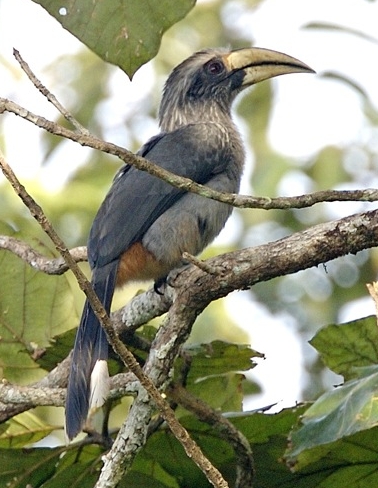
The Sri Lanka Grey Hornbill has grey wings with black primary flight feathers, a grey back and a brown crown. Its long tail is blackish with white sides, and its underparts are white.[1][2][3][4]
It has a long, curved bill without a casque. Adult males have cream-coloured bills, while adult females have black bills with a cream stripe.[5][6][7]
Immature individuals have dark grey upperparts and tails with white tips.[8][9]
Habitat
The Sri Lanka Grey Hornbill inhabits forests. It is endemic to Sri Lanka, where it occurs as a widespread and common resident breeder.[10][11]
Diet
The Sri Lanka Grey Hornbill consumes berries, fruits, insects and small lizards. Figs constitute the main component of its diet.[12][13][14][15][16]
It occasionally eats small rodents, reptiles and insects.[17][18][19]
Behaviour
The Sri Lanka Grey Hornbill is gregarious and usually lives in pairs or small flocks containing up to five birds. Its flight is slow and powerful.[20][21][22]
Reproduction and life cycle
Females lay clutches of up to four white eggs in tree holes. The nesting tree hole is sealed during incubation using cement made from mud, droppings and fruit pulp.[23][24][25]
The sealed nest contains a narrow opening through which the male transfers food to the female and chicks.[26]
Classification of the Sri Lanka Grey Hornbill
| Kingdom | Animalia |
|---|---|
| Phylum | Chordata |
| Subphylum | Vertebrata |
| Infraphylum | Gnathostomata |
| Parvphylum | Osteichthyes |
| Megaclass | Tetrapoda |
| Class | Aves (Bird) |
| Order | Bucerotiformes (Hoopoes) |
| Family | Bucerotidae (Hornbill) |
| Genus | Ocyceros (Asian Gray Hornbills) |
| Species | Ocyceros gingalensis (Shaw, 1812) |
Where the Sri Lanka Grey Hornbill is found
Checklists and occurrence records place Ocyceros gingalensis in 1 country across Asia. GBIF holds 10,740 georeferenced records of it.
Countries
Regions and cities with the most records
- Dambulla, Sri Lanka 686
- Kandy, Sri Lanka 644
- Matale, Sri Lanka 513
- Gampola, Sri Lanka 459
- Kurunegala, Sri Lanka 387
- Weligama, Sri Lanka 372
- Matara, Sri Lanka 371
- Devinuwara, Sri Lanka 365
- Ambalangoda, Sri Lanka 356
- Bentota, Sri Lanka 352
- Kataragama, Sri Lanka 342
- Badulla, Sri Lanka 340
- Anuradhapura, Sri Lanka 332
- Ratnapura, Sri Lanka 203
- Hanwella Ihala, Sri Lanka 163
- Beliatta, Sri Lanka 151
- Nuwara Eliya, Sri Lanka 150
- Homagama, Sri Lanka 127
- Galle, Sri Lanka 121
- Kegalle, Sri Lanka 112
- Hatton, Sri Lanka 98
- Maharagama, Sri Lanka 33
- Mulleriyawa, Sri Lanka 25
- Ampara, Sri Lanka 24
- Hambantota, Sri Lanka 24
- Kelaniya, Sri Lanka 23
- Hendala, Sri Lanka 22
- Wattala, Sri Lanka 22
- Chilaw, Sri Lanka 21
- Beruwala, Sri Lanka 20
- Peliyagoda, Sri Lanka 20
- Welisara, Sri Lanka 20
- Battaramulla South, Sri Lanka 19
- Kotikawatta, Sri Lanka 19
- Kolonnawa, Sri Lanka 18
- Sri Jayewardenepura Kotte, Sri Lanka 18
Range as the checklists state it
Southern Asia
A number beside a place is its count of GBIF occurrence records. A place without a number comes from a checklist alone. Records show where a species has been observed or collected, which can include escapes and vagrants.
Common names
English
- Sri Lanka Grey Hornbill
- Ceylon Gray Hornbill
- Ceylon Grey Hornbill
- Ceylon Grey-Hornbill
- Sri Lanka Gray Hornbill
- Sri Lankan Grey Hornbill
Names in 27 other languages
- Arabic
- أبو قرن سيريلانكي رمادي
- Catalan
- Calau Gris d'Sri Lanka, calau gris de Sri Lanka
- Chinese
- 斯里兰卡灰犀鸟, 斯里蘭卡灰犀鳥
- Croatian
- cejlonski kljunorožac
- Czech
- zoborožec srílanský
- Danish
- Sri Lanka-gråtoko
- Dutch
- Ceylontok
- Esperanto
- srilanka bucero
- Estonian
- tseiloni sarvnokk
- Finnish
- srilankantoko
- French
- Calao de Ceylan
- German
- Ceylon-Grautoko, Ceylonhornvogel, Ceylontoko, Greisentoko
- Hungarian
- ceyloni szürketokó
- Italian
- Bucero grigio dello Sri Lanka, Bucero grigio di Sri Lanka
- Japanese
- スリランカコサイチョウ
- Lithuanian
- šrilankinis tokas
- Norwegian
- singaleserhornfugl
- Polish
- dzioborożec cejloński
- Portuguese
- calau-cingalês, calau-do-ceilão
- Russian
- Цейлонский серый ток
- Serbian
- Sivi kljunorožac sa Šri Lanke
- Sinhala
- අළු කෑදැත්තා
- Slovak
- zobákorožec sivo-biely
- Spanish
- Cálao gris cingalés
- Swedish
- ceylonnäshornsfågel
- Turkish
- Seylan Boynuzgagası
- Ukrainian
- токо цейлонський
Synonyms
5 other scientific names have been used for this species and are now treated as synonyms of Ocyceros gingalensis.
- Buceros gingala Wilkes, J, 1808
- Buceros gingalensis Shaw, 1812
- Tockus cingalensis Lewis, F, 1898
- Tockus gingalensis Shaw, G, 1811
- Tockus griseus gingalensis Shaw, G, 1811
Related species
-
 Indian Grey HornbillOcyceros birostris
-
 Malabar Grey HornbillOcyceros griseus
-
 Great HornbillBuceros bicornis
-
 Rhinoceros HornbillBuceros rhinoceros
-
 Helmeted HornbillRhinoplax vigil
-
 Oriental Pied HornbillAnthracoceros albirostris
-
 Rufous HornbillBuceros hydrocorax
-
 Southern Red-billed HornbillTockus rufirostris
Compare
Questions and answers
What is the scientific name of the Sri Lanka Grey Hornbill?
The scientific name of the Sri Lanka Grey Hornbill is Ocyceros gingalensis. Written with its author, the full name is Ocyceros gingalensis (Shaw, 1812).
Which family does the Sri Lanka Grey Hornbill belong to?
Ocyceros gingalensis belongs to the family Bucerotidae, in the order Bucerotiformes and the class Aves.
Where is the Sri Lanka Grey Hornbill found?
Checklists and occurrence records place Ocyceros gingalensis in 1 country: Sri Lanka.
What is the conservation status of the Sri Lanka Grey Hornbill?
The IUCN Red List category recorded for Ocyceros gingalensis is Least Concern (LC).
What other names does the Sri Lanka Grey Hornbill have?
Ocyceros gingalensis is also known in English as Ceylon Gray Hornbill, Ceylon Grey Hornbill, Ceylon Grey-Hornbill, Sri Lanka Gray Hornbill and Sri Lankan Grey Hornbill.
Are there hornbills in Sri Lanka?
The Sri Lanka Grey Hornbill is endemic to Sri Lanka, where it occurs as a widespread and common resident breeder.[10]
Sources
Passages the profile rests on
- The species has grey wings with black primary flight feathers. Source passage: “It has grey wings with black primary flight feathers,” — English Wikipedia
- The species has a grey back and brown crown. Source passage: “a grey back, and a brown crown.” — English Wikipedia
- The species has a blackish long tail with white sides. Source passage: “Its long tail is blackish with white sides,” — English Wikipedia
- The species has white underparts. Source passage: “and the underparts are white.” — English Wikipedia
- The species has a long, curved bill without a casque. Source passage: “The long, curved bill has no casque.” — English Wikipedia
- Adult males have cream-coloured bills. Source passage: “the male has a cream-coloured bill,” — English Wikipedia
- Adult females have black bills with a cream stripe. Source passage: “whereas the female's is black with a cream stripe.” — English Wikipedia
- Immature individuals have dark grey upperparts. Source passage: “Immature birds have dark grey upperparts,” — English Wikipedia
- Immature individuals have tails with white tips. Source passage: “and a tail with a white tip.” — English Wikipedia
- The species is endemic to Sri Lanka, where it occurs as a widespread and common resident breeder. Source passage: “a widespread and common endemic resident breeder in Sri Lanka.” — English Wikipedia
- The species inhabits forests. Source passage: “The Sri Lanka grey hornbill is a gregarious bird found in forest habitats.” — English Wikipedia
- The species consumes berries. Source passage: “observed consuming berries, fruits, insects and small lizards.” — English Wikipedia
- The species consumes fruits. Source passage: “observed consuming berries, fruits, insects and small lizards.” — English Wikipedia
- The species consumes insects. Source passage: “observed consuming berries, fruits, insects and small lizards.” — English Wikipedia
- The species consumes small lizards. Source passage: “observed consuming berries, fruits, insects and small lizards.” — English Wikipedia
- Figs constitute the main component of the species' diet. Source passage: “It feeds mostly on figs,” — English Wikipedia
- The species occasionally eats small rodents. Source passage: “although occasionally it eats small rodents, reptiles and insects.” — English Wikipedia
- The species occasionally eats reptiles. Source passage: “although occasionally it eats small rodents, reptiles and insects.” — English Wikipedia
- The species occasionally eats insects. Source passage: “although occasionally it eats small rodents, reptiles and insects.” — English Wikipedia
- The species is gregarious. Source passage: “The Sri Lanka grey hornbill is a gregarious bird” — English Wikipedia
- The species usually lives in pairs or small flocks containing up to five birds. Source passage: “These birds usually live in pairs or small flocks consisting up to five birds (2 adults and 2-3 juveniles)” — English Wikipedia
- The species has a slow and powerful flight. Source passage: “Its flight is slow and powerful.” — English Wikipedia
- Females lay clutches of up to four white eggs. Source passage: “The female lays up to four white eggs” — English Wikipedia
- The species lays its eggs in tree holes. Source passage: “The female lays up to four white eggs in a tree hole” — English Wikipedia
- The nesting tree hole is sealed during incubation using cement made from mud, droppings and fruit pulp. Source passage: “blocked off during incubation with a cement made of mud, droppings and fruit pulp.” — English Wikipedia
- The sealed nest contains a narrow opening through which the male transfers food to the female and chicks. Source passage: “There is only one narrow aperture, barely wide enough for the male to transfer food to the mother and chicks.” — English Wikipedia
Data
- Catalogue of Life, 2026-10-16 XR cc by
- Global Biodiversity Information Facility CC BY 4.0
- Wikidata CC0
- GeoNames CC BY 4.0
- Wikimedia Commons per image; credit shown with each image
- Within the Catalogue of Life, this name comes from The Integrated Taxonomic Information System cc0
References
- Dickinson, Edward C., ed. (2003). The Howard and Moore Complete Checklist of the Birds of the World, 3rd Edition.
- Gill, Frank, & and Minturn Wright. (2006). Birds of the World: Recommended English Names.
- Dickinson, E. C., and J. V. Remsen Jr., eds. (2013). The Howard and Moore Complete Checklist of the Birds of the World, 4th Edition, Vol. 1 Non-Passerines.
This species in other databases
Page built on 27 November 2026. See how the catalog is made and all sources and licences.
Cite this page
ScientificNames.org. (2026). Ocyceros gingalensis (Sri Lanka Grey Hornbill). Retrieved November 27, 2026, from https://scientificnames.org/species/ocyceros-gingalensis
“Ocyceros gingalensis (Sri Lanka Grey Hornbill).” ScientificNames.org, 2026, scientificnames.org/species/ocyceros-gingalensis. Accessed 27 Nov. 2026.
ScientificNames.org. “Ocyceros gingalensis (Sri Lanka Grey Hornbill).” Accessed November 27, 2026. https://scientificnames.org/species/ocyceros-gingalensis.
@misc{scientificnames_ocyceros_gingalensis_sri_lanka_grey_hornbill,
  author = {{ScientificNames.org}},
  title = {Ocyceros gingalensis (Sri Lanka Grey Hornbill)},
  year = {2026},
  url = {https://scientificnames.org/species/ocyceros-gingalensis},
  note = {Accessed 2026-11-27}
}