Species · Birds
Malabar Grey Hornbill Ocyceros griseus
The scientific name of the Malabar Grey Hornbill is Ocyceros griseus. It is a species of bird in the family Bucerotidae (hornbill), order Bucerotiformes. The name dates from 1790.
- Scientific name
- Ocyceros griseus (Latham, 1790)
- Common name
- Malabar Grey Hornbill
- Genus
- Ocyceros
- Family
- Bucerotidae (Hornbill)
- Order
- Bucerotiformes
- Class
- Aves
- Red List category
- VU Vulnerable
- Recorded in
- 2 countries
- Name status
- accepted in the Catalogue of Life
Overview
Ocyceros griseus is endemic to India's Western Ghats, extending approximately from Nashik in the north to the southernmost hills. It has a large bill without a casque and is the smallest of the Asian hornbills.
Written 26 November 2026 from the sources listed below. Each statement was checked against the passage it cites; statements that could not be supported were removed.
Appearance
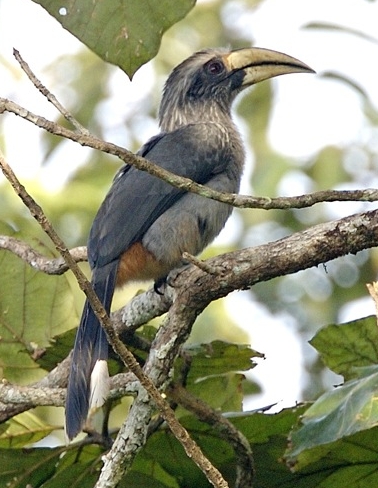
The Malabar Grey Hornbill has a large bill but lacks a casque. Males have reddish bills with yellow tips, while females have yellow bills with black coloration at the base of the lower mandible and a black stripe along the culmen.[1][2][3]
The species has a broad whitish superciliary band extending above the eye towards the neck. Its wings are brown-grey, with a white carpal patch and black primary flight feathers tipped with white.[4][5]
It has a grey back, cinnamon-coloured vent and grey underparts with white streaks. Its long, blackish tail has a white tip.[6][7]
Immature birds have browner upperparts and yellow bills. Young birds have dull white or yellow irises.[8][9]
The species measures 45–58 cm in length, and its tail measures approximately 23 cm.[10][11]
Habitat
The Malabar Grey Hornbill inhabits dense forests, evergreen forests and areas around rubber, arecanut and coffee plantations. It occurs mainly in small groups in habitats with substantial tree cover.[12][13][14]
In the Kalakad–Mundanthurai Tiger Reserve, the species has been recorded in evergreen forests between 500 and 900 m, with occasional records up to 1,100 m. In the Anamalai Hills, it occurs frequently up to 1,200 m elevation.[15][16]
Estimated population density decreases with increasing elevation at the two studied Western Ghats sites. In Anamalai Hills rainforest fragments, population density is positively associated with food-tree species richness.[17][18]
Diet
The Malabar Grey Hornbill feeds on figs and other forest fruits. Its diet also includes small vertebrates.[19][20]
During the breeding season, its diet includes berries, insects, small rodents and reptiles.[21]
Behaviour
Individuals commonly move in pairs or small groups. The species produces loud cackling, laughing and screeching calls.[22][23]
During flight, the species alternates strong wing flaps with gliding. Individuals hop heavily along the outer branches of large fruiting trees.[24][25]
Reproduction and life cycle
The breeding season extends from January through May. The species nests in pre-existing tree cavities because it cannot excavate its own nest, and it prefers large trees as nesting sites.[26][27][28]
Many nests in the Mudumalai area occur in Lagerstroemia microcarpa, Terminalia bellirica and Terminalia crenulata trees. The species is monogamous, and pairs reuse the same nest sites in successive years.[29][30]
The female seals herself inside the nest cavity using a cement-like material made from her droppings. Females lay three or occasionally four white eggs.[31][32]
Females undergo a complete moult of their flight feathers after laying eggs. The male supplies food to the female and offspring during nesting and taps trees to signal his arrival with food.[33][34][35]
Uses
The Malabar Grey Hornbill contributes to seed dispersal for numerous fruit-bearing forest tree species.[36]
Similar species
The Indian Grey Hornbill differs from the Malabar Grey Hornbill by having a prominent casque and a white trailing edge along the entire wing in flight.[37]
Classification of the Malabar Grey Hornbill
| Kingdom | Animalia |
|---|---|
| Phylum | Chordata |
| Subphylum | Vertebrata |
| Infraphylum | Gnathostomata |
| Parvphylum | Osteichthyes |
| Megaclass | Tetrapoda |
| Class | Aves (Bird) |
| Order | Bucerotiformes (Hoopoes) |
| Family | Bucerotidae (Hornbill) |
| Genus | Ocyceros (Asian Gray Hornbills) |
| Species | Ocyceros griseus (Latham, 1790) |
Where the Malabar Grey Hornbill is found
Checklists and occurrence records place Ocyceros griseus in 2 countries across Asia. GBIF holds 52,279 georeferenced records of it.
Countries
Regions and cities with the most records
- Kerala, India 22,332
- Karnataka, India 17,331
- Goa, India 5,755
- Kuttampuzha, India 5,707
- Kotamangalam, India 5,462
- Tamil Nadu, India 4,969
- Iramallūr, India 3,927
- Valparai, India 3,283
- Virajpet, India 2,832
- Curti, India 2,807
- Ponda, India 2,731
- Dandeli, India 2,398
- Kalpatta, India 2,224
- Curchorem, India 2,217
- Gudalur, India 2,111
- Maharashtra, India 1,807
- Madikeri, India 1,519
- Sakleshpur, India 1,204
- Cumbum, India 1,161
- Bicholim, India 1,083
- Mūvattupula, India 1,082
- Someshwar, India 1,063
- Sirsi, India 991
- Kottur, India 971
- Punalūr, India 970
- Nilambūr, India 952
- Haliyal, India 946
- Nedumangād, India 917
- Kushālnagar, India 880
- Vettaikkaranpudur, India 866
- Koovappady, India 831
- Kunnummal, India 790
- Gudalur, India 770
- Kollivāyal, India 764
- Chimbel, India 763
- Sāvantvādi, India 698
Range as the checklists state it
Southern Asia
A number beside a place is its count of GBIF occurrence records. A place without a number comes from a checklist alone. Records show where a species has been observed or collected, which can include escapes and vagrants.
Common names
English
- Malabar Grey Hornbill
- Malabar Gray Hornbill
- Malabar Grey-Hornbill
Names in 34 other languages
- Arabic
- أبو قرن مالابار الرمادي, أبو قرن مالبار رمادي
- Bengali
- মালাবার ধূসর ধনেশ
- Catalan
- calau gris malabar
- Chinese
- 印度灰犀鸟, 馬拉巴灰犀鳥
- Croatian
- malabarski kljunorožac
- Czech
- zoborožec indický
- Danish
- Malabar Gråtoko
- Dutch
- Malabartok
- Esperanto
- griza bucero
- Estonian
- malabari sarvnokk
- Finnish
- malabarintoko
- French
- Calao gris
- German
- Grauhornvogel, Malabar-Grautoko, Malabar-Toko, Malabartoko
- Hebrew
- קלאו מלבר אפור
- Hungarian
- malabári szürketokó
- Italian
- Bucero grigio del Malabar
- Japanese
- ニシインドコサイチョウ
- Lithuanian
- Malabarinis pilkasis ragasnapis, malabarinis tokas
- Malayalam
- കോഴി വേഴാമ്പൽ
- Marathi
- मलबारचा राखी धनेश
- Norwegian
- malabarhornfugl
- Persian
- نوکشاخ خاکستری مالابار
- Polish
- dzioborożec szary
- Portuguese
- calau-do-malabar, calau-malabar
- Russian
- Малабарский серый ток, Малабарский ток
- Serbian
- Malabarski sivi kljunorožac
- Slovak
- zobákorožec sivobruchý
- Spanish
- Cálao gris malabar
- Swedish
- ghatsnäshornsfågel
- Tamil
- சாம்பல் இருவாச்சி, சோலைக் காகா, மலபார் சாம்பல் இருவாச்சி
- Turkish
- Malabar Boynuzgagası
- Ukrainian
- токо малабарський
- Welsh
- Cornbig Malabar
- nav
- Biʼééʼ Łigaii Bikéyahdę́ę́ʼ tsídiidaantsxaaí łibáhígíí
Synonyms
4 other scientific names have been used for this species and are now treated as synonyms of Ocyceros griseus.
- Buceros cineraceus Temminck, CJ, 1832
- Buceros griseus Latham, 1790
- Tockus griseus Latham, J, 1790
- Tockus griseus griseus Latham, J, 1790
Related species
-
 Indian Grey HornbillOcyceros birostris
-
 Sri Lanka Grey HornbillOcyceros gingalensis
-
 Great HornbillBuceros bicornis
-
 Rhinoceros HornbillBuceros rhinoceros
-
 Helmeted HornbillRhinoplax vigil
-
 Oriental Pied HornbillAnthracoceros albirostris
-
 Rufous HornbillBuceros hydrocorax
-
 Southern Red-billed HornbillTockus rufirostris
Compare
Questions and answers
What is the scientific name of the Malabar Grey Hornbill?
The scientific name of the Malabar Grey Hornbill is Ocyceros griseus. Written with its author, the full name is Ocyceros griseus (Latham, 1790).
Which family does the Malabar Grey Hornbill belong to?
Ocyceros griseus belongs to the family Bucerotidae, in the order Bucerotiformes and the class Aves.
Where is the Malabar Grey Hornbill found?
Checklists and occurrence records place Ocyceros griseus in 2 countries: India and Sri Lanka.
What is the conservation status of the Malabar Grey Hornbill?
The IUCN Red List category recorded for Ocyceros griseus is Vulnerable (VU).
What other names does the Malabar Grey Hornbill have?
Ocyceros griseus is also known in English as Malabar Gray Hornbill and Malabar Grey-Hornbill.
Sources
Passages the profile rests on
- The Malabar Grey Hornbill has a large bill but lacks a casque. Source passage: “They have a large beak but lack the casque that is prominent in some other hornbill species.” — English Wikipedia
- Males have reddish bills with yellow tips. Source passage: “Males have a reddish bill with a yellow tip” — English Wikipedia
- Females have yellow bills with black coloration at the base of the lower mandible and a black stripe along the culmen. Source passage: “the females have a plain yellow bill with black at the base of the lower mandible and a black stripe along the culmen.” — English Wikipedia
- The species has a broad whitish superciliary band extending above the eye towards the neck. Source passage: “They show a broad whitish superciliary band above the eye, running down to the neck.” — English Wikipedia
- Its wings are brown-grey, with a white carpal patch and black primary flight feathers tipped with white. Source passage: “They have brown-grey wings, a white carpal patch and black primary flight feathers tipped with white.” — English Wikipedia
- The species has a grey back and cinnamon-coloured vent. Source passage: “The Malabar grey hornbill has a grey back and a cinnamon vent.” — English Wikipedia
- Its long tail is blackish with a white tip, while its grey underparts have white streaks. Source passage: “The long tail is blackish with a white tip, and the underparts are grey with white streaks.” — English Wikipedia
- Immature birds have browner upperparts and yellow bills. Source passage: “Immature birds have browner upperparts and a yellow bill.” — English Wikipedia
- Young birds have dull white or yellow irises. Source passage: “Young birds have a dull white or yellow iris.” — English Wikipedia
- The species measures 45–58 cm in length. Source passage: “at 45 to 58 cm (18 to 23 in) in length” — English Wikipedia
- Its tail measures approximately 23 cm. Source passage: “It has a 23 cm (9.1 in) tail” — English Wikipedia
- The species inhabits dense forests and areas around rubber, arecanut and coffee plantations. Source passage: “They are found mainly in dense forest and around rubber, arecanut or coffee plantations.” — English Wikipedia
- It occurs mainly in small groups in habitats with substantial tree cover. Source passage: “This hornbill is found in small groups mainly in habitats with good tree cover.” — English Wikipedia
- The species occurs in evergreen forests. Source passage: “found in evergreen forests and plantations.” — ebird.org
- In the Kalakad–Mundanthurai Tiger Reserve, the species has been recorded in evergreen forests between 500 and 900 m, with occasional records up to 1,100 m. Source passage: “reported in evergreen forests between 500 m and 900 m (sporadically to 1,100 m) elevation” — English Wikipedia
- In the Anamalai Hills, the species occurs frequently up to 1,200 m elevation. Source passage: “frequently up to 1,200 m in the Anamalai Hills further north.” — English Wikipedia
- Estimated population density decreases with increasing elevation at the two studied Western Ghats sites. Source passage: “the estimated Malabar Grey Hornbill density decreased with elevation” — English Wikipedia
- In Anamalai Hills rainforest fragments, population density is positively associated with food-tree species richness. Source passage: “the population density in rainforest fragments in the Anamalai Hills being additionally positively related to food tree species richness.” — English Wikipedia
- The species feeds on figs and other forest fruits. Source passage: “feeding on figs and other forest fruits.” — English Wikipedia
- Its diet also includes small vertebrates. Source passage: “They also feed on small vertebrates” — English Wikipedia
- Berries, insects, small rodents and reptiles are included in its breeding-season diet. Source passage: “Berries, insects, small rodents and reptiles are included in the diet.” — English Wikipedia
- Individuals commonly move in pairs or small groups. Source passage: “They move around in pairs or small groups” — English Wikipedia
- The species produces loud cackling, laughing and screeching calls. Source passage: “Their loud calls are distinctive and include "hysterical cackling", "laughing" and "screeching" calls.” — English Wikipedia
- During flight, the species alternates strong wing flaps with gliding. Source passage: “They fly with a strong flap and glide flight” — English Wikipedia
- Individuals hop heavily along the outer branches of large fruiting trees. Source passage: “hop around heavily on the outer branches of large fruiting trees.” — English Wikipedia
- The breeding season extends from January through May. Source passage: “The breeding season is January to May.” — English Wikipedia
- The species nests in pre-existing tree cavities because it cannot excavate its own nest. Source passage: “Being secondary cavity nesters (incapable of excavating their own nests), they find trees with large cavities.” — English Wikipedia
- The species prefers large trees as nesting sites. Source passage: “the species preferred nest sites that had large trees.” — English Wikipedia
- Many nests in the Mudumalai area occur in Lagerstroemia microcarpa, Terminalia bellirica and Terminalia crenulata trees. Source passage: “Trees of the species Lagerstroemia microcarpa, Terminalia bellirica and Terminalia crenulata were found to hold nearly 70% of all the nests in the Mudumalai area.” — English Wikipedia
- The species is monogamous and pairs reuse the same nest sites in successive years. Source passage: “The species is monogamous, and the same nest sites are used by the pair year after year.” — English Wikipedia
- The female seals herself inside the nest cavity using a cement-like material made from her droppings. Source passage: “The female incarcerates herself within the cavity by sealing its entrance with a cement made from her droppings.” — English Wikipedia
- Females lay three or occasionally four white eggs. Source passage: “The female then lays three or sometimes four white eggs” — English Wikipedia
- Females undergo a complete moult of their flight feathers after laying eggs. Source passage: “begins a complete moult of her flight feathers.” — English Wikipedia
- The male supplies food to the female and offspring during nesting. Source passage: “The male brings all the food needed for the female and the young.” — English Wikipedia
- Males tap trees to signal their arrival with food. Source passage: “Males tap the tree to beckon the female on arriving with food.” — English Wikipedia
- The species contributes to seed dispersal for numerous fruit-bearing forest tree species. Source passage: “they are important as seed dispersal agents for many species of fruit bearing forest trees.” — English Wikipedia
- The Indian Grey Hornbill differs from this species by having a prominent casque and a white trailing edge along the entire wing in flight. Source passage: “The Indian grey hornbill, which is found mainly on the adjoining plains, is easily told apart by its prominent casque, and in flight by the white trailing edge of the entire wing.” — English Wikipedia
Data
- Catalogue of Life, 2026-10-16 XR cc by
- Global Biodiversity Information Facility CC BY 4.0
- Wikidata CC0
- GeoNames CC BY 4.0
- Wikimedia Commons per image; credit shown with each image
- Within the Catalogue of Life, this name comes from The Integrated Taxonomic Information System cc0
References
- Dickinson, Edward C., ed. (2003). The Howard and Moore Complete Checklist of the Birds of the World, 3rd Edition.
- Gill, Frank, & and Minturn Wright. (2006). Birds of the World: Recommended English Names.
- Dickinson, E. C., and J. V. Remsen Jr., eds. (2013). The Howard and Moore Complete Checklist of the Birds of the World, 4th Edition, Vol. 1 Non-Passerines.
This species in other databases
Page built on 28 November 2026. See how the catalog is made and all sources and licences.
Cite this page
ScientificNames.org. (2026). Ocyceros griseus (Malabar Grey Hornbill). Retrieved November 28, 2026, from https://scientificnames.org/species/ocyceros-griseus
“Ocyceros griseus (Malabar Grey Hornbill).” ScientificNames.org, 2026, scientificnames.org/species/ocyceros-griseus. Accessed 28 Nov. 2026.
ScientificNames.org. “Ocyceros griseus (Malabar Grey Hornbill).” Accessed November 28, 2026. https://scientificnames.org/species/ocyceros-griseus.
@misc{scientificnames_ocyceros_griseus_malabar_grey_hornbill,
  author = {{ScientificNames.org}},
  title = {Ocyceros griseus (Malabar Grey Hornbill)},
  year = {2026},
  url = {https://scientificnames.org/species/ocyceros-griseus},
  note = {Accessed 2026-11-28}
}