Species · Molluscs
Odostomia clathratula
Odostomia clathratula has no English name on record in the checklists used here. It is a species of mollusc in the family Pyramidellidae (pyrams). The name dates from 1852.
- Scientific name
- Odostomia clathratula (C. B. Adams, 1852)
- Genus
- Odostomia
- Family
- Pyramidellidae (Pyrams)
- Class
- Gastropoda
- Environment
- marine
- Recorded in
- 2 countries
- Name status
- accepted in the Catalogue of Life
Overview
The species occurs in the Pacific Ocean off the Galapagos Islands and off Panama. It is distinguished by an elongate-conic shell with intersecting axial ribs and spiral cords that form tubercles.
Written 28 November 2026 from the sources listed below. Each statement was checked against the passage it cites; statements that could not be supported were removed.
Appearance
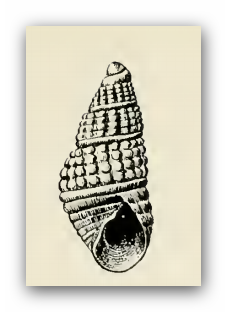
The shell is elongate-conic, slender, and vitreous. It has two and a half nuclear whorls forming a depressed helicoid spire and seven slightly rounded post-nuclear whorls that are strongly constricted at the sutures and prominently shouldered at the summit.[1][2][3]
The rounded, tuberculate axial ribs number 14 on each of the first two post-nuclear whorls, 18 on each of the fourth and fifth post-nuclear whorls, and 24 on the penultimate whorl. Four spiral cords between the sutures are as strong as the axial ribs and form tubercles where they intersect.[4][5][6][7]
The sutures are broadly and deeply channeled. The periphery and base of the body whorl are well rounded.[8][9]
The base of the body whorl has seven narrow, nearly equal, equally spaced spiral keels. The broad space between the basal keels and peripheral sulcus bears numerous slender axial riblets.[10][11]
The aperture is oval, and the thin outer lip displays the external shell sculpture on its inner surface. The columella is stout, slightly curved, and strongly reflected over the reinforcing base, with a strong fold at its insertion.[12][13][14][15]
Habitat
The species occurs in the Pacific Ocean off the Galapagos Islands and off Panama.[16][17]
Classification of Odostomia clathratula
| Kingdom | Animalia |
|---|---|
| Phylum | Mollusca |
| Class | Gastropoda (Gastropod) |
| Subclass | Heterobranchia |
| Infraclass | Euthyneura |
| Subterclass | Tectipleura |
| Superorder | Pylopulmonata |
| Superfamily | Pyramidelloidea |
| Family | Pyramidellidae (Pyrams) |
| Subfamily | Odostomiinae |
| Genus | Odostomia |
| Species | Odostomia clathratula (C. B. Adams, 1852) |
Where Odostomia clathratula is found
Checklists and occurrence records place Odostomia clathratula in 2 countries. GBIF holds 11 georeferenced records of it.
Countries
Regions and cities with the most records
- Ancón, Panama 5
- Curundú, Panama 5
- Panama City, Panama 5
- Arraiján, Panama 4
- Juan Díaz, Panama 4
- San Miguelito, Panama 4
- Veracruz, Panama 4
- Panamá Oeste Province, Panama 3
A number beside a place is its count of GBIF occurrence records. A place without a number comes from a checklist alone. Records show where a species has been observed or collected, which can include escapes and vagrants.
Synonyms
One other scientific name has been used for this species and is now treated as a synonym of Odostomia clathratula.
- Chemnitzia clathratula C. B. Adams, 1852
Related species
- Odostomia limpida
-
 Odostomia kromi
-
 Odostomia acuta
-
 Odostomia turrita
- Odostomia plicata
-
 Odostomia promeces
-
 Odostomia calliope
-
 Odostomia canfieldi
Compare
Questions and answers
Where does Odostomia clathratula occur?
It occurs in the Pacific Ocean off the Galapagos Islands and off Panama.[16][17]
What is the shell shape?
The shell is elongate-conic, slender, and vitreous.[1]
How many post-nuclear whorls does the shell have?
The shell has seven post-nuclear whorls.[3]
What is the shape of the aperture?
The aperture is oval.[12]
Sources
Passages the profile rests on
- The shell of Odostomia clathratula is elongate-conic, slender, and vitreous. Source passage: “The elongate-conic, slender shell is vitreous.” — English Wikipedia
- The shell has two and a half nuclear whorls forming a depressed helicoid spire. Source passage: “The two and one-half nuclear whorls form a depressed helicoid spire” — English Wikipedia
- The shell has seven post-nuclear whorls that are slightly rounded, strongly constricted at the sutures, and prominently shouldered at the summit. Source passage: “The seven post-nuclear whorls are very slightly rounded, strongly constricted at the sutures and prominently shouldered at the summit.” — English Wikipedia
- The shell's axial ribs are rounded and tuberculate, with 14 ribs on each of the first two post-nuclear whorls. Source passage: “well rounded, tuberculate, axial ribs, of which 14 occur upon the first and second” — English Wikipedia
- The fourth and fifth post-nuclear whorls each have 18 axial ribs. Source passage: “18 upon the fourth and fifth” — English Wikipedia
- The penultimate whorl has 24 axial ribs. Source passage: “24 upon the penultimate turn.” — English Wikipedia
- The whorls have four spiral cords between the sutures that are as strong as the axial ribs and form tubercles where they intersect. Source passage: “the whorls are marked between the sutures by four spiral cords which equal the ribs in strength, and render them tuberculate at their junction.” — English Wikipedia
- The sutures are broadly and deeply channeled. Source passage: “The sutures are broadly and deeply channeled.” — English Wikipedia
- The periphery and base of the body whorl are well rounded. Source passage: “The periphery and the somewhat prolonged base of the body whorl are well rounded” — English Wikipedia
- The base of the body whorl has seven narrow, nearly equal, equally spaced spiral keels. Source passage: “the latter marked by seven narrow, almost equal, and equally spaced spiral keels” — English Wikipedia
- The broad space between the basal keels and peripheral sulcus bears numerous slender axial riblets. Source passage: “the broad space between which and the peripheral sulcus are marked by many slender axial riblets.” — English Wikipedia
- The aperture is oval. Source passage: “The aperture is oval.” — English Wikipedia
- The outer lip is thin and displays the external shell sculpture on its inner surface. Source passage: “The outer lip is thin, showing the external sculpture within.” — English Wikipedia
- The columella is stout, slightly curved, and strongly reflected over the reinforcing base. Source passage: “The columella is stout, slightly curved, strongly reflected over the reinforcing base” — English Wikipedia
- The columella has a strong fold at its insertion. Source passage: “provided with a strong fold at its insertion.” — English Wikipedia
- The species occurs in the Pacific Ocean off the Galapagos Islands. Source passage: “The species occurs in the Pacific Ocean off the Galapagos Islands and Panama.” — English Wikipedia
- The species occurs in the Pacific Ocean off Panama. Source passage: “The species occurs in the Pacific Ocean off the Galapagos Islands and Panama.” — English Wikipedia
Data
- Catalogue of Life, 2026-10-16 XR cc by
- Global Biodiversity Information Facility CC BY 4.0
- Wikidata CC0
- GeoNames CC BY 4.0
- Within the Catalogue of Life, this name comes from World Register of Marine Species cc by
This species in other databases
Page built on 29 November 2026. See how the catalog is made and all sources and licences.
Cite this page
ScientificNames.org. (2026). Odostomia clathratula. Retrieved November 29, 2026, from https://scientificnames.org/species/odostomia-clathratula
“Odostomia clathratula.” ScientificNames.org, 2026, scientificnames.org/species/odostomia-clathratula. Accessed 29 Nov. 2026.
ScientificNames.org. “Odostomia clathratula.” Accessed November 29, 2026. https://scientificnames.org/species/odostomia-clathratula.
@misc{scientificnames_odostomia_clathratula,
  author = {{ScientificNames.org}},
  title = {Odostomia clathratula},
  year = {2026},
  url = {https://scientificnames.org/species/odostomia-clathratula},
  note = {Accessed 2026-11-29}
}