Species · Molluscs
Odostomia dicella
Odostomia dicella has no English name on record in the checklists used here. It is a species of mollusc in the family Pyramidellidae (pyrams). The name dates from 1912.
- Scientific name
- Odostomia dicella Bartsch, 1912
- Genus
- Odostomia
- Family
- Pyramidellidae (Pyrams)
- Class
- Gastropoda
- Environment
- marine
- Name status
- accepted in the Catalogue of Life

Overview
The species occurs in the Pacific Ocean off San Diego, California. It is distinguished by an elongate-ovate, bluish-white shell with nodulose spiral cords, axial riblets, and a narrow, deep sulcus on the body whorl.
Written 28 November 2026 from the sources listed below. Each statement was checked against the passage it cites; statements that could not be supported were removed.
Appearance
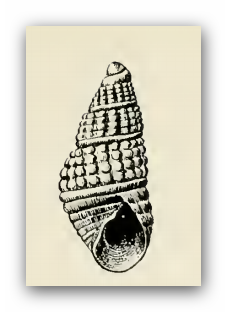
The shell is elongate-ovate, somewhat translucent, and bluish-white. It measures 3 mm in length and has five well-rounded post-nuclear whorls.[1][2][3]
The whorls have four spiral cords between the sutures. The three posterior cords are nodulose on the early whorls, while the suprasutural cord is smooth; the nodules become obsolete on the last whorl.[4][5][6][7]
The spiral cord at the summit is the weakest, and the second cord below it is the strongest. The spaces between the spiral keels are rather shallow and approximately half as wide as the keels.[8][9]
The whorls also have slender, almost axial riblets. Approximately 18 occur on the second whorl and approximately 22 on the third whorl.[10][11][12]
The grooves between the keels on the penultimate whorl are crossed by slender axial threads. The shell has strongly constricted sutures.[13][14]
The periphery of the body whorl has a narrow, deep sulcus. The shell base is moderately long and well rounded, with five spiral cords that progressively weaken toward the umbilical area.[15][16][17]
The grooves between the sutural cords are equal in width and crossed by numerous slender axial threads. Their intersections with the cords create minute pits.[18][19]
The aperture is moderately large and somewhat effuse anteriorly, with an acute posterior angle. The outer lip is thin and displays the external sculpture on its inner surface.[20][21][22]
The inner lip is moderately long, strong, somewhat curved, and reflected over and attached to the base. It has a slender fold at its insertion, and the parietal wall is covered with a thin callus.[23][24][25]
Habitat
The species occurs in the Pacific Ocean off San Diego, California.[26]
Classification of Odostomia dicella
| Kingdom | Animalia |
|---|---|
| Phylum | Mollusca |
| Class | Gastropoda (Gastropod) |
| Subclass | Heterobranchia |
| Infraclass | Euthyneura |
| Subterclass | Tectipleura |
| Superorder | Pylopulmonata |
| Superfamily | Pyramidelloidea |
| Family | Pyramidellidae (Pyrams) |
| Subfamily | Odostomiinae |
| Genus | Odostomia |
| Species | Odostomia dicella Bartsch, 1912 |
Synonyms
One other scientific name has been used for this species and is now treated as a synonym of Odostomia dicella.
- Odostomia (Chrysallida) dicella Bartsch, 1912
Related species
- Odostomia limpida
-
 Odostomia kromi
-
 Odostomia acuta
-
 Odostomia turrita
- Odostomia plicata
-
 Odostomia promeces
-
 Odostomia calliope
-
 Odostomia canfieldi
Compare
Sources
Passages the profile rests on
- The shell is elongate-ovate, somewhat translucent, and bluish-white. Source passage: “It is elongate-ovate, somewhat translucent, bluish-white.” — English Wikipedia
- The shell measures 3 mm in length. Source passage: “The small shell measures 3 mm.” — English Wikipedia
- The shell has five post-nuclear whorls that are well rounded. Source passage: “The five post-nuclear whorls are well rounded.” — English Wikipedia
- The whorls have four spiral cords between the sutures. Source passage: “They are marked by four spiral cords between the sutures” — English Wikipedia
- The three posterior spiral cords are nodulose on the early whorls. Source passage: “the three posterior of which are nodulose on the early whorls.” — English Wikipedia
- The suprasutural spiral cord is smooth. Source passage: “The fourth, or suprasutural one being smooth.” — English Wikipedia
- The nodules on the spiral cords become obsolete on the last whorl. Source passage: “On the last whorl the nodules are obsolete.” — English Wikipedia
- The spiral cord at the summit is the weakest, while the second cord below it is the strongest. Source passage: “the one at the summit is the weakest and the second below it the strongest.” — English Wikipedia
- The spaces between the spiral keels are approximately half as wide as the keels and are rather shallow. Source passage: “The spaces between the spiral keels are about half as wide as the keels and rather shallow.” — English Wikipedia
- The whorls have slender, almost axial riblets in addition to their spiral sculpture. Source passage: “In addition to the spiral sculpture the whorls are marked by slender, almost axial riblets” — English Wikipedia
- Approximately 18 axial riblets occur on the second whorl. Source passage: “about 18 occur upon the second” — English Wikipedia
- Approximately 22 axial riblets occur on the third whorl. Source passage: “and 22 upon the third whorl.” — English Wikipedia
- The grooves between the keels on the penultimate whorl are crossed by slender axial threads. Source passage: “On the fourth, which is the penultimate, the grooves between the keels are crossed by slender axial threads.” — English Wikipedia
- The shell has strongly constricted sutures. Source passage: “The sutures are strongly constricted.” — English Wikipedia
- The periphery of the body whorl has a narrow, deep sulcus. Source passage: “The periphery of the body whorl is marked by a narrow, deep sulcus.” — English Wikipedia
- The shell base is moderately long and well rounded. Source passage: “The base of the shell is moderately long, well rounded.” — English Wikipedia
- The shell base has five spiral cords that progressively weaken toward the umbilical area. Source passage: “It is marked by five spiral cords which grow successively weaker between the periphery and the umbilical area.” — English Wikipedia
- The grooves between the sutural cords are equal in width and crossed by numerous slender axial threads. Source passage: “The grooves between the sutural cords are equal, crossed by numerous, slender, axial threads” — English Wikipedia
- The intersections of the axial threads and cords create minute pits. Source passage: “which cause the spaces between the threads and cords to appear as minute pits.” — English Wikipedia
- The aperture is moderately large and somewhat effuse anteriorly. Source passage: “The aperture is moderately large, somewhat effuse anteriorly;” — English Wikipedia
- The posterior angle of the aperture is acute. Source passage: “The posterior angle is acute.” — English Wikipedia
- The outer lip is thin and displays the external sculpture on its inner surface. Source passage: “The outer lip is thin, showing the external sculpture within.” — English Wikipedia
- The inner lip is moderately long, strong, somewhat curved, and reflected over and attached to the base. Source passage: “The inner lip is moderately long, strong, somewhat curved, and reflected over and adnate to the base.” — English Wikipedia
- The inner lip has a slender fold at its insertion. Source passage: “It is provided with a slender fold at its insertion.” — English Wikipedia
- The parietal wall is covered with a thin callus. Source passage: “The parietal wall is covered with a thin callus.” — English Wikipedia
- The species occurs in the Pacific Ocean off San Diego, California. Source passage: “This species occurs in the Pacific Ocean off San Diego, California.” — English Wikipedia
Data
- Catalogue of Life, 2026-10-16 XR cc by
- Wikidata CC0
- Wikimedia Commons per image; credit shown with each image
- Within the Catalogue of Life, this name comes from World Register of Marine Species cc by
This species in other databases
Page built on 29 November 2026. See how the catalog is made and all sources and licences.
Cite this page
ScientificNames.org. (2026). Odostomia dicella. Retrieved November 29, 2026, from https://scientificnames.org/species/odostomia-dicella
“Odostomia dicella.” ScientificNames.org, 2026, scientificnames.org/species/odostomia-dicella. Accessed 29 Nov. 2026.
ScientificNames.org. “Odostomia dicella.” Accessed November 29, 2026. https://scientificnames.org/species/odostomia-dicella.
@misc{scientificnames_odostomia_dicella,
  author = {{ScientificNames.org}},
  title = {Odostomia dicella},
  year = {2026},
  url = {https://scientificnames.org/species/odostomia-dicella},
  note = {Accessed 2026-11-29}
}