Species · Molluscs
Odostomia inflata
Odostomia inflata has no English name on record in the checklists used here. It is a species of mollusc in the family Pyramidellidae (pyrams). The name dates from 1864.
- Scientific name
- Odostomia inflata P. P. Carpenter, 1864
- Genus
- Odostomia
- Family
- Pyramidellidae (Pyrams)
- Class
- Gastropoda
- Environment
- marine
- Recorded in
- 1 country
- Name status
- accepted in the Catalogue of Life

Overview
The species occurs in the Pacific Ocean off California and Washington. It is distinguished by its inflated, curved whorls, numerous spiral ridges and large aperture.
Written 27 November 2026 from the sources listed below. Each statement was checked against the passage it cites; statements that could not be supported were removed.
Appearance
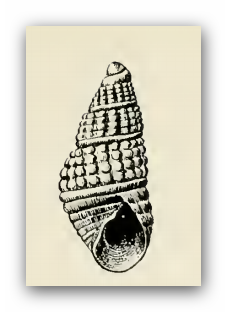
The shell is thin, ovate and white to light ashy beneath an ash-colored epidermis. The protoconch whorls are decollated, and the teleoconch consists of four rapidly increasing whorls.[1][2][3]
The teleoconch whorls are inflated and curved, with a more pronounced curve forming an evenly rounded shoulder on their posterior third. Their summits are slightly flattened and narrow, making the sutures distinct.[4][5]
The sutures are very slightly impressed and closely spirally striated. The body whorl has a slightly angular periphery, and the base narrows abruptly below it, producing a concave appearance between the periphery and umbilical area.[6][7][8]
The shell surface bears fine growth lines and numerous closely spaced spiral ridges. Five ridges are slightly stronger than the others and divide the area between the sutures into approximately equal sections.[9][10]
The last whorl has approximately 30 spiral threads between its summit and periphery, while the shell base bears approximately 60 spiral threads.[11][12]
The aperture is very large and open anteriorly. The outer lip is thin at its edge but very thick internally.[13][14]
The columella is strongly curved and revolute, with reinforcement extending to its edge from the attenuated base. It has a strong oblique fold at its insertion and a transverse, acute columellar tooth.[15][16][17]
The shell measures 6.5 mm in length.[18]
Habitat
The species occurs in the Pacific Ocean off California and Washington.[19]
Classification of Odostomia inflata
| Kingdom | Animalia |
|---|---|
| Phylum | Mollusca |
| Class | Gastropoda (Gastropod) |
| Subclass | Heterobranchia |
| Infraclass | Euthyneura |
| Subterclass | Tectipleura |
| Superorder | Pylopulmonata |
| Superfamily | Pyramidelloidea |
| Family | Pyramidellidae (Pyrams) |
| Subfamily | Odostomiinae |
| Genus | Odostomia |
| Species | Odostomia inflata P. P. Carpenter, 1864 |
Where Odostomia inflata is found
Checklists and occurrence records place Odostomia inflata in 1 country. GBIF holds 18 georeferenced records of it.
Countries
Regions and cities with the most records
- Alameda, United States 8
- Albany, United States 8
- Bayview-Hunters Point, United States 8
- Berkeley, United States 8
- Oakland, United States 8
- San Francisco, United States 8
- San Leandro, United States 8
- El Cerrito, United States 7
- Moraga, United States 7
- Orinda, United States 7
- Richmond, United States 7
- Daly City, United States 6
- South San Francisco, United States 6
- California, United States 5
- Ashland, United States 4
- San Lorenzo, United States 4
A number beside a place is its count of GBIF occurrence records. A place without a number comes from a checklist alone. Records show where a species has been observed or collected, which can include escapes and vagrants.
Related species
- Odostomia limpida
-
 Odostomia kromi
-
 Odostomia acuta
-
 Odostomia turrita
- Odostomia plicata
-
 Odostomia promeces
-
 Odostomia calliope
-
 Odostomia canfieldi
Compare
Questions and answers
Where does Odostomia inflata occur?
It occurs in the Pacific Ocean off California and Washington.[19]
What is the shell size?
The shell measures 6.5 mm in length.[18]
Sources
Passages the profile rests on
- The shell is thin, ovate, and white to light ashy beneath an ash-colored epidermis. Source passage: “The thin, ovate shell is white to light ashy, covered under an ash-colored epidermis.” — English Wikipedia
- The protoconch whorls are decollated. Source passage: “The whorls of the protoconch are decollated.” — English Wikipedia
- The teleoconch consists of four rapidly increasing whorls. Source passage: “There are four rapidly increasing whorls in the teleoconch.” — English Wikipedia
- The teleoconch whorls are inflated and curved, with a more pronounced curve forming an evenly rounded shoulder on their posterior third. Source passage: “These are inflated, gently curved over the anterior two-thirds of the whorl between the sutures and more strongly so on the posterior third this portion forming an evenly curved shoulder.” — English Wikipedia
- The whorl summits are slightly flattened and narrow, making the sutures distinct. Source passage: “The extreme summit of the whorls are slightly flattened and narrow, rendering the sutures well marked.” — English Wikipedia
- The sutures are very slightly impressed and closely spirally striated. Source passage: “The suture is very minutely impressed, and closely spirally striated” — English Wikipedia
- The body whorl has a slightly angular periphery. Source passage: “The periphery of the body whorl is subangulated.” — English Wikipedia
- The shell base narrows abruptly below the periphery, producing a concave appearance between the periphery and umbilical area. Source passage: “The base of the shell is attenuated, rather suddenly contracted below the periphery, which gives the space between the periphery and the umbilical area a concave aspect.” — English Wikipedia
- The shell surface bears fine growth lines and numerous closely spaced spiral ridges. Source passage: “The entire surface is marked by fine lines of growth and many fine, closely placed spiral lirations” — English Wikipedia
- Five spiral ridges are slightly stronger than the others and divide the area between the sutures into approximately equal sections. Source passage: “five of which are a little stronger than the rest and divide the space between the sutures into subequal areas.” — English Wikipedia
- The last whorl has approximately 30 spiral threads between its summit and periphery. Source passage: “There are about 30 of these threads upon the last turn between the summit and the periphery” — English Wikipedia
- The shell base bears approximately 60 spiral threads. Source passage: “about 60 on the base.” — English Wikipedia
- The aperture is very large and open anteriorly. Source passage: “The aperture is very large, patulous anteriorly;” — English Wikipedia
- The outer lip is thin at its edge but very thick internally. Source passage: “The outer lip is thin at the edge but very thick within.” — English Wikipedia
- The columella is strongly curved and revolute, with reinforcement extending to its edge from the attenuated base. Source passage: “The columella is decidedly curved, and revolute, reinforced to the very edge by the attenuated base.” — English Wikipedia
- The columella has a strong oblique fold at its insertion. Source passage: “It is provided with a strong oblique fold at its insertion.” — English Wikipedia
- The columellar tooth is transverse and acute. Source passage: “The columellar tooth is transverse and acute.” — English Wikipedia
- The shell measures 6.5 mm in length. Source passage: “The length of the shell is 6.5 mm.” — English Wikipedia
- The species occurs in the Pacific Ocean off California and Washington. Source passage: “This species occurs in the Pacific Ocean off California and Washington” — English Wikipedia
Data
- Catalogue of Life, 2026-10-16 XR cc by
- Global Biodiversity Information Facility CC BY 4.0
- Wikidata CC0
- GeoNames CC BY 4.0
- Wikimedia Commons per image; credit shown with each image
- Within the Catalogue of Life, this name comes from World Register of Marine Species cc by
References
- Carpenter, P. P. (1864). Supplementary report on the present state of our knowledge with regard to the Mollusca of the West Coast of North America. Reports of the British Association for the Advancement of Science, (1863) 33: 517–686. where the name was published
This species in other databases
Page built on 28 November 2026. See how the catalog is made and all sources and licences.
Cite this page
ScientificNames.org. (2026). Odostomia inflata. Retrieved November 28, 2026, from https://scientificnames.org/species/odostomia-inflata
“Odostomia inflata.” ScientificNames.org, 2026, scientificnames.org/species/odostomia-inflata. Accessed 28 Nov. 2026.
ScientificNames.org. “Odostomia inflata.” Accessed November 28, 2026. https://scientificnames.org/species/odostomia-inflata.
@misc{scientificnames_odostomia_inflata,
  author = {{ScientificNames.org}},
  title = {Odostomia inflata},
  year = {2026},
  url = {https://scientificnames.org/species/odostomia-inflata},
  note = {Accessed 2026-11-28}
}