Species · Insects
Large Tree-cricket Oecanthus dulcisonans
The scientific name of the Large Tree-cricket is Oecanthus dulcisonans. It is a species of insect in the family Oecanthidae (tree and bush crickets), order Orthoptera. The name dates from 1993.
- Scientific name
- Oecanthus dulcisonans Gorochov, 1993
- Common name
- Large Tree-cricket
- Genus
- Oecanthus
- Family
- Oecanthidae (Tree and Bush Crickets)
- Order
- Orthoptera
- Class
- Insecta
- Environment
- terrestrial
- Recorded in
- 13 countries
- Name status
- accepted in the Catalogue of Life

Overview
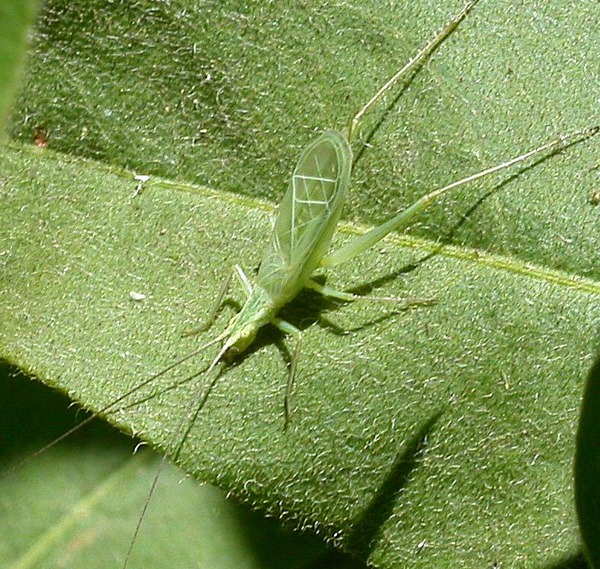
Oecanthus dulcisonans occurs sparsely across a wide area of the Mediterranean Basin and the Middle East, as well as in the Canary Islands. It has yellowish coloration, long forewings covering its abdomen and hind wings considerably longer than its forewings.
Written 26 November 2026 from the sources listed below. Each statement was checked against the passage it cites; statements that could not be supported were removed.
Habitat
The species inhabits both wet and xeric environments. In the Mediterranean region, its geographical range overlaps with that of Oecanthus pellucens.[1][2]
It occurs in several Tyrrhenian coastal regions of Italy, as well as in Sardinia and Sicily. It was originally reported from Saudi Arabia and also occurs in the Canary Islands.[3][4]
Appearance
The overall coloration is yellowish. Its long forewings completely cover the abdomen, while the hind wings are considerably longer than the forewings.[5][6][7]
Adult males measure up to 13–15 millimetres in length. Adult females measure 14–16 millimetres.[8][9]
Diet
The species is omnivorous but feeds predominantly on animal matter.[10]
Behaviour
The species preferentially sings from trees and produces a strong, melodious, continuous trill. Its song has a slightly higher peak frequency than that of Oecanthus pellucens.[11][12][13]
It can alter the elevation of its forewings, making the origin of its sound difficult to identify. It is more active at night than during the day.[14][15]
Adults appear in July and August, and their song remains audible until early autumn. The species can be attracted to artificial light.[16][17]
Reproduction and life cycle
Females deposit eggs inside the stems of various herbaceous plants.[18]
Conservation
The species is probably underrecorded because it is elusive and resembles Oecanthus pellucens.[19]
Similar species
The Large Tree-cricket can be distinguished from Oecanthus pellucens by its larger size, sternal plate shape and male genitalia. Its continuous song differs from the discrete trills of Oecanthus pellucens, which last 0.5–1 second.[20][21]
Classification of the Large Tree-cricket
| Kingdom | Animalia |
|---|---|
| Phylum | Arthropoda |
| Subphylum | Hexapoda |
| Class | Insecta (Insect) |
| Order | Orthoptera |
| Suborder | Ensifera |
| Infraorder | Gryllidea |
| Superfamily | Grylloidea |
| Family | Oecanthidae (Tree and Bush Crickets) |
| Subfamily | Oecanthinae (Tree Crickets) |
| Supertribe | Oecanthidi |
| Tribe | Oecanthini |
| Genus | Oecanthus (Tree Crickets) |
| Species | Oecanthus dulcisonans Gorochov, 1993 |
Where the Large Tree-cricket is found
Checklists and occurrence records place Oecanthus dulcisonans in 13 countries across Asia and Europe. GBIF holds 1,012 georeferenced records of it.
Countries
- Albania 9
- Croatia 9
- Cyprus 9
- France 226
- Greece 49
- Israel 7
- Italy 91
- Malta 14
- Montenegro 9
- Portugal 159
- Spain 426
- Turkey 4
- Yemen
Regions and cities with the most records
- Corsica, France 116
- Catalonia, Spain 79
- Faro, Portugal 75
- Valencia, Spain 71
- Occitanie, France 50
- Provence-Alpes-Côte d'Azur, France 48
- Quelfes, Portugal 47
- Olhão, Portugal 44
- El Campello, Spain 41
- Alicante, Spain 39
- Laranjeiro, Portugal 39
- Mutxamel, Spain 39
- San Vicent del Raspeig, Spain 39
- Sant Joan d'Alacant, Spain 39
- Faro, Portugal 38
- Extremadura, Spain 37
- Bastia, France 33
- Madeira, Portugal 29
- Tavira, Portugal 29
- Caniço, Portugal 28
- Badajoz, Spain 25
- Barberà del Vallès, Spain 25
- Barcelona, Spain 25
- Piedade, Portugal 25
- Badalona, Spain 24
- Balearic Islands, Spain 24
- Campo Grande, Portugal 24
- Cerdanyola del Vallès, Spain 24
- Llefià, Spain 24
- Lumiar, Portugal 24
- Montcada i Reixac, Spain 24
- Odivelas, Portugal 24
- Ripollet, Spain 24
- Sabadell, Spain 24
- Sant Adrià de Besòs, Spain 24
- Sant Cugat del Vallès, Spain 24
3 more countries have a few records outside this range
These countries hold a few records of Oecanthus dulcisonans but lie outside the range the checklists give for it. Such records are often zoo or garden specimens, museum material or vagrants, so the species is not counted as occurring there.
A number beside a place is its count of GBIF occurrence records. A place without a number comes from a checklist alone. Records show where a species has been observed or collected, which can include escapes and vagrants.
Common names
English
- Large Tree-cricket
Names in 4 other languages
- Croatian
- Veliki prozirni šturak
- Dutch
- Grote boomkrekel
- French
- Grillon des Canaries, Grillon mélodieux
- German
- Großes Weinhähnchen
Related species
-
 Snowy Tree CricketOecanthus fultoni
-
 Narrow-winged Tree CricketOecanthus niveus
-
 European Tree-cricketOecanthus pellucens
-
 Broad-winged Tree CricketOecanthus latipennis
-
 Black-horned Tree CricketOecanthus nigricornis
-
 Tamarack Tree CricketOecanthus laricis
-
 Pine Tree CricketOecanthus pini
-
 Davis' Tree CricketOecanthus exclamationis
Compare
Questions and answers
What is the scientific name of the Large Tree-cricket?
The scientific name of the Large Tree-cricket is Oecanthus dulcisonans. Written with its author, the full name is Oecanthus dulcisonans Gorochov, 1993.
Which family does the Large Tree-cricket belong to?
Oecanthus dulcisonans belongs to the family Oecanthidae, in the order Orthoptera and the class Insecta.
Where is the Large Tree-cricket found?
Checklists and occurrence records place Oecanthus dulcisonans in 13 countries, including Spain, France, Portugal, Italy, Greece and Malta.
What does a tree cricket eat?
The Large Tree-cricket is omnivorous but feeds predominantly on animal matter.[10]
Sources
Passages the profile rests on
- In the Mediterranean region, the species' geographical range overlaps with that of Oecanthus pellucens. Source passage: “In the Mediterranean area, its range overlaps that of its congener O. pellucens.” — English Wikipedia
- The species inhabits both wet and xeric environments. Source passage: “can be found both in wet and in xeric environments.” — English Wikipedia
- The species occurs in several Tyrrhenian coastal regions of Italy, as well as in Sardinia and Sicily. Source passage: “The species can be found in several Thyrrhenian coastal regions of Italy, as well as in Sardinia and Sicily.” — English Wikipedia
- The species was originally reported from Saudi Arabia and also occurs in the Canary Islands. Source passage: “O. dulcisonans was originally reported from Saudi Arabia and is present also in the Canary Islands.” — English Wikipedia
- The overall coloration of the species is yellowish. Source passage: “The overall color is yellowish.” — English Wikipedia
- The species has long forewings that completely cover its abdomen. Source passage: “Long forewings cover entirely the abdomen” — English Wikipedia
- The hind wings are considerably longer than the forewings. Source passage: “hind wings are decidedly longer.” — English Wikipedia
- Adult males measure up to 13–15 millimetres in length. Source passage: “The adult males grow up to 13–15 millimetres” — English Wikipedia
- Adult females measure 14–16 millimetres in length. Source passage: “while females reach 14–16 millimetres” — English Wikipedia
- The species is omnivorous but feeds predominantly on animal matter. Source passage: “O. dulcisonans is omnivorous but mainly zoophagous” — English Wikipedia
- The species preferentially sings from trees. Source passage: “O. dulcisonans sings preferentially from trees” — English Wikipedia
- The species produces a strong, melodious, continuous trill. Source passage: “the strong and melodious trill of the former is continuous” — English Wikipedia
- The species produces a song with a slightly higher peak frequency than Oecanthus pellucens. Source passage: “Furthermore, peak frequency by O. dulcisonans is slightly higher.” — English Wikipedia
- The species can alter the elevation of its forewings, making the origin of its sound difficult to identify. Source passage: “the insect can vary the elevation of the forewings making difficult to identify the provenance of the sound” — English Wikipedia
- The species is more active at night than during the day. Source passage: “and is more active at night.” — English Wikipedia
- Adults appear in July and August, and their song remains audible until early autumn. Source passage: “Adults appear in July / August and their song can be heard until early autumn.” — English Wikipedia
- The species can be attracted to artificial light. Source passage: “it can be attracted to artificial light.” — English Wikipedia
- Females deposit eggs inside the stems of various herbaceous plants. Source passage: “Eggs are deposed into the stem of various herbaceous plants.” — English Wikipedia
- The species is probably underrecorded because it is elusive and resembles Oecanthus pellucens. Source passage: “This species is most probably underrecorded due to its elusiveness and its similarity with O. pellucens.” — English Wikipedia
- The species can be distinguished from Oecanthus pellucens by its larger size, sternal plate shape, and male genitalia. Source passage: “It can be distinguished from O. pellucens by its bigger size, by the different shape of the sternal plate, and by the male genitalia.” — English Wikipedia
- Its continuous song differs from the discrete trills of Oecanthus pellucens, which last 0.5–1 second. Source passage: “as opposed to the equal, discrete 0.5sec - 1sec trills of O. pellucens.” — English Wikipedia
- The species occurs sparsely but across a wide area of the Mediterranean Basin and the Middle East. Source passage: “Oecanthus dulcisonans is a species of cricket sparsely but widely distributed in the Mediterranean Basin and in the Middle East.” — English Wikipedia
Data
- Catalogue of Life, 2026-10-16 XR cc by
- Global Biodiversity Information Facility CC BY 4.0
- Wikidata CC0
- GeoNames CC BY 4.0
- Wikimedia Commons per image; credit shown with each image
- Within the Catalogue of Life, this name comes from Orthoptera Species File cc by
References
- Gorochov, A.V. (1993) Grylloidea (Orthoptera) of Saudi Arabia and adjacent countries. In Fauna of Saudi Arabia. Ciba-Geigy Ltd., Basel. Vol. 13, 79–97 pp. Available at http://gryllus.smart21.ru/gryllus/Gorochov%27s%20papers%20in%20PDF%20and%20list%20of%20his%20publications/1993%20%2863-68%29/63%20Grylloidea%20of%20Saudi%20Arabia%201993.pdf where the name was published
This species in other databases
Page built on 27 November 2026. See how the catalog is made and all sources and licences.
Cite this page
ScientificNames.org. (2026). Oecanthus dulcisonans (Large Tree-cricket). Retrieved November 27, 2026, from https://scientificnames.org/species/oecanthus-dulcisonans
“Oecanthus dulcisonans (Large Tree-cricket).” ScientificNames.org, 2026, scientificnames.org/species/oecanthus-dulcisonans. Accessed 27 Nov. 2026.
ScientificNames.org. “Oecanthus dulcisonans (Large Tree-cricket).” Accessed November 27, 2026. https://scientificnames.org/species/oecanthus-dulcisonans.
@misc{scientificnames_oecanthus_dulcisonans_large_tree_cricket,
  author = {{ScientificNames.org}},
  title = {Oecanthus dulcisonans (Large Tree-cricket)},
  year = {2026},
  url = {https://scientificnames.org/species/oecanthus-dulcisonans},
  note = {Accessed 2026-11-27}
}