Species · Insects
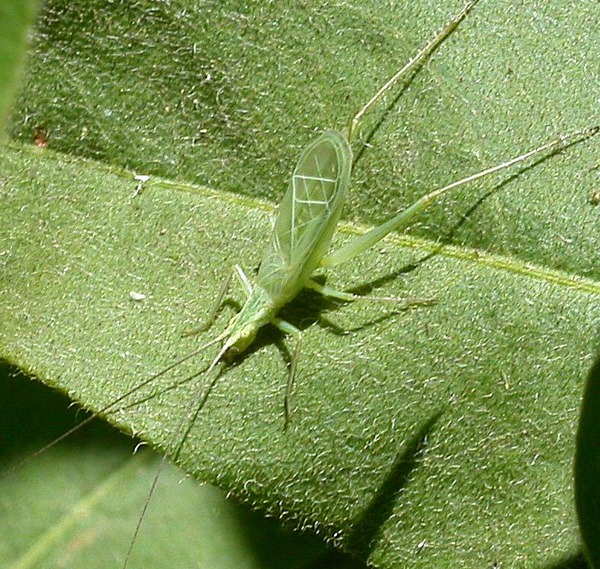
Narrow-winged Tree Cricket Oecanthus niveus
The scientific name of the Narrow-winged Tree Cricket is Oecanthus niveus. It is a species of insect in the family Oecanthidae (tree and bush crickets), order Orthoptera. The name dates from 1773.
- Scientific name
- Oecanthus niveus (De Geer, 1773)
- Common name
- Narrow-winged Tree Cricket
- Genus
- Oecanthus
- Family
- Oecanthidae (Tree and Bush Crickets)
- Order
- Orthoptera
- Class
- Insecta
- Environment
- terrestrial
- Recorded in
- 3 countries
- Name status
- accepted in the Catalogue of Life

Overview
Oecanthus niveus occurs primarily in eastern North America south of Canada and also in the Caribbean. Adults are pale green with a pale orange head, an orange cap and a dark streak along the middle of the pronotum.
Written 26 November 2026 from the sources listed below. Each statement was checked against the passage it cites; statements that could not be supported were removed.
Appearance
Adults are pale green with a pale orange head and an orange cap on top of the head. A dark streak runs along the middle of the pronotum.[1][2]
Adults typically measure 13–16 mm in length.[3]
Habitat
The narrow-winged tree cricket occurs on broad-leaved trees and can be found in man-made orchards.[4][5]
Behaviour
Male calling rate increases and song pitch rises as temperature increases.[6]
At 25°C, the male song has an average pulse rate of 71 per second and a frequency of 3.0 kHz.[7][8]
The species' songs are most commonly heard at night during late summer and autumn.[9]
Classification of the Narrow-winged Tree Cricket
| Kingdom | Animalia |
|---|---|
| Phylum | Arthropoda |
| Subphylum | Hexapoda |
| Class | Insecta (Insect) |
| Order | Orthoptera |
| Suborder | Ensifera |
| Infraorder | Gryllidea |
| Superfamily | Grylloidea |
| Family | Oecanthidae (Tree and Bush Crickets) |
| Subfamily | Oecanthinae (Tree Crickets) |
| Supertribe | Oecanthidi |
| Tribe | Oecanthini |
| Genus | Oecanthus (Tree Crickets) |
| Species | Oecanthus niveus (De Geer, 1773) |
Where the Narrow-winged Tree Cricket is found
Checklists and occurrence records place Oecanthus niveus in 3 countries across North America. GBIF holds 4,950 georeferenced records of it.
Countries
Regions and cities with the most records
- Ontario, Canada 501
- New York, United States 455
- Ohio, United States 347
- Massachusetts, United States 300
- Texas, United States 242
- Pennsylvania, United States 224
- Illinois, United States 217
- North Carolina, United States 187
- Virginia, United States 143
- Connecticut, United States 134
- Michigan, United States 127
- Maryland, United States 121
- New Jersey, United States 115
- Newton, United States 99
- Quebec, Canada 96
- Tennessee, United States 96
- Waltham, United States 93
- Watertown, United States 92
- Brighton, United States 91
- Chestnut Hill, United States 91
- Allston, United States 90
- Roxbury Crossing, United States 90
- Mission Hill, United States 89
- Back Bay, United States 88
- Brookline, United States 88
- Roslindale, United States 88
- Ashmont, United States 86
- Dorchester, United States 86
- Belmont, United States 85
- Boston, United States 82
- East Boston, United States 82
- Lexington, United States 81
- Mattapan, United States 81
- Arlington, United States 80
- Cambridge, United States 80
- Charlestown, United States 80
A number beside a place is its count of GBIF occurrence records. A place without a number comes from a checklist alone. Records show where a species has been observed or collected, which can include escapes and vagrants.
Common names
English
- Narrow-winged Tree Cricket
Names in 2 other languages
- French
- Oecanthe sifflet
- Russian
- Сверчок стеблевой снежный
Synonyms
2 other scientific names have been used for this species and are now treated as synonyms of Oecanthus niveus.
- Acheta niveus (De Geer, 1773)
- Oecanthus niveus var. angustipennis Fitch, 1856
Related species
-
 Snowy Tree CricketOecanthus fultoni
-
 European Tree-cricketOecanthus pellucens
-
 Large Tree-cricketOecanthus dulcisonans
-
 Broad-winged Tree CricketOecanthus latipennis
-
 Black-horned Tree CricketOecanthus nigricornis
-
 Tamarack Tree CricketOecanthus laricis
-
 Pine Tree CricketOecanthus pini
-
 Davis' Tree CricketOecanthus exclamationis
Compare
Questions and answers
What is the scientific name of the Narrow-winged Tree Cricket?
The scientific name of the Narrow-winged Tree Cricket is Oecanthus niveus. Written with its author, the full name is Oecanthus niveus (De Geer, 1773).
Which family does the Narrow-winged Tree Cricket belong to?
Oecanthus niveus belongs to the family Oecanthidae, in the order Orthoptera and the class Insecta.
Where is the Narrow-winged Tree Cricket found?
Checklists and occurrence records place Oecanthus niveus in 3 countries: United States, Canada and Cuba.
Sources
Passages the profile rests on
- Adult individuals are pale green with a pale orange head and an orange cap on top of the head. Source passage: “They are a pale green with a pale orange head, and feature a dark streak running medially along the pronotum. On top of the head is an orange cap.” — English Wikipedia
- Adults have a dark streak running along the middle of the pronotum. Source passage: “feature a dark streak running medially along the pronotum.” — English Wikipedia
- Adults typically measure 13–16 mm in length. Source passage: “Adult O. niveus are typically 13-16mm in length.” — English Wikipedia
- This species occurs on broad-leaved trees. Source passage: “O. niveus can be found on broad-leaved trees,” — English Wikipedia
- This species can be found in man-made orchards. Source passage: “and in man-made orchards.” — English Wikipedia
- Male calling rate increases and song pitch rises as temperature increases. Source passage: “with warmer temperatures resulting in more rapid calling at a higher pitch.” — English Wikipedia
- At 25°C, the male song has an average pulse rate of 71 per second. Source passage: “At 25°C, the pulse rate averages 71/sec” — English Wikipedia
- At 25°C, the male song has a frequency of 3.0 kHz. Source passage: “at a frequency of 3.0 kHz.” — English Wikipedia
- The species' songs are most commonly heard at night during late summer and autumn. Source passage: “Songs are most often heard at night in late summer and autumn.” — English Wikipedia
- This species occurs primarily in eastern North America south of Canada. Source passage: “it is found primarily in Eastern North America south of Canada,” — English Wikipedia
- This species also occurs in the Caribbean. Source passage: “and also in the Caribbean.” — English Wikipedia
Data
- Catalogue of Life, 2026-10-16 XR cc by
- Global Biodiversity Information Facility CC BY 4.0
- Wikidata CC0
- GeoNames CC BY 4.0
- Wikimedia Commons per image; credit shown with each image
- Within the Catalogue of Life, this name comes from Orthoptera Species File cc by
References
- De Geer, C. (1773) Mémoires pour servir à l'histoire des insectes. Pierre Hesselberg, Stockholm, Vol. 3, 696 pp., 44 pls. Available at http://books.google.com/books?id=emJNAAAAYAAJ where the name was published
This species in other databases
Page built on 27 November 2026. See how the catalog is made and all sources and licences.
Cite this page
ScientificNames.org. (2026). Oecanthus niveus (Narrow-winged Tree Cricket). Retrieved November 27, 2026, from https://scientificnames.org/species/oecanthus-niveus
“Oecanthus niveus (Narrow-winged Tree Cricket).” ScientificNames.org, 2026, scientificnames.org/species/oecanthus-niveus. Accessed 27 Nov. 2026.
ScientificNames.org. “Oecanthus niveus (Narrow-winged Tree Cricket).” Accessed November 27, 2026. https://scientificnames.org/species/oecanthus-niveus.
@misc{scientificnames_oecanthus_niveus_narrow_winged_tree_cricket,
  author = {{ScientificNames.org}},
  title = {Oecanthus niveus (Narrow-winged Tree Cricket)},
  year = {2026},
  url = {https://scientificnames.org/species/oecanthus-niveus},
  note = {Accessed 2026-11-27}
}