Species · Insects
European Tree-cricket Oecanthus pellucens
The scientific name of the European Tree-cricket is Oecanthus pellucens. It is a species of insect in the family Oecanthidae (tree and bush crickets), order Orthoptera. The name dates from 1763.
- Scientific name
- Oecanthus pellucens (Scopoli, 1763)
- Common name
- European Tree-cricket
- Genus
- Oecanthus
- Family
- Oecanthidae (Tree and Bush Crickets)
- Order
- Orthoptera
- Class
- Insecta
- Red List category
- LC Least Concern
- Environment
- terrestrial
- Recorded in
- 44 countries
- Name status
- accepted in the Catalogue of Life

Overview
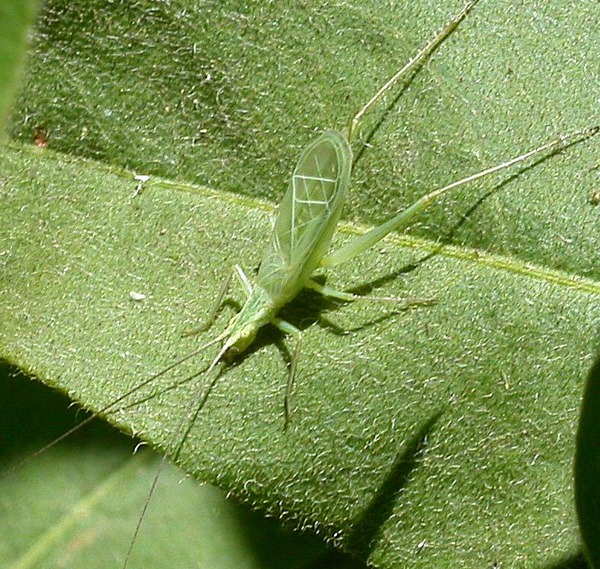
Oecanthus pellucens occurs across most of Europe, particularly in Mediterranean countries and Southern Europe, as well as in the eastern Palearctic, the Near East and North Africa. It has a yellowish-brown or straw-coloured, elongated and slender body, with antennae longer than its body.
Written 26 November 2026 from the sources listed below. Each statement was checked against the passage it cites; statements that could not be supported were removed.
Appearance
The European Tree-cricket has yellowish-brown or straw-coloured coloration. Its body is very elongated and slender, and its antennae are longer than its body.[1][2][3]
Its wings generally extend slightly beyond the abdomen, although their length can vary. Males have larger wings than females.[4][5]
Adult males reach a body length of 10–13 millimetres, while adult females measure approximately 11–14 millimetres. Females possess a long, slightly curved ovipositor with a club-shaped tip.[6][7][8]
Habitat
The European Tree-cricket typically inhabits sunny meadows with tall vegetation. It also occurs in dry, warm and nutrient-poor environments, including grasslands, sand dunes and brownfield sites.[9][10]
Behaviour
Adult individuals can be observed from July through October. The species is mainly nocturnal.[11][12]
Males produce sounds by rubbing their wings together. They sing from approximately five o'clock in the evening until three o'clock in the morning and begin singing a few days after their final moult.[13][14][15]
Reproduction and life cycle
After mating, females lay their eggs in plant stems. Grapevine (Vitis vinifera) is a particularly common plant for egg deposition.[16][17]
During June, nymphs inhabit plant tissues and leaves.[18]
Diet
The European Tree-cricket has an omnivorous diet. Its plant-based food includes leaves and delicate flower parts such as pollen and petals.[19][20]
Its animal-based food includes aphids, spiders and insect larvae.[21]
Similar species
Oecanthus dulcisonans is a closely related and very similar species occurring in Southern Europe.[22]
Two subspecies are listed: Oecanthus pellucens calinensis and Oecanthus pellucens pellucens.[23]
Classification of the European Tree-cricket
| Kingdom | Animalia |
|---|---|
| Phylum | Arthropoda |
| Subphylum | Hexapoda |
| Class | Insecta (Insect) |
| Order | Orthoptera |
| Suborder | Ensifera |
| Infraorder | Gryllidea |
| Superfamily | Grylloidea |
| Family | Oecanthidae (Tree and Bush Crickets) |
| Subfamily | Oecanthinae (Tree Crickets) |
| Supertribe | Oecanthidi |
| Tribe | Oecanthini |
| Genus | Oecanthus (Tree Crickets) |
| Species | Oecanthus pellucens (Scopoli, 1763) |
Where the European Tree-cricket is found
Checklists and occurrence records place Oecanthus pellucens in 44 countries across Africa, Asia and Europe. GBIF holds 43,873 georeferenced records of it.
Countries
- Albania 22
- Algeria 1
- Armenia 5
- Austria 1,716
- Azerbaijan 1
- Belarus 4
- Belgium 959
- Bosnia and Herzegovina 25
- Bulgaria 190
- Croatia 165
- Cyprus 10
- Czechia 184
- France 16,700
- Georgia 40
- Germany 7,537
- Greece 127
- Hungary 622
- Israel 7
- Italy 577
- Kazakhstan 2
- Kosovo 7
- Lebanon 4
- Libya
- Liechtenstein 25
- Luxembourg 352
- Moldova 10
- Montenegro 23
- Morocco 1
- North Macedonia 10
- Poland 160
- Portugal 369
- Romania 321
- Russia 381
- Saudi Arabia
- Serbia 735
- Slovakia 98
- Slovenia 21
- Spain 1,160
- Switzerland 7,630
- Tanzania 15
- The Netherlands 3,191
- Turkey 21
- Ukraine 381
- United Kingdom 64
Regions and cities with the most records
- Auvergne-Rhône-Alpes, France 2,859
- Île-de-France, France 2,410
- Provence-Alpes-Côte d'Azur, France 2,217
- Elst, The Netherlands 2,189
- Gelderland, The Netherlands 2,185
- Rheinland-Pfalz, Germany 2,145
- Huissen, The Netherlands 2,138
- Nijmegen, The Netherlands 2,136
- Beuningen, The Netherlands 2,097
- Duiven, The Netherlands 2,087
- Velp, The Netherlands 2,067
- Arnhem, The Netherlands 2,059
- Zevenaar, The Netherlands 2,053
- Groesbeek, The Netherlands 1,944
- Didam, The Netherlands 1,907
- Occitanie, France 1,885
- Kleve, Germany 1,754
- Centre-Val de Loire, France 1,731
- Valais, Switzerland 1,571
- Vernier, Switzerland 1,437
- Meyrin, Switzerland 1,431
- Emmerich, Germany 1,428
- Wijchen, The Netherlands 1,340
- Onex, Switzerland 1,304
- Carouge, Switzerland 1,293
- Geneva, Switzerland 1,283
- Grand Est, France 1,168
- Carrières-sous-Poissy, France 1,166
- Poissy, France 1,166
- Gennep, The Netherlands 1,158
- Verneuil-sur-Seine, France 1,142
- Jouy-le-Moutier, France 1,139
- Saint-Germain-en-Laye, France 1,138
- Le Pecq, France 1,136
- Montesson, France 1,132
- Le Vésinet, France 1,131
1 more country has a few records outside this range
These countries hold a few records of Oecanthus pellucens but lie outside the range the checklists give for it. Such records are often zoo or garden specimens, museum material or vagrants, so the species is not counted as occurring there.
A number beside a place is its count of GBIF occurrence records. A place without a number comes from a checklist alone. Records show where a species has been observed or collected, which can include escapes and vagrants.
Common names
English
- European Tree-cricket
- Italian Tree Cricket
- Tree Cricket
- Tree-cricket
Names in 19 other languages
- Asturian
- grillu italianu
- Catalan
- Grill de palla, Grill italià
- Croatian
- Vinogradski prozirni šturak
- Czech
- cvrčivec révový
- Danish
- Træfårekylling
- Dutch
- Boomkrekel, Wijnhaantje, wijnkrekel
- French
- Grillon d'Italie, Grillon transparent, Oecanthe transparent, grillon ditalie
- German
- Europäisches Weinhähnchen, Weinhahnchen, Weinhähnchen, Weinhähnchen (Blütengrille)
- Hebrew
- צרשיח עדין
- Hungarian
- Közönséges pirregő tücsök, pirregőtücsök
- Italian
- Grillo arboricolo italiano
- Polish
- Nakwietnik trębacz
- Portuguese
- Grilo-Italiano
- Russian
- Обыкновенный стеблевой сверчок, Трубачик обыкновенный
- Serbian
- Италијански попац
- Slovak
- Jesienka spevavá
- Slovenian
- vinski čriček
- Turkish
- Bağ Horozcuğu, İtalyan Ağaç Kriketi
- Ukrainian
- трубарик стебловий
Synonyms
2 other scientific names have been used for this species and are now treated as synonyms of Oecanthus pellucens.
- Gryllus pellucens Scopoli, 1763
- Meconema varia Fischer von Waldheim, 1846
Subspecies and varieties
- Oecanthus pellucens calinensis subspecies
- Oecanthus pellucens pellucens (Italian Cricket) subspecies
Related species
-
 Snowy Tree CricketOecanthus fultoni
-
 Narrow-winged Tree CricketOecanthus niveus
-
 Large Tree-cricketOecanthus dulcisonans
-
 Broad-winged Tree CricketOecanthus latipennis
-
 Black-horned Tree CricketOecanthus nigricornis
-
 Tamarack Tree CricketOecanthus laricis
-
 Pine Tree CricketOecanthus pini
-
 Davis' Tree CricketOecanthus exclamationis
Compare
Questions and answers
What is the scientific name of the European Tree-cricket?
The scientific name of the European Tree-cricket is Oecanthus pellucens. Written with its author, the full name is Oecanthus pellucens (Scopoli, 1763).
Which family does the European Tree-cricket belong to?
Oecanthus pellucens belongs to the family Oecanthidae, in the order Orthoptera and the class Insecta.
Where is the European Tree-cricket found?
Checklists and occurrence records place Oecanthus pellucens in 44 countries, including France, Switzerland, Germany, The Netherlands, Austria and Spain.
What is the conservation status of the European Tree-cricket?
The IUCN Red List category recorded for Oecanthus pellucens is Least Concern (LC).
What other names does the European Tree-cricket have?
Oecanthus pellucens is also known in English as Italian Tree Cricket, Tree Cricket and Tree-cricket.
Where are tree crickets found?
The European Tree-cricket occurs across most of Europe, particularly in Mediterranean countries and Southern Europe. Its northern distribution boundary extends through northern France, Belgium, southern Germany, the Czech Republic and southern Poland. It also occurs in the eastern Palearctic, the Near East and North Africa. A seemingly viable British colony was first discovered near Dungeness in Kent in 2015.[24][25][26][27]
What does a tree cricket eat?
The European Tree-cricket is omnivorous. It eats leaves, pollen and petals, as well as aphids, spiders and insect larvae.[19][20][21]
Sources
Passages the profile rests on
- The species has yellowish-brown or straw-coloured coloration. Source passage: “The colouration of Oecanthus pellucens is yellowish-brown, straw-colored.” — English Wikipedia
- Its body is very elongated and slender. Source passage: “The body is very elongated and slender.” — English Wikipedia
- Its antennae are longer than its body. Source passage: “The antennae are longer than the body.” — English Wikipedia
- Its wings generally extend slightly beyond the abdomen, although their length can vary. Source passage: “The wings usually protrude out slightly above the abdomen, but can be shorter or longer.” — English Wikipedia
- Male individuals have larger wings than females. Source passage: “The wings of the males are larger than those of females.” — English Wikipedia
- Adult males reach a body length of 10–13 millimetres. Source passage: “The adult males grow up to 10–13 millimetres (0.39–0.51 in) long” — English Wikipedia
- Adult females measure approximately 11–14 millimetres in length. Source passage: “the female is slightly larger than the male, about 11–14 millimetres (0.43–0.55 in) long.” — English Wikipedia
- Females possess a long, slightly curved ovipositor with a club-shaped tip. Source passage: “The ovipositor of the female is long and slightly curved. The females are recognizable by the club-shaped end of the ovipositor.” — English Wikipedia
- The species typically inhabits sunny meadows with tall vegetation. Source passage: “The typical habitat of Oecanthus pellucens are sunny meadows with high vegetation” — English Wikipedia
- The species inhabits dry, warm and nutrient-poor environments, including grasslands, sand dunes and brownfield sites. Source passage: “dry warm and nutrient-poor areas such as grasslands, sand dunes and brownfield lands.” — English Wikipedia
- Adult individuals can be observed from July through October. Source passage: “Adults can be encountered from July through October.” — English Wikipedia
- The species is mainly nocturnal. Source passage: “These crickets are mainly nocturnal.” — English Wikipedia
- Males produce sounds by rubbing their wings together. Source passage: “The males rub their wings together (stridulation) to produce a subtle but constant, fluctuating in volume sound.” — English Wikipedia
- Males sing from approximately five o'clock in the evening until three o'clock in the morning. Source passage: “They sing from about five o'clock until three o'clock in the morning.” — English Wikipedia
- Males begin singing a few days after their final moult. Source passage: “A few days after the last molt the male begins to sing.” — English Wikipedia
- Females lay their eggs in plant stems after mating. Source passage: “After mating, the female lays her eggs in plant stems” — English Wikipedia
- Grapevine (Vitis vinifera) is a particularly common plant for egg deposition. Source passage: “especially in grape (Vitis vinifera).” — English Wikipedia
- Nymphs inhabit plant tissues and leaves during June. Source passage: “In June the nymphs live in the tissue and leaves of the plant.” — English Wikipedia
- The species has an omnivorous diet. Source passage: “These crickets are omnivorous” — English Wikipedia
- Its plant-based food includes leaves and delicate flower parts such as pollen and petals. Source passage: “usually feed on leaves or delicate flower parts such as pollen and petals” — English Wikipedia
- Its animal-based food includes aphids, spiders and insect larvae. Source passage: “but also on animal foods such as aphids, spiders and insect larvae.” — English Wikipedia
- Oecanthus dulcisonans is a closely related and very similar species occurring in Southern Europe. Source passage: “In southern Europe there is also the closely related and very similar species Oecanthus dulcisonans.” — English Wikipedia
- The species has two listed subspecies: Oecanthus pellucens calinensis and Oecanthus pellucens pellucens. Source passage: “Oecanthus pellucens calinensis Jannone, 1936 Oecanthus pellucens pellucens (Scopoli, 1763)” — English Wikipedia
- The species occurs across most of Europe, particularly in Mediterranean countries and Southern Europe. Source passage: “This species is present in most of Europe, especially in the countries around the Mediterranean with a focus on Southern Europe.” — English Wikipedia
- The northern distribution boundary extends through northern France, Belgium, southern Germany, the Czech Republic and southern Poland. Source passage: “The northern boundary runs through northern France, Belgium, southern Germany, the Czech Republic and southern Poland.” — English Wikipedia
- A seemingly viable British colony was first discovered near Dungeness in Kent in 2015. Source passage: “The first, apparently viable, British colony was discovered near Dungeness in Kent in 2015.” — English Wikipedia
- The species also occurs in the eastern Palearctic, the Near East and North Africa. Source passage: “It is also present in the eastern Palearctic realm, in the Near East, and in North Africa.” — English Wikipedia
Data
- Catalogue of Life, 2026-10-16 XR cc by
- Global Biodiversity Information Facility CC BY 4.0
- Wikidata CC0
- GeoNames CC BY 4.0
- Wikimedia Commons per image; credit shown with each image
- Within the Catalogue of Life, this name comes from Orthoptera Species File cc by
References
- Scopoli, J.A. (1763) Entomologia carniolica, exibens Insecta Carniolae indigera. Vindobonae, 420 pp. Available at http://www.biodiversitylibrary.org/item/209872#page/5/mode/1up where the name was published
This species in other databases
Page built on 27 November 2026. See how the catalog is made and all sources and licences.
Cite this page
ScientificNames.org. (2026). Oecanthus pellucens (European Tree-cricket). Retrieved November 27, 2026, from https://scientificnames.org/species/oecanthus-pellucens
“Oecanthus pellucens (European Tree-cricket).” ScientificNames.org, 2026, scientificnames.org/species/oecanthus-pellucens. Accessed 27 Nov. 2026.
ScientificNames.org. “Oecanthus pellucens (European Tree-cricket).” Accessed November 27, 2026. https://scientificnames.org/species/oecanthus-pellucens.
@misc{scientificnames_oecanthus_pellucens_european_tree_cricket,
  author = {{ScientificNames.org}},
  title = {Oecanthus pellucens (European Tree-cricket)},
  year = {2026},
  url = {https://scientificnames.org/species/oecanthus-pellucens},
  note = {Accessed 2026-11-27}
}