Species · Fishes
Sailfin Jawfish Opistognathus fenmutis
The scientific name of the Sailfin Jawfish is Opistognathus fenmutis. It is a species of fish in the family Opistognathidae (smilers), order Perciformes. The name dates from 1993.
- Scientific name
- Opistognathus fenmutis Acero P. & Franke, 1993
- Common name
- Sailfin Jawfish
- Genus
- Opistognathus
- Family
- Opistognathidae (Smilers)
- Order
- Perciformes
- Class
- Teleostei
- Red List category
- DD Data Deficient
- Environment
- marine
- Recorded in
- 2 countries
- Name status
- accepted in the Catalogue of Life
Overview
Opistognathus fenmutis is endemic to the tropical Eastern Pacific, with a recorded equatorial distribution from Costa Rica to Ecuador, including the Galapagos, Clipperton, Cocos, and Malpelo islands. It is distinguished by its high, sail-like dorsal fin and differences in upper-jaw shape between males and females.
Written 28 November 2026 from the sources listed below. Each statement was checked against the passage it cites; statements that could not be supported were removed.
Appearance
The Sailfin Jawfish has an elongated, laterally compressed body that tapers toward the rear. Its head is large and bulbous, with a large eye positioned high on the head. The mouth is at the front of the head and extends well behind the eye, as does the upper jaw.[1][2][3][4]
Males have a long, blunt extension of the upper jaw that reaches the belly, while females have a pointed upper-jaw tip. The dorsal fin is high and sail-like, with its middle spiny section reaching the body depth.[5][6][7]
The head and the body anterior to the pectoral-fin base lack scales, while the posterior body is scaled. The body has 102–105 oblique rows of scales. The lateral line occupies only the anterior half of the body and terminates beneath the third soft dorsal-fin ray.[8][9][10]
The body and fins are dark grey, with a slightly lighter belly. Females are paler in coloration than males, and the upper membranes of the tail fin are pale.[11][12][13]
Three violet-blue lines run along each side of the body, accompanied by another line along the back beneath the dorsal-fin base. These body lines extend to the tail. The sides of the head have two blue stripes, and a blue blotch occurs at the upper rear corner of the operculum.[14][15][16][17]
A blue line runs along the upper jaw. The tail fin has a thin blue bar at its base and blue lines on the membranes between its rays. The pelvic fins have a blue anterior border, while the anal fin has a blue outer edge and blue coloration on the membranes between its rays.[18][19][20][21]
Habitat
The Sailfin Jawfish is recorded from soft-bottom substrates including mud, sand, gravel, beaches, estuaries, mangroves, and seagrass habitats.[22]
Diet
Recorded food categories include mobile benthic crustaceans, such as shrimps and crabs, and mobile benthic worms. Its diet also includes octopuses, squids, and cuttlefish.[23][24][25]
Classification of the Sailfin Jawfish
| Kingdom | Animalia |
|---|---|
| Phylum | Chordata |
| Subphylum | Vertebrata |
| Infraphylum | Gnathostomata |
| Parvphylum | Osteichthyes |
| Gigaclass | Actinopterygii |
| Superclass | Actinopteri |
| Class | Teleostei (Teleost) |
| Order | Perciformes |
| Suborder | Percoidei |
| Family | Opistognathidae (Smilers) |
| Genus | Opistognathus (Spotfin Jawfishes) |
| Species | Opistognathus fenmutis Acero P. & Franke, 1993 |
Where the Sailfin Jawfish is found
Checklists and occurrence records place Opistognathus fenmutis in 2 countries. GBIF holds 7 georeferenced records of it.
Countries
A number beside a place is its count of GBIF occurrence records. A place without a number comes from a checklist alone. Records show where a species has been observed or collected, which can include escapes and vagrants.
Common names
English
- Sailfin Jawfish
Names in 4 other languages
- Czech
- studnař kolumbijský
- Mandarin Chinese
- 哥伦比亚后颌鰧, 哥倫比亞後頜鰧
- Portuguese
- Bocão-veleiro
- Spanish
- bocón velero
Related species
-
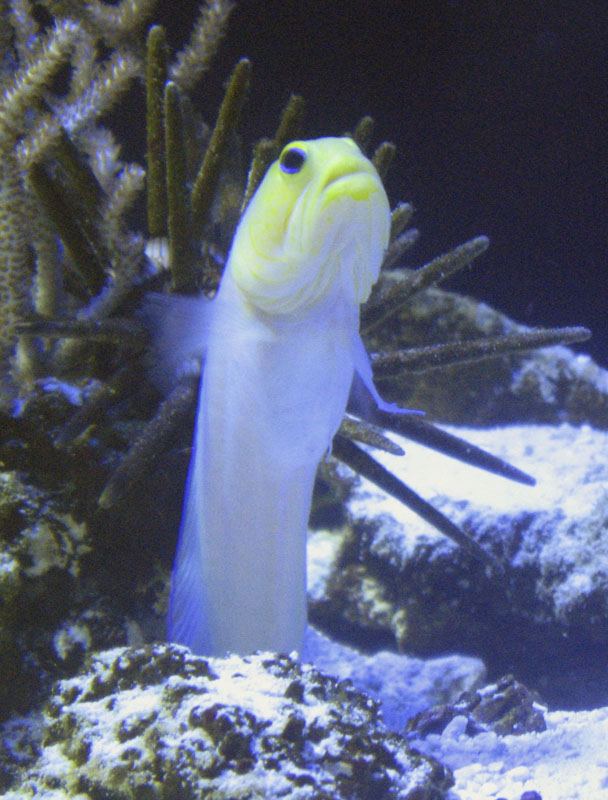 Yellowhead JawfishOpistognathus aurifrons
-
 Blue-spotted JawfishOpistognathus rosenblatti
-
 Bartail JawfishOpistognathus cuvierii
-
 Dusky JawfishOpistognathus whitehursti
-
 Moustache JawfishOpistognathus lonchurus
-
 Robust JawfishOpistognathus muscatensis
-
 Goldspecs JawfishOpistognathus randalli
-
 Fine-spotted JawfishOpistognathus punctatus
Compare
Questions and answers
What is the scientific name of the Sailfin Jawfish?
The scientific name of the Sailfin Jawfish is Opistognathus fenmutis. Written with its author, the full name is Opistognathus fenmutis Acero P. & Franke, 1993.
Which family does the Sailfin Jawfish belong to?
Opistognathus fenmutis belongs to the family Opistognathidae, in the order Perciformes and the class Teleostei.
Where is the Sailfin Jawfish found?
Checklists and occurrence records place Opistognathus fenmutis in 2 countries: Colombia and Costa Rica.
What is the conservation status of the Sailfin Jawfish?
The IUCN Red List category recorded for Opistognathus fenmutis is Data Deficient (DD).
Sources
Passages the profile rests on
- The species has an elongated, laterally compressed body that tapers toward the rear. Source passage: “Elongate, compressed, tapering body” — biogeodb.stri.si.edu
- Its head is large and bulbous, with a large eye positioned high on the head. Source passage: “large bulbous head, eye large, high” — biogeodb.stri.si.edu
- The mouth is positioned at the front of the head and extends well behind the eye. Source passage: “mouth at front, large, extends well to rear of eye” — biogeodb.stri.si.edu
- The upper jaw extends considerably behind the eye. Source passage: “top jaw long, reaches well behind eye” — biogeodb.stri.si.edu
- Males have a long, blunt extension of the upper jaw that reaches the belly. Source passage: “long blunt extension to belly in male” — biogeodb.stri.si.edu
- Females have a pointed tip on the upper jaw. Source passage: “pointed tip in female” — biogeodb.stri.si.edu
- The dorsal fin is high and sail-like, with its middle spiny section reaching the body depth. Source passage: “dorsal fin high and sail-like, middle of spiny part as high as body depth” — biogeodb.stri.si.edu
- The head and the body anterior to the pectoral-fin base lack scales, while the posterior body is scaled. Source passage: “head and body before base of pectoral fin scaleless, scaly thereafter” — biogeodb.stri.si.edu
- The body has 102–105 oblique rows of scales. Source passage: “102-105 oblique scale rows” — biogeodb.stri.si.edu
- The lateral line occupies only the anterior half of the body and terminates beneath the third soft dorsal-fin ray. Source passage: “lateral line on front half of body only, high, ends under 3rd dorsal soft ray” — biogeodb.stri.si.edu
- The body and fins are dark grey, with a slightly lighter belly. Source passage: “Dark grey body and all fins, a little lighter on belly” — biogeodb.stri.si.edu
- Females are paler in coloration than males. Source passage: “female paler than male” — biogeodb.stri.si.edu
- The upper membranes of the tail fin are pale. Source passage: “upper tail membranes pale” — biogeodb.stri.si.edu
- The sides of the body have three violet-blue lines, accompanied by another line along the back beneath the dorsal-fin base. Source passage: “3 violet-blue lines along side and another along back just under base of dorsal fin” — biogeodb.stri.si.edu
- The violet-blue body lines extend to the tail. Source passage: “all reaching to tail” — biogeodb.stri.si.edu
- The sides of the head have two blue stripes. Source passage: “head with 2 blue stripes on side” — biogeodb.stri.si.edu
- A blue blotch occurs at the upper rear corner of the operculum. Source passage: “a blue blotch at top rear corner of operculum” — biogeodb.stri.si.edu
- A blue line runs along the upper jaw. Source passage: “a blue line along top jaw” — biogeodb.stri.si.edu
- The tail fin has a thin blue bar at its base and blue lines on the membranes between its rays. Source passage: “tail fin with thin blue bar at base and blue lines on membranes between fin rays” — biogeodb.stri.si.edu
- The pelvic fins have a blue anterior border. Source passage: “pelvic with blue front border” — biogeodb.stri.si.edu
- The anal fin has a blue outer edge and blue coloration on the membranes between its rays. Source passage: “anal fin with blue outer edge and blue on membranes between rays” — biogeodb.stri.si.edu
- Its recorded soft-bottom substrates include mud, sand, gravel, beaches, estuaries, mangroves, and seagrass habitats. Source passage: “Soft bottom (mud/sand/gravel/beach/estuary/mangrove/seagrass)” — biogeodb.stri.si.edu
- Mobile benthic crustaceans, including shrimps and crabs, are recorded food categories. Source passage: “Mobile benthic crustacea (shrimps/crabs)” — biogeodb.stri.si.edu
- Mobile benthic worms are included among its recorded food categories. Source passage: “Mobile benthic worms” — biogeodb.stri.si.edu
- Octopuses, squids, and cuttlefish are included among its recorded food categories. Source passage: “Octopus/squid/cuttlefish” — biogeodb.stri.si.edu
Data
- Catalogue of Life, 2026-10-16 XR cc by
- Global Biodiversity Information Facility CC BY 4.0
- Wikidata CC0
- GeoNames CC BY 4.0
- Within the Catalogue of Life, this name comes from World Register of Marine Species cc by
References
- Acero, A. P., & Franke, R. (1993). Una nueva especie de Opistognathus (Pisces: Perciformes) para la isla de Gorgona (Pacífico Colombiano). Caldasia 17(2):291-293. where the name was published
This species in other databases
- Catalogue of Life 752H6
- Wikidata Q3500291
- iNaturalist 107714
- WoRMS urn:lsid:marinespecies.org:taxname:276451
- ITIS 645831
Page built on 28 November 2026. See how the catalog is made and all sources and licences.
Cite this page
ScientificNames.org. (2026). Opistognathus fenmutis (Sailfin Jawfish). Retrieved November 28, 2026, from https://scientificnames.org/species/opistognathus-fenmutis
“Opistognathus fenmutis (Sailfin Jawfish).” ScientificNames.org, 2026, scientificnames.org/species/opistognathus-fenmutis. Accessed 28 Nov. 2026.
ScientificNames.org. “Opistognathus fenmutis (Sailfin Jawfish).” Accessed November 28, 2026. https://scientificnames.org/species/opistognathus-fenmutis.
@misc{scientificnames_opistognathus_fenmutis_sailfin_jawfish,
  author = {{ScientificNames.org}},
  title = {Opistognathus fenmutis (Sailfin Jawfish)},
  year = {2026},
  url = {https://scientificnames.org/species/opistognathus-fenmutis},
  note = {Accessed 2026-11-28}
}