Species · Fishes
Yellow Jawfish Opistognathus gilberti
The scientific name of the Yellow Jawfish is Opistognathus gilberti. It is a species of fish in the family Opistognathidae (smilers), order Perciformes. The name dates from 1967.
- Scientific name
- Opistognathus gilberti Böhlke, 1967
- Common name
- Yellow Jawfish
- Genus
- Opistognathus
- Family
- Opistognathidae (Smilers)
- Order
- Perciformes
- Class
- Teleostei
- Red List category
- LC Least Concern
- Environment
- marine
- Recorded in
- 1 country
- Name status
- accepted in the Catalogue of Life
Overview
Opistognathus gilberti is recorded from tropical areas between 10°N and 23°N, including Nicaragua and Cuba, and subtropical areas between 23°N and 35°N, including Florida, the Carolinas, and Bermuda. It has an elongated, compressed body, a large bulbous head, and distinct yellow and blue-grey markings that differ between males and females.
Written 28 November 2026 from the sources listed below. Each statement was checked against the passage it cites; statements that could not be supported were removed.
Appearance
The Yellow Jawfish has an elongated, compressed body that tapers toward the rear and a large, bulbous head. Its large terminal mouth extends well behind the eye, and the rear edge of its upper jaw is straight, expanded, and square-shaped.[1][2][3]
Its pelvic fins have one spine and five rays, consisting of two stout unbranched outer rays and three weaker branched inner rays. Its rounded tail is shorter than its head and measures 19–30% of standard length. The lateral line extends along only the front half of the body and is positioned high, while the scales are small and smooth and the head is scaleless.[4][5][6][7]
Females have dark blue-grey heads and bodies, yellow eyes, and a yellow bar across the head behind the eyes. They have a large oblique yellow blotch on the operculum, a yellow stripe along the lateral line, and dark blue-grey dorsal and anal fins with central yellow stripes. Their yellow tail fin has a blue-grey edge.[8][9][10][11]
Males have blue-grey heads and bodies that become darker toward the rear, with a white underside. They have blue spots around the mouth and beneath and behind the eye, as well as a yellow eye, a yellow bar behind the eyes, and a yellow bar on the operculum. Their dorsal, anal, and pelvic fins are whitish, and the dorsal fin has a conspicuous black spot on its third and fourth spines. The tail fin is black with a white border.[12][13][14][15][16][17]
Habitat
The Yellow Jawfish inhabits burrows in rubble bottoms on steep outer-reef slopes. Its recorded habitat categories include rocky, coral, and oyster reefs.[18][19]
Diet
The Yellow Jawfish feeds on mobile benthic crustaceans, including shrimps and crabs.[20]
Classification of the Yellow Jawfish
| Kingdom | Animalia |
|---|---|
| Phylum | Chordata |
| Subphylum | Vertebrata |
| Infraphylum | Gnathostomata |
| Parvphylum | Osteichthyes |
| Gigaclass | Actinopterygii |
| Superclass | Actinopteri |
| Class | Teleostei (Teleost) |
| Order | Perciformes |
| Suborder | Percoidei |
| Family | Opistognathidae (Smilers) |
| Genus | Opistognathus (Spotfin Jawfishes) |
| Species | Opistognathus gilberti Böhlke, 1967 |
Where the Yellow Jawfish is found
Checklists and occurrence records place Opistognathus gilberti in 1 country. GBIF holds 15 georeferenced records of it.
Countries
A number beside a place is its count of GBIF occurrence records. A place without a number comes from a checklist alone. Records show where a species has been observed or collected, which can include escapes and vagrants.
Common names
English
- Yellow Jawfish
Names in 5 other languages
- Czech
- studnař Gilbertův
- Danish
- Gul kæbefisk
- Mandarin Chinese
- 巴哈馬後頜鰧, 巴哈马后颌鰧
- Portuguese
- Bocão-amarelo
- Spanish
- bocón amarillo
Related species
-
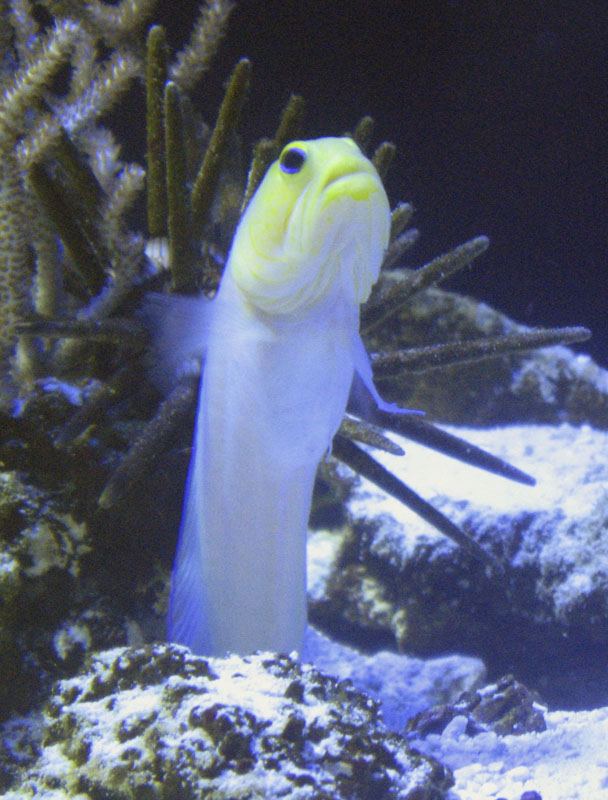 Yellowhead JawfishOpistognathus aurifrons
-
 Blue-spotted JawfishOpistognathus rosenblatti
-
 Bartail JawfishOpistognathus cuvierii
-
 Dusky JawfishOpistognathus whitehursti
-
 Moustache JawfishOpistognathus lonchurus
-
 Robust JawfishOpistognathus muscatensis
-
 Goldspecs JawfishOpistognathus randalli
-
 Fine-spotted JawfishOpistognathus punctatus
Compare
Questions and answers
What is the scientific name of the Yellow Jawfish?
The scientific name of the Yellow Jawfish is Opistognathus gilberti. Written with its author, the full name is Opistognathus gilberti Böhlke, 1967.
Which family does the Yellow Jawfish belong to?
Opistognathus gilberti belongs to the family Opistognathidae, in the order Perciformes and the class Teleostei.
Where is the Yellow Jawfish found?
Checklists and occurrence records place Opistognathus gilberti in 1 country: Bahamas.
What is the conservation status of the Yellow Jawfish?
The IUCN Red List category recorded for Opistognathus gilberti is Least Concern (LC).
What do jawfish eat?
The Yellow Jawfish eats mobile benthic crustaceans such as shrimps and crabs.[20]
Sources
Passages the profile rests on
- The species has an elongated, compressed body that tapers toward the rear and a large, bulbous head. Source passage: “Elongate, compressed, tapering body; large bulbous head” — biogeodb.stri.si.edu
- Its mouth is large, terminally positioned, and extends well behind the eye. Source passage: “mouth terminal, large, extends well to rear of eye” — biogeodb.stri.si.edu
- The rear edge of its upper jaw is straight, noticeably expanded, and square-shaped. Source passage: “rear of top jaw straight, noticeably expanded and square” — biogeodb.stri.si.edu
- Its pelvic fins have one spine and five rays, with two stout unbranched outer rays and three weaker branched inner rays. Source passage: “pelvic fins I, 5, outer 2 rays stout and unbranched, inner 3 rays weaker and branched” — biogeodb.stri.si.edu
- Its rounded tail is shorter than its head and measures 19–30% of standard length. Source passage: “tail rounded, shorter than head, 19-30% of SL” — biogeodb.stri.si.edu
- Its lateral line extends only along the front half of the body and is positioned high. Source passage: “lateral line on front half of body only, high” — biogeodb.stri.si.edu
- Its scales are small and smooth, and its head is scaleless. Source passage: “scales small, smooth, none on head.” — biogeodb.stri.si.edu
- Females have dark blue-grey heads and bodies, yellow eyes, and a yellow bar across the head behind the eyes. Source passage: “Female: head and body dark blue-grey; eye yellow; a yellow bar across top of head at rear of eyes” — biogeodb.stri.si.edu
- Females have a large oblique yellow blotch on the operculum and a yellow stripe along the lateral line. Source passage: “an large oblique yellow blotch on operculum; a yellow stripe along lateral line” — biogeodb.stri.si.edu
- Female dorsal and anal fins are dark blue-grey with central yellow stripes. Source passage: “dorsal and anal fins dark blue-grey, with a central yellow stripe” — biogeodb.stri.si.edu
- The female's yellow tail fin has a blue-grey edge. Source passage: “tail fin yellow, with a blue grey edge.” — biogeodb.stri.si.edu
- Males have blue-grey heads and bodies that become darker toward the rear, with a white underside. Source passage: “Male: head and body blue-grey, darker at rear, underside of belly white” — biogeodb.stri.si.edu
- Males have blue spots around the mouth and beneath and behind the eye. Source passage: “head with blue spots around mouth and under and behind eye” — biogeodb.stri.si.edu
- Males have a yellow eye, a yellow bar behind the eyes, and a yellow bar on the operculum. Source passage: “eye yellow, a yellow bar across top of head at rear of eyes, a yellow bar on operculum” — biogeodb.stri.si.edu
- Male dorsal, anal, and pelvic fins are whitish. Source passage: “dorsal, anal and pelvic fins whitish” — biogeodb.stri.si.edu
- The male dorsal fin has a conspicuous black spot on its third and fourth spines. Source passage: “dorsal fin with a conspicuous black spot on spines III-IV” — biogeodb.stri.si.edu
- The male tail fin is black with a white border. Source passage: “tail fin black with a white border.” — biogeodb.stri.si.edu
- The species inhabits burrows in rubble bottoms on steep outer-reef slopes. Source passage: “In burrows on rubble bottoms on steep outer-reef slopes.” — biogeodb.stri.si.edu
- Its recorded habitat categories include rocky, coral, and oyster reefs. Source passage: “Reef (rock/coral/oyster)” — biogeodb.stri.si.edu
- Its recorded food category includes mobile benthic crustaceans such as shrimps and crabs. Source passage: “Mobile benthic crustacea (shrimps/crabs)” — biogeodb.stri.si.edu
Data
- Catalogue of Life, 2026-10-16 XR cc by
- Global Biodiversity Information Facility CC BY 4.0
- Wikidata CC0
- GeoNames CC BY 4.0
- Within the Catalogue of Life, this name comes from World Register of Marine Species cc by
References
- Böhlke, J. E. (1967). A new sexually dimorphic jawfish (Opistognathus; Opistognathidae) from the Bahamas. Notulae Naturae (Philadelphia), No. 407: 1–12. where the name was published
This species in other databases
- Catalogue of Life 6SQH5
- Wikidata Q3340771
- iNaturalist 618815
- WoRMS urn:lsid:marinespecies.org:taxname:276453
- ITIS 170934
Page built on 29 November 2026. See how the catalog is made and all sources and licences.
Cite this page
ScientificNames.org. (2026). Opistognathus gilberti (Yellow Jawfish). Retrieved November 29, 2026, from https://scientificnames.org/species/opistognathus-gilberti
“Opistognathus gilberti (Yellow Jawfish).” ScientificNames.org, 2026, scientificnames.org/species/opistognathus-gilberti. Accessed 29 Nov. 2026.
ScientificNames.org. “Opistognathus gilberti (Yellow Jawfish).” Accessed November 29, 2026. https://scientificnames.org/species/opistognathus-gilberti.
@misc{scientificnames_opistognathus_gilberti_yellow_jawfish,
  author = {{ScientificNames.org}},
  title = {Opistognathus gilberti (Yellow Jawfish)},
  year = {2026},
  url = {https://scientificnames.org/species/opistognathus-gilberti},
  note = {Accessed 2026-11-29}
}