Species · Fishes
Banded Jawfish Opistognathus macrognathus
The scientific name of the Banded Jawfish is Opistognathus macrognathus. It is a species of fish in the family Opistognathidae (smilers), order Perciformes. The name dates from 1860.
- Scientific name
- Opistognathus macrognathus Poey, 1860
- Common name
- Banded Jawfish
- Genus
- Opistognathus
- Family
- Opistognathidae (Smilers)
- Order
- Perciformes
- Class
- Teleostei
- Red List category
- LC Least Concern
- Environment
- marine
- Recorded in
- 9 countries
- Name status
- accepted in the Catalogue of Life
Overview
Wikidata describes Opistognathus macrognathus as “species of fish”.
Classification of the Banded Jawfish
| Kingdom | Animalia |
|---|---|
| Phylum | Chordata |
| Subphylum | Vertebrata |
| Infraphylum | Gnathostomata |
| Parvphylum | Osteichthyes |
| Gigaclass | Actinopterygii |
| Superclass | Actinopteri |
| Class | Teleostei (Teleost) |
| Order | Perciformes |
| Suborder | Percoidei |
| Family | Opistognathidae (Smilers) |
| Genus | Opistognathus (Spotfin Jawfishes) |
| Species | Opistognathus macrognathus Poey, 1860 |
Where the Banded Jawfish is found
Checklists and occurrence records place Opistognathus macrognathus in 9 countries. GBIF holds 166 georeferenced records of it.
Countries
- Bahamas 4
- Cayman Islands 3
- Cuba 6
- Guadeloupe 7
- Martinique 7
- Mexico 6
- Saint Barthelemy 7
- U.S. Virgin Islands 8
- United States 118
Regions and cities with the most records
- Florida, United States 28
- Greenacres City, United States 28
- Lake Worth Beach, United States 28
- Lake Worth Corridor, United States 28
- Palm Springs, United States 28
- Riviera Beach, United States 28
- West Palm Beach, United States 28
- Palm Beach Gardens, United States 27
- Jupiter, United States 25
- Key West, United States 13
- Road Town, British Virgin Islands 8
- Gustavia, Saint Barthelemy 7
- Cocoa, United States 6
- Merritt Island, United States 6
- Rockledge, United States 6
- Allapattah, United States 5
- Brownsville, United States 5
- Ducos, Martinique 5
- Fort-de-France, Martinique 5
- Le Lamentin, Martinique 5
- Les Abymes, Guadeloupe 5
- Little Havana, United States 5
- Miami, United States 5
- Miami Beach, United States 5
- Charlotte Amalie, U.S. Virgin Islands 4
- Sainte-Anne, Guadeloupe 4
- Royal Palm Beach, United States 3
2 more countries have a few records outside this range
These countries hold a few records of Opistognathus macrognathus but lie outside the range the checklists give for it. Such records are often zoo or garden specimens, museum material or vagrants, so the species is not counted as occurring there.
A number beside a place is its count of GBIF occurrence records. A place without a number comes from a checklist alone. Records show where a species has been observed or collected, which can include escapes and vagrants.
Common names
English
- Banded Jawfish
- Longjaw Jawfish
- Spotfin Jawfish
Names in 6 other languages
- Chinese
- 斑鰭後頜鰧
- Czech
- studnař pásovaný
- French
- Marionnette ponctuée
- Mandarin Chinese
- 斑鳍后颌鰧
- Portuguese
- Bocão-guardião
- Spanish
- Guardián Bocón, Guardián Dudoso, Traganavi, Traganavis, bocón bandeado, guardián bandeado
Synonyms
10 other scientific names have been used for this species and are now treated as synonyms of Opistognathus macrognathus.
- Opisthognathus fasciatum Longley & Hildebrand, 1940
- Opisthognathus macrops Poey, 1860
- Opisthognathus megastoma Günther, 1860
- Opisthognathus scaphiurus Goode & Bean, 1882
- Opisthognatus macrognathus Poey, 1860
- Opisthognatus macrops Poey in Poey, 1860
- Opistognathus macrops Poey, 1860
- Opistognathus megastoma Günther, 1860
- Opistognathus scaphiurus Goode & Bean, 1882
- Opistognathus fasciatus Longley & Hildebrand, 1940 ambiguous synonym
Related species
-
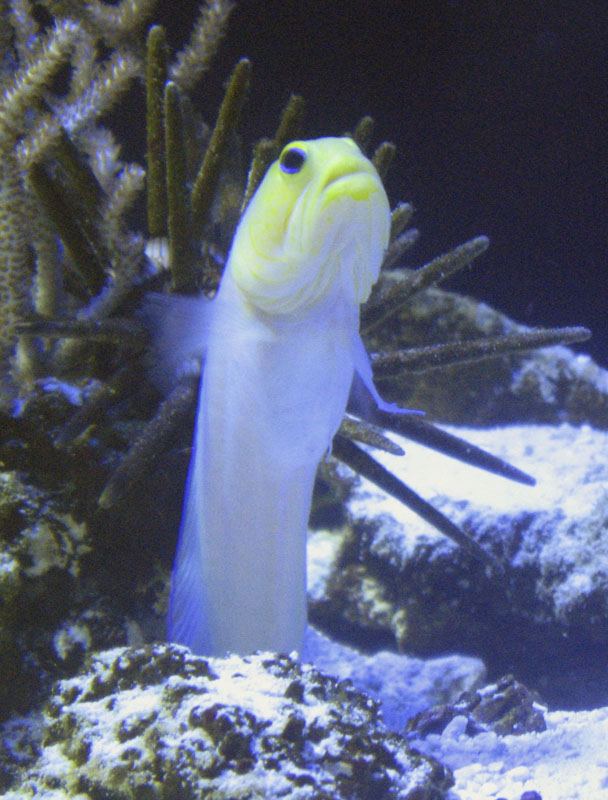 Yellowhead JawfishOpistognathus aurifrons
-
 Blue-spotted JawfishOpistognathus rosenblatti
-
 Bartail JawfishOpistognathus cuvierii
-
 Dusky JawfishOpistognathus whitehursti
-
 Moustache JawfishOpistognathus lonchurus
-
 Robust JawfishOpistognathus muscatensis
-
 Goldspecs JawfishOpistognathus randalli
-
 Fine-spotted JawfishOpistognathus punctatus
Compare
Questions and answers
What is the scientific name of the Banded Jawfish?
The scientific name of the Banded Jawfish is Opistognathus macrognathus. Written with its author, the full name is Opistognathus macrognathus Poey, 1860.
Which family does the Banded Jawfish belong to?
Opistognathus macrognathus belongs to the family Opistognathidae, in the order Perciformes and the class Teleostei.
Where is the Banded Jawfish found?
Checklists and occurrence records place Opistognathus macrognathus in 9 countries, including United States, U.S. Virgin Islands, Guadeloupe, Martinique, Saint Barthelemy and Cuba.
What is the conservation status of the Banded Jawfish?
The IUCN Red List category recorded for Opistognathus macrognathus is Least Concern (LC).
What other names does the Banded Jawfish have?
Opistognathus macrognathus is also known in English as Longjaw Jawfish and Spotfin Jawfish.
Sources
Data
- Catalogue of Life, 2026-10-16 XR cc by
- Global Biodiversity Information Facility CC BY 4.0
- Wikidata CC0
- GeoNames CC BY 4.0
- Within the Catalogue of Life, this name comes from World Register of Marine Species cc by
References
- Poey, F. (1858). Memorias sobra la historia natural de la Isla de Cuba, acompañadas de sumarios Latinos y extractos en Francés. 2: 1–96 (1858), 97–336 (1860), 337–442 (1861), pls. 1–19; La Habana [“1856–1858”]. where the name was published
This species in other databases
- Catalogue of Life 6SQJ5
- Wikidata Q2212222
- iNaturalist 317261
- WoRMS urn:lsid:marinespecies.org:taxname:276463
- ITIS 170931
Page built on 29 November 2026. See how the catalog is made and all sources and licences.
Cite this page
ScientificNames.org. (2026). Opistognathus macrognathus (Banded Jawfish). Retrieved November 29, 2026, from https://scientificnames.org/species/opistognathus-macrognathus
“Opistognathus macrognathus (Banded Jawfish).” ScientificNames.org, 2026, scientificnames.org/species/opistognathus-macrognathus. Accessed 29 Nov. 2026.
ScientificNames.org. “Opistognathus macrognathus (Banded Jawfish).” Accessed November 29, 2026. https://scientificnames.org/species/opistognathus-macrognathus.
@misc{scientificnames_opistognathus_macrognathus_banded_jawfish,
  author = {{ScientificNames.org}},
  title = {Opistognathus macrognathus (Banded Jawfish)},
  year = {2026},
  url = {https://scientificnames.org/species/opistognathus-macrognathus},
  note = {Accessed 2026-11-29}
}