Species · Insects
Orodaliscus rotundangulus
Orodaliscus rotundangulus has no English name on record in the checklists used here. It is a species of insect in the family Scarabaeidae (dung beetles), order Coleoptera. The name dates from 1900.
- Scientific name
- Orodaliscus rotundangulus (Reitter, 1900)
- Genus
- Orodaliscus
- Family
- Scarabaeidae (Dung Beetles)
- Order
- Coleoptera
- Class
- Insecta
- Recorded in
- 7 countries
- Name status
- accepted in the Catalogue of Life
Overview
Orodaliscus rotundangulus occurs in Bulgaria, China (Xinjiang), Kazakhstan, Kyrgyzstan, Poland, Romania, Russia, and Ukraine.
Written 27 November 2026 from the sources listed below. Each statement was checked against the passage it cites; statements that could not be supported were removed.
Appearance
The margins of the clypeus and the front angles of the pronotum are reddish. The elytra are dark red.[1][2]
Reproduction and life cycle
A female builds a nest containing eight tunnels filled with nourishment.[3]
Classification of Orodaliscus rotundangulus
| Kingdom | Animalia |
|---|---|
| Phylum | Arthropoda |
| Subphylum | Hexapoda |
| Class | Insecta (Insect) |
| Order | Coleoptera (Beetle) |
| Suborder | Polyphaga |
| Series | Staphyliniformia |
| Superfamily | Scarabaeoidea |
| Family | Scarabaeidae (Dung Beetles) |
| Subfamily | Aphodiinae |
| Tribe | Aphodiini |
| Subtribe | Aphodiina |
| Genus | Orodaliscus |
| Species | Orodaliscus rotundangulus (Reitter, 1900) |
Where Orodaliscus rotundangulus is found
Checklists and occurrence records place Orodaliscus rotundangulus in 7 countries across Asia and Europe.
Countries
Range as the checklists state it
Palaearctic(Bulgaria, China:Xinjiang, Kazakhstan, Kyrgyzstan, Poland, Romania, Russia, Ukraine)
A number beside a place is its count of GBIF occurrence records. A place without a number comes from a checklist alone. Records show where a species has been observed or collected, which can include escapes and vagrants.
Synonyms
4 other scientific names have been used for this species and are now treated as synonyms of Orodaliscus rotundangulus.
- Aphodius (Mendidaphodius) batesoni Semenov & Medvedev, 1928
- Aphodius (Mendidaphodius) makolskii Roubal, 1936
- Aphodius (Orodaliscus) rotundangulus Reitter, 1900
- Aphodius (Orodalus) fortimargo Reitter, 1907
Related species
- Orodaliscus zangi
- Orodaliscus angulatulus
- Orodaliscus spalacophilus
- Orodaliscus transaralicus
-
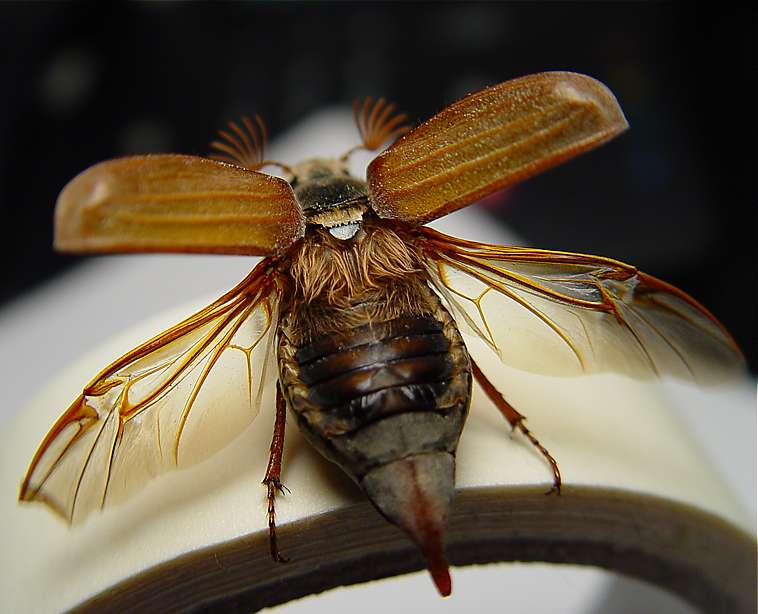 CockchaferMelolontha melolontha
-
 Hercules BeetleDynastes (Dynastes) hercules
-
 Japanese BeetlePopillia japonica
-
 Japanese Rhinoceros BeetleTrypoxylus dichotomus
Compare
Sources
Passages the profile rests on
- The margins of the clypeus and the front angles of the pronotum are reddish. Source passage: “The margin of the clypeus and the front angles of the pronotum are reddish” — English Wikipedia
- The elytra are dark red. Source passage: “the elytra are dark red.” — English Wikipedia
- A female of Orodaliscus rotundangulus builds a nest containing eight tunnels filled with nourishment. Source passage: “female to build a nest with 8 tunnels filled with nourish-” — academia.edu
Data
- Catalogue of Life, 2026-10-16 XR cc by
- Wikidata CC0
- GeoNames CC BY 4.0
- Within the Catalogue of Life, this name comes from World Scarabaeidae Database cc by
References
- Dellacasa, G., Bordat, P., & Dellacasa, M. (2001). A revisional essay of world genus-group taxa of Aphodiinae (Coleoptera: Aphodiidae). Memorie Della Società Entomologica Italiana, Genova 79:1-482. https://archive.org/download/revisionalessayv792dell/revisionalessayv792dell.pdf Link where the name was published
This species in other databases
Page built on 28 November 2026. See how the catalog is made and all sources and licences.
Cite this page
ScientificNames.org. (2026). Orodaliscus rotundangulus. Retrieved November 28, 2026, from https://scientificnames.org/species/orodaliscus-rotundangulus
“Orodaliscus rotundangulus.” ScientificNames.org, 2026, scientificnames.org/species/orodaliscus-rotundangulus. Accessed 28 Nov. 2026.
ScientificNames.org. “Orodaliscus rotundangulus.” Accessed November 28, 2026. https://scientificnames.org/species/orodaliscus-rotundangulus.
@misc{scientificnames_orodaliscus_rotundangulus,
  author = {{ScientificNames.org}},
  title = {Orodaliscus rotundangulus},
  year = {2026},
  url = {https://scientificnames.org/species/orodaliscus-rotundangulus},
  note = {Accessed 2026-11-28}
}