Species · Birds
Grey-collared Becard Pachyramphus major
The scientific name of the Grey-collared Becard is Pachyramphus major. It is a species of bird in the family Tityridae (becards), order Passeriformes. The name dates from 1847.
- Scientific name
- Pachyramphus major (Cabanis, 1847)
- Common name
- Grey-collared Becard
- Genus
- Pachyramphus
- Family
- Tityridae (Becards)
- Order
- Passeriformes
- Class
- Aves
- Red List category
- LC Least Concern
- Environment
- terrestrial
- Recorded in
- 7 countries
- Name status
- accepted in the Catalogue of Life

Overview
The species occurs in Belize, El Salvador, Guatemala, Honduras, Mexico, and Nicaragua, and has been recorded as a vagrant in Arizona and Texas. Adult males have gray, black, and white plumage, including a gray collar extending around the neck.
Written 27 November 2026 from the sources listed below. Each statement was checked against the passage it cites; statements that could not be supported were removed.
Appearance
Adult males of the nominate subspecies have a glossy black crown, a light gray face, and a gray collar extending around the neck. Their black backs may show gray mottling, and their rumps are gray.[1][2]
Adult males have mostly black wings with white markings along the scapulars and flight-feather edges. Their tails are black with white tips on the outer feathers, and their throats and underparts are uniformly light gray.[3][4][5]
Adult females have a blackish-brown to glossy blackish crown and a pale cinnamon to tawny-buff face. Their upperparts are cinnamon-brown, and their mostly blackish wings have broad cinnamon-colored edges.[6][7]
Adult females have buff to cinnamon-buff throats and underparts. All subspecies have dark irises, blackish bills, and dark gray legs and feet.[8][9]
The species measures 14–16.3 cm in length and weighs approximately 21–28 g.[10][11]
Habitat
The Grey-collared Becard inhabits humid to semi-arid forests in tropical and subtropical zones. It occurs in evergreen, deciduous, and particularly pine-oak forests.[12][13]
The species occurs from sea level to elevations of 2,500 m.[14]
Diet
The Grey-collared Becard feeds on insects and fruits.[15]
Behaviour
The species generally forages alone or in pairs and occasionally joins mixed-species feeding flocks. It mainly forages in the middle and upper layers of the forest.[16][17]
The species appears to undertake elevational movements in Mexico, breeding at higher elevations and wintering at lower elevations.[18]
The song is a repeatedly delivered whistle, usually repeated four to six times and sometimes ten times in approximately ten seconds. The species also produces a begging-like call consisting of repeated eeuup notes.[19][20]
The species occasionally produces squabbling sounds and agitated nasal notes.[21]
Reproduction and life cycle
The breeding season apparently extends from at least May through August. A described nest was discovered in August.[22][23]
The described nest was a spherical structure with a side entrance, constructed from lichen, twigs, and pine needles and covered with bark strips secured by spider web. It was located in an oak-tree fork approximately 10 m above the ground.[24][25]
Both parents provisioned the nestlings. The clutch size and incubation and fledging periods have not been documented.[26][27]
Conservation
The Grey-collared Becard is considered uncommon to fairly common across its overall range. In northern Central America, it is rare to uncommon on the Caribbean slope and rare and locally distributed on the Pacific slope.[28][29]
The population size of the eastern and western grey-collared becards is unknown, and the populations of both grey-collared becard taxa are believed to be decreasing. No immediate threats have been identified for either taxon.[30][31][32]
The species occurs in a few protected areas.[33]
Similar species
The male Grey-collared Becard is reported to have no similar species in Mexico.[34]
Classification of the Grey-collared Becard
| Kingdom | Animalia |
|---|---|
| Phylum | Chordata |
| Subphylum | Vertebrata |
| Infraphylum | Gnathostomata |
| Parvphylum | Osteichthyes |
| Megaclass | Tetrapoda |
| Class | Aves (Bird) |
| Order | Passeriformes (Passerine) |
| Family | Tityridae (Becards) |
| Genus | Pachyramphus (Becard) |
| Species | Pachyramphus major (Cabanis, 1847) |
Where the Grey-collared Becard is found
Checklists and occurrence records place Pachyramphus major in 7 countries across North America. GBIF holds 7,892 georeferenced records of it.
Countries
- Belize 538
- El Salvador 23
- Guatemala 1,452
- Honduras 69
- Mexico 4,420
- Nicaragua 241
- United States 1,149
Regions and cities with the most records
- Texas, United States 1,146
- Brownsville, United States 1,145
- Heroica Matamoros, Mexico 1,145
- San Benito, United States 1,144
- Yucatán, Mexico 644
- Quintana Roo, Mexico 639
- Jalisco, Mexico 499
- Alta Verapaz, Guatemala 482
- Cobán, Guatemala 470
- San Pedro Carchá, Guatemala 468
- San Cristóbal Verapaz, Guatemala 460
- Chiapas, Mexico 442
- Santiago Atitlán, Guatemala 441
- Chicacao, Guatemala 412
- Sololá, Guatemala 376
- Santa Bárbara, Guatemala 362
- Nuevo León, Mexico 361
- Oaxaca, Mexico 331
- Jardines de la Silla, Mexico 297
- Sololá, Guatemala 286
- Guadalupe, Mexico 280
- Monterrey, Mexico 280
- San Pedro Garza García, Mexico 279
- Tamaulipas, Mexico 269
- Nayarit, Mexico 258
- Petén, Guatemala 227
- Cayo District, Belize 202
- San Nicolás de los Garza, Mexico 175
- Santa Catarina, Mexico 174
- Santiago, Mexico 163
- San Ignacio, Belize 152
- Campeche, Mexico 149
- Estelí Department, Nicaragua 145
- Villa Nueva, Guatemala 145
- Mixco, Guatemala 141
- Petapa, Guatemala 140
1 more country has a few records outside this range
These countries hold a few records of Pachyramphus major but lie outside the range the checklists give for it. Such records are often zoo or garden specimens, museum material or vagrants, so the species is not counted as occurring there.
Range as the checklists state it
Middle America
North America
A number beside a place is its count of GBIF occurrence records. A place without a number comes from a checklist alone. Records show where a species has been observed or collected, which can include escapes and vagrants.
Common names
English
- Grey-collared Becard
- Eastern Grey-collared Becard
- Gray-collared Becard
Names in 23 other languages
- Catalan
- anambé de Mèxic
- Chinese
- 灰領比卡雀, 灰领厚嘴霸鹟
- Croatian
- sivovrati satir
- Czech
- tityra šedolímcová
- Danish
- Mexicobekard
- Dutch
- Mexicaanse Bekarde
- Esperanto
- grizkola titiro
- Finnish
- meksikonbekardi, meksikonlepinkäistyranni
- French
- Bécarde du Mexique
- German
- Glanzkopf-Bekarde, Glanzkopfbekarde, Schwarzrückenbekarde
- Italian
- Beccaio dal collare
- Japanese
- オオカザリドリモドキ
- Lithuanian
- meksikinis bekardas
- Norwegian
- grånakkebekard
- Polish
- bekardzik szaroszyi
- Portuguese
- caneleiro-de-colar-cinzento, caneleiro-mexicano
- Russian
- Мексиканский бекард
- Slovak
- tityra sivokrká
- Spanish
- Anambé Mexicano, Anambé mexicano oriental, Cabezón Mexicano, Mosquero cabezón mexicano, Mosquero-cabezón mexicano
- Swedish
- gråhalsad bekard
- Turkish
- Orta Amerika Bekardı
- Ukrainian
- бекард сосновий
- Welsh
- becard gyddflwyd
Synonyms
One other scientific name has been used for this species and is now treated as a synonym of Pachyramphus major.
- Bathmidurus major Cabanis, 1847
Subspecies and varieties
- Pachyramphus major australis subspecies
- Pachyramphus major itzensis subspecies
- Pachyramphus major major subspecies
- Pachyramphus major matudai subspecies
- Pachyramphus major uropygialis (Western Grey-collared Becard) subspecies
Related species
-
 Rose-throated BecardPachyramphus aglaiae
-
 White-winged BecardPachyramphus polychopterus
-
 Cinnamon BecardPachyramphus cinnamomeus
-
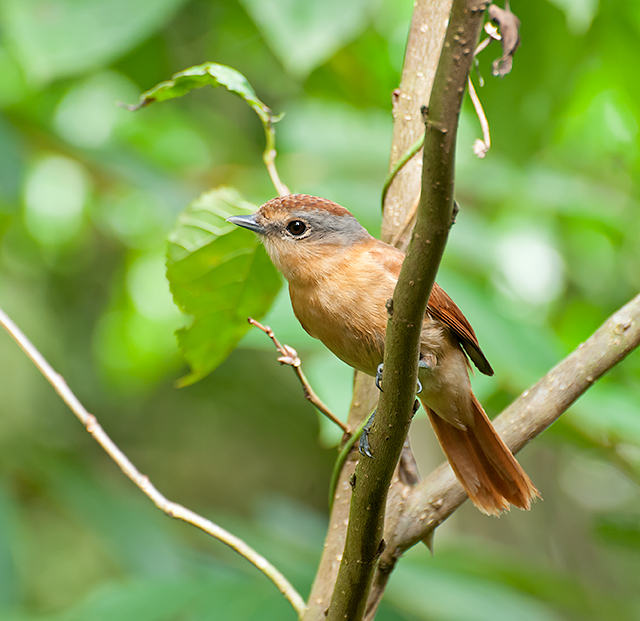 Chestnut-crowned BecardPachyramphus castaneus
-
 Barred BecardPachyramphus versicolor
-
 Cinereous BecardPachyramphus rufus
-
 Black-and-white BecardPachyramphus albogriseus
-
 Green-backed BecardPachyramphus viridis
Compare
Questions and answers
What is the scientific name of the Grey-collared Becard?
The scientific name of the Grey-collared Becard is Pachyramphus major. Written with its author, the full name is Pachyramphus major (Cabanis, 1847).
Which family does the Grey-collared Becard belong to?
Pachyramphus major belongs to the family Tityridae, in the order Passeriformes and the class Aves.
Where is the Grey-collared Becard found?
Checklists and occurrence records place Pachyramphus major in 7 countries, including Mexico, Guatemala, United States, Belize, Nicaragua and Honduras.
What is the conservation status of the Grey-collared Becard?
The IUCN Red List category recorded for Pachyramphus major is Least Concern (LC).
What other names does the Grey-collared Becard have?
Pachyramphus major is also known in English as Eastern Grey-collared Becard and Gray-collared Becard.
Where does the Grey-collared Becard occur?
It occurs in Belize, El Salvador, Guatemala, Honduras, Mexico, and Nicaragua. It has also been recorded as a vagrant in Arizona and Texas.[35][36]
What are the subspecies and their distributions?
The nominate subspecies occurs in eastern Mexico from southern Nuevo León south to Oaxaca and western Chiapas. P. m. matudai occurs along the Pacific slope from Chiapas to southern Guatemala; P. m. itzensis occurs in Campeche, Yucatán, and Quintana Roo in southeastern Mexico; and P. m. australis occurs in El Salvador, Honduras, and north-central Nicaragua. The population in Belize and northern Guatemala belongs to either P. m. itzensis or P. m. australis.[37][38][39][40][41]
How was the species originally described?
The species was originally described under the scientific name Bathmidurus major in 1847.[42]
How was its classification historically treated?
Pachyramphus major and P. uropygialis were previously treated together as a single species.[43]
When was the eastern grey-collared becard assessed for the IUCN Red List?
The eastern grey-collared becard was assessed for the IUCN Red List in 2020.[44]
Sources
Passages the profile rests on
- Adult males of the nominate subspecies have a glossy black crown, a light gray face, and a gray collar extending around the neck. Source passage: “Adult males of the nominate subspecies P. m. major have a glossy black crown. They have a pale stripe above the lores and an otherwise light gray face. The gray of their face wraps around their neck as a collar.” — English Wikipedia
- Adult males of the nominate subspecies have a black back that may show gray mottling and a gray rump. Source passage: “Their back is black, sometimes with gray mottling, and their rump and uppertail coverts are gray.” — English Wikipedia
- Adult males have mostly black wings with white markings along the scapulars and flight-feather edges. Source passage: “Their wings are mostly black with a white stripe on the scapulars and white edges on the coverts, secondaries, and tertials.” — English Wikipedia
- Adult males have black tails with white tips on the outer feathers. Source passage: “Their tail is black with white tips on the outer feathers.” — English Wikipedia
- Adult males have uniformly light gray throats and underparts. Source passage: “Their throat and underparts are a uniform light gray.” — English Wikipedia
- Adult females have a blackish-brown to glossy blackish crown and a pale cinnamon to tawny-buff face. Source passage: “Adult females have a blackish brown to glossy blackish crown. They have a pale stripe above the lores on an otherwise pale cinnamon to tawny-buff face.” — English Wikipedia
- Adult females have cinnamon-brown upperparts and mostly blackish wings with broad cinnamon-colored edges. Source passage: “Their upperparts are cinnamon-brown. Their wings are mostly blackish with wide cinnamon to cinnamon-brown edges on the coverts, secondaries, and tertials.” — English Wikipedia
- Adult females have buff to cinnamon-buff throats and underparts. Source passage: “Their throat and underparts are buff to cinnamon-buff.” — English Wikipedia
- All subspecies have dark irises, blackish bills, and dark gray legs and feet. Source passage: “All subspecies have a dark iris, a blackish bill with sometimes some grayish pink on the mandible, and dark gray legs and feet.” — English Wikipedia
- The species measures 14–16.3 cm in length. Source passage: “The grey-collared becard is 14 to 16.3 cm (5.5 to 6.4 in) long” — English Wikipedia
- The species weighs approximately 21–28 g. Source passage: “weighs about 21 to 28 g (0.74 to 0.99 oz).” — English Wikipedia
- The species inhabits humid to semi-arid forests in tropical and subtropical zones. Source passage: “The grey-collared becard inhabits several types of humid to semi-arid forest in the tropical and subtropical zones.” — English Wikipedia
- The species occurs in evergreen, deciduous, and particularly pine-oak forests. Source passage: “These include evergreen, deciduous, and especially pine-oak types.” — English Wikipedia
- The species occurs from sea level to elevations of 2,500 m. Source passage: “In elevation it ranges from sea level to 2,500 m (8,200 ft).” — English Wikipedia
- The species feeds on insects and fruits. Source passage: “The grey-collared becard feeds on insects and fruits.” — English Wikipedia
- The species generally forages alone or in pairs and occasionally joins mixed-species feeding flocks. Source passage: “It apparently forages mostly singly or in pairs and occasionally joins mixed species feeding flocks.” — English Wikipedia
- The species mainly forages in the middle and upper layers of the forest. Source passage: “It forages mostly from the forest's mid-story to its canopy.” — English Wikipedia
- The species appears to undertake elevational movements in Mexico, breeding at higher elevations and wintering at lower elevations. Source passage: “The grey-collared becard appears to make elevational movements, at least in Mexico, where it breeds in higher elevations and winters lower.” — English Wikipedia
- The species' song is a repeatedly delivered whistle, usually repeated four to six times and sometimes ten times in approximately ten seconds. Source passage: “a rich and constantly repeated (usually 4–6 times, and ten in c. 10 seconds) hoo wee-deet or hu whi-ditt whistle” — English Wikipedia
- The species produces a begging-like call consisting of repeated eeuup notes. Source passage: “begging-like eeuup-eeuup-eeuup” — English Wikipedia
- The species occasionally produces squabbling sounds and agitated nasal notes. Source passage: “squabbles and nasal agitated notes” — English Wikipedia
- The breeding season apparently extends from at least May through August. Source passage: “The grey-collared becard's breeding season has not been defined but apparently spans at least May to August.” — English Wikipedia
- A described nest of the species was discovered in August. Source passage: “Its one described nest was found in August.” — English Wikipedia
- The described nest was a spherical structure with a side entrance, constructed from lichen, twigs, and pine needles and covered with bark strips secured by spider web. Source passage: “It was a globe with a side entrance, made of lichen, twigs, and pine needles with a "roof" of bark strips held with spider web.” — English Wikipedia
- A described nest was located in an oak-tree fork approximately 10 m above the ground. Source passage: “It was in a fork in an oak tree about 10 m (35 ft) above the ground.” — English Wikipedia
- Both parents provisioned the nestlings. Source passage: “Both parents provisioned its nestlings.” — English Wikipedia
- The clutch size and incubation and fledging periods have not been documented. Source passage: “The clutch size, incubation period, time to fledging, and other details of parental care are not known.” — English Wikipedia
- The grey-collared becard is considered uncommon to fairly common across its overall range. Source passage: “The grey-collared becard is considered uncommon to fairly common overall.” — English Wikipedia
- In northern Central America, the species is rare to uncommon on the Caribbean slope and rare and locally distributed on the Pacific slope. Source passage: “In northern Central America it is rare to uncommon on the Caribbean slope and rare and local on the Pacific slope.” — English Wikipedia
- The population size of the eastern and western grey-collared becards is unknown. Source passage: “The population size of neither is known” — English Wikipedia
- The populations of both grey-collared becard taxa are believed to be decreasing. Source passage: “both are believed to be decreasing.” — English Wikipedia
- No immediate threats have been identified for either grey-collared becard taxon. Source passage: “No immediate threats to either have been identified.” — English Wikipedia
- The species occurs in a few protected areas. Source passage: “It occurs in a few protected areas.” — English Wikipedia
- The male is reported to have no similar species in Mexico. Source passage: “no similar species in Mexico.” — ebird.org
- The species occurs in Belize, El Salvador, Guatemala, Honduras, Mexico, and Nicaragua. Source passage: “It is found in Belize, El Salvador, Guatemala, Honduras, Mexico, and Nicaragua.” — English Wikipedia
- The species has been recorded as a vagrant in Arizona and Texas. Source passage: “It has also occurred as a vagrant in Arizona and Texas.” — English Wikipedia
- The nominate subspecies occurs in eastern Mexico from southern Nuevo León south to Oaxaca and western Chiapas. Source passage: “P. m. major: eastern Mexico from southern Nuevo León south to Oaxaca and western Chiapas” — English Wikipedia
- The subspecies P. m. matudai occurs along the Pacific slope from Chiapas to southern Guatemala. Source passage: “P. m. matudai: on the Pacific slope from Chiapas south to southern Guatemala” — English Wikipedia
- The subspecies P. m. itzensis occurs in Campeche, Yucatán, and Quintana Roo in southeastern Mexico. Source passage: “P. m. itzensis: Campeche, Yucatán, and Quintana Roo in southeastern Mexico” — English Wikipedia
- The subspecies P. m. australis occurs in El Salvador, Honduras, and north-central Nicaragua. Source passage: “P. m. australis: El Salvador, Honduras, and north-central Nicaragua” — English Wikipedia
- The population in Belize and northern Guatemala belongs to either P. m. itzensis or P. m. australis. Source passage: “The population in Belize and northern Guatemala belongs to either P. m. itzensis or P. m. australis.” — English Wikipedia
- The species was originally described under the scientific name Bathmidurus major in 1847. Source passage: “The grey-collared becard was originally described in 1847 as Bathmidurus major.” — English Wikipedia
- Pachyramphus major and P. uropygialis were previously treated together as a single species. Source passage: “Pachyramphus major and P. uropygialis (del Hoyo and Collar 2016) were previously lumped as P. major.” — datazone.birdlife.org
- The eastern grey-collared becard was assessed for the IUCN Red List in 2020. Source passage: “Eastern Grey-collared Becard Pachyramphus major has most recently been assessed for The IUCN Red List of Threatened Species in 2020.” — iucnredlist.org
Data
- Catalogue of Life, 2026-10-16 XR cc by
- Global Biodiversity Information Facility CC BY 4.0
- Wikidata CC0
- GeoNames CC BY 4.0
- Wikimedia Commons per image; credit shown with each image
- Within the Catalogue of Life, this name comes from The Integrated Taxonomic Information System cc0
References
- Arch. Naturgesch., 13: 246. 1847 where the name was published
- Gill, Frank, & and Minturn Wright. (2006). Birds of the World: Recommended English Names.
- Howell, Steve N. G., Ian Lewington, and Will Russell. (2014). Rare Birds of North America.
This species in other databases
Page built on 28 November 2026. See how the catalog is made and all sources and licences.
Cite this page
ScientificNames.org. (2026). Pachyramphus major (Grey-collared Becard). Retrieved November 28, 2026, from https://scientificnames.org/species/pachyramphus-major
“Pachyramphus major (Grey-collared Becard).” ScientificNames.org, 2026, scientificnames.org/species/pachyramphus-major. Accessed 28 Nov. 2026.
ScientificNames.org. “Pachyramphus major (Grey-collared Becard).” Accessed November 28, 2026. https://scientificnames.org/species/pachyramphus-major.
@misc{scientificnames_pachyramphus_major_grey_collared_becard,
  author = {{ScientificNames.org}},
  title = {Pachyramphus major (Grey-collared Becard)},
  year = {2026},
  url = {https://scientificnames.org/species/pachyramphus-major},
  note = {Accessed 2026-11-28}
}