Species · Birds
Jamaican Becard Pachyramphus niger
The scientific name of the Jamaican Becard is Pachyramphus niger. It is a species of bird in the family Tityridae (becards), order Passeriformes. The name dates from 1788.
- Scientific name
- Pachyramphus niger (J. F. Gmelin, 1788)
- Common name
- Jamaican Becard
- Genus
- Pachyramphus
- Family
- Tityridae (Becards)
- Order
- Passeriformes
- Class
- Aves
- Red List category
- LC Least Concern
- Recorded in
- 2 countries
- Name status
- accepted in the Catalogue of Life

Overview
Adult males are entirely black with white markings at the base of the wings, while adult females have reddish-brown upperparts and pale gray lower underparts.
Written 27 November 2026 from the sources listed below. Each statement was checked against the passage it cites; statements that could not be supported were removed.
Appearance
Adult male Jamaican Becards are entirely black except for white markings at the base of the wings, which are visible during flight.[1]
Adult females have a deep brown crown, reddish-brown upperparts, cinnamon cheeks, throat, neck and upper breast, and pale gray lower underparts.[2]
The Jamaican Becard measures approximately 18 cm in length and weighs approximately 39–41.5 g.[3][4]
Habitat
The Jamaican Becard inhabits mature open forests, woodlands and tree-containing pastures. It also occurs in gardens and within or along the edges of more closed forests.[5][6]
The species occupies tropical and lower subtropical landscapes, particularly relatively open environments. It occurs from sea level to approximately 1,800 m elevation.[7][8]
Diet
The Jamaican Becard feeds on insects and fruit.[9]
Behaviour
The species is often observed hovering beneath the woodland canopy while catching insects or fruit. It makes seasonal elevational movements and moves downslope after breeding.[10][11]
The species' main vocalization consists of two hoarse notes followed by a gradually rising and falling musical phrase.[12]
Reproduction and life cycle
The Jamaican Becard breeds between March and June and sometimes raises two broods in a breeding season.[13][14]
The nest is a large, bulky, globe-shaped structure with an entrance hole near its bottom. It is constructed from plant materials and suspended beneath a branch.[15][16]
The nest is typically placed high in a tree in closed forest and lower in more open landscapes. The clutch consists of three eggs.[17][18]
Conservation
The Jamaican Becard is classified as Least Concern by the IUCN. Its population size is unknown and its population is believed to be stable.[19][20]
The species is considered widespread and fairly common locally. No immediate threats to the Jamaican Becard have been identified.[21][22]
The Jamaican Becard persists in secondary habitats despite extensive historical forest clearance in Jamaica. It tolerates disturbed habitats.[23][24]
The Jamaican Becard is recorded as an extant native breeding species in Jamaica.[25]
Classification of the Jamaican Becard
| Kingdom | Animalia |
|---|---|
| Phylum | Chordata |
| Subphylum | Vertebrata |
| Infraphylum | Gnathostomata |
| Parvphylum | Osteichthyes |
| Megaclass | Tetrapoda |
| Class | Aves (Bird) |
| Order | Passeriformes (Passerine) |
| Family | Tityridae (Becards) |
| Genus | Pachyramphus (Becard) |
| Species | Pachyramphus niger (J. F. Gmelin, 1788) |
Where the Jamaican Becard is found
Checklists and occurrence records place Pachyramphus niger in 2 countries across North America. GBIF holds 2,432 georeferenced records of it.
Countries
Regions and cities with the most records
- Half Way Tree, Jamaica 745
- Kingston, Jamaica 742
- Mandeville, Jamaica 168
- Barrett Town, Jamaica 167
- Westmoreland, Jamaica 166
- Manchester, Jamaica 164
- Montego Bay, Jamaica 147
- Savanna-la-Mar, Jamaica 119
- Ocho Rios, Jamaica 59
- Portmore, Jamaica 32
- Linstead, Jamaica 23
- Spanish Town, Jamaica 17
- Hanover, Jamaica 13
- May Pen, Jamaica 6
- Old Harbour, Jamaica 6
- Clarendon, Jamaica 5
4 more countries have a few records outside this range
These countries hold a few records of Pachyramphus niger but lie outside the range the checklists give for it. Such records are often zoo or garden specimens, museum material or vagrants, so the species is not counted as occurring there.
Range as the checklists state it
Caribbean
A number beside a place is its count of GBIF occurrence records. A place without a number comes from a checklist alone. Records show where a species has been observed or collected, which can include escapes and vagrants.
Common names
English
- Jamaican Becard
Names in 23 other languages
- Catalan
- anambé de Jamaica
- Chinese
- 牙买加厚嘴霸鹟, 牙買加比卡雀
- Croatian
- jamajčanski satir
- Czech
- tityra černá
- Danish
- Jamaicabekard
- Dutch
- Jamaicaanse Bekarde
- Esperanto
- jamajka titiro
- Finnish
- jamaikanbekardi, jamaikanlepinkäistyranni
- French
- Bécarde de Jamaïque
- German
- Jamaika-Bekarde, Jamaikabekarde
- Hungarian
- jamaicai bekard
- Italian
- Beccaio della Giamaica
- Japanese
- クロカザリドリモドキ
- Lithuanian
- jamaikinis bekardas
- Polish
- bekardzik czarny
- Portuguese
- caneleiro-jamaicano
- Russian
- Ямайский бекард
- Slovak
- tityra čierna
- Spanish
- Anambé jamaicano
- Turkish
- Jamaika Bekardı
- Ukrainian
- бекард чорний
- Welsh
- becard Jamaica
- jam
- Richatee
Synonyms
3 other scientific names have been used for this species and are now treated as synonyms of Pachyramphus niger.
- Lanius niger J. F. Gmelin, 1788
- Platypsaris niger Gmelin, JF, 1788
- Tityra leuconotus Gray, GR, 1846
Related species
-
 Rose-throated BecardPachyramphus aglaiae
-
 White-winged BecardPachyramphus polychopterus
-
 Cinnamon BecardPachyramphus cinnamomeus
-
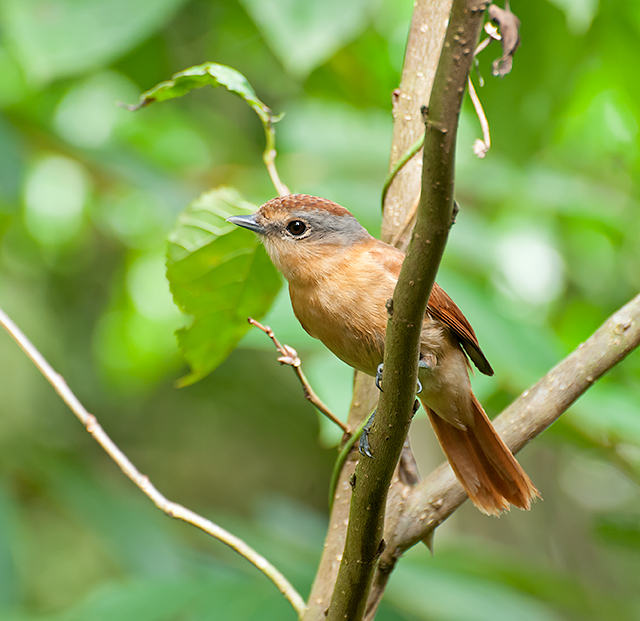 Chestnut-crowned BecardPachyramphus castaneus
-
 Barred BecardPachyramphus versicolor
-
 Cinereous BecardPachyramphus rufus
-
 Black-and-white BecardPachyramphus albogriseus
-
 Green-backed BecardPachyramphus viridis
Compare
Questions and answers
What is the scientific name of the Jamaican Becard?
The scientific name of the Jamaican Becard is Pachyramphus niger. Written with its author, the full name is Pachyramphus niger (J. F. Gmelin, 1788).
Which family does the Jamaican Becard belong to?
Pachyramphus niger belongs to the family Tityridae, in the order Passeriformes and the class Aves.
Where is the Jamaican Becard found?
Checklists and occurrence records place Pachyramphus niger in 2 countries: Jamaica and Trinidad and Tobago.
What is the conservation status of the Jamaican Becard?
The IUCN Red List category recorded for Pachyramphus niger is Least Concern (LC).
Sources
Passages the profile rests on
- Adult male Jamaican becards are entirely black except for white markings at the base of the wings that are visible during flight. Source passage: “Adult males are entirely black except for some white at the base of the wing that shows only in flight.” — English Wikipedia
- Adult females have a deep brown crown, reddish-brown upperparts, cinnamon cheeks, throat, neck and upper breast, and pale gray lower underparts. Source passage: “Adult females have a deep brown crown. Their upperparts are reddish brown. Their cheeks, throat, neck, and upper breast are cinnamon and their lower breast and the rest of their underparts are pale gray.” — English Wikipedia
- The Jamaican becard measures approximately 18 cm in length. Source passage: “The Jamaican becard is about 18 cm (7.1 in) long” — English Wikipedia
- The Jamaican becard weighs approximately 39–41.5 g. Source passage: “weighs about 39 to 41.5 g (1.4 to 1.5 oz).” — English Wikipedia
- The species inhabits mature open forests, woodlands and tree-containing pastures. Source passage: “These include mature open forest, woodlands, and pastures with trees.” — English Wikipedia
- The Jamaican becard also occurs in gardens and within or along the edges of more closed forests. Source passage: “It also inhabits gardens and the interior and edges of more closed forest.” — English Wikipedia
- The species occupies tropical and lower subtropical landscapes, particularly relatively open environments. Source passage: “It inhabits a variety of landscapes in the tropical and lower subtropical zones, most of which are somewhat open.” — English Wikipedia
- The Jamaican becard occurs from sea level to approximately 1,800 m elevation. Source passage: “In elevation it ranges from sea level to 1,800 m (5,900 ft).” — English Wikipedia
- The Jamaican becard feeds on insects and fruit. Source passage: “The Jamaican becard feeds on insects and fruit.” — English Wikipedia
- The species makes seasonal elevational movements and moves downslope after breeding. Source passage: “The Jamaican becard makes elevational movements between the seasons, moving downslope after breeding.” — English Wikipedia
- The Jamaican becard is often observed hovering beneath the woodland canopy while catching insects or fruit. Source passage: “A small but stout woodland species often found hovering beneath the canopy while snapping up insects or fruit.” — ebird.org
- The species' main vocalization consists of two hoarse notes followed by a gradually rising and falling musical phrase. Source passage: “The Jamaican becards main vocalization is "two hoarse quecks followed by [a] musical Co-ome and tell me what you hee-ear" that gradually rises and then falls.” — English Wikipedia
- The Jamaican becard breeds between March and June. Source passage: “The Jamaican becard breeds between March and June” — English Wikipedia
- The species sometimes raises two broods in a breeding season. Source passage: “and sometimes raises two broods.” — English Wikipedia
- The nest is a large, bulky, globe-shaped structure with an entrance hole near its bottom. Source passage: “Its nest is a large bulky globe with an entrance hole near the bottom.” — English Wikipedia
- The nest is constructed from plant materials and suspended beneath a branch. Source passage: “It is made of plant materials and is suspended below a branch;” — English Wikipedia
- The nest is typically placed high in a tree in closed forest and lower in more open landscapes. Source passage: “it is typically high in a tree in closed forest and lower in more open landscapes.” — English Wikipedia
- The clutch consists of three eggs. Source passage: “The clutch is three eggs.” — English Wikipedia
- The Jamaican becard is classified as Least Concern by the IUCN. Source passage: “The IUCN has assessed the Jamaican becard as being of Least Concern.” — English Wikipedia
- The population size of the Jamaican becard is unknown and its population is believed to be stable. Source passage: “its population size is not known and is believed to be stable.” — English Wikipedia
- No immediate threats to the Jamaican becard have been identified. Source passage: “No immediate threats have been identified.” — English Wikipedia
- The species is considered widespread and fairly common locally. Source passage: “It is considered "widespread and fairly common locally".” — English Wikipedia
- The Jamaican becard persists in secondary habitats despite extensive historical forest clearance in Jamaica. Source passage: “this species survives well in secondary habitats and is tolerant of disturbed habitats” — English Wikipedia
- The species tolerates disturbed habitats. Source passage: “this species survives well in secondary habitats and is tolerant of disturbed habitats” — English Wikipedia
- The Jamaican becard is recorded as an extant native breeding species in Jamaica. Source passage: “Jamaica Extant Native Breeding.” — datazone.birdlife.org
Data
- Catalogue of Life, 2026-10-16 XR cc by
- Global Biodiversity Information Facility CC BY 4.0
- Wikidata CC0
- GeoNames CC BY 4.0
- Wikimedia Commons per image; credit shown with each image
- Within the Catalogue of Life, this name comes from The Integrated Taxonomic Information System cc0
This species in other databases
Page built on 27 November 2026. See how the catalog is made and all sources and licences.
Cite this page
ScientificNames.org. (2026). Pachyramphus niger (Jamaican Becard). Retrieved November 27, 2026, from https://scientificnames.org/species/pachyramphus-niger
“Pachyramphus niger (Jamaican Becard).” ScientificNames.org, 2026, scientificnames.org/species/pachyramphus-niger. Accessed 27 Nov. 2026.
ScientificNames.org. “Pachyramphus niger (Jamaican Becard).” Accessed November 27, 2026. https://scientificnames.org/species/pachyramphus-niger.
@misc{scientificnames_pachyramphus_niger_jamaican_becard,
  author = {{ScientificNames.org}},
  title = {Pachyramphus niger (Jamaican Becard)},
  year = {2026},
  url = {https://scientificnames.org/species/pachyramphus-niger},
  note = {Accessed 2026-11-27}
}