Species · Insects
Pachytricha demarzi
Pachytricha demarzi has no English name on record in the checklists used here. It is a species of insect in the family Scarabaeidae (dung beetles), order Coleoptera. The name dates from 1966.
- Scientific name
- Pachytricha demarzi Frey, 1966
- Genus
- Pachytricha
- Family
- Scarabaeidae (Dung Beetles)
- Order
- Coleoptera
- Class
- Insecta
- Name status
- accepted in the Catalogue of Life
Overview
The species occurs in Western Australia. Adults are blackish-brown, moderately glossy, and approximately 23–25 mm long.
Written 28 November 2026 from the sources listed below. Each statement was checked against the passage it cites; statements that could not be supported were removed.
Appearance
Adults have blackish-brown upper and lower surfaces with a moderately glossy appearance. The upper surface is smooth.[1][2]
The underside is densely covered with whitish hairs, while the ventral segments have relatively sparse hair. The antennae are brown and the legs are blackish-brown.[3][4][5]
Classification of Pachytricha demarzi
| Kingdom | Animalia |
|---|---|
| Phylum | Arthropoda |
| Subphylum | Hexapoda |
| Class | Insecta (Insect) |
| Order | Coleoptera (Beetle) |
| Suborder | Polyphaga |
| Series | Staphyliniformia |
| Superfamily | Scarabaeoidea |
| Family | Scarabaeidae (Dung Beetles) |
| Subfamily | Melolonthinae |
| Tribe | Pachytrichini |
| Genus | Pachytricha |
| Species | Pachytricha demarzi Frey, 1966 |
Where Pachytricha demarzi is found
Range as the checklists state it
Australian(Western Australia)
A number beside a place is its count of GBIF occurrence records. A place without a number comes from a checklist alone. Records show where a species has been observed or collected, which can include escapes and vagrants.
Related species
- Pachytricha minor
- Pachytricha robusta
- Pachytricha castanea
- Pachytricha tecta
-
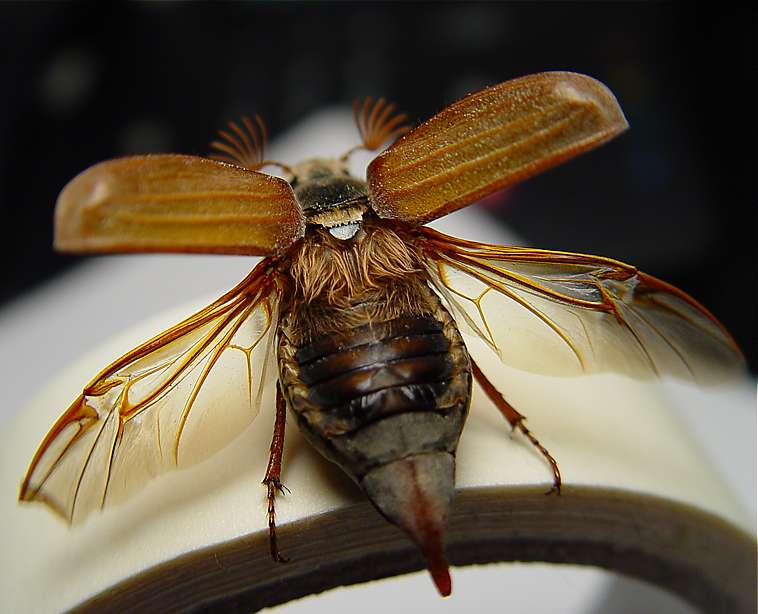 CockchaferMelolontha melolontha
-
 Hercules BeetleDynastes (Dynastes) hercules
-
 Japanese BeetlePopillia japonica
-
 Japanese Rhinoceros BeetleTrypoxylus dichotomus
Compare
Questions and answers
Where does Pachytricha demarzi occur?
The species occurs in Western Australia.[6]
How large are the adults?
Adults measure approximately 23–25 mm in length.[7]
Sources
Passages the profile rests on
- Adults have blackish-brown upper and lower surfaces with a moderately glossy appearance. Source passage: “The upper and lower surfaces are blackish-brown and moderately glossy.” — English Wikipedia
- The upper surface of adults is smooth. Source passage: “The upper surface is smooth” — English Wikipedia
- The underside of adults is densely covered with whitish hairs, while the ventral segments have relatively sparse hair. Source passage: “the underside is densely whitish-haired, but the ventral segments are only sparsely haired.” — English Wikipedia
- The antennae are brown. Source passage: “The antennae are brown” — English Wikipedia
- The legs are blackish-brown. Source passage: “the legs are blackish-brown.” — English Wikipedia
- The species occurs in Western Australia. Source passage: “It is found in Australia (Western Australia).” — English Wikipedia
- Adults measure approximately 23–25 mm in length. Source passage: “Adults reach a length of about 23–25 mm (0.91–0.98 in).” — English Wikipedia
Data
- Catalogue of Life, 2026-10-16 XR cc by
- Wikidata CC0
- Within the Catalogue of Life, this name comes from World Scarabaeidae Database cc by
References
- Frey, G. (1966). Neue Melolonthidae (Coleoptera). Entomologische Arbeiten Aus Dem Museum G.Frey 17:326-332. https://www.zobodat.at/pdf/Entomologische-Arbeiten-Museum-Frey_17_0326-0332.pdf Link where the name was published
This species in other databases
Page built on 29 November 2026. See how the catalog is made and all sources and licences.
Cite this page
ScientificNames.org. (2026). Pachytricha demarzi. Retrieved November 29, 2026, from https://scientificnames.org/species/pachytricha-demarzi
“Pachytricha demarzi.” ScientificNames.org, 2026, scientificnames.org/species/pachytricha-demarzi. Accessed 29 Nov. 2026.
ScientificNames.org. “Pachytricha demarzi.” Accessed November 29, 2026. https://scientificnames.org/species/pachytricha-demarzi.
@misc{scientificnames_pachytricha_demarzi,
  author = {{ScientificNames.org}},
  title = {Pachytricha demarzi},
  year = {2026},
  url = {https://scientificnames.org/species/pachytricha-demarzi},
  note = {Accessed 2026-11-29}
}