Species · Mammals
Golden Palm Civet Paradoxurus zeylonensis
The scientific name of the Golden Palm Civet is Paradoxurus zeylonensis. It is a species of mammal in the family Viverridae (oyans), order Carnivora. The name dates from 1778.
- Scientific name
- Paradoxurus zeylonensis (Schreber, 1778)
- Common name
- Golden Palm Civet
- Genus
- Paradoxurus
- Family
- Viverridae (Oyans)
- Order
- Carnivora
- Class
- Mammalia
- Red List category
- LC Least Concern
- Recorded in
- 1 country
- Name status
- accepted in the Catalogue of Life

Overview
Paradoxurus zeylonensis is endemic to Sri Lanka and inhabits wet, intermediate, and dry climatic zones. It has golden and dark brown coat-color morphs and is nocturnal, arboreal, and solitary.
Written 26 November 2026 from the sources listed below. Each statement was checked against the passage it cites; statements that could not be supported were removed.
Appearance
The Golden Palm Civet has golden to golden-brown upperparts and paler golden underparts. Individuals vary in coloration from dark sepia to ochreous, rusty, or golden-brown, with two main coat-color morphs: golden and dark brown.[1][2][3]
Individuals from montane areas have darker, slightly greyish wood-brown coats and paler undersides. Juvenile and immature individuals are generally grey to grey-brown.[4][5]
The species has rounded ears with hairless edges, large eyes with vertical pupils, and dirty-white vibrissae. It lacks a facial pattern, while its dorsal coat has faint bands and spots slightly darker than the background coloration.[6][7][8][9]
The Golden Palm Civet lacks the black, grey, or white facial markings, tail rings, and body markings found in common palm civets. Its coat hairs measure between 3 and 4 cm in length.[10][11]
The species produces an odour from its anal glands reminiscent of Michelia champaca flowers.[12]
Males possess bacula, or penis bones. Females have two or three pairs of abdominal mammae.[13][14]
Adult Golden Palm Civets weigh between 1.4 and 3.2 kg. Their body length from the nose to the base of the tail is approximately 50 cm, and the tail measures approximately 40 cm, giving a total length of approximately 90 cm.[15][16][17][18]
Habitat
The Golden Palm Civet inhabits Sri Lanka's wet, intermediate, and dry climatic zones. It occurs in lowland rainforests, tropical montane cloud forests, dense monsoon forests, and dry-zone forests.[19][20]
The species occurs from sea level to at least 2,000 m in Sri Lanka's Central Highlands and Knuckles Mountain Range. It also occupies degraded and secondary forests, fragmented forest patches, agricultural landscapes, and home gardens containing tall trees.[21][22]
An isolated population occurs in Wilpattu National Park. The species is predominantly associated with forests despite the presence of mangrove patches along Sri Lanka's shores.[23][24]
Behaviour
The Golden Palm Civet is nocturnal, arboreal, and solitary. Individuals generally do not form social groups.[25][26]
The species primarily uses scent marking and olfactory cues for communication.[27]
Diet
The Golden Palm Civet consumes fruits, berries, invertebrates, and small vertebrates.[28]
Members of the genus Paradoxurus consume fruits including plantains, pineapples, guava, and mango. When food resources are limited, members of the genus also consume small mammals, birds, reptiles, frogs, moths, and other insects.[29][30]
Reproduction and life cycle
The Golden Palm Civet is gonochoric, with separate sexes. Early observations reported litters of two to three young appearing around October and November.[31][32]
The species' mating system has not been well documented. It is unknown whether breeding pairs remain together or change partners between breeding seasons.[33][34]
Conservation
The Golden Palm Civet has been classified as Least Concern on the IUCN Red List since 2016. The extent and quality of its habitat in Sri Lanka's hill regions are declining.[35][36]
Similar species
The brown palm civet (Paradoxurus jerdoni) is identified as a close relative of the Golden Palm Civet. The Golden Palm Civet occurs sympatrically with the common palm civet (Paradoxurus hermaphroditus).[37][38]
Classification of the Golden Palm Civet
| Kingdom | Animalia |
|---|---|
| Phylum | Chordata |
| Subphylum | Vertebrata |
| Infraphylum | Gnathostomata |
| Parvphylum | Osteichthyes |
| Megaclass | Tetrapoda |
| Class | Mammalia (Mammal) |
| Subclass | Theria |
| Infraclass | Eutheria |
| Order | Carnivora (Carnivores) |
| Suborder | Feliformia (Cat-like Carnivores) |
| Family | Viverridae (Oyans) |
| Subfamily | Paradoxurinae (Binturong) |
| Genus | Paradoxurus (Palm Civet) |
| Species | Paradoxurus zeylonensis (Schreber, 1778) |
Where the Golden Palm Civet is found
Checklists and occurrence records place Paradoxurus zeylonensis in 1 country across Asia. GBIF holds 29 georeferenced records of it.
Countries
Regions and cities with the most records
Range as the checklists state it
Southern Asia
A number beside a place is its count of GBIF occurrence records. A place without a number comes from a checklist alone. Records show where a species has been observed or collected, which can include escapes and vagrants.
Common names
English
- Golden Palm Civet
Names in 21 other languages
- Arabic
- زباد النخيل الذهبي
- Catalan
- Civeta de palmera daurada
- Czech
- oviječ zlatý
- Dutch
- Sri Lanka Palmroller, Sri Lanka-palmroller
- Finnish
- srilankanmusanki
- French
- Civette de Ceylan
- German
- Ceylonmusang, Goldmusang
- Hebrew
- גחן דקלים זהוב
- Italian
- Civetta delle palme dorata
- Japanese
- キンイロパームシベット
- Korean
- 황금사향고양이
- Norwegian Bokmål
- Gullpalmemår
- Persian
- زباد نخلی طلایی
- Polish
- Łaskun cejloński
- Portuguese
- Civeta-cingalesa, Civeta-dourada
- Russian
- Цейлонский страннохвост, Шри-ланкский мусанг
- Sinhala
- කළවැද්දා, පැණි උගුඩුවා, රන් හෝතඹුවා, සපුමල් කලවැද්දා
- Spanish
- civeta de las palmeras dorada
- Tamil
- பொன் மரநாய்
- Ukrainian
- Мусанг золотистий
- Vietnamese
- Cầy cọ lông vàng
Synonyms
5 other scientific names have been used for this species and are now treated as synonyms of Paradoxurus zeylonensis.
- Paradoxurus aureus F. Cuvier, 1822
- Paradoxurus montanus Kelaart, 1852
- Paradoxurus stenocephalus Groves et al., 2009
- Viverra zeylonensis Schreber, 1778
- Viverra zeylonensis Pallas, 1778
Related species
-
 Asian Palm CivetParadoxurus hermaphroditus
-
 Brown Palm CivetParadoxurus jerdoni
-
 Philippine Palm CivetParadoxurus philippinensis
- Sumatran Palm CivetParadoxurus musangus
-
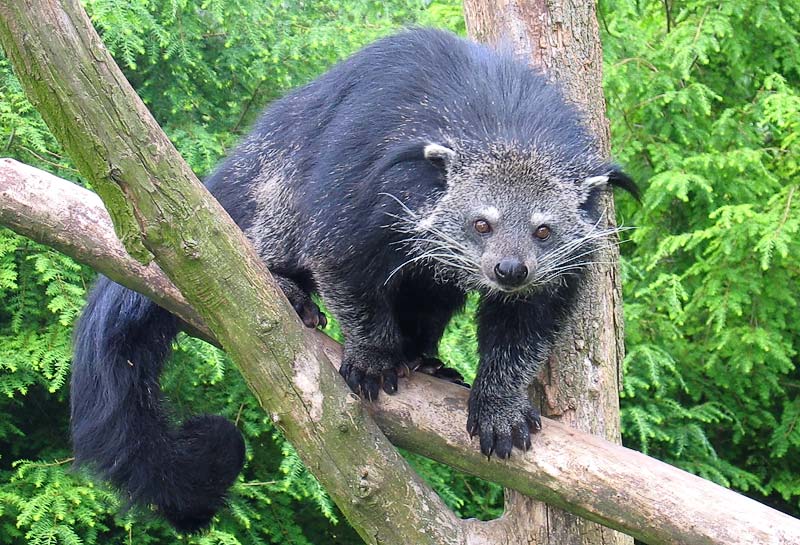 BinturongArctictis binturong
-
 African CivetCivettictis civetta
-
 Common GenetGenetta genetta
-
 Masked Palm CivetPaguma larvata
Compare
Questions and answers
What is the scientific name of the Golden Palm Civet?
The scientific name of the Golden Palm Civet is Paradoxurus zeylonensis. Written with its author, the full name is Paradoxurus zeylonensis (Schreber, 1778).
Which family does the Golden Palm Civet belong to?
Paradoxurus zeylonensis belongs to the family Viverridae, in the order Carnivora and the class Mammalia.
Where is the Golden Palm Civet found?
Checklists and occurrence records place Paradoxurus zeylonensis in 1 country: Sri Lanka.
What is the conservation status of the Golden Palm Civet?
The IUCN Red List category recorded for Paradoxurus zeylonensis is Least Concern (LC).
What do palm civets eat?
The Golden Palm Civet consumes fruits, berries, invertebrates, and small vertebrates. Fruits consumed by members of the genus Paradoxurus include plantains, pineapples, guava, and mango.[28][29]
What food does civet eat?
Members of the genus Paradoxurus consume fruits, small mammals, birds, reptiles, frogs, moths, and other insects. Small mammals and other animal foods are also consumed when food resources are limited.[29][30]
Where do palm civets live?
The Golden Palm Civet is endemic to Sri Lanka. It inhabits lowland rainforests, tropical montane cloud forests, dense monsoon forests, dry-zone forests, degraded and secondary forests, fragmented forest patches, agricultural landscapes, and home gardens containing tall trees.[39][20][22]
Sources
Passages the profile rests on
- The species has golden to golden-brown upperparts and paler golden underparts. Source passage: “The golden palm civet is gold to golden brown on the upper side and paler gold on the belly.” — English Wikipedia
- Individuals vary in coloration from dark sepia to ochreous, rusty, or golden-brown. Source passage: “Individuals vary from dark sepia to ochreous, rusty or golden-brown.” — English Wikipedia
- The species has two coat-color morphs, one golden and the other dark brown. Source passage: “The golden palm civet has two morphs — one golden and one dark brown.” — English Wikipedia
- Individuals from montane areas have darker, slightly greyish wood-brown coats and paler undersides. Source passage: “Specimens from montane areas are darker, slightly greyish-toned wood-brown, and paler on the underside with a yellowish-white tail tip.” — English Wikipedia
- Juvenile and immature individuals are generally grey to grey-brown. Source passage: “Juvenile and immature golden palm civets are usually grey to grey-brown in coloration.” — animaldiversity.org
- The species has rounded ears with hairless edges. Source passage: “The rounded ears have hairless edges.” — English Wikipedia
- The species has large eyes with vertical pupils. Source passage: “The eyes are large with vertical pupils.” — English Wikipedia
- The species lacks a facial pattern and has dirty-white vibrissae. Source passage: “The face does not have a pattern, and the vibrissae are dirty white.” — English Wikipedia
- The species' dorsal coat has faint bands and spots that are slightly darker than its background coloration. Source passage: “The dorsal pattern consists of faint bands and spots that are slightly darker than the ground colour.” — English Wikipedia
- The species' coat hairs measure between 3 and 4 cm in length. Source passage: “Their coat length varies between 3 and 4 cm” — animaldiversity.org
- The golden palm civet lacks the black, grey, or white facial markings, tail rings, and body markings found in common palm civets. Source passage: “Golden palm civets are distinct from common palm civets in that they lack black, grey, or white facial markings, as well as tail rings and body markings.” — animaldiversity.org
- The species produces an odour from its anal glands reminiscent of Michelia champaca flowers. Source passage: “It emits a pleasant odour from anal glands, which is reminiscent of Michelia champaca flowers.” — English Wikipedia
- Males possess bacula, or penis bones. Source passage: “Males have bacula, or penis bones” — animaldiversity.org
- Females have two or three pairs of abdominal mammae. Source passage: “females have two or three pairs of abdominal mammae (Nowak 1999).” — animaldiversity.org
- Adult golden palm civets weigh between 1.4 and 3.2 kg. Source passage: “Golden palm civets are small-bodied mammals, weighing between 1.4 and 3.2 kg” — animaldiversity.org
- The species measures approximately 50 cm from the nose to the base of the tail. Source passage: “measuring about 50 cm from their noses to the bases of the tails.” — animaldiversity.org
- The tail measures approximately 40 cm. Source passage: “Their tails are 40 cm long” — animaldiversity.org
- The total length from the nose to the tail tip is approximately 90 cm. Source passage: “meaning they measure roughly 90 cm from their noses to the tips of their tails.” — animaldiversity.org
- The species inhabits Sri Lanka's wet, intermediate, and dry climatic zones. Source passage: “The golden palm civet's distribution is largely contiguous across the island's wet, intermediate, and dry zones.” — English Wikipedia
- The species occurs in lowland rainforests, tropical montane cloud forests, dense monsoon forests, and dry-zone forests. Source passage: “This species inhabits lowland rainforests, tropical montane cloud forests, dense monsoon forests and dry zone forests.” — English Wikipedia
- The species occurs from sea level to at least 2,000 m in Sri Lanka's Central Highlands and Knuckles Mountain Range. Source passage: “It occurs from sea level up to at least 2,000 m (6,600 ft) in the Central Highlands and Knuckles Mountain Range.” — English Wikipedia
- The species also occupies degraded and secondary forests, fragmented forest patches, agricultural landscapes, and home gardens containing tall trees. Source passage: “It is also found in degraded and secondary forests, small, fragmented forest patches, agricultural landscapes and home gardens with tall trees.” — English Wikipedia
- An isolated population occurs in Wilpattu National Park. Source passage: “An isolated population exists in Wilpattu National Park.” — English Wikipedia
- The species is predominantly associated with forests despite the presence of mangrove patches along Sri Lanka's shores. Source passage: “however golden palm civets predominantly reside in forests, as they are mostly arboreal (Perara 1975 and Groves et al. 2018).” — animaldiversity.org
- The golden palm civet is nocturnal, arboreal, and solitary. Source passage: “It is arboreal, nocturnal, and solitary” — English Wikipedia
- Individuals generally do not form social groups. Source passage: “They live solitary lives and do not form social groups (Veron et al. 2014).” — animaldiversity.org
- The species primarily uses scent marking and olfactory cues for communication. Source passage: “They predominantly rely on scent marking and olfactory cues to communicate (Rozhnov and Rozhnov 2000).” — animaldiversity.org
- The species consumes fruits, berries, invertebrates, and small vertebrates. Source passage: “its diet consists of fruits, berries, invertebrates, and a wide range of small vertebrates.” — English Wikipedia
- Members of the genus Paradoxurus consume fruits including plantains, pineapples, guava, and mango. Source passage: “All species in the family Paradoxurus are largely frugivorous, eating fruits such as plantains, pineapples, guava, mango.” — animaldiversity.org
- When food resources are limited, members of the genus Paradoxurus also consume small mammals, birds, reptiles, frogs, moths, and other insects. Source passage: “if resources are limited, they will also eat small vertebrates and invertebrates , such as small mammals, birds, small reptiles, frogs, moths and other insects” — animaldiversity.org
- The species is gonochoric, with separate sexes. Source passage: “gonochoric/gonochoristic/dioecious (sexes separate)” — animaldiversity.org
- Early observations reported litters of two to three young appearing around October and November. Source passage: “Early observations of golden palm civets from the 1930s, describe them as having small litter sizes of 2 to 3 young, appearing around October and November (Pocock 1939).” — animaldiversity.org
- The species' mating system has not been well documented. Source passage: “Not much is known about the mating system of golden palm civets.” — animaldiversity.org
- It is unknown whether breeding pairs remain together or change partners between breeding seasons. Source passage: “It is not known whether breeding pairs remain together or change partners during each breeding season.” — animaldiversity.org
- The species has been classified as Least Concern on the IUCN Red List since 2016. Source passage: “It is listed as Least Concern on the IUCN Red List since 2016.” — English Wikipedia
- The extent and quality of the species' habitat in Sri Lanka's hill regions are declining. Source passage: “The extent and quality of its habitat in Sri Lanka's hill regions are declining.” — English Wikipedia
- The brown palm civet (Paradoxurus jerdoni) is identified as a close relative of the golden palm civet. Source passage: “Their closest relatives, brown palm civets ( Paradoxurus jerdoni ) live in India.” — animaldiversity.org
- The golden palm civet occurs sympatrically with the common palm civet (Paradoxurus hermaphroditus). Source passage: “Golden palm civets are sympatric with common palm civets ( Paradoxurus hermaphroditus )” — animaldiversity.org
- The golden palm civet is endemic to Sri Lanka. Source passage: “The golden palm civet (Paradoxurus zeylonensis) is a viverrid endemic to Sri Lanka.” — English Wikipedia
Data
- Catalogue of Life, 2026-10-16 XR cc by
- Global Biodiversity Information Facility CC BY 4.0
- Wikidata CC0
- GeoNames CC BY 4.0
- Wikimedia Commons per image; credit shown with each image
- Within the Catalogue of Life, this name comes from The Integrated Taxonomic Information System cc0
References
- Die Säugethiere vol.3 26 p.451 where the name was published
- Wilson, Don E., and DeeAnn M. Reeder, eds. (1993). Mammal Species of the World: A Taxonomic and Geographic Reference, 2nd Ed., 3rd Printing.
- Wilson, Don E., and F. Russell Cole. (2000). Common Names of Mammals of the World.
- Wilson, Don E., and DeeAnn M. Reeder, eds. (2005). Mammal Species of the World: A Taxonomic and Geographic Reference, 3rd Ed., Vols. 1 & 2.
- Jennings, A. P., and G. Veron / Don E. Wilson and Russell A. Mittermeier, eds. (2009). Family Viverridae (Civets, Genets and Oyans). Handbook of the Mammals of the World. Vol. 1: Carnivores.
- Veron, Géraldine, Marie-Lilith Patou, Mária Tóth, Manori Goontilake, and Andrew P. Jennings. (2015). How many species of Paradoxurus civets are there? New insights from India and Sri Lanka. Journal of Zoological Systematics and Evolutionary Research, Vol. 53, No. 2.
This species in other databases
Page built on 27 November 2026. See how the catalog is made and all sources and licences.
Cite this page
ScientificNames.org. (2026). Paradoxurus zeylonensis (Golden Palm Civet). Retrieved November 27, 2026, from https://scientificnames.org/species/paradoxurus-zeylonensis
“Paradoxurus zeylonensis (Golden Palm Civet).” ScientificNames.org, 2026, scientificnames.org/species/paradoxurus-zeylonensis. Accessed 27 Nov. 2026.
ScientificNames.org. “Paradoxurus zeylonensis (Golden Palm Civet).” Accessed November 27, 2026. https://scientificnames.org/species/paradoxurus-zeylonensis.
@misc{scientificnames_paradoxurus_zeylonensis_golden_palm_civet,
  author = {{ScientificNames.org}},
  title = {Paradoxurus zeylonensis (Golden Palm Civet)},
  year = {2026},
  url = {https://scientificnames.org/species/paradoxurus-zeylonensis},
  note = {Accessed 2026-11-27}
}