Species · Fishes
Sakhalin Taimen Parahucho perryi
The scientific name of the Sakhalin Taimen is Parahucho perryi. It is a species of fish in the family Salmonidae (trouts), order Salmoniformes. The name dates from 1856.
- Scientific name
- Parahucho perryi (Brevoort, 1856)
- Common name
- Sakhalin Taimen
- Genus
- Parahucho
- Family
- Salmonidae (Trouts)
- Order
- Salmoniformes
- Class
- Teleostei
- Red List category
- CR Critically Endangered
- Environment
- brackish, freshwater, marine
- Recorded in
- 2 countries
- Name status
- accepted in the Catalogue of Life

Overview
Sakhalin Taimen is a large salmonid freshwater fish. It occurs on Sakhalin Island in Russia, Hokkaido in Japan, and parts of the Russian Far East mainland. It belongs to its own monotypic genus rather than the genus Hucho.
Written 26 November 2026 from the sources listed below. Each statement was checked against the passage it cites; statements that could not be supported were removed.
Similar species
Sakhalin Taimen belongs to the monotypic genus Parahucho rather than the genus Hucho.[1]
Appearance
The average weight of caught specimens is approximately 5 kg. The largest recorded catch weighed 15 kg.[2][3][4]
An unverified Japanese record describes a specimen measuring 2.1 m that was captured in 1937.[5]
Habitat
Sakhalin Taimen primarily inhabits the lower and middle reaches of lakes and rivers.[6]
The species occurs in lakes and large rivers of Primorsky, Khabarovsk, Sakhalin, and the Kuril Islands in Russia, as well as Hokkaido in Japan.[7]
Diet
Young individuals feed primarily on aquatic insects. Individuals longer than 30 cm feed almost exclusively on fish.[8][9]
Behaviour
All sampled Sakhalin Taimen from the Koppi River were classified as freshwater residents. Two sampled individuals from the Tumnin River appeared to have recently migrated into saltwater, and one individual showed evidence of marine migration.[10][11][12]
Reproduction and life cycle
Individuals reach sexual maturity at approximately eight years of age. Females typically lay between 2,000 and 10,000 eggs during spring.[13][14]
Spawning takes place on sandy or gravelly river bottoms. Individuals can spawn multiple times during their lifetimes.[15][16]
Conservation
The IUCN has classified Sakhalin Taimen as critically endangered since 2006. Its range-wide population has declined to less than five percent of its historical level.[17][18]
Agriculture, urbanization, and oil and gas development have caused the loss of more than half of the species' original habitat. Logging, oil exploration, and agricultural land-use changes have also contributed to the population decline.[19][20]
Commercial salmon-fishery bycatch and illegal fishing in Russia are significant threats to the species.[21]
Uses
Sakhalin Taimen is caught commercially as bycatch. Recreational anglers also catch the species as a trophy fish.[22][23]
The species is bred for game fishing at managed fishing sites in Japan. Farm-raised individuals are available for purchase in Japan.[24][25]
Classification of the Sakhalin Taimen
| Kingdom | Animalia |
|---|---|
| Phylum | Chordata |
| Subphylum | Vertebrata |
| Infraphylum | Gnathostomata |
| Parvphylum | Osteichthyes |
| Gigaclass | Actinopterygii |
| Superclass | Actinopteri |
| Class | Teleostei (Teleost) |
| Order | Salmoniformes |
| Family | Salmonidae (Trouts) |
| Subfamily | Salmoninae |
| Genus | Parahucho (Japanese Taimens) |
| Species | Parahucho perryi (Brevoort, 1856) |
Where the Sakhalin Taimen is found
Checklists and occurrence records place Parahucho perryi in 2 countries. GBIF holds 317 georeferenced records of it.
Countries
Regions and cities with the most records
A number beside a place is its count of GBIF occurrence records. A place without a number comes from a checklist alone. Records show where a species has been observed or collected, which can include escapes and vagrants.
Common names
English
- Sakhalin Taimen
- Ito
- Japanese Huchen
- Sea-run Taimen
- Stringfish
Names in 9 other languages
- Belarusian
- Сахалінскі таймень
- Chinese
- 遠東哲羅魚
- Czech
- hlavatka japonská
- Finnish
- japaninjokilohi
- German
- Japanischer Huchen
- Japanese
- イトウ
- Polish
- czewica
- Russian
- Гой, Сахалинский таймень, Чеви́ца
- Spanish
- Trucha de Sajalín
Synonyms
3 other scientific names have been used for this species and are now treated as synonyms of Parahucho perryi.
- Hucho perryi (Brevoort, 1856)
- Salmo blackistoni Hilgendorf, 1876
- Salmo perryi Brevoort, 1856
Related species
-
 Arctic CharSalvelinus alpinus
-
 Sockeye SalmonOncorhynchus nerka
-
 Rainbow TroutOncorhynchus mykiss
-
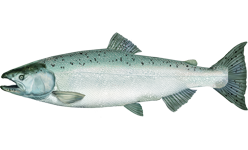 Chinook SalmonOncorhynchus tshawytscha
-
 Atlantic SalmonSalmo salar
-
 Coho SalmonOncorhynchus kisutch
-
 Brown TroutSalmo trutta
-
 Brook TroutSalvelinus fontinalis
Compare
Questions and answers
What is the scientific name of the Sakhalin Taimen?
The scientific name of the Sakhalin Taimen is Parahucho perryi. Written with its author, the full name is Parahucho perryi (Brevoort, 1856).
Which family does the Sakhalin Taimen belong to?
Parahucho perryi belongs to the family Salmonidae, in the order Salmoniformes and the class Teleostei.
Where is the Sakhalin Taimen found?
Checklists and occurrence records place Parahucho perryi in 2 countries: Russia and Japan.
What is the conservation status of the Sakhalin Taimen?
The IUCN Red List category recorded for Parahucho perryi is Critically Endangered (CR).
What other names does the Sakhalin Taimen have?
Parahucho perryi is also known in English as Ito, Japanese Huchen, Sea-run Taimen and Stringfish.
Are huchen and taimen the same?
Sakhalin Taimen belongs to its own monotypic genus, Parahucho, rather than the genus Hucho.[1]
How big do taimen get?
The average weight of caught Sakhalin Taimen is approximately 5 kg, and the largest recorded catch weighed 15 kg. An unverified Japanese record describes a specimen measuring 2.1 m captured in 1937.[3][4][5]
What do taimen eat?
Young Sakhalin Taimen feed primarily on aquatic insects. Individuals longer than 30 cm feed almost exclusively on fish.[8][9]
Where do taimen live?
Sakhalin Taimen occurs in lakes and large rivers of Primorsky, Khabarovsk, Sakhalin, and the Kuril Islands in Russia, as well as Hokkaido in Japan.[26][7]
How long do taimen live?
The estimated lifespan of Sakhalin Taimen is approximately fourteen years.[27]
Sources
Passages the profile rests on
- Parahucho perryi belongs to its own monotypic genus rather than the genus Hucho. Source passage: “molecular phylogenetic and other evidence has shown that it belongs in its own monotypic genus Parahucho.” — English Wikipedia
- Parahucho perryi is a large salmonid freshwater fish. Source passage: “The Sakhalin taimen (Parahucho perryi, syn. Hucho perryi), also known as the Japanese huchen or stringfish (Japanese: 伊富/イトウ, romanized: itō), is a large species of salmonid freshwater fish in Northeast Asia” — English Wikipedia
- The average weight of caught specimens is approximately 5 kg. Source passage: “The average specimens caught have weighed around 5 kg (11 lb).” — English Wikipedia
- The largest recorded catch weighed 15 kg. Source passage: “The largest fish caught was recorded at 15 kg (33 lb 1 oz) (IGFA world record).” — English Wikipedia
- An unverified Japanese record describes a specimen measuring 2.1 m captured in 1937. Source passage: “According to an unverified record from Japan, a fish with length of 2.1 m (6.9 ft) was captured in 1937 from the Tokachi River, Hokkaidō.” — English Wikipedia
- The species primarily inhabits the lower and middle reaches of lakes and rivers. Source passage: “primarily inhabits the lower to middle reaches of lakes and rivers.” — English Wikipedia
- The species occurs in lakes and large rivers of Primorsky, Khabarovsk, Sakhalin, and the Kuril Islands in Russia, as well as Hokkaido in Japan. Source passage: “found in the lakes and large rivers of Primorsky, Khabarovsk, Sakhalin and Kuril Islands of Far Eastern Russia, as well as Hokkaido of Japan.” — English Wikipedia
- Individuals longer than 30 cm feed almost exclusively on fish. Source passage: “Fish over 30 cm (1 ft) long are almost exclusively piscivores” — English Wikipedia
- Young individuals feed primarily on aquatic insects. Source passage: “while the young feed mostly on aquatic insects.” — English Wikipedia
- All sampled Sakhalin taimen from the Koppi River were classified as freshwater residents. Source passage: “all Koppi River taimen were classified as freshwater residents.” — usgs.gov
- Two sampled individuals from the Tumnin River appeared to have recently migrated into saltwater. Source passage: “Two fish from the Tumnin River appeared to be recent migrants to saltwater” — usgs.gov
- One sampled Tumnin River individual showed evidence of marine migration. Source passage: “one fish was characterized by an otolith Sr/Ca transect consistent with marine migration.” — usgs.gov
- Females typically lay between 2,000 and 10,000 eggs during spring. Source passage: “Females typically lay between 2,000 and 10,000 eggs in the spring” — English Wikipedia
- Individuals reach sexual maturity at approximately eight years of age. Source passage: “The fish take about eight years to mature” — English Wikipedia
- Spawning takes place on sandy or gravelly river bottoms. Source passage: “on the sandy or gravelly river bottom.” — English Wikipedia
- Individuals can spawn multiple times during their lifetimes. Source passage: “can spawn several times during their lifetime” — English Wikipedia
- The IUCN has classified the species as critically endangered since 2006. Source passage: “Since 2006, the IUCN has listed Parahucho perryi as critically endangered” — English Wikipedia
- The range-wide population has declined to less than five percent of its historical level. Source passage: “The assessment revealed that the range-wide population has dropped in size to less than 5% of historic levels.” — English Wikipedia
- Agriculture, urbanization, and oil and gas development have caused the loss of more than half of the species' original habitat. Source passage: “The loss of more than 50% of their original habitat due to agriculture, urbanization, and more recently, oil and gas development, is a major factor.” — English Wikipedia
- Logging, oil exploration, and agricultural land-use changes have contributed to the population decline. Source passage: “with contributory factors including degradation of the environment by logging, oil exploration and change of land use to agriculture.” — English Wikipedia
- Commercial salmon-fishery bycatch and illegal fishing in Russia are significant threats to the species. Source passage: “Other considerable pressures include bycatch in the commercial salmon fisheries of Russia and Japan, as well as illegal fishing practices in Russia.” — English Wikipedia
- The species is caught commercially as bycatch. Source passage: “The fish is caught by commercial fishing as bycatch” — English Wikipedia
- Recreational anglers catch the species as a trophy fish. Source passage: “The fish are also prized as trophies by Japanese recreational anglers.” — English Wikipedia
- The species is bred for game fishing at managed fishing sites in Japan. Source passage: “In Japan, this species is bred for game-fishing at managed fishing sites” — English Wikipedia
- Farm-raised individuals are available for purchase in Japan. Source passage: “raised fish are available for purchase.” — English Wikipedia
- The species occurs on Sakhalin Island in Russia, Hokkaido in Japan, and parts of the Russian Far East mainland. Source passage: “Parahucho perryi are found in the Northwest Pacific: Sakhalin Island (Russia), the Island of Hokkaidō (Japan), and parts of the far eastern Russian mainland.” — English Wikipedia
- The estimated lifespan of the species is approximately fourteen years. Source passage: “which is estimated to be about fourteen years.” — English Wikipedia
Data
- Catalogue of Life, 2026-10-16 XR cc by
- Global Biodiversity Information Facility CC BY 4.0
- Wikidata CC0
- GeoNames CC BY 4.0
- Wikimedia Commons per image; credit shown with each image
- Within the Catalogue of Life, this name comes from World Register of Marine Species cc by
This species in other databases
- Catalogue of Life 75PXN
- Wikidata Q20894190
- iNaturalist 620211
- WoRMS urn:lsid:marinespecies.org:taxname:320038
- ITIS 623487
Page built on 29 November 2026. See how the catalog is made and all sources and licences.
Cite this page
ScientificNames.org. (2026). Parahucho perryi (Sakhalin Taimen). Retrieved November 29, 2026, from https://scientificnames.org/species/parahucho-perryi
“Parahucho perryi (Sakhalin Taimen).” ScientificNames.org, 2026, scientificnames.org/species/parahucho-perryi. Accessed 29 Nov. 2026.
ScientificNames.org. “Parahucho perryi (Sakhalin Taimen).” Accessed November 29, 2026. https://scientificnames.org/species/parahucho-perryi.
@misc{scientificnames_parahucho_perryi_sakhalin_taimen,
  author = {{ScientificNames.org}},
  title = {Parahucho perryi (Sakhalin Taimen)},
  year = {2026},
  url = {https://scientificnames.org/species/parahucho-perryi},
  note = {Accessed 2026-11-29}
}