Species · Fishes
Tropical Flounder Paralichthys tropicus
The scientific name of the Tropical Flounder is Paralichthys tropicus. It is a species of fish in the family Paralichthyidae (sand flounders), order Pleuronectiformes. The name dates from 1933.
- Scientific name
- Paralichthys tropicus Ginsburg, 1933
- Common name
- Tropical Flounder
- Genus
- Paralichthys
- Family
- Paralichthyidae (Sand Flounders)
- Order
- Pleuronectiformes
- Class
- Teleostei
- Red List category
- DD Data Deficient
- Environment
- marine
- Recorded in
- 5 countries
- Name status
- accepted in the Catalogue of Life
Overview
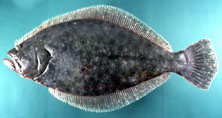
Paralichthys tropicus is recorded in the Greater Caribbean and West Atlantic, with a distribution extending south of the Greater Caribbean continental region and an equatorial zone between 0 and 10 degrees north, including Costa Rica and Venezuela. Both eyes are positioned on the left side of the body, which bears asymmetric eye-sized ocellated spots alongside smaller dark and light spots.
Written 28 November 2026 from the sources listed below. Each statement was checked against the passage it cites; statements that could not be supported were removed.
Appearance
The body is oval and elongate, measuring 43–48% of standard length. Both eyes are positioned on the left side of the body, and the space between them is flat and narrower than an eye.[1][2][3]
The upper head profile is slightly concave above the eyes. The mouth is large and extends behind the rear edge of the lower eye, and each jaw bears a single row of large canine teeth.[4][5][6]
The fish has between 10 and 13 lower gill rakers. The dorsal fin originates slightly before the front edge of the upper eye, and its front rays are not elongated.[7][8][9]
Pectoral fins occur on both sides of the body and have branched rays. The eye-side pectoral fin is short, rounded and has 11 rays.[10][11]
The pelvic-fin bases are symmetrical, and neither fin base lies on the body's midline. The urinary papilla is located on the eyed side immediately behind the level of the anus.[12][13]
The tail fin has a blunt point. The scales on the eyed side are smooth and small, with between 95 and 98 scales along the lateral line on that side.[14][15][16]
The lateral line is well developed on both sides and extends onto the head. It has branches extending toward the upper eye and below the lower eye, and is strongly arched above the pectoral fin.[17][18][19]
The body and dorsal, anal and tail fins display asymmetric eye-sized ocellated spots alongside smaller dark and light spots.[20]
Diet
Recorded food items include mobile benthic crustaceans, including shrimps and crabs.[21]
Conservation
The species has a reported low-to-moderate vulnerability score of 34 out of 100.[22]
Classification of the Tropical Flounder
| Kingdom | Animalia |
|---|---|
| Phylum | Chordata |
| Subphylum | Vertebrata |
| Infraphylum | Gnathostomata |
| Parvphylum | Osteichthyes |
| Gigaclass | Actinopterygii |
| Superclass | Actinopteri |
| Class | Teleostei (Teleost) |
| Order | Pleuronectiformes |
| Suborder | Pleuronectoidei |
| Family | Paralichthyidae (Sand Flounders) |
| Genus | Paralichthys (Summer Flounders) |
| Species | Paralichthys tropicus Ginsburg, 1933 |
Where the Tropical Flounder is found
Checklists and occurrence records place Paralichthys tropicus in 5 countries. GBIF holds 44 georeferenced records of it.
Countries
Regions and cities with the most records
- La Guardia, Venezuela 8
- Punta de Piedras, Venezuela 7
- Nueva Esparta, Venezuela 5
- Diego Martin, Trinidad and Tobago 4
- San Juan Bautista, Venezuela 4
A number beside a place is its count of GBIF occurrence records. A place without a number comes from a checklist alone. Records show where a species has been observed or collected, which can include escapes and vagrants.
Common names
English
- Tropical Flounder
Names in 5 other languages
- Chinese
- 熱帶牙鮃
- French
- Cardeau tropical
- Japanese
- ゴイシヒラメ
- Polish
- Poskarp karaibski
- Spanish
- Lenguado criollo
Related species
-
 Summer FlounderParalichthys dentatus
-
 Olive FlounderParalichthys olivaceus
-
 Southern FlounderParalichthys lethostigma
-
 California HalibutParalichthys californicus
-
 Gulf FlounderParalichthys albigutta
-
 Fine FlounderParalichthys adspersus
-
 Brazilian FlounderParalichthys brasiliensis
-
 Small-eyed FlounderParalichthys microps
Compare
Questions and answers
What is the scientific name of the Tropical Flounder?
The scientific name of the Tropical Flounder is Paralichthys tropicus. Written with its author, the full name is Paralichthys tropicus Ginsburg, 1933.
Which family does the Tropical Flounder belong to?
Paralichthys tropicus belongs to the family Paralichthyidae, in the order Pleuronectiformes and the class Teleostei.
Where is the Tropical Flounder found?
Checklists and occurrence records place Paralichthys tropicus in 5 countries: Venezuela, Suriname, Trinidad and Tobago, Colombia and French Guiana.
What is the conservation status of the Tropical Flounder?
The IUCN Red List category recorded for Paralichthys tropicus is Data Deficient (DD).
What do flounder's eat?
The Tropical Flounder feeds on mobile benthic crustaceans, including shrimps and crabs.[21]
Sources
Passages the profile rests on
- The body is oval and elongate, measuring 43–48% of standard length. Source passage: “Body oval, elongate (43-48% of SL)” — biogeodb.stri.si.edu
- Both eyes are positioned on the left side of the body. Source passage: “eyes on left side, relatively small” — biogeodb.stri.si.edu
- The space between the eyes is flat and narrower than an eye. Source passage: “space between eyes flat, and narrower than an eye” — biogeodb.stri.si.edu
- The upper head profile is slightly concave above the eyes. Source passage: “upper profile of head slightly concave above eyes” — biogeodb.stri.si.edu
- The mouth is large and extends behind the rear edge of the lower eye. Source passage: “mouth large, ends behind rear edge of lower eye” — biogeodb.stri.si.edu
- Each jaw bears a single row of large canine teeth. Source passage: “teeth are large canines, in a single row on each jaw” — biogeodb.stri.si.edu
- The fish has between 10 and 13 lower gill rakers. Source passage: “10-13 lower gill rakers” — biogeodb.stri.si.edu
- The dorsal fin originates slightly before the front edge of the upper eye. Source passage: “its origin slightly before front edge of top eye” — biogeodb.stri.si.edu
- The front rays of the dorsal fin are not elongated. Source passage: “front rays not elongated” — biogeodb.stri.si.edu
- Pectoral fins occur on both sides of the body and have branched rays. Source passage: “pectoral fins on both sides of body, with branched rays” — biogeodb.stri.si.edu
- The eye-side pectoral fin is short, rounded and has 11 rays. Source passage: “eye-side fin short (not reaching to straight part of lateral line) and rounded, 11 rays” — biogeodb.stri.si.edu
- The pelvic-fin bases are symmetrical, and neither fin base lies on the body's midline. Source passage: “bases of pelvics symmetric, base of neither fin on body midline” — biogeodb.stri.si.edu
- The urinary papilla is located on the eyed side immediately behind the level of the anus. Source passage: “urinary papilla on eye side, immediately behind level of anus” — biogeodb.stri.si.edu
- The tail fin has a blunt point. Source passage: “tail fin with a blunt point” — biogeodb.stri.si.edu
- The scales on the eyed side are smooth and small. Source passage: “eye-side scales smooth and small” — biogeodb.stri.si.edu
- There are between 95 and 98 scales along the lateral line on the eyed side. Source passage: “95-98 on lateral line” — biogeodb.stri.si.edu
- The lateral line is well developed on both sides and extends onto the head. Source passage: “lateral line well developed on both sides, extending onto head” — biogeodb.stri.si.edu
- The lateral line has branches extending toward the upper eye and below the lower eye. Source passage: “with branches to upper eye and below lower eye” — biogeodb.stri.si.edu
- The lateral line is strongly arched above the pectoral fin. Source passage: “strongly arched over pectoral fin” — biogeodb.stri.si.edu
- The body and dorsal, anal and tail fins display asymmetric eye-sized ocellated spots alongside smaller dark and light spots. Source passage: “body and dorsal, anal and tail fins with asymmetric eye-sized ocellated spots, plus smaller dark and light spots.” — biogeodb.stri.si.edu
- Mobile benthic crustaceans, including shrimps and crabs, are recorded as food items. Source passage: “Mobile benthic crustacea (shrimps/crabs)” — biogeodb.stri.si.edu
- The species has a reported low-to-moderate vulnerability score of 34 out of 100. Source passage: “Low to moderate vulnerability (34 of 100).” — fishbase.se
Data
- Catalogue of Life, 2026-10-16 XR cc by
- Global Biodiversity Information Facility CC BY 4.0
- Wikidata CC0
- GeoNames CC BY 4.0
- Within the Catalogue of Life, this name comes from World Register of Marine Species cc by
References
- Ginsburg, I. (1933). Descriptions of new and imperfectly known species and genera of gobioid and pleuronectid fishes in the United States National Museum. Proceedings of the United States National Museum, 82 (2961): 1–23. https://doi.org/10.5479/si.00963801.82-2961.1 Link where the name was published
This species in other databases
- Catalogue of Life 4CYW6
- Wikidata Q2128473
- iNaturalist 618995
- WoRMS urn:lsid:marinespecies.org:taxname:275821
- ITIS 172742
Page built on 28 November 2026. See how the catalog is made and all sources and licences.
Cite this page
ScientificNames.org. (2026). Paralichthys tropicus (Tropical Flounder). Retrieved November 28, 2026, from https://scientificnames.org/species/paralichthys-tropicus
“Paralichthys tropicus (Tropical Flounder).” ScientificNames.org, 2026, scientificnames.org/species/paralichthys-tropicus. Accessed 28 Nov. 2026.
ScientificNames.org. “Paralichthys tropicus (Tropical Flounder).” Accessed November 28, 2026. https://scientificnames.org/species/paralichthys-tropicus.
@misc{scientificnames_paralichthys_tropicus_tropical_flounder,
  author = {{ScientificNames.org}},
  title = {Paralichthys tropicus (Tropical Flounder)},
  year = {2026},
  url = {https://scientificnames.org/species/paralichthys-tropicus},
  note = {Accessed 2026-11-28}
}