Species · Other invertebrates
Royal Cucumber Parastichopus regalis
The scientific name of the Royal Cucumber is Parastichopus regalis. It is a species of animal in the family Stichopodidae, order Synallactida. The name dates from 1817.
- Scientific name
- Parastichopus regalis (Cuvier, 1817)
- Common name
- Royal Cucumber
- Genus
- Parastichopus
- Family
- Stichopodidae
- Order
- Synallactida
- Class
- Holothuroidea
- Red List category
- LC Least Concern
- Environment
- marine
- Recorded in
- 13 countries
- Name status
- accepted in the Catalogue of Life

Overview
Parastichopus regalis occurs in the Mediterranean Sea, along the African coasts of the eastern Atlantic Ocean, and in the tropical and subtropical western Atlantic Ocean, including the Gulf of Mexico. It frequently hosts the pearlfish Carapus acus in a commensal relationship.
Written 26 November 2026 from the sources listed below. Each statement was checked against the passage it cites; statements that could not be supported were removed.
Appearance
The body is soft and somewhat flattened, with a distinct lateral fold separating the dorsal and ventral surfaces. The dorsal surface is mottled brown, while the ventral surface is paler and has a dark longitudinal central streak.[1][2]
Its integument is strengthened by bony sclerites, including tables, terminal plates and perforated plates. Individuals can reach approximately 20 cm in length.[3][4]
Habitat
The royal cucumber typically inhabits sandy or other soft substrates. It occurs at depths reaching approximately 800 metres, with its highest occurrence reported between 100 and 300 metres deep.[5][6][7]
Behaviour
When stressed, the royal cucumber can expel its internal organs as a defensive response and subsequently regenerate them.[8][9]
The species frequently hosts the pearlfish Carapus acus in a commensal relationship. The pearlfish enters the sea cucumber's respiratory tree through its anus, and two individuals can occupy the same host.[10][11][12]
Reproduction and life cycle
A pair of pearlfish have been recorded breeding inside a host individual of the royal cucumber.[13]
Uses
The royal cucumber is edible and consumed in some parts of its geographical range. Its biomass has been identified as having balanced nutritional quality and suitability for human consumption.[14][15]
Conservation
The species is described as common. It is not a targeted fishery species and is caught as bycatch during deepwater trawling.[16][17]
Similar species
In a comparative study of four sea cucumber species, the royal cucumber had the lowest phenolic compound content and antioxidant activity. Its biomass exhibited the highest anti-inflammatory activity levels among the species examined.[18][19]
Classification of the Royal Cucumber
| Kingdom | Animalia |
|---|---|
| Phylum | Echinodermata |
| Subphylum | Echinozoa |
| Class | Holothuroidea |
| Subclass | Actinopoda |
| Order | Synallactida |
| Family | Stichopodidae |
| Genus | Parastichopus |
| Species | Parastichopus regalis (Cuvier, 1817) |
Where the Royal Cucumber is found
Checklists and occurrence records place Parastichopus regalis in 13 countries. GBIF holds 1,233 georeferenced records of it.
Countries
- Angola 23
- Croatia 15
- France 39
- Gabon 4
- Greece 17
- Italy 35
- Mauritania 10
- Montenegro 7
- Morocco 8
- Portugal 469
- Republic of the Congo 8
- Spain 590
- Tunisia 8
Regions and cities with the most records
- Sesimbra, Portugal 263
- Azeitão, Portugal 257
- Quinta Do Conde, Portugal 257
- Setúbal, Portugal 172
- Palmela, Portugal 65
- Faro, Portugal 28
- Calvià, Spain 27
- Olhão, Portugal 25
- Maó, Spain 20
- Palafrugell, Spain 19
- Sant Feliu de Guíxols, Spain 18
- Ciutadella, Spain 17
- Sant Pere de Ribes, Spain 17
- Sitges, Spain 17
- Vilanova i la Geltrú, Spain 17
- Calella, Spain 16
- Laranjeiro, Portugal 15
- Lloret de Mar, Spain 15
- Quelfes, Portugal 15
- Sant Agustí, Spain 15
- Calafell, Spain 14
- Malgrat de Mar, Spain 14
- Palamós, Spain 14
- Blanes, Spain 13
- Son Rapinya, Spain 13
- Arenys de Mar, Spain 12
- Alcúdia, Spain 11
- Felanitx, Spain 11
- Lagos, Portugal 10
- Mataró, Spain 10
- Palma, Spain 10
- Pineda de Mar, Spain 10
- Porto de Mós, Portugal 10
- Barcelona, Spain 9
- Castelldefels, Spain 9
- Cornellà de Llobregat, Spain 9
A number beside a place is its count of GBIF occurrence records. A place without a number comes from a checklist alone. Records show where a species has been observed or collected, which can include escapes and vagrants.
Common names
English
- Royal Cucumber
Names in 10 other languages
- Albanian
- shulajkori barkuq, trangull deti barkuq
- Asturian
- miaomiáu mariellu
- Catalan
- Espardenya, Llongo
- Czech
- sumýš královský
- Dutch
- witgevlekte zeekomkommer
- French
- Holothurie de sable, holothurie jaune
- German
- Königsseegurke
- Greek
- Χρυσάγγουρο
- Polish
- trepang królewski
- Spanish
- Espardeña
Synonyms
9 other scientific names have been used for this species and are now treated as synonyms of Parastichopus regalis.
- Eostichopus regalis (Cuvier, 1817)
- Gastrothuria limbata R. Perrier, 1899
- Holothuria limbata Perrier R., 1898
- Holothuria regale Cuvier, 1817
- Holothuria triquetra Delle Chiaje, 1828
- Holothuria triquetra Delle Chiaje, 1841
- Pudendum regale Cuvier, 1817
- Stichopus regalis (Cuvier, 1817)
- Holothuria columnae Cuvier, 1817 ambiguous synonym
Related species
-
 Parastichopus tremulus
-
 Pineapple Sea CucumberThelenota ananas
-
 Japanese Sea CucumberApostichopus japonicus
-
 California Sea CucumberApostichopus californicus
-
 Greenfish Sea CucumberStichopus chloronotus
-
 AmberfishThelenota anax
-
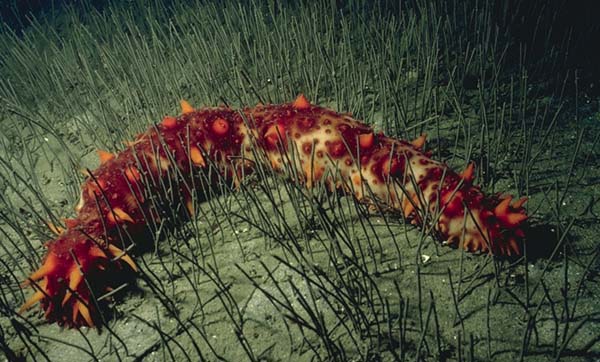 Brown Sea CucumberIsostichopus fuscus
-
 Chocolate Chip Sea CucumberIsostichopus badionotus
Compare
Questions and answers
What is the scientific name of the Royal Cucumber?
The scientific name of the Royal Cucumber is Parastichopus regalis. Written with its author, the full name is Parastichopus regalis (Cuvier, 1817).
Which family does the Royal Cucumber belong to?
Parastichopus regalis belongs to the family Stichopodidae, in the order Synallactida and the class Holothuroidea.
Where is the Royal Cucumber found?
Checklists and occurrence records place Parastichopus regalis in 13 countries, including Spain, Portugal, France, Italy, Angola and Greece.
What is the conservation status of the Royal Cucumber?
The IUCN Red List category recorded for Parastichopus regalis is Least Concern (LC).
Sources
Passages the profile rests on
- The body is soft and somewhat flattened, with a distinct lateral fold separating its dorsal and ventral surfaces. Source passage: “The body is soft and somewhat flattened, and a clearly incised lateral fold with large papillae separates the dorsal surface from the ventral surface.” — English Wikipedia
- The dorsal surface is mottled brown, while the ventral surface is paler and has a dark longitudinal central streak. Source passage: “The dorsal surface is mottled brown, and the ventral surface is rather paler, with a darker longitudinal streak in the centre.” — English Wikipedia
- Its integument is strengthened by bony sclerites that include tables, terminal plates and perforated plates. Source passage: “The bony sclerites that strengthen the integument include tables, terminal plates and perforated plates;” — English Wikipedia
- Individuals can reach approximately 20 cm in length. Source passage: “Parastichopus regalis grows to a length of about 20 cm (8 in).” — English Wikipedia
- The species typically inhabits sandy or other soft substrates. Source passage: “It is typically found on sand or other soft substrates,” — English Wikipedia
- The species occurs at depths reaching approximately 800 metres. Source passage: “at depths down to about 800 m (2,600 ft);” — English Wikipedia
- Its highest occurrence is reported between 100 and 300 metres deep. Source passage: “it is commonest in the 100 to 300 m (300 to 1,000 ft) depth range.” — English Wikipedia
- When stressed, the species can expel its internal organs and subsequently regenerate them. Source passage: “When stressed, it autotomises its internal organs, regenerating them again later.” — English Wikipedia
- The species can expel internal organs as a defensive response to stress. Source passage: “since, when in stress, they can expel internal organs, a measure commonly used as a defence mechanism.” — pmc.ncbi.nlm.nih.gov
- The species frequently hosts the pearlfish Carapus acus in a commensal relationship. Source passage: “In a commensal arrangement, Parastichopus regalis is often host to the pearlfish Carapus acus,” — English Wikipedia
- The pearlfish Carapus acus enters the sea cucumber's respiratory tree through its anus. Source passage: “which enters the sea cucumber's respiratory tree via its anus.” — English Wikipedia
- Two pearlfish individuals can occupy the same host. Source passage: “Two fish may occupy a single host,” — English Wikipedia
- A pair of pearlfish have been recorded breeding inside a host individual of this species. Source passage: “and a pair have been known to breed inside their host.” — English Wikipedia
- The species is edible and consumed in some parts of its geographical range. Source passage: “It is edible and is eaten in parts of its range” — English Wikipedia
- Its biomass has been identified as having balanced nutritional quality and suitability for human consumption. Source passage: “Regarding P. regalis, a balanced nutritional quality has been identified [18], thus making its biomass suitable for human consumption.” — pmc.ncbi.nlm.nih.gov
- The species is described as common. Source passage: “This sea cucumber is a common species.” — English Wikipedia
- It is not a targeted fishery species and is caught as bycatch during deepwater trawling. Source passage: “but is not a targeted species, being caught as bycatch during deepwater trawling.” — English Wikipedia
- In a comparative study of four sea cucumber species, P. regalis had the lowest phenolic compound content and antioxidant activity. Source passage: “P. regalis had the lowest content in phenolic compounds and antioxidant activity in contrast to Holothuria species.” — pmc.ncbi.nlm.nih.gov
- Among the species examined in the comparative study, P. regalis biomass exhibited the highest anti-inflammatory activity levels. Source passage: “Overall, P. regalis biomass presented the highest anti-inflammatory activity levels and H. arguinensis the lowest anti-inflammatory levels.” — pmc.ncbi.nlm.nih.gov
Data
- Catalogue of Life, 2026-10-16 XR cc by
- Global Biodiversity Information Facility CC BY 4.0
- Wikidata CC0
- GeoNames CC BY 4.0
- Wikimedia Commons per image; credit shown with each image
- Within the Catalogue of Life, this name comes from World Register of Marine Species cc by
References
- WoRMS, 2020, Parastichopus regalis (Cuvier, 1817). Accessed at: http://www.marinespecies.org/aphia.php?p=taxdetails&id=149898 on 2020-03-02 where the name was published
This species in other databases
- Catalogue of Life 762LS
- Wikidata Q28319165
- iNaturalist 433004
- WoRMS urn:lsid:marinespecies.org:taxname:149898
- ITIS 1078759
Page built on 27 November 2026. See how the catalog is made and all sources and licences.
Cite this page
ScientificNames.org. (2026). Parastichopus regalis (Royal Cucumber). Retrieved November 27, 2026, from https://scientificnames.org/species/parastichopus-regalis
“Parastichopus regalis (Royal Cucumber).” ScientificNames.org, 2026, scientificnames.org/species/parastichopus-regalis. Accessed 27 Nov. 2026.
ScientificNames.org. “Parastichopus regalis (Royal Cucumber).” Accessed November 27, 2026. https://scientificnames.org/species/parastichopus-regalis.
@misc{scientificnames_parastichopus_regalis_royal_cucumber,
  author = {{ScientificNames.org}},
  title = {Parastichopus regalis (Royal Cucumber)},
  year = {2026},
  url = {https://scientificnames.org/species/parastichopus-regalis},
  note = {Accessed 2026-11-27}
}