Species · Reptiles
Baise Slug-eating Snake Pareas baiseensis
The scientific name of the Baise Slug-eating Snake is Pareas baiseensis. It is a species of reptile in the family Pareidae (slug snakes & wood snakes), order Squamata. The name dates from 2023.
- Scientific name
- Pareas baiseensis Wu, Gong, Huang & Xu, 2023
- Common name
- Baise Slug-eating Snake
- Genus
- Pareas
- Family
- Pareidae (Slug Snakes & Wood Snakes)
- Order
- Squamata
- Class
- Reptilia
- Recorded in
- 2 countries
- Name status
- accepted in the Catalogue of Life
Overview
Pareas baiseensis is known only from its type locality in Daleng Township, Youjiang District, near Baise City, China. It specializes in eating snails and slugs and has a brown body marked with approximately 35 irregular black crossbands.
Written 27 November 2026 from the sources listed below. Each statement was checked against the passage it cites; statements that could not be supported were removed.
Appearance
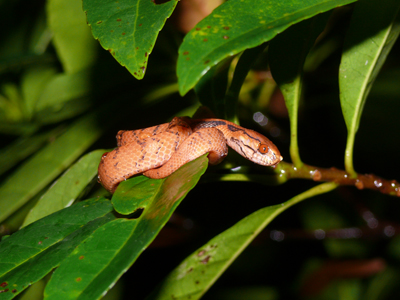
The dorsal surface of the head is light brown with dark brown spots. Two postocular stripes mark each side of the head: the upper stripe extends from the temporal scales backward to the nape, while the lower stripe extends beyond the ninth supralabial scale and contacts the nape.[1][2][3][4]
Two black lines on the parietal scales extend toward the neck and combine with the postorbital stripes to form a four-pointed black nuchal collar. The inner two points of the fork-shaped collar are shorter than the outer two points.[5][6]
The dorsal body surface is brown with dark brown speckling and approximately 35 irregular black crossbands extending along the sides from the neck to the vent. The ventral scales are yellowish cream with scattered black spots, and the ventral coloration becomes darker toward the posterior of the body.[7][8][9][10]
The subcaudal scales are light brown, and the cloacal plate is undivided. The species has 15 dorsal scale rows across its entire body, including one enlarged vertebral row, with five medial dorsal rows keeled.[11][12][13][14][15]
The adult male holotype and three juvenile paratypes have one postocular scale, nine infralabial scales, and eight supralabial scales on each side of the head. The adult has three subocular scales on each side, whereas the juveniles have two on each side.[16][17][18][19]
The adult specimen has three posterior temporal scales on each side, while the number in juveniles varies by side. Juveniles have two anterior temporal scales on each side, while the adult has one additional anterior temporal scale on its right side.[20][21]
The species typically has approximately 190 ventral scales and approximately 95 subcaudal scales. The adult male holotype measures 579 mm in total length.[22][23][24]
Habitat
The type specimens were found in a well-preserved subtropical broad-leaved evergreen forest. They were collected at elevations between 750 and 790 metres above sea level.[25][26]
The type specimens were discovered at the beginning of the autumn dry season.[27]
Diet
The Baise slug-eating snake specializes in eating snails and slugs.[28][29][30]
Behaviour
The species is nocturnal. The type specimens were encountered late at night.[31][32]
Classification of the Baise Slug-eating Snake
| Kingdom | Animalia |
|---|---|
| Phylum | Chordata |
| Subphylum | Vertebrata |
| Infraphylum | Gnathostomata |
| Parvphylum | Osteichthyes |
| Megaclass | Tetrapoda |
| Class | Reptilia (Reptile) |
| Order | Squamata (Snakes) |
| Suborder | Serpentes (Snakes) |
| Infraorder | Alethinophidia |
| Family | Pareidae (Slug Snakes & Wood Snakes) |
| Genus | Pareas (Oriental Slug-eating Snakes) |
| Species | Pareas baiseensis Wu, Gong, Huang & Xu, 2023 |
Where the Baise Slug-eating Snake is found
Checklists and occurrence records place Pareas baiseensis in 2 countries across Asia. GBIF holds 7 georeferenced records of it.
Countries
Regions and cities with the most records
Range as the checklists state it
China (Guangxi)
A number beside a place is its count of GBIF occurrence records. A place without a number comes from a checklist alone. Records show where a species has been observed or collected, which can include escapes and vagrants.
Common names
English
- Baise Slug-eating Snake
Names in 2 other languages
- Chinese
- 百色钝头蛇
- Vietnamese
- Rắn ăn sên Bách Sắc
Related species
-
 Iwasaki's Snail-eaterPareas iwasakii
-
 Keeled Slug SnakePareas carinatus
-
 Mountain Slug SnakePareas margaritophorus
- Common Slug SnakePareas monticola
-
 Formosa Slug SnakePareas formosensis
-
 Atayal Slug-eating SnakePareas atayal
-
 Hampton's Slug SnakePareas hamptoni
-
 Mountain Slug SnakePareas macularius
Compare
Questions and answers
What is the scientific name of the Baise Slug-eating Snake?
The scientific name of the Baise Slug-eating Snake is Pareas baiseensis. Written with its author, the full name is Pareas baiseensis Wu, Gong, Huang & Xu, 2023.
Which family does the Baise Slug-eating Snake belong to?
Pareas baiseensis belongs to the family Pareidae, in the order Squamata and the class Reptilia.
Where is the Baise Slug-eating Snake found?
Checklists and occurrence records place Pareas baiseensis in 2 countries: Vietnam and China.
What snake eats slugs?
The Baise slug-eating snake (Pareas baiseensis) eats slugs and specializes in eating snails and slugs.[28][29]
Are snail-eating snakes venomous?
The Baise slug-eating snake is non-venomous.[33]
Which snakes eat slugs?
The Baise slug-eating snake (Pareas baiseensis) eats slugs.[29]
Sources
Passages the profile rests on
- The dorsal surface of the head is light brown and marked with dark brown spots. Source passage: “The dorsal surfaces of the head are light brown with dark brown spots.” — English Wikipedia
- The sides of the head have two postocular stripes. Source passage: “The sides of the head have two lateral postocular stripes.” — English Wikipedia
- The upper postocular stripe extends from the temporal scales backward to the nape. Source passage: “The upper postocular stripe extending from the temporal scales backward to the nape” — English Wikipedia
- The lower postocular stripe extends beyond the ninth supralabial scale and contacts the nape. Source passage: “the lower postocular stripe extends backwards past the ninth supralabial scale, also contacting the nape.” — English Wikipedia
- Two black lines on the parietal scales extend toward the neck and combine with the postorbital stripes to form a four-pointed black nuchal collar. Source passage: “Two black lines on the back of the parietal scales extend back to the neck alongside the two postorbital stripes to form a dark black four-pointed fork-shaped nuchal collar” — English Wikipedia
- The inner two points of the fork-shaped nuchal collar are shorter than its outer two points. Source passage: “the inner two tines of the fork are shorter than the outer two.” — English Wikipedia
- The dorsal body surface is brown with dark brown speckling. Source passage: “The dorsum of the body is brown with dark-brown speckling” — English Wikipedia
- The body has approximately 35 irregular black crossbands extending from the neck to the vent on its sides. Source passage: “about 35 irregular black crossbands spanning from neck to vent on the sides.” — English Wikipedia
- The ventral scales are yellowish cream with scattered black spots. Source passage: “The ventral scales are yellowish cream with scattered black spots” — English Wikipedia
- The ventral coloration becomes darker toward the posterior of the body. Source passage: “though the ventral color darkens toward the posterior” — English Wikipedia
- The subcaudal scales are light brown. Source passage: “flanked by light brown subcaudal scales.” — English Wikipedia
- The cloacal plate is undivided. Source passage: “About 190 ventral scales and 95 subcaudal scales are to be expected alongside an undivided cloacal plate.” — English Wikipedia
- The species has 15 dorsal scale rows across its entire body. Source passage: “15 dorsal scale rows can be found across the entire body” — English Wikipedia
- One vertebral scale row is enlarged. Source passage: “with one vertebral scale row enlarged” — English Wikipedia
- Five medial dorsal scale rows are keeled. Source passage: “five medial dorsal scale rows keeled.” — English Wikipedia
- The adult male holotype and three juvenile paratypes have one postocular scale on each side of the head. Source passage: “All four specimens of Pareas baiseensis have 1 postocular scale” — English Wikipedia
- The adult male holotype and three juvenile paratypes have nine infralabial scales on each side of the head. Source passage: “9 infralabial scales” — English Wikipedia
- The adult male holotype and three juvenile paratypes have eight supralabial scales on each side of the head. Source passage: “8 supralabial scales on either side of their heads” — English Wikipedia
- The adult specimen has three subocular scales on each side, whereas the juveniles have two on each side. Source passage: “3/3 for the adult, 2/2 for the juveniles” — English Wikipedia
- The adult specimen has three posterior temporal scales on each side, while the number in juveniles varies by side. Source passage: “3/3 in the adult, +/-1 on either side in juveniles” — English Wikipedia
- Juveniles have two anterior temporal scales on each side, while the adult has one additional scale on its right side. Source passage: “2/2 in juveniles, +1 on the right side in the adult” — English Wikipedia
- The adult male holotype measures 579 mm in total length. Source passage: “The total length of the adult holotype is 579mm.” — English Wikipedia
- The species typically has approximately 190 ventral scales. Source passage: “About 190 ventral scales” — English Wikipedia
- The species typically has approximately 95 subcaudal scales. Source passage: “95 subcaudal scales are to be expected” — English Wikipedia
- The type specimens were found in a well-preserved subtropical broad-leaved evergreen forest. Source passage: “in a well-preserved subtropical broad-leafed evergreen forest” — English Wikipedia
- The type specimens were collected at elevations between 750 and 790 metres above sea level. Source passage: “at 750 to 790 metres above sea level” — English Wikipedia
- The type specimens were discovered at the beginning of the autumn dry season. Source passage: “at the very beginning of the autumn dry season.” — English Wikipedia
- The species specializes in eating snails and slugs. Source passage: “snail and slug-eating specialist.” — English Wikipedia
- The species eats slugs. Source passage: “slug-eating specialist.” — English Wikipedia
- The species eats snails. Source passage: “snail and slug-eating specialist.” — English Wikipedia
- The species is nocturnal. Source passage: “Pareas baiseensis is a nocturnal” — English Wikipedia
- The type specimens were encountered late at night. Source passage: “were found late at night” — English Wikipedia
- The species is non-venomous. Source passage: “is a non-venomous snake” — English Wikipedia
Data
- Catalogue of Life, 2026-10-16 XR cc by
- Global Biodiversity Information Facility CC BY 4.0
- Wikidata CC0
- GeoNames CC BY 4.0
- Within the Catalogue of Life, this name comes from The Reptile Database cc by
References
- Gong, Yan-an, Jia-Xiang Wu, Song Huang & Yu-Hao Xu. 2023. A new species of Pareas (Squamata, Pareidae) from Guangxi Province, China. Animals 13(2233). Link where the name was published
- Gong, Y., Wu, J., Huang, S., Xu, Y., Yang, D., Liu, Y., Liang, S., & Lee, P. (2023). A New Species of Pareas (Squamata, Pareidae) from Guangxi Province, China. Animals 13: 2233.
- Kwet, & Axel. (2024). Liste der im Jahr 2023 neu beschriebenen Reptilien. Elaphe 2024 (3): 50.
This species in other databases
Page built on 29 November 2026. See how the catalog is made and all sources and licences.
Cite this page
ScientificNames.org. (2026). Pareas baiseensis (Baise Slug-eating Snake). Retrieved November 29, 2026, from https://scientificnames.org/species/pareas-baiseensis
“Pareas baiseensis (Baise Slug-eating Snake).” ScientificNames.org, 2026, scientificnames.org/species/pareas-baiseensis. Accessed 29 Nov. 2026.
ScientificNames.org. “Pareas baiseensis (Baise Slug-eating Snake).” Accessed November 29, 2026. https://scientificnames.org/species/pareas-baiseensis.
@misc{scientificnames_pareas_baiseensis_baise_slug_eating_snake,
  author = {{ScientificNames.org}},
  title = {Pareas baiseensis (Baise Slug-eating Snake)},
  year = {2026},
  url = {https://scientificnames.org/species/pareas-baiseensis},
  note = {Accessed 2026-11-29}
}