Species · Reptiles
Barred Slug-eating Snake Pareas nuchalis
The scientific name of the Barred Slug-eating Snake is Pareas nuchalis. It is a species of reptile in the family Pareidae (slug snakes & wood snakes), order Squamata. The name dates from 1900.
- Scientific name
- Pareas nuchalis (Boulenger, 1900)
- Common name
- Barred Slug-eating Snake
- Genus
- Pareas
- Family
- Pareidae (Slug Snakes & Wood Snakes)
- Order
- Squamata
- Class
- Reptilia
- Red List category
- LC Least Concern
- Recorded in
- 2 countries
- Name status
- accepted in the Catalogue of Life
Overview
The species is native to Indonesia and Malaysia and has been recorded in central Sumatra. It is distinguished by a large black ring-shaped marking on the nape and between 61 and 78 transverse dark brown bands on its body.
Written 27 November 2026 from the sources listed below. Each statement was checked against the passage it cites; statements that could not be supported were removed.
Appearance
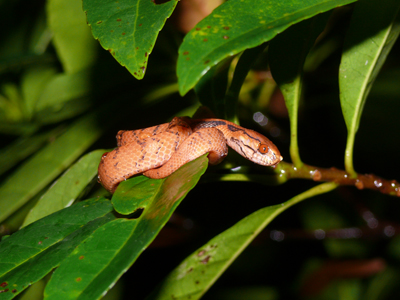
The species is predominantly tan to light brown, with weak dark brown spots along the vertebral region. Its body bears between 61 and 78 transverse dark brown bands.[1][2][3]
Stripes originating from the upper postocular scales meet at the nape to form a large black ring-shaped marking. Thick black stripes originating from the lower postocular scales reach the anterior part of the sixth supralabial scale and frequently extend to the lower jaw and chin.[4][5][6]
The belly is yellowish and may have sparse brown dusting. The iris is whitish with brownish speckles and veins that become denser near the pupil.[7][8]
Diet
The Barred slug-eating snake specializes in eating snails and slugs.[9]
Behaviour
The species is nocturnal.[10]
Habitat
The species is native to Indonesia and Malaysia and has been recorded in central Sumatra. It was formerly considered endemic to Borneo.[11][12][13]
Classification of the Barred Slug-eating Snake
| Kingdom | Animalia |
|---|---|
| Phylum | Chordata |
| Subphylum | Vertebrata |
| Infraphylum | Gnathostomata |
| Parvphylum | Osteichthyes |
| Megaclass | Tetrapoda |
| Class | Reptilia (Reptile) |
| Order | Squamata (Snakes) |
| Suborder | Serpentes (Snakes) |
| Infraorder | Alethinophidia |
| Family | Pareidae (Slug Snakes & Wood Snakes) |
| Genus | Pareas (Oriental Slug-eating Snakes) |
| Species | Pareas nuchalis (Boulenger, 1900) |
Where the Barred Slug-eating Snake is found
Checklists and occurrence records place Pareas nuchalis in 2 countries across Asia. GBIF holds 13 georeferenced records of it.
Countries
Regions and cities with the most records
Range as the checklists state it
Indonesia (Borneo), Malaysia (Borneo, Sarawak)
A number beside a place is its count of GBIF occurrence records. A place without a number comes from a checklist alone. Records show where a species has been observed or collected, which can include escapes and vagrants.
Common names
English
- Barred Slug-eating Snake
Names in 1 other language
- Chinese
- 頸斑鈍頭蛇
Synonyms
One other scientific name has been used for this species and is now treated as a synonym of Pareas nuchalis.
- Amblycephalus nuchalis Boulenger, 1900
Related species
-
 Iwasaki's Snail-eaterPareas iwasakii
-
 Keeled Slug SnakePareas carinatus
-
 Mountain Slug SnakePareas margaritophorus
- Common Slug SnakePareas monticola
-
 Formosa Slug SnakePareas formosensis
-
 Atayal Slug-eating SnakePareas atayal
-
 Hampton's Slug SnakePareas hamptoni
-
 Mountain Slug SnakePareas macularius
Compare
Questions and answers
What is the scientific name of the Barred Slug-eating Snake?
The scientific name of the Barred Slug-eating Snake is Pareas nuchalis. Written with its author, the full name is Pareas nuchalis (Boulenger, 1900).
Which family does the Barred Slug-eating Snake belong to?
Pareas nuchalis belongs to the family Pareidae, in the order Squamata and the class Reptilia.
Where is the Barred Slug-eating Snake found?
Checklists and occurrence records place Pareas nuchalis in 2 countries: Malaysia and Indonesia.
What is the conservation status of the Barred Slug-eating Snake?
The IUCN Red List category recorded for Pareas nuchalis is Least Concern (LC).
What snake eats slugs?
The Barred slug-eating snake specializes in eating snails and slugs.[9]
Sources
Passages the profile rests on
- The species is predominantly tan to light brown in coloration. Source passage: “Pareas nuchalis is mostly tan to light brown” — English Wikipedia
- The species has weak dark brown spots along its vertebral region. Source passage: “with weak dark brown vertebral spots” — English Wikipedia
- The body bears between 61 and 78 transverse dark brown bands. Source passage: “61 to 78 transverse dark brown bands.” — English Wikipedia
- Stripes originating from the upper postocular scales meet at the nape to form a large black ring-shaped marking. Source passage: “Stripes beginning at the upper postocular scales contact one another at the nape of the neck, forming a large, black, ring-shaped blotch.” — English Wikipedia
- The thick black stripes originating from the lower postocular scales reach the anterior part of the sixth supralabial scale. Source passage: “The stripes beginning at the lower postocular scales are thick and black, reaching the anterior portion of the sixth supralabial scale” — English Wikipedia
- The lower postocular stripes frequently extend to the lower jaw and chin. Source passage: “frequently continuing to the lower jaw and chin.” — English Wikipedia
- The belly is yellowish and may have sparse brown dusting. Source passage: “The belly is yellowish, sometimes with sparse brown dusting.” — English Wikipedia
- The iris is whitish with brownish speckles and veins that become denser near the pupil. Source passage: “The iris is whitish with brownish speckles and veins that become denser nearest the pupil.” — English Wikipedia
- The species specializes in eating snails and slugs. Source passage: “snail and slug specialist.” — English Wikipedia
- The species is nocturnal. Source passage: “P. nuchalis is a nocturnal” — English Wikipedia
- The species is native to Indonesia and Malaysia. Source passage: “is a non-venomous snake native to Indonesia and Malaysia.” — English Wikipedia
- The species was formerly considered endemic to Borneo. Source passage: “Until recently, it was considered endemic to Borneo” — English Wikipedia
- The species has been recorded in central Sumatra. Source passage: “it was recently recorded in central Sumatra” — English Wikipedia
Data
- Catalogue of Life, 2026-10-16 XR cc by
- Global Biodiversity Information Facility CC BY 4.0
- Wikidata CC0
- GeoNames CC BY 4.0
- Within the Catalogue of Life, this name comes from The Reptile Database cc by
References
- Boulenger, G. A. (1900). Description of new reptiles and batrachians from Bomeo. Proc. Zool. Soc. London: 182-187.
- de Rooij, & DE, N. (1917). The Reptiles of the Indo-Australian Archipelago. Il. Ophidia. Leiden (E. J. Brill), Xiv + 334 S.
- Malkmus, R., & Sauer, H. (1996). Ruhestellung von Pareas nuchalis und Erstnachweis dieser Art im Nationalpark Mount Kinabalu/Malaysia. Salamandra 32 (1): 55-58.
- Malkmus, R.; Manthey, U.; Vogel, G. Hoffmann, P. & Kosuch, J. (2002). Amphibians and reptiles of Mount Kinabalu (North Borneo). A.R.G. Ganther Verlag, Rugell, 404 Pp.
- Guo, Keji, Deng, & Xuejiang. (2009). A new species of Pareas (Serpentes: Colubridae: Pareatinae) from the Gaoligong Mountains, southwestern China. Zootaxa 2008: 53-60.
- Beolens, B., & Michael Watkins, a. M. G. (2011). The Eponym Dictionary of Reptiles. Johns Hopkins University Press, Baltimore, USA.
- Das, I. (2012). A Naturalist’s Guide to the Snakes of South-East Asia: Malaysia, Singapore, Thailand, Myanmar, Borneo, Sumatra, Java and Bali. Oxford J, Ohn Beaufoy Publishing.
- Stuebing, R. B., Inger, R. F., & Lardner, B. (2014). A field guide to the snakes of Borneo, second edition. Natural History Publications (Borneo).
- Wallach, Van; Kenneth L. Williams, Jeff Boundy. (2014). Snakes of the World: A Catalogue of Living and Extinct Species. [type catalogue]. Taylor and Francis, CRC Press, 1237 Pp.
- Harrington, Sean M; Jordyn M de Haan, Lindsey Shapiro, Sara Ruane. (2018). Habits and characteristics of arboreal snakes worldwide: arboreality constrains body size but does not affect lineage diversification. Biological Journal of the Linnean Society 125 (1): 61–71.
- Poyarkov NA, Nguyen TV, Pawangkhanant P, Yushchenko PV, Brakels P, Nguyen LH, Nguyen HN, Suwannapoom C, Orlov N, Vogel G. (2022). An integrative taxonomic revision of slug-eating snakes (Squamata: Pareidae: Pareineae) reveals unprecedented diversity in Indochina. PeerJ 10: E12713. Link
This species in other databases
Page built on 28 November 2026. See how the catalog is made and all sources and licences.
Cite this page
ScientificNames.org. (2026). Pareas nuchalis (Barred Slug-eating Snake). Retrieved November 28, 2026, from https://scientificnames.org/species/pareas-nuchalis
“Pareas nuchalis (Barred Slug-eating Snake).” ScientificNames.org, 2026, scientificnames.org/species/pareas-nuchalis. Accessed 28 Nov. 2026.
ScientificNames.org. “Pareas nuchalis (Barred Slug-eating Snake).” Accessed November 28, 2026. https://scientificnames.org/species/pareas-nuchalis.
@misc{scientificnames_pareas_nuchalis_barred_slug_eating_snake,
  author = {{ScientificNames.org}},
  title = {Pareas nuchalis (Barred Slug-eating Snake)},
  year = {2026},
  url = {https://scientificnames.org/species/pareas-nuchalis},
  note = {Accessed 2026-11-28}
}