Species · Fishes
Cowtail Stingray Pastinachus sephen
The scientific name of the Cowtail Stingray is Pastinachus sephen. It is a species of fish in the family Dasyatidae (whiptail stingray), order Myliobatiformes. The name dates from 1775.
- Scientific name
- Pastinachus sephen (Forsskål, 1775)
- Common name
- Cowtail Stingray
- Genus
- Pastinachus
- Family
- Dasyatidae (Whiptail Stingray)
- Order
- Myliobatiformes
- Class
- Elasmobranchii
- Red List category
- NT Near Threatened
- Environment
- brackish, freshwater, marine
- Recorded in
- 20 countries
- Name status
- accepted in the Catalogue of Life

Overview
Pastinachus sephen inhabits coastal waters, coral reefs, estuaries and rivers throughout tropical waters of the Indo-Pacific. It is distinguished by a large, flag-like ventral tail fold and a single venomous spine behind the pelvic fins.
Written 26 November 2026 from the sources listed below. Each statement was checked against the passage it cites; statements that could not be supported were removed.
Appearance
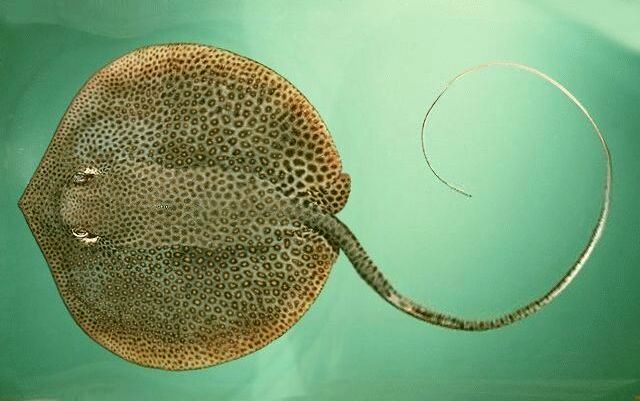
The pectoral fin disc is very thick, with nearly straight anterior margins and rounded tips. It is between 1.1 and 1.3 times as long as it is wide, and the snout is broadly rounded and blunt.[1][2][3]
The eyes are very small and widely spaced. Each jaw has 20 rows of distinctive hexagonal, high-crowned teeth, and the mouth floor has five papillae.[4][5][6]
The upper surface is uniformly greyish brown to black, while the underside is mostly white. The tail fold and tail tip are black.[7][8]
Newborn individuals have completely smooth skin. Juveniles have four circular tubercles in the centre of the disc.[9][10]
The species can reach 3 metres in total length, a width of 1.8 metres and a weight of 250 kilograms.[11][12][13]
Habitat
The Cowtail Stingray usually inhabits sandy bottoms in coastal waters and coral reefs, at depths of up to 60 metres. It also inhabits muddy and sandy substrates in estuarine mangrove areas.[14][15][16]
The species enters estuaries and rivers. It has been recorded in the Ganges River approximately 2,200 kilometres from the sea.[17][18]
The species occurs throughout tropical waters of the Indo-Pacific, from South Africa and the Red Sea to Japan and Australia. Its distribution includes Melanesia and Micronesia.[19][20]
In Australia, the species occurs from the central coast of Western Australia around the tropical north to the central coast of New South Wales.[21]
Diet
The Cowtail Stingray feeds on bony fishes, including leiognathids, Nemipterus and soles. Its diet also includes polychaete worms and sipunculids.[22][23]
Behaviour
The species is a solitary forager. When threatened, individuals flee at an angle of approximately 45 degrees away from the predator.[24][25]
In Shark Bay, individuals enter shallow sandy flats during high tide to rest for at least four hours. Resting individuals sometimes form small groups, particularly in turbid water or low-light conditions.[26][27]
Resting groups typically contain three individuals and arrange themselves in a rosette formation with their tails pointing outward. The species preferentially forms mixed-species groups with reticulate whiprays.[28][29][30]
The species sometimes approaches closely when fish have been speared.[31]
Reproduction and life cycle
The Cowtail Stingray reproduces by ovoviviparity. Developing embryos receive histotroph, also called uterine milk, during late development.[32][33]
Females give birth to live young measuring at least 18 centimetres across. Single young individuals have been reported throughout the year in the Strait of Malacca.[34][35]
Conservation
The species is threatened by heavy exploitation. Large-scale harvesting for the international shagreen trade has increased since the 1990s.[36][37]
The species is considered vulnerable to unsustainable exploitation because stingrays reproduce slowly and live for a long time.[38]
Uses
The Cowtail Stingray is commercially targeted as a source of shagreen leather and is a primary source of shagreen, also known as galuchat. Its tough skin is also used to polish wood.[39][40][41]
The species is caught as trawl bycatch and marketed for its meat.[42]
Classification of the Cowtail Stingray
| Kingdom | Animalia |
|---|---|
| Phylum | Chordata |
| Subphylum | Vertebrata |
| Infraphylum | Gnathostomata |
| Parvphylum | Chondrichthyes |
| Class | Elasmobranchii |
| Subclass | Neoselachii |
| Infraclass | Batoidea |
| Order | Myliobatiformes |
| Family | Dasyatidae (Whiptail Stingray) |
| Genus | Pastinachus (Cowtail Stingrays) |
| Species | Pastinachus sephen (Forsskål, 1775) |
Where the Cowtail Stingray is found
Checklists and occurrence records place Pastinachus sephen in 20 countries. GBIF holds 290 georeferenced records of it.
Countries
- Australia 46
- Bangladesh 4
- Egypt 72
- India 24
- Indonesia 6
- Israel 18
- Japan 15
- Kuwait 11
- Malaysia 9
- Maldives 8
- New Caledonia 5
- Oman 5
- Pakistan 14
- Philippines 4
- Qatar 3
- Saudi Arabia 19
- Seychelles 3
- South Africa 3
- Thailand 5
- United Arab Emirates 16
Regions and cities with the most records
- Western Australia, Australia 24
- Aqaba, Jordan 19
- Eilat, Israel 19
- Sharm el-Sheikh, Egypt 8
- Ad Dasmah, Kuwait 7
- Al Farwānīyah, Kuwait 7
- Janūb as Surrah, Kuwait 7
- Kuwait City, Kuwait 7
- Ḩawallī, Kuwait 7
- Dubai, United Arab Emirates 6
- Warīsān, United Arab Emirates 6
- Şabāḩ as Sālim, Kuwait 6
- Bur Dubai, United Arab Emirates 5
- The Palm Jumeirah, United Arab Emirates 5
- Abu Dhabi, United Arab Emirates 4
- Dibba Al-Fujairah, United Arab Emirates 4
- Dibba Al-Hisn, United Arab Emirates 4
- Dubai, United Arab Emirates 4
- Madhya Pradesh, India 4
- Khawr Fakkān, United Arab Emirates 3
A number beside a place is its count of GBIF occurrence records. A place without a number comes from a checklist alone. Records show where a species has been observed or collected, which can include escapes and vagrants.
Common names
English
- Cowtail Stingray
- Banana-tail Ray
- Cowtail Ray
- Fantail Stingray
Names in 14 other languages
- Arabic
- راي لساع ذو ذيل البقر الواسع, سفن
- Czech
- trnucha jemenská
- Dutch
- Veerstaartpijlstaartrog
- Finnish
- lehmänhäntärausku
- French
- Pastenague plumetée, Pastenague à queue de vache
- German
- Federschwanz-Stechrochen, Kuhschwanzrochen
- Hebrew
- טריגון כנוף-זנב
- Italian
- Pastinaca coda di vacca occidentale
- Japanese
- ツカエイ
- Malay
- Pari tanjung
- Marathi
- पकात
- Portuguese
- Raia-cauda-de-vaca
- Russian
- Широкохвостый хвостокол
- Thai
- ปลากระเบนชายธง, ปลากระเบนธง
Synonyms
13 other scientific names have been used for this species and are now treated as synonyms of Pastinachus sephen.
- Dasyatis gruveli (Chabanaud, 1923)
- Dasyatis sephen (Forsskål, 1775)
- Dasybatus gruveli Chabanaud, 1923
- Dasybatus sephen (Forsskål, 1775)
- Himantura fluviatilis (Hamilton-Buchanan, 1822)
- Hypolophus sephen (Forsskål, 1775)
- Pastinachus gruveli (Chabanaud, 1923)
- Pastinachus sephen ater (MacLeay, 1883)
- Raia sancur Hamilton, 1822
- Raja sancur Hamilton, 1822
- Raja sephen Forsskål, 1775
- Trigon forskalii Rüppell, 1829
- Trygon sephen (Forsskål, 1775)
Related species
- Roughnose StingrayPastinachus solocirostris
- Starrynose Cowtail RayPastinachus stellurostris
- Narrow Cowtail RayPastinachus gracilicaudus
- Banana-tail RayPastinachus ater
-
 Bluespotted Ribbontail RayTaeniura lymma
-
 Common StingrayDasyatis pastinaca
-
 Pelagic StingrayPteroplatytrygon violacea
-
 Reticulate WhiprayHimantura uarnak
Compare
Questions and answers
What is the scientific name of the Cowtail Stingray?
The scientific name of the Cowtail Stingray is Pastinachus sephen. Written with its author, the full name is Pastinachus sephen (Forsskål, 1775).
Which family does the Cowtail Stingray belong to?
Pastinachus sephen belongs to the family Dasyatidae, in the order Myliobatiformes and the class Elasmobranchii.
Where is the Cowtail Stingray found?
Checklists and occurrence records place Pastinachus sephen in 20 countries, including Egypt, Australia, India, Saudi Arabia, Israel and United Arab Emirates.
What is the conservation status of the Cowtail Stingray?
The IUCN Red List category recorded for Pastinachus sephen is Near Threatened (NT).
What other names does the Cowtail Stingray have?
Pastinachus sephen is also known in English as Banana-tail Ray, Cowtail Ray and Fantail Stingray.
Sources
Passages the profile rests on
- The pectoral fin disc is very thick, with nearly straight anterior margins and rounded tips. Source passage: “The pectoral fin disk of the cowtail stingray is very thick, with almost straight anterior margins and rounded apices” — English Wikipedia
- The pectoral fin disc is between 1.1 and 1.3 times as long as it is wide. Source passage: “measuring 1.1-1.3 times as long as wide.” — English Wikipedia
- The snout is broadly rounded and blunt. Source passage: “The snout is broadly rounded and blunt.” — English Wikipedia
- The eyes are very small and widely spaced. Source passage: “The eyes are very small and widely spaced.” — English Wikipedia
- Each jaw has 20 rows of distinctive hexagonal, high-crowned teeth. Source passage: “20 rows of distinctive hexagonal, high-crowned teeth in each jaw” — English Wikipedia
- The mouth floor has five papillae. Source passage: “and five papillae on the mouth floor.” — English Wikipedia
- The upper surface is uniformly greyish brown to black, while the underside is mostly white. Source passage: “The coloration is a uniform grayish brown to black above and mostly white below.” — English Wikipedia
- The tail fold and tail tip are black. Source passage: “The tail fold and tip are black.” — English Wikipedia
- Newborn individuals have completely smooth skin. Source passage: “Newborns are entirely smooth” — English Wikipedia
- Juveniles have four circular tubercles in the centre of the disc. Source passage: “Juveniles have four circular tubercles at the center of the disk” — English Wikipedia
- The species can reach 3 metres in total length. Source passage: “This species may reach 3 meters (9.8 feet) long” — English Wikipedia
- The species can reach a width of 1.8 metres. Source passage: “and 1.8 meters (5.9 feet) across” — English Wikipedia
- The species can reach a weight of 250 kilograms. Source passage: “and 250 kg (550 lb) in weight.” — English Wikipedia
- The species usually inhabits sandy bottoms in coastal waters and coral reefs. Source passage: “They are usually found on sandy bottoms in coastal waters and on coral reefs” — English Wikipedia
- The species occurs at depths of up to 60 metres. Source passage: “to a depth of 60 meters (200 feet).” — English Wikipedia
- The species inhabits muddy and sandy substrates in estuarine mangrove areas. Source passage: “It can be found in muddy and sandy substrates in estuarine mangrove areas” — australian.museum
- The species enters estuaries and rivers. Source passage: “They are amphidromous and known to enter estuaries and rivers.” — English Wikipedia
- The species has been recorded in the Ganges River approximately 2,200 kilometres from the sea. Source passage: “there is a record from the Ganges River some 2,200 km (1,400 mi) from the sea.” — English Wikipedia
- The species occurs throughout tropical waters of the Indo-Pacific, from South Africa and the Red Sea to Japan and Australia. Source passage: “from South Africa and the Red Sea to Japan and Australia” — English Wikipedia
- Its distribution includes Melanesia and Micronesia. Source passage: “including Melanesia and Micronesia.” — English Wikipedia
- In Australia, the species occurs from the central coast of Western Australia around the tropical north to the central coast of New South Wales. Source passage: “In Australia it is known from the central coast of Western Australia, around the tropical north of the country and south to the central coast of New South Wales .” — australian.museum
- The species feeds on bony fishes, including leiognathids, Nemipterus and soles. Source passage: “feed on bony fishes (including leiognathids, Nemipterus, and soles)” — English Wikipedia
- The species feeds on polychaete worms and sipunculids. Source passage: “polychaete worms, sipunculids” — English Wikipedia
- The species is a solitary forager. Source passage: “Cowtail stingrays are solitary foragers” — English Wikipedia
- When threatened, individuals flee at an angle of approximately 45 degrees away from the predator. Source passage: “they consistently flee at a 45° angle away from the predator” — English Wikipedia
- In Shark Bay, individuals enter shallow sandy flats during high tide to rest for at least four hours. Source passage: “this species enters shallow, sandy flats during high tide to rest for a minimum of four hours.” — English Wikipedia
- Resting individuals sometimes form small groups, particularly in turbid water or low-light conditions. Source passage: “They often form small groups when resting, particularly when visibility is poor such as in turbid water or under low light conditions.” — English Wikipedia
- Resting groups typically contain three individuals. Source passage: “The typical size of such groups is three individuals” — English Wikipedia
- Resting groups arrange themselves in a rosette formation with their tails pointing outward. Source passage: “arranged in a "rosette" formation with their tails pointing outward.” — English Wikipedia
- The species preferentially forms mixed-species groups with reticulate whiprays. Source passage: “Cowtail stingrays also preferentially form mixed-species groups with reticulate whiprays (Himantura uarnak)” — English Wikipedia
- The species sometimes approaches closely when fish have been speared. Source passage: “They tend to be inquisitive and approach closely if fish have been speared.” — australian.museum
- The species reproduces by ovoviviparity. Source passage: “reproduction in this species is ovoviviparous” — English Wikipedia
- Developing embryos receive histotroph, also called uterine milk, during late development. Source passage: “the embryos sustained in late development by histotroph ("uterine milk")” — English Wikipedia
- Females give birth to live young measuring at least 18 centimetres across. Source passage: “The females giving birth to live young measuring 18 cm (7.1 in) across or more.” — English Wikipedia
- Single young individuals have been reported throughout the year in the Strait of Malacca. Source passage: “Single young individuals have been reported year-round in the Strait of Malacca” — English Wikipedia
- The species is threatened by heavy exploitation. Source passage: “its populations are now under threat from heavy exploitation.” — English Wikipedia
- Large-scale harvesting for the international shagreen trade has increased since the 1990s. Source passage: “A boom in the international shagreen trade since the 1990s” — English Wikipedia
- The species is considered vulnerable to unsustainable exploitation because stingrays reproduce slowly and live for a long time. Source passage: “As stingrays are slow-reproducing, long-lived animals, there are fears that this unregulated exploitation is unsustainable” — English Wikipedia
- The species is commercially targeted as a source of shagreen leather. Source passage: “This species is targeted by commercial fisheries as a source of high-quality shagreen” — English Wikipedia
- Its tough skin is used to polish wood. Source passage: “their tough skin is used to polish wood.” — English Wikipedia
- The species is a primary source of shagreen, also known as galuchat. Source passage: “This species is also the primary source of shagreen or galuchat” — English Wikipedia
- The species is caught as trawl bycatch and marketed for its meat. Source passage: “Small to moderate numbers of cowtail stingrays are caught as bycatch in trawls and marketed for meat throughout their range” — English Wikipedia
Data
- Catalogue of Life, 2026-10-16 XR cc by
- Global Biodiversity Information Facility CC BY 4.0
- Wikidata CC0
- GeoNames CC BY 4.0
- Wikimedia Commons per image; credit shown with each image
- iNaturalist per image; credit shown with each image
- Within the Catalogue of Life, this name comes from World Register of Marine Species cc by
This species in other databases
- Catalogue of Life 4DZC8
- Wikidata Q1185275
- iNaturalist 47277
- WoRMS urn:lsid:marinespecies.org:taxname:217419
- ITIS 564479
Page built on 27 November 2026. See how the catalog is made and all sources and licences.
Cite this page
ScientificNames.org. (2026). Pastinachus sephen (Cowtail Stingray). Retrieved November 27, 2026, from https://scientificnames.org/species/pastinachus-sephen
“Pastinachus sephen (Cowtail Stingray).” ScientificNames.org, 2026, scientificnames.org/species/pastinachus-sephen. Accessed 27 Nov. 2026.
ScientificNames.org. “Pastinachus sephen (Cowtail Stingray).” Accessed November 27, 2026. https://scientificnames.org/species/pastinachus-sephen.
@misc{scientificnames_pastinachus_sephen_cowtail_stingray,
  author = {{ScientificNames.org}},
  title = {Pastinachus sephen (Cowtail Stingray)},
  year = {2026},
  url = {https://scientificnames.org/species/pastinachus-sephen},
  note = {Accessed 2026-11-27}
}