Species · Fishes
Pelagic Stingray Pteroplatytrygon violacea
The scientific name of the Pelagic Stingray is Pteroplatytrygon violacea. It is a species of fish in the family Dasyatidae (whiptail stingray), order Myliobatiformes. The name dates from 1832.
- Scientific name
- Pteroplatytrygon violacea (Bonaparte, 1832)
- Common name
- Pelagic Stingray
- Genus
- Pteroplatytrygon
- Family
- Dasyatidae (Whiptail Stingray)
- Order
- Myliobatiformes
- Class
- Elasmobranchii
- Red List category
- LC Least Concern
- Environment
- marine
- Recorded in
- 23 countries
- Name status
- accepted in the Catalogue of Life

Overview
Pteroplatytrygon violacea inhabits tropical to warm-temperate pelagic waters between 52°N and 50°S. It is unusual among stingrays because it primarily inhabits the open ocean rather than the sea floor.
Written 26 November 2026 from the sources listed below. Each statement was checked against the passage it cites; statements that could not be supported were removed.
Appearance
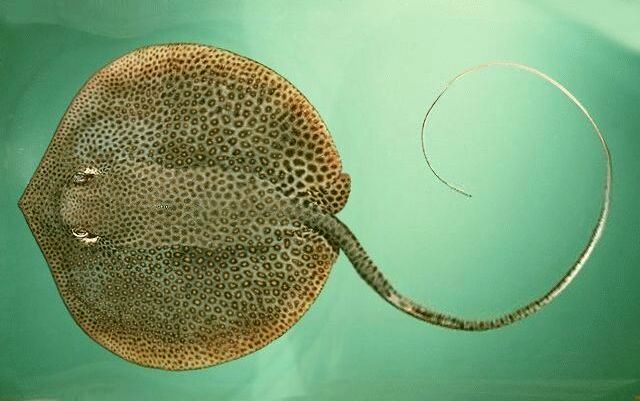
The Pelagic Stingray has a thick, wedge-shaped pectoral disc that is approximately one-third wider than it is long. Its dorsal surface is dark purple to blue-green, while its underside is slightly lighter.[1][2]
Its snout is short and rounded, and its eyes are very small and do not protrude above the body. Both sexes have pointed teeth, with adult males having longer and sharper teeth than adult females.[3][4]
The species releases thick black mucus over its body when captured and handled. Its dark dorsal coloration helps camouflage it in the open ocean.[5][6]
The species typically reaches approximately 1.3 m in total length and 59 cm in disc width. Its recorded maximum disc width is 80 cm and maximum total length is 160 cm.[7][8]
Newborn individuals measure 15–25 cm in disc width. The largest recorded captive-reared female measured 94 cm across and weighed 49 kg.[9][10]
Habitat
The Pelagic Stingray primarily inhabits the open ocean rather than the sea floor. It generally occupies surface waters to depths of approximately 100 m over deep water, although it can also occur in inshore bays.[11][12][13]
The species prefers water temperatures above 19 °C and dies when temperatures fall to 15 °C. It has occasionally been caught at depths of 330–381 m over the Kyushu–Palau Ridge.[14][15]
Diet
The Pelagic Stingray feeds on crustaceans, including amphipods, krill and larval crabs, and molluscs such as squid, octopus and pteropods. Stomach-content analyses identified euphausiids and amphipods as major dietary items.[16][17][18]
Its recorded bony fish prey includes herring, mackerel, seahorses and filefish. Its diet also includes comb jellies, medusae and polychaete worms.[19][20]
Off California, the species hunts large aggregations of mating squid between November and April. Juveniles consume approximately 6–7% of their body weight in food daily.[21][22]
Behaviour
The Pelagic Stingray swims by flapping its pectoral fins rather than undulating the margins of its disc. It can also swim backwards.[23][24]
It captures prey by wrapping its pectoral fins around the prey and manipulating it towards its mouth. Individuals may segregate by sex vertically, with males occupying deeper water than females.[25][26]
Seasonal migrations follow warm water masses. Captive individuals can behave aggressively towards ocean sunfish, biting and harassing them.[27][28]
Reproduction and life cycle
The Pelagic Stingray is aplacentally viviparous. Embryos are initially nourished by yolk and subsequently by histotroph.[29]
Females may produce two litters annually, with gestation lasting approximately 2–4 months. Litter sizes range from four to thirteen offspring, averaging six.[30][31][32]
Females can store sperm internally for more than one year. Males reach sexual maturity at approximately 37–50 cm disc width and two years of age, while females mature at approximately 39–50 cm disc width and three years of age.[33][34][35]
Conservation
The IUCN classifies the Pelagic Stingray as Least Concern. New Zealand classified the species as Not Threatened in June 2018, with the qualifier Secure Overseas.[36][37]
Uses
The Pelagic Stingray has been kept in public aquariums for almost a century. It has little commercial value and is usually discarded when caught as bycatch.[38][39]
Classification of the Pelagic Stingray
| Kingdom | Animalia |
|---|---|
| Phylum | Chordata |
| Subphylum | Vertebrata |
| Infraphylum | Gnathostomata |
| Parvphylum | Chondrichthyes |
| Class | Elasmobranchii |
| Subclass | Neoselachii |
| Infraclass | Batoidea |
| Order | Myliobatiformes |
| Family | Dasyatidae (Whiptail Stingray) |
| Genus | Pteroplatytrygon (Pelagic Stingray) |
| Species | Pteroplatytrygon violacea (Bonaparte, 1832) |
Where the Pelagic Stingray is found
Checklists and occurrence records place Pteroplatytrygon violacea in 23 countries. GBIF holds 1,976 georeferenced records of it.
Countries
- Albania 3
- Brazil 55
- Chile 604
- Colombia 13
- Costa Rica 5
- Croatia 23
- Denmark 11
- Ecuador 5
- Faroe Islands 32
- France 347
- Germany 11
- Greenland 119
- Iceland 3
- Ireland 7
- Italy 336
- Mexico 24
- Norway 61
- Peru 3
- Portugal 23
- Spain 83
- Svalbard and Jan Mayen 10
- United Kingdom 162
- United States 36
Regions and cities with the most records
- Toulon, France 22
- La Ciotat, France 21
- La Garde, France 20
- La Valette-du-Var, France 20
- Sanary-sur-Mer, France 20
- Six-Fours-les-Plages, France 20
- La Seyne-sur-Mer, France 19
- Antibes, France 18
- Marseille 09, France 17
- Ancona, Italy 16
- Bastia, France 16
- Juan-les-Pins, France 16
- Cagnes-sur-Mer, France 15
- Hyères, France 15
- La Crau, France 15
- Marseille 08, France 15
- Marseille 10, France 15
- Marseille 11, France 15
- Marseille 12, France 15
- Marseille, France 14
- Marseille 01, France 14
- Marseille 02, France 14
- Marseille 06, France 14
- Marseille 07, France 14
- Provence-Alpes-Côte d'Azur, France 14
- Saint-Laurent-du-Var, France 14
- Aubagne, France 13
- Falconara Marittima, Italy 13
- Lido, Italy 13
- Marseille 03, France 13
- Marseille 04, France 13
- Marseille 05, France 13
- São Paulo, Brazil 13
- Marseille 13, France 12
- Senigallia, Italy 12
- Vallauris, France 12
14 more countries have a few records outside this range
These countries hold a few records of Pteroplatytrygon violacea but lie outside the range the checklists give for it. Such records are often zoo or garden specimens, museum material or vagrants, so the species is not counted as occurring there.
A number beside a place is its count of GBIF occurrence records. A place without a number comes from a checklist alone. Records show where a species has been observed or collected, which can include escapes and vagrants.
Common names
English
- Pelagic Stingray
- Blue Stingray
- Guiler's Stingray
- Guilers Stingray
- Violet Stingray
Names in 21 other languages
- Chinese
- 土魟, 紫色翼魟, 紫魟
- Czech
- trnucha fialová
- Danish
- Pelagisk pigrokke
- Dutch
- Violette pijlstaartrog
- Finnish
- ulappakeihäsrausku
- French
- pastenague violette
- German
- Freiwasser-Stechrochen, Pelagischer Stechrochen, Violetter Stechrochen
- Greek
- Γλαυκοτρυγόνα
- Hebrew
- טריגון כד-אף
- Italian
- Trigone viola
- Japanese
- カラスエイ
- Polish
- ogończa fioletowa
- Portuguese
- Raia-pelágica, Raia-violeta, Uge-de-alto-mar
- Russian
- Пелагический скат, Пелагический хвостокол, Синий хвостокол, хвостокол пелагический
- Serbian
- Siba zutulja
- Slovenian
- vijoličasti morski bič
- Spanish
- Pastinaca violeta, Raya Negra, Raya pelágica, Violácea, raya látigo obispo, raya látigo violeta, raya violácea
- Swedish
- Stingrocka
- Thai
- ปลากระเบนดำ
- Turkish
- Mor Rina, dikenli vatoz, iğneli vatoz, mavi rina balığı, rina, rina baligi
- Ukrainian
- Морський-кіт пелагічний
Synonyms
8 other scientific names have been used for this species and are now treated as synonyms of Pteroplatytrygon violacea.
- Dasyatis atratus Ishiyama & Okada, 1955
- Dasyatis guileri Last, 1979
- Dasyatis purpurea (Müller & Henle, 1841)
- Dasyatis purpureus (Müller & Henle, 1841)
- Dasyatis violacea (Bonaparte, 1832)
- Trygon purpurea Müller & Henle, 1841
- Trygon purpurea (Bonaparte, 1832) Smith
- Trygon violacea Bonaparte, 1832
Related species
-
 Bluespotted Ribbontail RayTaeniura lymma
-
 Common StingrayDasyatis pastinaca
-
 Reticulate WhiprayHimantura uarnak
-
 Leopard WhiprayHimantura leoparda
-
 Cowtail StingrayPastinachus sephen
-
 Porcupine RayUrogymnus asperrimus
-
 Kuhl's MaskrayNeotrygon kuhlii
-
 Red StingrayHemitrygon akajei
Compare
Questions and answers
What is the scientific name of the Pelagic Stingray?
The scientific name of the Pelagic Stingray is Pteroplatytrygon violacea. Written with its author, the full name is Pteroplatytrygon violacea (Bonaparte, 1832).
Which family does the Pelagic Stingray belong to?
Pteroplatytrygon violacea belongs to the family Dasyatidae, in the order Myliobatiformes and the class Elasmobranchii.
Where is the Pelagic Stingray found?
Checklists and occurrence records place Pteroplatytrygon violacea in 23 countries, including Chile, France, Italy, United Kingdom, Greenland and Spain.
What is the conservation status of the Pelagic Stingray?
The IUCN Red List category recorded for Pteroplatytrygon violacea is Least Concern (LC).
What other names does the Pelagic Stingray have?
Pteroplatytrygon violacea is also known in English as Blue Stingray, Guiler's Stingray, Guilers Stingray and Violet Stingray.
What type of fish are pelagic?
The Pelagic Stingray is a fish that primarily inhabits the open ocean rather than the sea floor.[11]
What type of habitat do stingrays live in?
The Pelagic Stingray primarily inhabits open ocean waters, generally occupying surface waters to depths of approximately 100 m over deep water. It can also occur in inshore bays.[11][12][13]
Sources
Passages the profile rests on
- The species has a thick, wedge-shaped pectoral disc that is approximately one-third wider than it is long. Source passage: “The pelagic stingray has a very thick, distinctively wedge-shaped pectoral fin disc one-third wider than long” — English Wikipedia
- Its dorsal surface is dark purple to blue-green, while its underside is slightly lighter. Source passage: “This species is a plain dark purple to blue-green above, extending onto the tail fold, and a slightly lighter shade below.” — English Wikipedia
- Its snout is short and rounded, and its eyes are very small and do not protrude above the body. Source passage: “The snout is short with a rounded tip. The eyes are minute and, unlike in other stingrays, do not protrude above the body” — English Wikipedia
- Both sexes have pointed teeth, with adult males having longer and sharper teeth than adult females. Source passage: “the teeth of both sexes have single, pointed cusps, but those of adult males are longer and sharper than those of adult females.” — English Wikipedia
- The species releases thick black mucus over its body when captured and handled. Source passage: “When captured and handled, it exudes a thick black mucus that covers its body.” — English Wikipedia
- Its dark dorsal coloration helps camouflage it in the open ocean. Source passage: “Its all-around dark coloration likely serves to camouflage it against its featureless habitat.” — English Wikipedia
- The species typically reaches approximately 1.3 m in total length and 59 cm in disc width. Source passage: “The pelagic stingray typically grows to 1.3 m (4.3 ft) long and 59 cm (23 in) across.” — English Wikipedia
- The species has been recorded at a maximum disc width of 80 cm and total length of 160 cm. Source passage: “reaching a maximum size of 31.5 inches (80 cm) disc width and 63 inches (160 cm) total length.” — floridamuseum.ufl.edu
- The largest recorded captive-reared female measured 94 cm across and weighed 49 kg. Source passage: “a female 94 cm (37 in) across and 49 kg (108 lb).” — English Wikipedia
- Newborn individuals measure 15–25 cm in disc width. Source passage: “Newborns measure 15–25 cm (5.9–9.8 in) across.” — English Wikipedia
- The species is unusual among stingrays because it primarily inhabits the open ocean rather than the sea floor. Source passage: “Unique amongst stingrays in inhabiting the open ocean rather than the sea floor” — English Wikipedia
- It generally inhabits surface waters to depths of approximately 100 m over deep water. Source passage: “generally found from the surface to a depth of 100 m (330 ft) over deep water.” — English Wikipedia
- The species can occur in inshore bays as well as open ocean waters. Source passage: “the pelagic stingray is found in open ocean waters and inshore bays rather than buried in sandy bottom shallow waters.” — floridamuseum.ufl.edu
- The species prefers water temperatures above 19 °C and dies when temperatures fall to 15 °C. Source passage: “This species prefers water temperatures above 19 °C (66 °F), and will die if the temperature drops to 15 °C (59 °F).” — English Wikipedia
- It has occasionally been caught at depths of 330–381 m over the Kyushu–Palau Ridge. Source passage: “it has also been caught at a depth of 330–381 m (1,083–1,250 ft) over the Kyushu–Palau Ridge” — English Wikipedia
- Its diet includes crustaceans such as amphipods, krill and larval crabs. Source passage: “crustaceans including amphipods, krill, and larval crabs” — English Wikipedia
- Its diet includes molluscs such as squid, octopus and pteropods. Source passage: “molluscs including squid, octopus, and pteropods” — English Wikipedia
- Stomach-content analyses identified euphausiids and amphipods as major dietary items. Source passage: “their diet consists primarily of planktonic crustaceans in the form of euphausiids and amphipods.” — floridamuseum.ufl.edu
- Its recorded bony fish prey includes herring, mackerel, seahorses and filefish. Source passage: “bony fishes including herring, mackerel, sea horses and filefish” — English Wikipedia
- Its diet also includes comb jellies, medusae and polychaete worms. Source passage: “comb jellies and medusae, and polychaete worms.” — English Wikipedia
- Off California, the species hunts large aggregations of mating squid between November and April. Source passage: “Off California, pelagic stingrays hunt large mating aggregations of squid that form from November to April.” — English Wikipedia
- Juveniles consume approximately 6–7% of their body weight in food daily. Source passage: “Juvenile rays consume 6–7% of their body weight in food per day” — English Wikipedia
- The species swims by flapping its pectoral fins rather than undulating the margins of its disc. Source passage: “this species swims by oscillating (flapping) its pectoral fins” — English Wikipedia
- It can swim backwards. Source passage: “The pelagic stingray is adept at swimming backwards” — English Wikipedia
- It captures prey by wrapping its pectoral fins around the prey and manipulating it towards its mouth. Source passage: “captures prey by wrapping its pectoral fins around it, before manipulating it to the mouth.” — English Wikipedia
- Individuals may segregate by sex vertically, with males occupying deeper water than females. Source passage: “males are found in deeper water than females” — English Wikipedia
- Captive individuals can behave aggressively towards ocean sunfish, biting and harassing them. Source passage: “Captive individuals often act highly aggressively towards ocean sunfish (Mola mola), biting and harassing them” — English Wikipedia
- Seasonal migrations follow warm water masses. Source passage: “The pelagic stingray performs seasonal migrations following warm water masses.” — English Wikipedia
- The species is aplacentally viviparous, with embryos initially nourished by yolk and subsequently by histotroph. Source passage: “the developing embryos are at first nourished by yolk, which is later supplanted by histotroph” — English Wikipedia
- Females may produce two litters annually. Source passage: “Females have only one functional ovary and uterus, on the left, and may produce two litters per year.” — English Wikipedia
- The gestation period lasts approximately 2–4 months. Source passage: “The gestation period may be the shortest of any shark or ray, lasting only 2–4 months” — English Wikipedia
- Litter sizes range from four to thirteen offspring, averaging six. Source passage: “The litter size ranges from 4 to 13 (average six)” — English Wikipedia
- Females can store sperm internally for more than one year. Source passage: “Females are capable of storing sperm internally for more than a year” — English Wikipedia
- Males reach sexual maturity at approximately 37–50 cm disc width and two years of age. Source passage: “Males reach sexual maturity at 37–50 cm (15–20 in) across and two years of age” — English Wikipedia
- Females reach sexual maturity at approximately 39–50 cm disc width and three years of age. Source passage: “females at 39–50 cm (15–20 in) and three years of age.” — English Wikipedia
- The IUCN classifies the species as Least Concern. Source passage: “has led the International Union for Conservation of Nature (IUCN) to list this species under Least Concern.” — English Wikipedia
- New Zealand classified the species as Not Threatened in June 2018, with the qualifier Secure Overseas. Source passage: “In June 2018 the New Zealand Department of Conservation classified the pelagic stingray as "Not Threatened" with the qualifier "Secure Overseas"” — English Wikipedia
- The species has been kept in public aquariums for almost a century. Source passage: “This species has been kept in public aquariums for almost a century.” — English Wikipedia
- The species has little commercial value and is usually discarded when caught as bycatch. Source passage: “it is usually discarded due to its low commercial value.” — English Wikipedia
Data
- Catalogue of Life, 2026-10-16 XR cc by
- Global Biodiversity Information Facility CC BY 4.0
- Wikidata CC0
- GeoNames CC BY 4.0
- Wikimedia Commons per image; credit shown with each image
- Within the Catalogue of Life, this name comes from World Register of Marine Species cc by
References
- Bonaparte, C. L. (1832) Iconografia delle fauna italica per le quattro classi degli animali vertebrati, Roma, Tomo III, Pesci., Fasc. 1, puntata 1 - 6, 2 pls. https: // doi. org / 10.5962 / bhl. title. 70395 where the name was published
This species in other databases
- Catalogue of Life 4Q2NB
- Wikidata Q1815013
- iNaturalist 111212
- WoRMS urn:lsid:marinespecies.org:taxname:158540
- ITIS 621026
Page built on 27 November 2026. See how the catalog is made and all sources and licences.
Cite this page
ScientificNames.org. (2026). Pteroplatytrygon violacea (Pelagic Stingray). Retrieved November 27, 2026, from https://scientificnames.org/species/pteroplatytrygon-violacea
“Pteroplatytrygon violacea (Pelagic Stingray).” ScientificNames.org, 2026, scientificnames.org/species/pteroplatytrygon-violacea. Accessed 27 Nov. 2026.
ScientificNames.org. “Pteroplatytrygon violacea (Pelagic Stingray).” Accessed November 27, 2026. https://scientificnames.org/species/pteroplatytrygon-violacea.
@misc{scientificnames_pteroplatytrygon_violacea_pelagic_stingray,
  author = {{ScientificNames.org}},
  title = {Pteroplatytrygon violacea (Pelagic Stingray)},
  year = {2026},
  url = {https://scientificnames.org/species/pteroplatytrygon-violacea},
  note = {Accessed 2026-11-27}
}