Species · Amphibians
Iberian Spadefoot Pelobates cultripes
The scientific name of the Iberian Spadefoot is Pelobates cultripes. It is a species of amphibian in the family Pelobatidae (european spadefoot toad), order Anura. The name dates from 1829.
- Scientific name
- Pelobates cultripes (Cuvier, 1829)
- Common name
- Iberian Spadefoot
- Genus
- Pelobates
- Family
- Pelobatidae (European Spadefoot Toad)
- Order
- Anura
- Class
- Amphibia
- Red List category
- VU Vulnerable
- Recorded in
- 3 countries
- Name status
- accepted in the Catalogue of Life

Overview
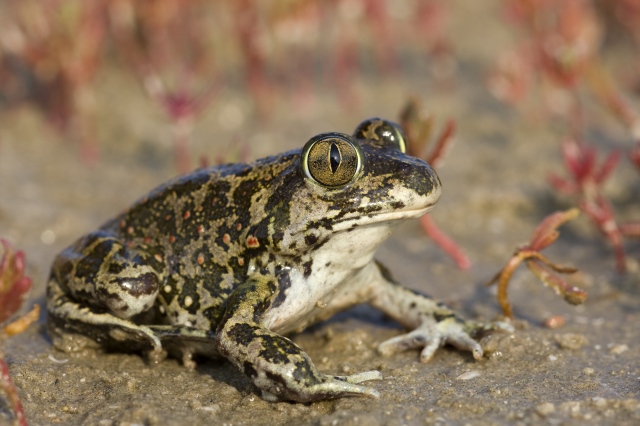
Pelobates cultripes inhabits open landscapes with soft or sandy soils, including dunes, agricultural landscapes, fields and meadows. It is distinguished by a black digging spade on each hind foot and greyish-yellowish upper surfaces with dark brown or greenish blotches and spots.
Written 26 November 2026 from the sources listed below. Each statement was checked against the passage it cites; statements that could not be supported were removed.
Appearance
The upper surface is greyish-yellowish with dark brown or greenish blotches and spots. Each hind foot has a black digging spade.[1][2]
Adults have a snout-to-vent length ranging from 40 to 120 mm. Females are larger than males on average.[3][4]
Tadpoles are larger than those of most other toad species.[5]
Habitat
The species inhabits open landscapes, including dunes, agricultural landscapes, fields and meadows. It occurs in open areas with soft or sandy soils.[6][7]
It breeds in stagnant water bodies, frequently in temporary water bodies that can be brackish.[8][9]
Diet
Larvae exert a substantial herbivorous impact on aquatic macrophytes.[10]
Behaviour
The species is primarily nocturnal. Large numbers of individuals may appear after rainfall.[11][12]
Individuals hide in burrows reaching depths of 20 cm and can dig themselves into the ground rapidly.[13][14]
When threatened, individuals inflate their bodies and produce kitten-like mewing sounds.[15]
Males produce deep, rapid underwater calls resembling a clucking hen. Females occasionally produce calls.[16][17]
Reproduction and life cycle
The species breeds once annually. Males arrive at breeding sites before females on wet nights during the mating season.[18][19]
The duration of the breeding period varies with rainfall and can range from a few days to a month. During mating, males grasp females around the loins.[20][21]
Females lay clutches containing approximately 1,300–4,000 eggs in temporary ponds. Egg bands can reach 100 cm in length.[22][23][24]
Eggs are deposited among vegetation or on the bottom of ponds. They hatch approximately two weeks after being laid.[25][26]
Larval development generally takes four to six months. Larvae usually undergo metamorphosis at a large body size, and newly metamorphosed individuals measure approximately 2–3.5 cm.[27][28][29]
Individuals reach sexual maturity at approximately three years of age.[30]
Larvae can accelerate their development by approximately 30% when they detect a risk of pond desiccation. Accelerated development results in smaller metamorphosis size and increased oxidative stress.[31][32]
Similar species
The tadpoles are larger than those of most other toad species.[5]
Classification of the Iberian Spadefoot
| Kingdom | Animalia |
|---|---|
| Phylum | Chordata |
| Subphylum | Vertebrata |
| Infraphylum | Gnathostomata |
| Parvphylum | Osteichthyes |
| Megaclass | Tetrapoda |
| Class | Amphibia (Amphibians) |
| Order | Anura (Frogs) |
| Family | Pelobatidae (European Spadefoot Toad) |
| Genus | Pelobates (European Spadefoot Toad) |
| Species | Pelobates cultripes (Cuvier, 1829) |
Where the Iberian Spadefoot is found
Checklists and occurrence records place Pelobates cultripes in 3 countries. GBIF holds 25,154 georeferenced records of it.
Countries
Regions and cities with the most records
- Rochefort, France 4,863
- La Rochelle, France 3,690
- Occitanie, France 3,437
- Provence-Alpes-Côte d'Azur, France 1,700
- Catalonia, Spain 1,352
- Pays de la Loire, France 1,071
- Lattes, France 897
- Extremadura, Spain 870
- Castelnau-le-Lez, France 821
- Sète, France 818
- Montpellier, France 809
- Frontignan, France 706
- Royan, France 657
- Mauguio, France 588
- Lunel, France 532
- Madrid, Spain 509
- Beja, Portugal 473
- Valencia, Spain 425
- Aragon, Spain 420
- Castelo Branco, Portugal 413
- Évora, Portugal 366
- L'Isle-sur-la-Sorgue, France 341
- Carpentras, France 333
- Cavaillon, France 332
- Setúbal, Portugal 312
- Portalegre, Portugal 301
- Agde, France 295
- Figueres, Spain 277
- Tres Cantos, Spain 254
- Bragança, Portugal 252
- Béziers, France 241
- Colmenar Viejo, Spain 239
- Istres, France 227
- Guarda, Portugal 220
- Torrelodones, Spain 213
- El Goloso, Spain 210
A number beside a place is its count of GBIF occurrence records. A place without a number comes from a checklist alone. Records show where a species has been observed or collected, which can include escapes and vagrants.
Common names
English
- Iberian Spadefoot
- Iberian Spadefoot Toad
- Western Spadefoot
- Western Spadefoot Toad
Names in 17 other languages
- Asturian
- sapu d'espolones
- Catalan
- Gripau d'esperons
- Chinese
- 強刃鋤足蟾
- Czech
- blatnice západní
- Danish
- Spansk Løgfrø
- Dutch
- Iberische Knoflookpad, Spaanse Knoflookpad
- Finnish
- iberiankaivajasammakko
- French
- Pélobate cultripède, Pélobate cultripède (Le), Pélobate à couteaux
- Galician
- Sapo de esporóns
- German
- Messerfuß
- Hungarian
- zöld ásóbéka
- Italian
- Pelobate occidentale
- Japanese
- イベリアニンニクガエル
- Polish
- Grzebiuszka gibraltarska
- Portuguese
- Sapo-de-unha-negra
- Russian
- Западная чесночница
- Spanish
- Sapo de Espuelas, Sapo de espuelas occidental
Synonyms
8 other scientific names have been used for this species and are now treated as synonyms of Pelobates cultripes.
- Bufo calcaratus (Michahelles, 1830)
- Cultripes cultripes (Cuvier, 1829)
- Cultripes provincialis Müller, 1832
- Didocus calcaratus (Michahelles, 1830)
- Pelabates calcaratus (Michahelles, 1830)
- Rana calcarata Michahelles, 1830
- Rana cultripes Cuvier, 1829
- Rana cultripes cultripes Cuvier, 1829
Related species
-
 Common Spadefoot ToadPelobates fuscus
-
 Syrian SpadefootPelobates syriacus
-
 Moroccan SpadefootPelobates varaldii
-
 Pallas' Spadefoot ToadPelobates vespertinus
-
 Balkan SpadefootPelobates balcanicus
Compare
Questions and answers
What is the scientific name of the Iberian Spadefoot?
The scientific name of the Iberian Spadefoot is Pelobates cultripes. Written with its author, the full name is Pelobates cultripes (Cuvier, 1829).
Which family does the Iberian Spadefoot belong to?
Pelobates cultripes belongs to the family Pelobatidae, in the order Anura and the class Amphibia.
Where is the Iberian Spadefoot found?
Checklists and occurrence records place Pelobates cultripes in 3 countries: France, Spain and Portugal.
What is the conservation status of the Iberian Spadefoot?
The IUCN Red List category recorded for Pelobates cultripes is Vulnerable (VU).
What other names does the Iberian Spadefoot have?
Pelobates cultripes is also known in English as Iberian Spadefoot Toad, Western Spadefoot and Western Spadefoot Toad.
How long do spadefoot toads live?
The species can live for up to 15 years.[33]
Sources
Passages the profile rests on
- The species has a black digging spade on each hind foot. Source passage: “It has a black spade on the hind foot, hence its name.” — English Wikipedia
- Its upper surface is greyish-yellowish with dark brown or greenish blotches and spots. Source passage: “The upperside is greyish-yellowish with dark brown or greenish blotches and spots.” — English Wikipedia
- Adults have a snout-to-vent length ranging from 40 to 120 mm. Source passage: “As adults, P. cultripes are medium sized anurans (40–120 mm, snout-vent length)” — pmc.ncbi.nlm.nih.gov
- Females are larger than males on average. Source passage: “with sexual size dimorphism in favour of females.” — pmc.ncbi.nlm.nih.gov
- Its tadpoles are larger than those of most other toad species. Source passage: “The tadpoles are larger than those of most other toad species.” — English Wikipedia
- The species inhabits open landscapes including dunes, agricultural landscapes, fields and meadows. Source passage: “Pelobates cultripes lives in various open landscapes, such as dunes, agricultural landscapes, fields, meadows etc.” — amphibiaweb.org
- The species occurs in open areas with soft or sandy soils. Source passage: “It occurs in open areas usually with soft or sandy soils” — English Wikipedia
- The species breeds in stagnant water bodies. Source passage: “Reproduction occurs in stagnant water bodies.” — amphibiaweb.org
- Breeding frequently takes place in temporary water bodies that can be brackish. Source passage: “It breeds often in temporary water that is sometimes brackish.” — English Wikipedia
- Larvae exert a substantial herbivorous impact on aquatic macrophytes. Source passage: “causing a big herbivorous impact on aquatic macrophytes” — pmc.ncbi.nlm.nih.gov
- The species is primarily nocturnal. Source passage: “This toad is mostly nocturnal” — English Wikipedia
- Large numbers of individuals may appear after rainfall. Source passage: “but occasionally vast numbers of it can be seen after rain.” — English Wikipedia
- Individuals hide in burrows reaching depths of 20 cm. Source passage: “It hides in burrows up to 20 cm deep” — English Wikipedia
- Individuals can dig themselves into the ground rapidly. Source passage: “and can dig itself into earth quite fast.” — English Wikipedia
- When threatened, individuals inflate their bodies and produce kitten-like mewing sounds. Source passage: “When threatened it inflates its body and mews, kitten-like.” — English Wikipedia
- Males produce deep, rapid underwater calls resembling a clucking hen. Source passage: “Males produce a deep and rapid 'co-co-co' under water which sound like a clucking hen.” — English Wikipedia
- Females occasionally produce calls. Source passage: “Females call occasionally too.” — English Wikipedia
- The species breeds once annually. Source passage: “This species breeds once a year” — pmc.ncbi.nlm.nih.gov
- Males arrive at breeding sites before females on wet nights during the mating season. Source passage: “During mating season males appear first on wet nights at breeding sites, the females arrive later.” — English Wikipedia
- The duration of the breeding period varies with rainfall and can range from a few days to a month. Source passage: “The length of the breeding period depends on the rainfall and may last a month or only few days.” — English Wikipedia
- Males grasp females around the loins during mating. Source passage: “Males grab the females at the loins.” — English Wikipedia
- Females lay clutches containing approximately 1,300–4,000 eggs. Source passage: “laying large clutches (1,300–4,000 eggs)” — pmc.ncbi.nlm.nih.gov
- Eggs are laid in temporary ponds. Source passage: “in temporary ponds where the larvae develop” — pmc.ncbi.nlm.nih.gov
- Females can produce egg bands reaching 100 cm in length. Source passage: “Females produce bands of up to 7000 eggs which are up to 100 cm long.” — English Wikipedia
- Eggs are deposited among vegetation or on the bottom of ponds. Source passage: “They lay them among vegetation or on the pond bottom.” — English Wikipedia
- Eggs hatch approximately two weeks after being laid. Source passage: “The eggs hatch after two weeks” — English Wikipedia
- Larval development generally takes four to six months. Source passage: “the tadpoles take around 4 to 6 months to develop.” — English Wikipedia
- Larvae usually undergo metamorphosis at a large body size. Source passage: “until they reach metamorphosis, usually at a large size.” — pmc.ncbi.nlm.nih.gov
- Newly metamorphosed individuals measure approximately 2–3.5 cm. Source passage: “Young toads are 2 to 3.5 cm long after metamorphosis” — English Wikipedia
- Individuals reach sexual maturity at approximately three years of age. Source passage: “and take 3 years to reach maturity.” — English Wikipedia
- Larvae can accelerate their development by approximately 30% when they detect a risk of pond desiccation. Source passage: “capable of accelerating their development by ∼30% when they perceive risk of desiccation from pond drying” — pmc.ncbi.nlm.nih.gov
- Accelerated larval development results in smaller metamorphosis size and increased oxidative stress. Source passage: “at the expense of metamorphosing at a smaller size and increased oxidative stress.” — pmc.ncbi.nlm.nih.gov
- The species can live for up to 15 years. Source passage: “This toad may live up to 15 years.” — English Wikipedia
Data
- Catalogue of Life, 2026-10-16 XR cc by
- Global Biodiversity Information Facility CC BY 4.0
- Wikidata CC0
- GeoNames CC BY 4.0
- Wikimedia Commons per image; credit shown with each image
- Within the Catalogue of Life, this name comes from The Integrated Taxonomic Information System cc0
This species in other databases
Page built on 28 November 2026. See how the catalog is made and all sources and licences.
Cite this page
ScientificNames.org. (2026). Pelobates cultripes (Iberian Spadefoot). Retrieved November 28, 2026, from https://scientificnames.org/species/pelobates-cultripes
“Pelobates cultripes (Iberian Spadefoot).” ScientificNames.org, 2026, scientificnames.org/species/pelobates-cultripes. Accessed 28 Nov. 2026.
ScientificNames.org. “Pelobates cultripes (Iberian Spadefoot).” Accessed November 28, 2026. https://scientificnames.org/species/pelobates-cultripes.
@misc{scientificnames_pelobates_cultripes_iberian_spadefoot,
  author = {{ScientificNames.org}},
  title = {Pelobates cultripes (Iberian Spadefoot)},
  year = {2026},
  url = {https://scientificnames.org/species/pelobates-cultripes},
  note = {Accessed 2026-11-28}
}