Species · Amphibians
Moroccan Spadefoot Pelobates varaldii
The scientific name of the Moroccan Spadefoot is Pelobates varaldii. It is a species of amphibian in the family Pelobatidae (european spadefoot toad), order Anura. The name dates from 1959.
- Scientific name
- Pelobates varaldii Pasteur & Bons, 1959
- Common name
- Moroccan Spadefoot
- Genus
- Pelobates
- Family
- Pelobatidae (European Spadefoot Toad)
- Order
- Anura
- Class
- Amphibia
- Red List category
- EN Endangered
- Recorded in
- 1 country
- Name status
- accepted in the Catalogue of Life

Overview
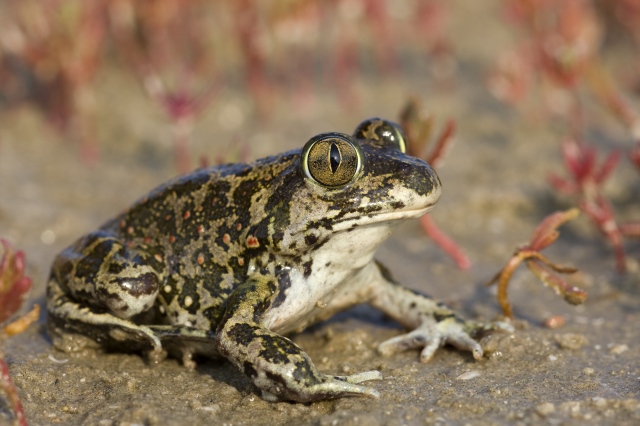
The Moroccan Spadefoot is an amphibian in the family Pelobatidae, order Anura and class Amphibia. It is endemic to coastal north-western Morocco according to current knowledge. It has a stocky body, smooth grey-brown dorsal skin with irregular darker markings, and enlarged metatarsal tubercles on its hind feet.
Written 27 November 2026 from the sources listed below. Each statement was checked against the passage it cites; statements that could not be supported were removed.
Appearance
The Moroccan Spadefoot has a stocky overall body shape, an inconspicuous tympanum and no parotoid glands. Its dorsal skin is smooth and finely glandular.[1][2][3][4]
Its dorsal coloration is grey-brown with irregular darker markings, and some individuals have red speckles above their eyes. The underside of its body is white.[5][6][7]
Its hind feet have enlarged metatarsal tubercles used for digging. Adult males reach 65 mm in snout–vent length, while adult females reach 70 mm.[8][9][10]
The tadpoles can reach 130 mm in length.[11]
Habitat
The Moroccan Spadefoot inhabits uncultivated lowland sandy soils, sometimes in areas near cork woodlands. It occurs at elevations below 350 m.[12][13][14]
It breeds in large temporary ponds with hydroperiods lasting four to eight months.[15][16]
Behaviour
The Moroccan Spadefoot is strictly nocturnal and generally lives a fossorial lifestyle.[17][18]
Male individuals produce a loud, harsh clucking advertisement call.[19]
Reproduction and life cycle
Spawning typically occurs in temporary standing-water habitats, including dayas and rain puddles. The species breeds in large temporary ponds with hydroperiods of four to eight months.[20][21]
Diet
The tadpoles feed on plankton and detritus.[22]
Conservation
The Moroccan Spadefoot does not inhabit modified habitats. Habitat loss and degradation caused by conversion of land to livestock pasture threaten the species.[23][24]
Pollution of ponds by livestock droppings is another threat. The introduced fish Gambusia holbrooki also threatens the species.[25][26]
The species might occur within the Merja Zerga Biological Reserve.[27]
Classification of the Moroccan Spadefoot
| Kingdom | Animalia |
|---|---|
| Phylum | Chordata |
| Subphylum | Vertebrata |
| Infraphylum | Gnathostomata |
| Parvphylum | Osteichthyes |
| Megaclass | Tetrapoda |
| Class | Amphibia (Amphibians) |
| Order | Anura (Frogs) |
| Family | Pelobatidae (European Spadefoot Toad) |
| Genus | Pelobates (European Spadefoot Toad) |
| Species | Pelobates varaldii Pasteur & Bons, 1959 |
Where the Moroccan Spadefoot is found
Checklists and occurrence records place Pelobates varaldii in 1 country. GBIF holds 203 georeferenced records of it.
Countries
Regions and cities with the most records
- Bouknadel, Morocco 20
- Salé Al Jadida, Morocco 20
- Rabat, Morocco 18
- Salé, Morocco 18
- El Harhoura, Morocco 15
- Temara, Morocco 15
- Sidi Allal El Bahraoui, Morocco 12
- Aïn Attig, Morocco 6
- Sidi Taibi, Morocco 5
- Gueznaia, Morocco 4
- Mehdya, Morocco 4
- Asilah, Morocco 3
- Sidi Yahia El Gharb, Morocco 3
A number beside a place is its count of GBIF occurrence records. A place without a number comes from a checklist alone. Records show where a species has been observed or collected, which can include escapes and vagrants.
Common names
English
- Moroccan Spadefoot
- Moroccan Spadefoot Toad
- Varaldias Spadefoot Toad
- Varaldi’s Spadefoot Toad
Names in 9 other languages
- Chinese
- 瓦拉鋤足蟾
- Czech
- blatnice marocká
- Dutch
- Marokkaanse knoflookpad
- French
- Pélobate Marocain, Pélobate de Varaldi, Pélobate du Maroc
- German
- Marokkanischer Messerfuß
- Hungarian
- marokkói ásóbéka
- Japanese
- モロッコニンニクガエル
- Russian
- Марокканская чесночница
- Spanish
- Sapo de Espuelas Marroquí
Related species
-
 Common Spadefoot ToadPelobates fuscus
-
 Syrian SpadefootPelobates syriacus
-
 Iberian SpadefootPelobates cultripes
-
 Pallas' Spadefoot ToadPelobates vespertinus
-
 Balkan SpadefootPelobates balcanicus
Compare
Questions and answers
What is the scientific name of the Moroccan Spadefoot?
The scientific name of the Moroccan Spadefoot is Pelobates varaldii. Written with its author, the full name is Pelobates varaldii Pasteur & Bons, 1959.
Which family does the Moroccan Spadefoot belong to?
Pelobates varaldii belongs to the family Pelobatidae, in the order Anura and the class Amphibia.
Where is the Moroccan Spadefoot found?
Checklists and occurrence records place Pelobates varaldii in 1 country: Morocco.
What is the conservation status of the Moroccan Spadefoot?
The IUCN Red List category recorded for Pelobates varaldii is Endangered (EN).
What other names does the Moroccan Spadefoot have?
Pelobates varaldii is also known in English as Moroccan Spadefoot Toad, Varaldias Spadefoot Toad and Varaldi’s Spadefoot Toad.
Why are they called spadefoot toads?
The Moroccan Spadefoot has enlarged metatarsal tubercles on its hind feet that are used for digging.[8]
Sources
Passages the profile rests on
- The species has a stocky overall body shape. Source passage: “The overall appearance is stocky.” — English Wikipedia
- The species has an inconspicuous tympanum. Source passage: “The tympanum is present but inconspicuous.” — English Wikipedia
- The species lacks parotoid glands. Source passage: “No parotoid glands are present.” — English Wikipedia
- Its dorsal skin is smooth and finely glandular. Source passage: “The dorsum is finely glandular and smooth” — English Wikipedia
- Its dorsal coloration is grey-brown with irregular darker markings. Source passage: “colouration is grey-brown with irregular darker markings.” — English Wikipedia
- Some individuals have red speckles above their eyes. Source passage: “There can be red speckles above the eyes.” — English Wikipedia
- The underside of its body is white. Source passage: “The ventral side of the body is white.” — English Wikipedia
- Its hind feet have enlarged metatarsal tubercles used for digging. Source passage: “The hind feet have enlarged metatarsal tubercles (used in digging)” — English Wikipedia
- Adult males reach 65 mm in snout–vent length. Source passage: “Males grow to 65 mm (2.6 in) and females to 70 mm (2.8 in) in snout–vent length.” — English Wikipedia
- Adult females reach 70 mm in snout–vent length. Source passage: “Males grow to 65 mm (2.6 in) and females to 70 mm (2.8 in) in snout–vent length.” — English Wikipedia
- The tadpoles can reach 130 mm in length. Source passage: “The tadpoles can reach 130 mm (5.1 in) in length.” — English Wikipedia
- The species inhabits lowland sandy soils that are uncultivated. Source passage: “Pelobates varaldii occurs in lowland sandy uncultivated soils” — English Wikipedia
- Its habitat sometimes includes areas near cork woodlands. Source passage: “sometimes in the vicinity of cork woodlands” — English Wikipedia
- The species occurs at elevations below 350 m. Source passage: “at elevations below 350 m (1,150 ft).” — English Wikipedia
- The species breeds in large temporary ponds. Source passage: “Pelobates varaldii breeds in large temporary ponds” — amphibiaweb.org
- Its breeding ponds have hydroperiods lasting four to eight months. Source passage: “with long hydroperiods (four to eight months;” — amphibiaweb.org
- The species is strictly nocturnal. Source passage: “It is a strictly nocturnal species.” — amphibiaweb.org
- The species generally lives a fossorial lifestyle. Source passage: “It is generally fossorial.” — English Wikipedia
- Male individuals produce a loud, harsh clucking advertisement call. Source passage: “The male advertisement call is aloud, harsh clucking.” — English Wikipedia
- Spawning typically occurs in temporary standing-water habitats, including dayas and rain puddles. Source passage: “Spawning typically takes place in temporary bodies of standing water (e.g., dayas and rain puddles).” — English Wikipedia
- The species breeds in large temporary ponds with hydroperiods of four to eight months. Source passage: “Pelobates varaldii breeds in large temporary ponds with long hydroperiods (four to eight months;” — amphibiaweb.org
- The tadpoles feed on plankton and detritus. Source passage: “The tadpoles are aquatic and feed on plankton and detritus.” — English Wikipedia
- The species does not inhabit modified habitats. Source passage: “This species does not occur in modified habitats.” — English Wikipedia
- Habitat loss and degradation caused by conversion of land to livestock pasture threaten the species. Source passage: “It is threatened by habitat loss and degradation caused by the conversion of land to livestock pasture” — English Wikipedia
- Pollution of ponds by livestock droppings is a threat to the species. Source passage: “the pollution of ponds with livestock droppings.” — English Wikipedia
- The introduced fish Gambusia holbrooki is another threat to the species. Source passage: “Also the introduced Gambusia holbrooki is a threat.” — English Wikipedia
- The species might occur within the Merja Zerga Biological Reserve. Source passage: “This species might be present in the Merja Zerga Biological Reserve.” — English Wikipedia
Data
- Catalogue of Life, 2026-10-16 XR cc by
- Global Biodiversity Information Facility CC BY 4.0
- Wikidata CC0
- GeoNames CC BY 4.0
- Wikimedia Commons per image; credit shown with each image
- Within the Catalogue of Life, this name comes from The Integrated Taxonomic Information System cc0
This species in other databases
Page built on 28 November 2026. See how the catalog is made and all sources and licences.
Cite this page
ScientificNames.org. (2026). Pelobates varaldii (Moroccan Spadefoot). Retrieved November 28, 2026, from https://scientificnames.org/species/pelobates-varaldii
“Pelobates varaldii (Moroccan Spadefoot).” ScientificNames.org, 2026, scientificnames.org/species/pelobates-varaldii. Accessed 28 Nov. 2026.
ScientificNames.org. “Pelobates varaldii (Moroccan Spadefoot).” Accessed November 28, 2026. https://scientificnames.org/species/pelobates-varaldii.
@misc{scientificnames_pelobates_varaldii_moroccan_spadefoot,
  author = {{ScientificNames.org}},
  title = {Pelobates varaldii (Moroccan Spadefoot)},
  year = {2026},
  url = {https://scientificnames.org/species/pelobates-varaldii},
  note = {Accessed 2026-11-28}
}