Species · Mammals
California Deermouse Peromyscus californicus
The scientific name of the California Deermouse is Peromyscus californicus. It is a species of mammal in the family Cricetidae (new world mice and rats), order Rodentia. The name dates from 1848.
- Scientific name
- Peromyscus californicus (Gambel, 1848)
- Common name
- California Deermouse
- Genus
- Peromyscus
- Family
- Cricetidae (New World Mice and Rats)
- Order
- Rodentia
- Class
- Mammalia
- Red List category
- LC Least Concern
- Recorded in
- 2 countries
- Name status
- accepted in the Catalogue of Life

Overview
Peromyscus californicus occurs in central and southern California and northwestern Mexico. It is the largest species in its genus and has very large ears and a tail longer than its head and body combined.
Written 26 November 2026 from the sources listed below. Each statement was checked against the passage it cites; statements that could not be supported were removed.
Appearance
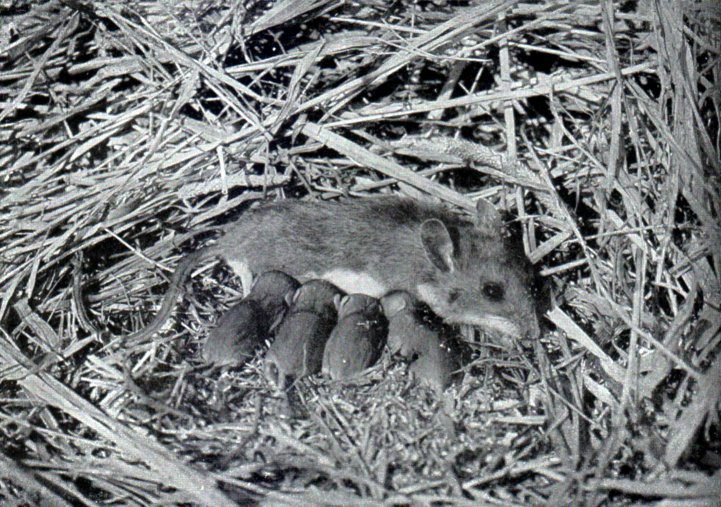
The California Deermouse has very large ears measuring between 20 and 25 mm. Its tail is longer than its head and body combined.[1][2][3]
Adults have yellowish-brown or gray dorsal coloring mixed with black and a white underside. Many individuals have a fulvous throat patch and a fulvous lateral line separating their dorsal and ventral fur.[4][5]
Juveniles have gray upperparts and white undersides. Its manus and feet are white.[6][7]
Its total body length, including the tail, ranges from 220 to 285 mm. Its tail measures approximately 117 to 156 mm.[8][9]
Habitat
The California Deermouse is generally restricted to dense chaparral and broad-sclerophyll woodland. It commonly uses woodrat houses as dens.[10][11]
It builds globular nests from grasses or sticks lined with fine grass. Nests are generally placed on the ground beneath debris such as fallen logs and insulated with coarse, dry grasses, weeds, and sticks.[12][13][14]
The species is an excellent climber and is frequently found in trees and shrubs.[15]
Diet
The California Deermouse eats shrub fruits, seeds, and flowers. California bay laurel seeds are a major food source in woodland habitats.[16][17]
Its diet also includes grasses, forbs, fungi, and arthropods. Arthropods may constitute a small proportion of its diet but are not actively hunted.[18][19]
Behaviour
The California Deermouse is monogamous and forms lifelong pair bonds. Males and females live in small family groups, and both sexes defend their nest sites against members of the same sex.[20][21][22]
The species is nocturnal and has a slight activity peak shortly before dawn. It communicates with other members of its species using ultrasound.[23][24]
It readily excludes California mice of the species P. truei from woodrat houses when the two species coexist.[25]
Reproduction and life cycle
Mating can occur throughout the year but occurs mainly from March to September. Wild populations average three to four litters annually, while laboratory females can produce up to six litters annually.[26][27][28]
Gestation lasts between 30 and 33 days. Young are weaned at approximately five weeks of age.[29][30]
Females reach sexual maturity at approximately 11 weeks, while males take longer. Males participate extensively in caring for and protecting offspring.[31][32]
Conservation
Despite its restricted habitat, limited geographic range, and generally low population densities, the California Deermouse has healthy populations.[33]
Uses
The California Deermouse is used as a model organism for research into the genetics and neurobiology of partner fidelity and paternal care.[34]
Classification of the California Deermouse
| Kingdom | Animalia |
|---|---|
| Phylum | Chordata |
| Subphylum | Vertebrata |
| Infraphylum | Gnathostomata |
| Parvphylum | Osteichthyes |
| Megaclass | Tetrapoda |
| Class | Mammalia (Mammal) |
| Subclass | Theria |
| Infraclass | Eutheria |
| Order | Rodentia (Rodent) |
| Suborder | Myomorpha (Mice) |
| Superfamily | Muroidea |
| Family | Cricetidae (New World Mice and Rats) |
| Subfamily | Neotominae |
| Genus | Peromyscus (Deer Mice) |
| Species | Peromyscus californicus (Gambel, 1848) |
Where the California Deermouse is found
Checklists and occurrence records place Peromyscus californicus in 2 countries across North America. GBIF holds 7,127 georeferenced records of it.
Countries
Regions and cities with the most records
- California, United States 4,578
- Mountain View, United States 396
- Los Altos, United States 389
- Menlo Park, United States 387
- Cupertino, United States 386
- Palo Alto, United States 383
- Saratoga, United States 375
- Los Gatos, United States 366
- East Palo Alto, United States 358
- Campbell, United States 350
- Sunnyvale, United States 343
- Santa Clara, United States 291
- Lafayette, United States 246
- Moraga, United States 246
- San Jose, United States 246
- Walnut Creek, United States 245
- Berkeley, United States 237
- Newark, United States 237
- Orinda, United States 237
- Albany, United States 235
- Oakland, United States 235
- Alameda, United States 233
- El Cerrito, United States 227
- Richmond, United States 220
- San Pablo, United States 219
- Pinole, United States 218
- Baja California, Mexico 217
- Hercules, United States 216
- Fremont, United States 214
- Milpitas, United States 214
- Santa Barbara, United States 210
- Goleta, United States 206
- Rancho San Diego, United States 206
- Isla Vista, United States 205
- Tecate, Mexico 198
- San Leandro, United States 197
Range as the checklists state it
Middle America
North America
A number beside a place is its count of GBIF occurrence records. A place without a number comes from a checklist alone. Records show where a species has been observed or collected, which can include escapes and vagrants.
Common names
English
- California Deermouse
- California Mouse
Names in 9 other languages
- Czech
- křeček kalifornský
- Finnish
- kalifornianpeurahiiru
- French
- Souris de Californie
- German
- Kalifornische Maus
- Japanese
- カリフォルニアシロアシマウス
- Norwegian Bokmål
- Kaliforniahjortemus
- Polish
- myszak kalifornijski
- Russian
- Калифорнийский хомячок
- Spanish
- Ratón californiano
Synonyms
5 other scientific names have been used for this species and are now treated as synonyms of Peromyscus californicus.
- Hesperomys parasiticus Baird, 1857
- Mus californicus Gambel, 1848
- Peromyscus californicus benitoensis Grinnell & Orr, 1934
- Peromyscus californicus mariposae Grinnell & Orr, 1934
- Peromyscus insignis Rhoads, 1895
Related species
-
 White-footed MousePeromyscus leucopus
-
 Eastern Deer MousePeromyscus maniculatus
-
 Oldfield MousePeromyscus polionotus
-
 Cactus MousePeromyscus eremicus
-
 Brush MousePeromyscus boylii
- Angel Island MousePeromyscus guardia
-
 Cotton MousePeromyscus gossypinus
-
 Pinyon MousePeromyscus truei
Compare
Questions and answers
What is the scientific name of the California Deermouse?
The scientific name of the California Deermouse is Peromyscus californicus. Written with its author, the full name is Peromyscus californicus (Gambel, 1848).
Which family does the California Deermouse belong to?
Peromyscus californicus belongs to the family Cricetidae, in the order Rodentia and the class Mammalia.
Where is the California Deermouse found?
Checklists and occurrence records place Peromyscus californicus in 2 countries: United States and Mexico.
What is the conservation status of the California Deermouse?
The IUCN Red List category recorded for Peromyscus californicus is Least Concern (LC).
What other names does the California Deermouse have?
Peromyscus californicus is also known in English as California Mouse.
Do California deer mice carry hantavirus?
The California Deermouse's fecal matter may transmit hantavirus.[35]
What is the diet of a deer mouse?
The California Deermouse eats shrub fruits, seeds, and flowers, as well as grasses, forbs, fungi, and arthropods. California bay laurel seeds are a major food source in woodland habitats.[16][17][18]
Sources
Passages the profile rests on
- The California mouse has very large ears. Source passage: “The California deermouse has very large ears” — English Wikipedia
- Its tail is longer than its head and body combined. Source passage: “its tail is longer than the head and body combined.” — English Wikipedia
- Its ears measure between 20 and 25 mm. Source passage: “The ears are large, ranging from 20-25 mm (Whitaker 1997).” — animaldiversity.org
- Adults have yellowish-brown or gray dorsal coloring mixed with black and a white underside. Source passage: “Adults have a yellowish brown or gray mixed with black dorsal coloring, and a white underside, and feet.” — animaldiversity.org
- Many individuals have a fulvous throat patch and a fulvous lateral line separating their dorsal and ventral fur. Source passage: “Many individuals have a distinctly fulvous throat patch and a fulvous lateral line separating dorsal from ventral pelage in the shoulder region” — animaldiversity.org
- Its manus and feet are white. Source passage: “The manus and feet are white.” — English Wikipedia
- Juveniles have gray upperparts and white undersides. Source passage: “Juveniles are gray on top with a white underside.” — animaldiversity.org
- Its total body length, including the tail, ranges from 220 to 285 mm. Source passage: “the mouse ranges in length from 220 to 285 mm (8.7 to 11.2 in).” — English Wikipedia
- Its tail measures approximately 117 to 156 mm. Source passage: “tail length ranging from approximately 117-156 mm (Whitaker 1997).” — animaldiversity.org
- The species is generally restricted to dense chaparral and broad-sclerophyll woodland. Source passage: “Peromyscus californicus is generally restricted to dense chaparrel and broad-sclerophyll woodland” — animaldiversity.org
- It commonly uses woodrat houses as dens. Source passage: “A poor burrower, Peromyscus californicus readily uses woodrat ( Neotoma fuscipes ) houses for dens” — animaldiversity.org
- It builds globular nests from grasses or sticks lined with fine grass. Source passage: “They build globular nests out of grasses or sticks, lined with fine grass.” — animaldiversity.org
- It tends to nest on the ground beneath debris such as fallen logs. Source passage: “tends to nest on the ground, under debris such as fallen logs” — English Wikipedia
- Its nests are insulated with coarse, dry grasses, weeds, and sticks. Source passage: “Nests are insulated with coarse, dry grasses, weeds, and sticks” — English Wikipedia
- It is an excellent climber and is frequently found in trees and shrubs. Source passage: “California mice are excellent climbers and are often found in trees and shrubs.” — animaldiversity.org
- Its diet includes shrub fruits, seeds, and flowers. Source passage: “The mouse's diet consists of shrub fruits, seeds, and flowers” — English Wikipedia
- California bay laurel seeds are a major food source in woodland habitats. Source passage: “In woodland habitat the seeds of California bay laurel ( Umbellularia californica ) are the major food” — animaldiversity.org
- It also consumes grasses, forbs, fungi, and arthropods. Source passage: “also consume grasses, forbs, fungi, and arthropods.” — English Wikipedia
- Arthropods may constitute a small proportion of its diet but are not actively hunted. Source passage: “Arthropods may make up a small percentage on the diet but these are not actively hunted” — animaldiversity.org
- The species is monogamous and forms lifelong pair bonds. Source passage: “Unlike most mice P. californicus is truly monogamous, and once mated will stay paired for life” — animaldiversity.org
- Both sexes defend their nest sites against members of the same sex. Source passage: “with both sexes defending the nest site.” — English Wikipedia
- Males and females live in small family groups. Source passage: “Males and females form long-term pair bonds and these mice live in small family groups.” — animaldiversity.org
- The species is nocturnal and has a slight activity peak shortly before dawn. Source passage: “Peromyscus californicus is nocturnal, with a slight activity peak just before dawn” — animaldiversity.org
- It communicates with other members of its species using ultrasound. Source passage: “The mouse communicates with other members of its species via ultrasound.” — English Wikipedia
- It readily excludes California mice of the species P. truei from woodrat houses when the two species coexist. Source passage: “where found together, P. californicus actively excludes its conspecific P. truei from these woodrat houses” — animaldiversity.org
- Mating can occur throughout the year but occurs mainly from March to September. Source passage: “Mating may occur year round, but mainly from March to September.” — animaldiversity.org
- Wild populations average three to four litters annually. Source passage: “in the wild the average is 3-4.” — animaldiversity.org
- Laboratory females can produce up to six litters annually. Source passage: “In the lab P. californicus can have up to 6 litters per year” — animaldiversity.org
- Gestation lasts between 30 and 33 days. Source passage: “Gestation is 30 to 33 days” — animaldiversity.org
- Young are weaned at approximately five weeks of age. Source passage: “weaning is not completed for about 5 weeks.” — animaldiversity.org
- Females reach sexual maturity at approximately 11 weeks, while males take longer. Source passage: “approximately 11 weeks for females and even longer for males.” — animaldiversity.org
- Males participate extensively in caring for and protecting offspring. Source passage: “Males help extensively in caring for and protecting the young.” — animaldiversity.org
- Despite its restricted habitat, limited geographic range, and generally low population densities, its populations remain healthy. Source passage: “Despite its relatively narrow habitat, limited geographic range, and generally low population densities, Peromyscus californicus populations remain healthy.” — animaldiversity.org
- The species is used as a model organism for research into the genetics and neurobiology of partner fidelity and paternal care. Source passage: “making it a model organism for researchers studying the genetics and neurobiology of partner fidelity and paternal care.” — English Wikipedia
- Its fecal matter may transmit hantavirus. Source passage: “California mice fecal matter may transmit hantavirus.” — animaldiversity.org
Data
- Catalogue of Life, 2026-10-16 XR cc by
- Global Biodiversity Information Facility CC BY 4.0
- Wikidata CC0
- GeoNames CC BY 4.0
- Wikimedia Commons per image; credit shown with each image
- Within the Catalogue of Life, this name comes from The Integrated Taxonomic Information System cc0
References
- Proc. Acad. Nat. Sci. Philadelphia vol.4 p.78 where the name was published
- Hall, & Raymond, E. (1981). The Mammals of North America, 2nd Ed., Vol. 2.
- Banks, R. C., R. W. McDiarmid, and A. L. Gardner. (1987). Checklist of Vertebrates of the United States, the U.S. Territories, and Canada. Resource Publication, No. 166.
- Wilson, Don E., and DeeAnn M. Reeder, eds. (1993). Mammal Species of the World: A Taxonomic and Geographic Reference, 2nd Ed., 3rd Printing.
- Wilson, Don E., and F. Russell Cole. (2000). Common Names of Mammals of the World.
- Musser, Guy G., and Michael D. Carleton / Wilson, Don E., and DeeAnn M. Reeder, eds. (2005). Superfamily Muroidea. Mammal Species of the World: A Taxonomic and Geographic Reference, 3rd Ed., Vol. 2.
This species in other databases
Page built on 26 November 2026. See how the catalog is made and all sources and licences.
Cite this page
ScientificNames.org. (2026). Peromyscus californicus (California Deermouse). Retrieved November 26, 2026, from https://scientificnames.org/species/peromyscus-californicus
“Peromyscus californicus (California Deermouse).” ScientificNames.org, 2026, scientificnames.org/species/peromyscus-californicus. Accessed 26 Nov. 2026.
ScientificNames.org. “Peromyscus californicus (California Deermouse).” Accessed November 26, 2026. https://scientificnames.org/species/peromyscus-californicus.
@misc{scientificnames_peromyscus_californicus_california_deermouse,
  author = {{ScientificNames.org}},
  title = {Peromyscus californicus (California Deermouse)},
  year = {2026},
  url = {https://scientificnames.org/species/peromyscus-californicus},
  note = {Accessed 2026-11-26}
}