Species · Mammals
Eastern Deer Mouse Peromyscus maniculatus
The scientific name of the Eastern Deer Mouse is Peromyscus maniculatus. It is a species of mammal in the family Cricetidae (new world mice and rats), order Rodentia. The name dates from 1845.
- Scientific name
- Peromyscus maniculatus (Wagner, 1845)
- Common name
- Eastern Deer Mouse
- Genus
- Peromyscus
- Family
- Cricetidae (New World Mice and Rats)
- Order
- Rodentia
- Class
- Mammalia
- Red List category
- LC Least Concern
- Environment
- terrestrial
- Recorded in
- 4 countries
- Name status
- accepted in the Catalogue of Life

Overview
Peromyscus maniculatus occurs across North America, from Alaska and Canada southward to central Mexico, excluding the southeastern United States. It has a sharply differentiated bicolored tail that distinguishes it from the closely related white-footed mouse (Peromyscus leucopus).
Written 26 November 2026 from the sources listed below. Each statement was checked against the passage it cites; statements that could not be supported were removed.
Appearance
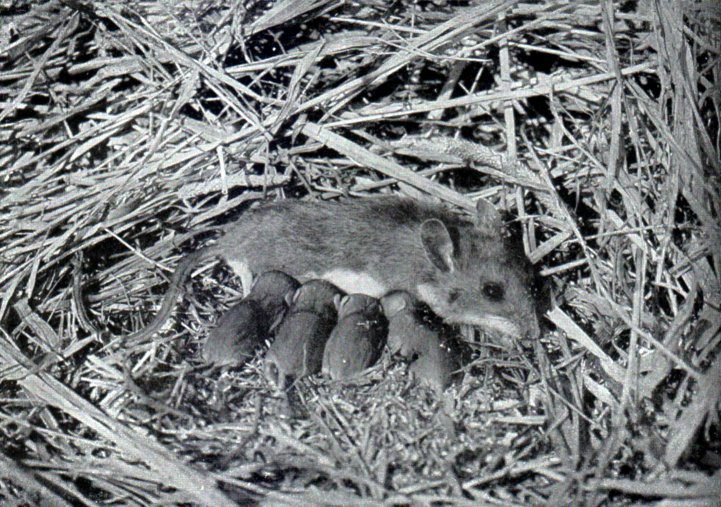
Its tail is finely haired, with a sharply differentiated dark upper surface and lighter lower surface. Its head has a pointed nose, large black eyes, and large ears with little fur, while its vibrissae are long and prominent.[1][2][3]
Its forelimbs are shorter than its hind limbs. Its total body length, excluding the tail, is approximately 8–10 cm, and its total length ranges from 119 to 222 mm.[4][5][6]
Its body mass ranges from 10 to 24 grams, and its tail length varies among populations from 45 to 105 mm. Woodland forms are generally larger and have larger tails and feet than prairie forms.[7][8][9]
Habitat
The Eastern Deer Mouse occupies alpine habitats, boreal forests, deserts, grasslands, brushlands, agricultural fields, and southern montane woodlands. Its most common habitats are prairies, bushy areas, and woodlands.[10][11]
It occupies boreal, temperate, and tropical islands. In the Adirondacks, it occurs in all terrestrial habitats and at all elevations, with the largest populations supported by mixed and mature deciduous forests with sparse ground cover.[12][13][14]
It constructs nests in underground burrows and in cavities among stumps, logs, brush piles, and trees. Forest-dwelling forms construct nests in stumps, logs, brush piles, and tree cavities.[15][16]
Diet
The Eastern Deer Mouse is omnivorous and consumes both plant and animal matter. Its diet includes insects, other invertebrates, seeds, fruits, flowers, nuts, fungi, and carrion.[17][18][19]
Small invertebrates such as insects, earthworms, and snails are important components of its summer diet. It stores food, particularly seeds, in underground holes, tree cavities, and bird nests.[20][21]
Behaviour
The Eastern Deer Mouse is primarily nocturnal. It spends most of its time on the ground but is also an adept climber.[22][23]
It may enter daily torpor during winter to conserve energy. Its home ranges typically cover 242 to 3,000 square meters.[24][25]
Male home ranges are larger than female home ranges and overlap more frequently. The species communicates through visual, tactile, chemical, and auditory signals.[26][27]
When disturbed, it may drum its front paws rapidly against a hard surface.[28]
Reproduction and life cycle
The Eastern Deer Mouse is polygynous. Females have an estrous cycle lasting approximately five days.[29][30]
Gestation lasts approximately 22.4–25.5 days in nonlactating females and approximately 24.1–30.6 days in lactating females. Typical litters contain four, five, or six young.[31][32][33]
Females can become pregnant shortly after giving birth. Young are generally weaned between 25 and 35 days after birth, and their eyes open at approximately 15 days of age.[34][35][36]
Females typically experience their first estrus at approximately 49 days of age.[37]
Similar species
The Eastern Deer Mouse is closely related to the white-footed mouse (Peromyscus leucopus). It can be distinguished by its more sharply differentiated bicolored tail.[38][39]
Its hind feet are generally 22 mm or shorter, whereas those of Peromyscus leucopus are usually 22 mm or longer.[40]
Uses
The Eastern Deer Mouse is used in laboratory experimentation.[41]
Classification of the Eastern Deer Mouse
| Kingdom | Animalia |
|---|---|
| Phylum | Chordata |
| Subphylum | Vertebrata |
| Infraphylum | Gnathostomata |
| Parvphylum | Osteichthyes |
| Megaclass | Tetrapoda |
| Class | Mammalia (Mammal) |
| Subclass | Theria |
| Infraclass | Eutheria |
| Order | Rodentia (Rodent) |
| Suborder | Myomorpha (Mice) |
| Superfamily | Muroidea |
| Family | Cricetidae (New World Mice and Rats) |
| Subfamily | Neotominae |
| Genus | Peromyscus (Deer Mice) |
| Species | Peromyscus maniculatus (Wagner, 1845) |
Where the Eastern Deer Mouse is found
Checklists and occurrence records place Peromyscus maniculatus in 4 countries across North America. GBIF holds 330,407 georeferenced records of it.
Countries
Regions and cities with the most records
- Saskatchewan, Canada 41,237
- California, United States 26,361
- Utah, United States 21,968
- Colorado, United States 18,159
- Washington, United States 14,830
- New Mexico, United States 14,070
- Kansas, United States 10,592
- Nevada, United States 8,175
- Alberta, Canada 8,015
- North Dakota, United States 6,903
- Wisconsin, United States 6,679
- Wyoming, United States 6,431
- British Columbia, Canada 6,088
- Oregon, United States 5,890
- Arizona, United States 5,765
- Manhattan, United States 5,294
- Idaho, United States 4,495
- Montana, United States 4,061
- Texas, United States 3,873
- Ontario, Canada 3,864
- Michigan, United States 3,267
- New Hampshire, United States 3,246
- Nebraska, United States 2,580
- Oklahoma, United States 2,463
- Battle Ground, United States 2,382
- Baja California, Mexico 2,104
- Tennessee, United States 2,021
- Minnesota, United States 1,873
- Junction City, United States 1,859
- New York, United States 1,839
- Bismarck, United States 1,826
- Mandan, United States 1,826
- Virginia, United States 1,789
- South Dakota, United States 1,747
- Puebla, Mexico 1,600
- Quebec, Canada 1,493
1 more country has a few records outside this range
These countries hold a few records of Peromyscus maniculatus but lie outside the range the checklists give for it. Such records are often zoo or garden specimens, museum material or vagrants, so the species is not counted as occurring there.
Range as the checklists state it
Middle America
North America
A number beside a place is its count of GBIF occurrence records. A place without a number comes from a checklist alone. Records show where a species has been observed or collected, which can include escapes and vagrants.
Common names
English
- Eastern Deer Mouse
- Deer Mouse
- Gambel's Deer Mouse
- North American Deermouse
- Western Deer Mouse
Names in 16 other languages
- Czech
- křeček dlouhoocasý
- Dutch
- Hertmuis
- Finnish
- peurahiiru
- French
- Souris du soir, souris sylvestre
- German
- Eigentliche Hirschmaus, Hirschmaus
- Greek
- Αγροποντικός του Gambel, Δυτικός Ελαφοποντικός, Ελαφοποντικός
- Hungarian
- őzegér
- Japanese
- シカシロアシマウス
- Korean
- 북미들쥐
- Norwegian Bokmål
- Nordhjortemus, Vanlig Hjortemus
- Polish
- myszak leśny
- Portuguese
- Rato-veadeiro
- Russian
- Олений хомячок
- Scottish Gaelic
- luch
- Spanish
- Ratón norteamericano, Ratón norteño de campo
- oji
- Waawaabiganoojiinh
Synonyms
64 other scientific names have been used for this species and are now treated as synonyms of Peromyscus maniculatus.
- Hesperomys arcticus Coues, 1877
- Hesperomys austerus Baird, 1855
- Hesperomys gambelii Baird, 1857
- Hesperomys gracilis Le Conte, 1855
- Hesperomys leucopus arcticus Mearns, 1890
- Hesperomys leucopus deserticolus Mearns, 1890
- Hesperomys leucopus rufinus Merriam, 1890
- Hesperomys maniculatus Wagner, 1845
- Hesperomys sonoriensis Le Conte, 1853
- Hesperomys sonoriensis nebrascensis Coues, 1877
- Mus bairdii Hoy & Kennicott, 1857
- Peromyscus canadensis abietorum Bangs, 1896
- Peromyscus canadensis argentatus Copeland & Church, 1906
- Peromyscus catalinae Elliot, 1903
- Peromyscus cineritius J. A. Allen, 1898
- Peromyscus dubius J. A. Allen, 1898
- Peromyscus exiguus J. A. Allen, 1898
- Peromyscus gambelii (Baird, 1857)
- Peromyscus geronimensis J. A. Allen, 1898
- Peromyscus imperfectus Dice, 1925
- Peromyscus labecula Elliot, 1903
- Peromyscus leucopus coolidgei Thomas, 1898
- Peromyscus leucopus nubiterrae Rhoads, 1896
- Peromyscus luteus Osgood, 1905
- Peromyscus maniculatus alpinus Cowan, 1937
- Peromyscus maniculatus anacapae von Bloeker, 1942
- Peromyscus maniculatus angustus Hall, 1932
- Peromyscus maniculatus anticostiensis Moulthrop, 1937
- Peromyscus maniculatus assimilis Nelson & Goldman, 1931
- Peromyscus maniculatus balaclavae McCabe & Cowan, 1945
- Peromyscus maniculatus borealis Mearns, 1911
- Peromyscus maniculatus clementis Mearns, 1896
- Peromyscus maniculatus dorsalis Nelson & Goldman, 1931
- Peromyscus maniculatus elusus Nelson & Goldman, 1931
- Peromyscus maniculatus eremus Osgood, 1909
- Peromyscus maniculatus exterus Nelson & Goldman, 1931
- Peromyscus maniculatus georgiensis Hall, 1938
- Peromyscus maniculatus gunnisoni Goldman, 1937
- Peromyscus maniculatus hollisteri Osgood, 1909
- Peromyscus maniculatus hueyi Nelson & Goldman, 1932
Showing 40 of 64.
Related species
-
 White-footed MousePeromyscus leucopus
-
 Oldfield MousePeromyscus polionotus
-
 Cactus MousePeromyscus eremicus
-
 California DeermousePeromyscus californicus
-
 Brush MousePeromyscus boylii
- Angel Island MousePeromyscus guardia
-
 Cotton MousePeromyscus gossypinus
-
 Pinyon MousePeromyscus truei
Compare
Questions and answers
What is the scientific name of the Eastern Deer Mouse?
The scientific name of the Eastern Deer Mouse is Peromyscus maniculatus. Written with its author, the full name is Peromyscus maniculatus (Wagner, 1845).
Which family does the Eastern Deer Mouse belong to?
Peromyscus maniculatus belongs to the family Cricetidae, in the order Rodentia and the class Mammalia.
Where is the Eastern Deer Mouse found?
Checklists and occurrence records place Peromyscus maniculatus in 4 countries: United States, Canada, Mexico and El Salvador.
What is the conservation status of the Eastern Deer Mouse?
The IUCN Red List category recorded for Peromyscus maniculatus is Least Concern (LC).
What other names does the Eastern Deer Mouse have?
Peromyscus maniculatus is also known in English as Deer Mouse, Gambel's Deer Mouse, North American Deermouse and Western Deer Mouse.
What is the diet of a deer mouse?
The Eastern Deer Mouse eats plant and animal matter, including insects, other invertebrates, seeds, fruits, flowers, nuts, fungi, and carrion.[17][18][19]
What is the habitat of a deer mouse?
The Eastern Deer Mouse occupies alpine habitats, boreal forests, deserts, grasslands, brushlands, agricultural fields, and southern montane woodlands. Its most common habitats are prairies, bushy areas, and woodlands.[10][11]
Is a deer mouse an herbivore, carnivore, or omnivore?
The Eastern Deer Mouse is an omnivore that consumes both plant and animal matter.[17]
Sources
Passages the profile rests on
- Its tail is finely haired and has a sharply differentiated dark upper surface and lighter lower surface. Source passage: “The finely-haired tail is bicolored, the darker top half and the lighter bottom sharply differentiated.” — animaldiversity.org
- Its head has a pointed nose, large black eyes, and large ears with little fur. Source passage: “The head has a pointed nose with large, black, beady eyes. The ears are large and have little fur covering them.” — animaldiversity.org
- Its vibrissae are long and prominent. Source passage: “The vibrissae are long and prominent.” — animaldiversity.org
- Its forelimbs are shorter than its hind limbs. Source passage: “Peromyscus maniculatus has shorter forelimbs than hind limbs (Baker 1983).” — animaldiversity.org
- Its total body length, excluding the tail, is approximately 8–10 cm. Source passage: “only 3 to 4 inches (8 to 10 cm) long, not including the tail.” — English Wikipedia
- Its total length ranges from 119 to 222 mm. Source passage: “It is typically 119 to 222 mm long” — animaldiversity.org
- Its body mass ranges from 10 to 24 grams. Source passage: “weighs between 10 and 24 grams.” — animaldiversity.org
- Its tail length varies among populations from 45 to 105 mm. Source passage: “Tail length is variable in different populations and ranges from 45 mm to 105 mm” — animaldiversity.org
- Woodland forms are generally larger and have larger tails and feet than prairie forms. Source passage: “Woodland forms are typically larger and have larger tails and feet than prairie forms” — animaldiversity.org
- The species occupies alpine habitats, boreal forests, deserts, grasslands, brushlands, agricultural fields, and southern montane woodlands. Source passage: “Deer mice can be found in alpine habitats, northern boreal forest, desert, grassland, brushland, agricultural fields, southern montane woodland” — animaldiversity.org
- Its most common habitats are prairies, bushy areas, and woodlands. Source passage: “However, its most common habitats are prairies, bushy areas, and woodlands (King 1968).” — animaldiversity.org
- It occupies boreal, temperate, and tropical islands. Source passage: “Also, P. maniculatus is found on boreal, temperate, and tropical islands.” — animaldiversity.org
- In the Adirondacks, the species occurs in all terrestrial habitats and at all elevations. Source passage: “In the Adirondacks the deer mouse is wide spread, occurring in all terrestrial habitats at all elevations.” — esf.edu
- Mixed and mature deciduous forests with sparse ground cover support the largest populations in the Adirondacks. Source passage: “Mixed and mature deciduous forest with sparse ground cover harbor the largest populations.” — esf.edu
- It constructs nests in underground burrows and in cavities among stumps, logs, brush piles, and trees. Source passage: “In terrestrial prairie subspecies, a nest is constructed just below ground level in its own burrow or one abandoned by another animal.” — animaldiversity.org
- Forest-dwelling forms construct nests in stumps, logs, brush piles, and tree cavities. Source passage: “Forest dwelling subspecies construct nests near the ground in stumps, logs, brush piles, tree cavities” — animaldiversity.org
- The species is omnivorous and consumes plant and animal matter. Source passage: “Peromyscus maniculatus is omnivorous. It eats a wide variety of plant and animal matter depending on what is available” — animaldiversity.org
- Its diet includes insects, other invertebrates, seeds, fruits, flowers, and nuts. Source passage: “including insects and other invertebrates, seeds, fruits, flowers, nuts, and other plant products.” — animaldiversity.org
- It also consumes fungi, fruit, and carrion. Source passage: “Fungi, fruit, and even carrion are other foods.” — esf.edu
- Small invertebrates such as insects, earthworms, and snails are important components of its summer diet. Source passage: “Small invertebrates such as insects, earthworms, and snails form an important part of the summer diet.” — esf.edu
- It stores food, particularly seeds, in underground holes, tree cavities, and bird nests. Source passage: “Deer mice cache food, especially seeds, in holes in the ground, in tree cavities, and even in bird nests” — esf.edu
- The species is primarily nocturnal. Source passage: “Peromyscus maniculatus is primarily a nocturnal species.” — animaldiversity.org
- It spends most of its time on the ground but is also an adept climber. Source passage: “Peromyscus maniculatus spends most of its time on the ground but it is also an adept climber.” — animaldiversity.org
- It may enter daily torpor during winter to conserve energy. Source passage: “Also during winter, P. maniculatus may enter a daily torpor to reduce body temperature and conserve energy (Baker 1983).” — animaldiversity.org
- Its home ranges typically cover 242 to 3,000 square meters. Source passage: “Home ranges of P. maniculatus range from 242 square meters to 3000 square meters.” — animaldiversity.org
- Male home ranges are larger than female home ranges and overlap more frequently. Source passage: “Home ranges of males are larger than females and show more overlap.” — animaldiversity.org
- It communicates through visual, tactile, chemical, and auditory signals. Source passage: “They communicate using tactile, visual, chemical, and auditory signals.” — animaldiversity.org
- When disturbed, it may drum its front paws rapidly against a hard surface. Source passage: “Sometimes when disturbed they drum their front paws rapidly up and down against a hard surface” — animaldiversity.org
- The species is polygynous. Source passage: “Peromyscus maniculatus is polygynous (Kirkland and Layne 1989).” — animaldiversity.org
- Females have an estrous cycle lasting approximately five days. Source passage: “Female Peromyscus maniculatus are seasonally polyestrous with an estrous cycle of about five days.” — animaldiversity.org
- Gestation lasts approximately 22.4–25.5 days in nonlactating females. Source passage: “The gestation period of a nonlactating female deer mouse lasts from 22.4 to 25.5 days” — animaldiversity.org
- Gestation lasts approximately 24.1–30.6 days in lactating females. Source passage: “and 24.1 to 30.6 days in a lactating female (Kirkland and Layne 1989).” — animaldiversity.org
- Typical litters contain four, five, or six young. Source passage: “typical litters containing four, five, or six individuals (Baker 1983).” — animaldiversity.org
- Females can become pregnant shortly after giving birth. Source passage: “Females exhibit post-partum estrus and are able to become pregnant shortly after giving birth (Baker 1983).” — animaldiversity.org
- Young are generally weaned between 25 and 35 days after birth. Source passage: “the young are weaned between day 25 and 35.” — animaldiversity.org
- The eyes of young mice open at approximately 15 days of age. Source passage: “Eyes open on the fifteenth day” — animaldiversity.org
- Females typically experience their first estrus at approximately 49 days of age. Source passage: “but the first estrus typically occurs around 49 days (King 1968).” — animaldiversity.org
- Peromyscus maniculatus is closely related to the white-footed mouse, Peromyscus leucopus. Source passage: “It is closely related to Peromyscus leucopus, the white-footed mouse.” — English Wikipedia
- The species can be distinguished from Peromyscus leucopus by its more sharply differentiated bicolored tail. Source passage: “This differs from the other species of Peromyscus ( Peromyscus leucopus ), in which the separation of the two colors is less distinct.” — animaldiversity.org
- Its hind feet are generally 22 mm or shorter, whereas those of Peromyscus leucopus are usually 22 mm or longer. Source passage: “Peromyscus maniculatus generally has hind feet that are 22 mm or less, while P. leucopus usually has hind feet 22 mm or more.” — animaldiversity.org
- The species is used in laboratory experimentation. Source passage: “Deer mouse species, such as the eastern deermouse, the white-footed mouse, and the cactus mouse, are very often used for laboratory experimentation” — English Wikipedia
Data
- Catalogue of Life, 2026-10-16 XR cc by
- Global Biodiversity Information Facility CC BY 4.0
- Wikidata CC0
- GeoNames CC BY 4.0
- Wikimedia Commons per image; credit shown with each image
- Within the Catalogue of Life, this name comes from The Integrated Taxonomic Information System cc0
References
- Arch. Naturgesch. vol.11 1 p.148 where the name was published
- Hall, & Raymond, E. (1981). The Mammals of North America, 2nd Ed., Vol. 2.
- Banks, R. C., R. W. McDiarmid, and A. L. Gardner. (1987). Checklist of Vertebrates of the United States, the U.S. Territories, and Canada. Resource Publication, No. 166.
- Wilson, Don E., and DeeAnn M. Reeder, eds. (1993). Mammal Species of the World: A Taxonomic and Geographic Reference, 2nd Ed., 3rd Printing.
- Wilson, Don E., and F. Russell Cole. (2000). Common Names of Mammals of the World.
- Musser, Guy G., and Michael D. Carleton / Wilson, Don E., and DeeAnn M. Reeder, eds. (2005). Superfamily Muroidea. Mammal Species of the World: A Taxonomic and Geographic Reference, 3rd Ed., Vol. 2.
This species in other databases
- Catalogue of Life 4F7KP
- Wikidata Q649836
- iNaturalist 44396
- WoRMS urn:lsid:marinespecies.org:taxname:1597420
Page built on 27 November 2026. See how the catalog is made and all sources and licences.
Cite this page
ScientificNames.org. (2026). Peromyscus maniculatus (Eastern Deer Mouse). Retrieved November 27, 2026, from https://scientificnames.org/species/peromyscus-maniculatus
“Peromyscus maniculatus (Eastern Deer Mouse).” ScientificNames.org, 2026, scientificnames.org/species/peromyscus-maniculatus. Accessed 27 Nov. 2026.
ScientificNames.org. “Peromyscus maniculatus (Eastern Deer Mouse).” Accessed November 27, 2026. https://scientificnames.org/species/peromyscus-maniculatus.
@misc{scientificnames_peromyscus_maniculatus_eastern_deer_mouse,
  author = {{ScientificNames.org}},
  title = {Peromyscus maniculatus (Eastern Deer Mouse)},
  year = {2026},
  url = {https://scientificnames.org/species/peromyscus-maniculatus},
  note = {Accessed 2026-11-27}
}