Species · Reptiles
Tsingy de Bemaraha Day Gecko Phelsuma borai
The scientific name of the Tsingy de Bemaraha Day Gecko is Phelsuma borai. It is a species of reptile in the family Gekkonidae (geckos), order Squamata. The name dates from 2009.
- Scientific name
- Phelsuma borai Glaw, Köhler & Vences, 2009
- Common name
- Tsingy de Bemaraha Day Gecko
- Genus
- Phelsuma
- Family
- Gekkonidae (Geckos)
- Order
- Squamata
- Class
- Reptilia
- Red List category
- DD Data Deficient
- Recorded in
- 1 country
- Name status
- accepted in the Catalogue of Life
Overview
Phelsuma borai is endemic to Madagascar and occurs in the Melaky region of western Madagascar. It has grayish brown dorsal coloration and whitish ventral coloration, and lacks the green and red coloration found in most other members of its genus.
Written 27 November 2026 from the sources listed below. Each statement was checked against the passage it cites; statements that could not be supported were removed.
Appearance
The Tsingy de Bemaraha Day Gecko has grayish brown dorsal coloration and whitish ventral coloration. Unlike most other members of its genus, it lacks green and red coloration.[1][2][3]
Habitat
Its preferred natural habitat is dry deciduous forest at an elevation of 177 m.[4]
Reproduction and life cycle
The reproductive mode of the Tsingy de Bemaraha Day Gecko is unknown.[5]
Classification of the Tsingy de Bemaraha Day Gecko
| Kingdom | Animalia |
|---|---|
| Phylum | Chordata |
| Subphylum | Vertebrata |
| Infraphylum | Gnathostomata |
| Parvphylum | Osteichthyes |
| Megaclass | Tetrapoda |
| Class | Reptilia (Reptile) |
| Order | Squamata (Snakes) |
| Suborder | Gekkota |
| Family | Gekkonidae (Geckos) |
| Genus | Phelsuma (Day Geckos) |
| Species | Phelsuma borai Glaw, Köhler & Vences, 2009 |
Origin of the name. Etymology. We dedicate this new species to our student, colleague and friend Parfait Bora who captured the holotype and was of invaluable help during several expeditions in Madagascar. Available names. Two available names are currently considered as junior synonyms of Phelsuma mutabilis (see Hallmann et al. 2008): The original description of Phelsuma androyense Mocquard, 1901 was based on two males from Androy Nord (Mocquard 1901), both studied by us (see table 1). In the original description of Phelsumia micropholis, Boettger (1913: 293 - 294) mentioned a total of 28 specimens (20 specimens from Tulear, one adult male from Andranohinaly, one adult male from Tsimanampetso and five males and one female from Menabe). He also stated that the original description was based on one male from Tsimanampetso (= Tsimanampetsotsa) as well as one male and one female from Menabe and provides measurements for these three specimens. Four paralectotypes, including the male from Tsimanampetso and three specimens from Menabe were identified by Bauer & Gunther (1991) in the Zoological Museum at Berlin (ZMB). Boettger (1913) provides partial data of at least 18 specimens in his description and we consider the whole series of 28 specimens as type material. However, Mertens (1962), in a review of the genus Phelsuma, listed only five of these specimens, SMF 9470 - 9473 (studied in this paper) and the male from Andranohinaly, indicating that many paralectotypes were exchanged or lost. Although Mertens (1962) already considered the male SMF 9473 from Menabe as " Typus " and SMF 9470 - 9472 as " Paratypen " he later considered SMF 9473 as lectotype (Mertens 1967), indicating that SMF 9470 - 9472 are paralectotypes. Upon examination these four specimens were morphologically homogeneous (Table 1). Based on the throat scalation and further morphological data (Table 1), it is evident that both Phelsuma androyense Mocquard, 1901 and Phelsumia micropholis Boettger, 1913 are indeed junior synonyms of Phelsuma mutabilis (see also table 1) and not conspecific with Phelsuma borai.
Where the Tsingy de Bemaraha Day Gecko is found
Checklists and occurrence records place Phelsuma borai in 1 country. GBIF holds 7 georeferenced records of it.
Countries
Range as the checklists state it
W Madagascar (Tsingy de Bemaraha National Park)
A number beside a place is its count of GBIF occurrence records. A place without a number comes from a checklist alone. Records show where a species has been observed or collected, which can include escapes and vagrants.
Common names
English
- Tsingy de Bemaraha Day Gecko
Names in 1 other language
- Chinese
- 博氏日行守宮
Related species
-
 Gold Dust Day GeckoPhelsuma laticauda
-
 Madagascar Giant Day GeckoPhelsuma grandis
-
 Mauritius Ornate Day GeckoPhelsuma ornata
-
 Yellow-headed Day GeckoPhelsuma klemmeri
-
 Blue-tailed Day GeckoPhelsuma cepediana
-
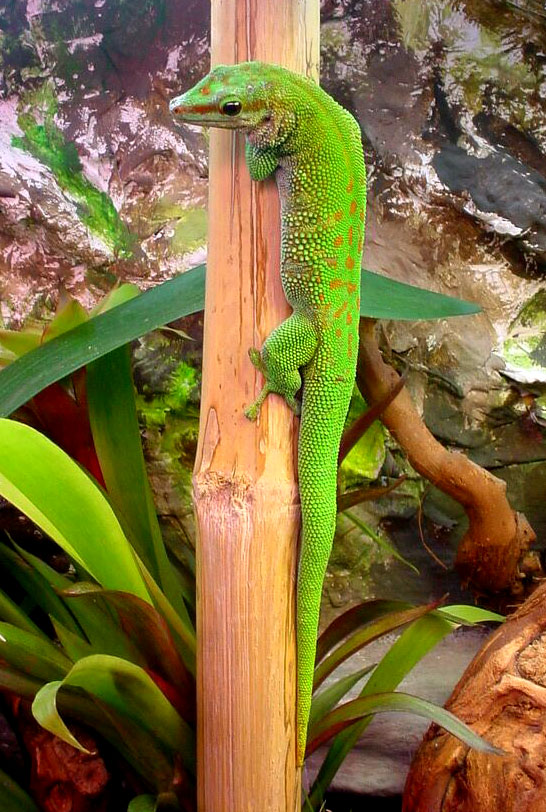 Madagascar Day GeckoPhelsuma madagascariensis
-
 Standing's Day GeckoPhelsuma standingi
-
 Rodrigues Giant Day GeckoPhelsuma gigas
Compare
Questions and answers
What is the scientific name of the Tsingy de Bemaraha Day Gecko?
The scientific name of the Tsingy de Bemaraha Day Gecko is Phelsuma borai. Written with its author, the full name is Phelsuma borai Glaw, Köhler & Vences, 2009.
Which family does the Tsingy de Bemaraha Day Gecko belong to?
Phelsuma borai belongs to the family Gekkonidae, in the order Squamata and the class Reptilia.
Where is the Tsingy de Bemaraha Day Gecko found?
Checklists and occurrence records place Phelsuma borai in 1 country: Madagascar.
What is the conservation status of the Tsingy de Bemaraha Day Gecko?
The IUCN Red List category recorded for Phelsuma borai is Data Deficient (DD).
Sources
Passages the profile rests on
- Its dorsal coloration is grayish brown. Source passage: “Dorsally, P. borai is grayish brown;” — English Wikipedia
- Its ventral coloration is whitish. Source passage: “ventrally it is whitish.” — English Wikipedia
- Unlike most other members of its genus, it lacks green and red coloration. Source passage: “Unlike most other species in its genus, it has no green or red coloration.” — English Wikipedia
- Its preferred natural habitat is dry deciduous forest at an elevation of 177 m. Source passage: “The preferred natural habitat of P. borai is dry deciduous forest, at an altitude of 177 m (581 ft).” — English Wikipedia
- The reproductive mode of Phelsuma borai is unknown. Source passage: “The mode of reproduction of P. borai is unknown.” — English Wikipedia
- Phelsuma borai is endemic to Madagascar. Source passage: “The species is endemic to Madagascar.” — English Wikipedia
- Phelsuma borai occurs in the Melaky region of western Madagascar. Source passage: “P. borai is found in the Melaky region of western Madagascar.” — English Wikipedia
Data
- Catalogue of Life, 2026-10-16 XR cc by
- Global Biodiversity Information Facility CC BY 4.0
- Wikidata CC0
- GeoNames CC BY 4.0
- Within the Catalogue of Life, this name comes from The Reptile Database cc by
References
- Glaw, Frank, Jörn Köhler & Miguel Vences. 2009. A new species of cryptically coloured day gecko (Phelsuma) from the Tsingy de Bemaraha National Park in western Madagascar. Zootaxa 2195: 61-68. Link where the name was published
- Glaw, F.; Köhler, J. & Vences, M. (2009). A new species of cryptically coloured day gecko (Phelsuma) from the Tsingy de Bemaraha National Park in western Madagascar. Zootaxa 2195: 61–68.
- Gehring, P. S., & Glaw, F. (2010). Bunte Vielfalt in modernem Licht: Taggeckos der Gattung Phelsuma. Draco 11 (43): 4-21.
- BORA, PARFAIT; J. CHRISTIAN RANDRIANANTOANDRO, ROMA RANDRIANAVELONA, ELISOA F. HANTALALAINA, RAPHALI R. ANDRIANTSIMANARILAFY, DANIEL RAKOTONDRAVONY, OLGA R. RAMILIJAONA, MIGUEL VENCES, RICHARD K. B. JENKINS, FRANK GLAW, AND JÖRN KÖHLER. (2010). AMPHIBIANS AND REPTILES OF THE TSINGY DE BEMARAHA PLATEAU, WESTERN MADAGASCAR: CHECKLIST, BIOGEOGRAPHY AND CONSERVATION. Herp. Cons. Biol. 5 (1): 111-125.
- ROCHA, SARA; HERBERT RÖSLER, PHILIP-SEBASTIAN GEHRING, FRANK GLAW, DAVID POSADA, D. JAMES HARRIS & MIGUEL VENCES. (2010). Phylogenetic systematics of day geckos, genus Phelsuma, based on molecular and morphological data (Squamata: Gekkonidae). Zootaxa 2429: 1–28.
- Beolens, B., & Michael Watkins, a. M. G. (2011). The Eponym Dictionary of Reptiles. Johns Hopkins University Press, Baltimore, USA.
- Gardner CJ, Raxworthy CJ, Metcalfe K, Raselimanana AP, Smith RJ, & Davies ZG. (2015). Comparing Methods for Prioritising Protected Areas for Investment: A Case Study Using Madagascar’s Dry Forest Reptiles. PLoS One 10 (7): E0132803, Doi:10.1371/Journal.Pone.0132803.
- Glaw, F., & Rösler, H. (2015). Taxonomic checklist of the day geckos of the genera Phelsuma Gray,1825 and Rhoptropella Hewitt,1937 (Squamata: Gekkonidae). Vertebrate Zoology 65 (2):
- RÖSLER, H. (2020). Hommage an Murk van Phelsum. Sauria 42 (2): 3-27.
- Zimin, A., Zimin, S. V., Shine, R., Avila, L., Bauer, A., Böhm, M., Brown, R., Barki, G., de Oliveira Caetano, G. H., Castro Herrera, F., Chapple, D. G., Chirio, L., Colli, G. R., Doan, T. M., Glaw, F., Grismer, L. L., Itescu, Y., Kraus, F., LeBreton, M.; [...] Uetz, P.; Wagner, P.; Roll, U. & Meiri, S. (2022). A global analysis of viviparity in squamates highlights its prevalence in cold climates. Global Ecology and Biogeography, 00, 1–16.
This species in other databases
Page built on 28 November 2026. See how the catalog is made and all sources and licences.
Cite this page
ScientificNames.org. (2026). Phelsuma borai (Tsingy de Bemaraha Day Gecko). Retrieved November 28, 2026, from https://scientificnames.org/species/phelsuma-borai
“Phelsuma borai (Tsingy de Bemaraha Day Gecko).” ScientificNames.org, 2026, scientificnames.org/species/phelsuma-borai. Accessed 28 Nov. 2026.
ScientificNames.org. “Phelsuma borai (Tsingy de Bemaraha Day Gecko).” Accessed November 28, 2026. https://scientificnames.org/species/phelsuma-borai.
@misc{scientificnames_phelsuma_borai_tsingy_de_bemaraha_day_gecko,
  author = {{ScientificNames.org}},
  title = {Phelsuma borai (Tsingy de Bemaraha Day Gecko)},
  year = {2026},
  url = {https://scientificnames.org/species/phelsuma-borai},
  note = {Accessed 2026-11-28}
}