Species · Reptiles
Comoros Day Gecko Phelsuma comorensis
The scientific name of the Comoros Day Gecko is Phelsuma comorensis. It is a species of reptile in the family Gekkonidae (geckos), order Squamata. The name dates from 1913.
- Scientific name
- Phelsuma comorensis Boettger, 1913
- Common name
- Comoros Day Gecko
- Genus
- Phelsuma
- Family
- Gekkonidae (Geckos)
- Order
- Squamata
- Class
- Reptilia
- Red List category
- NT Near Threatened
- Recorded in
- 1 country
- Name status
- accepted in the Catalogue of Life
Overview
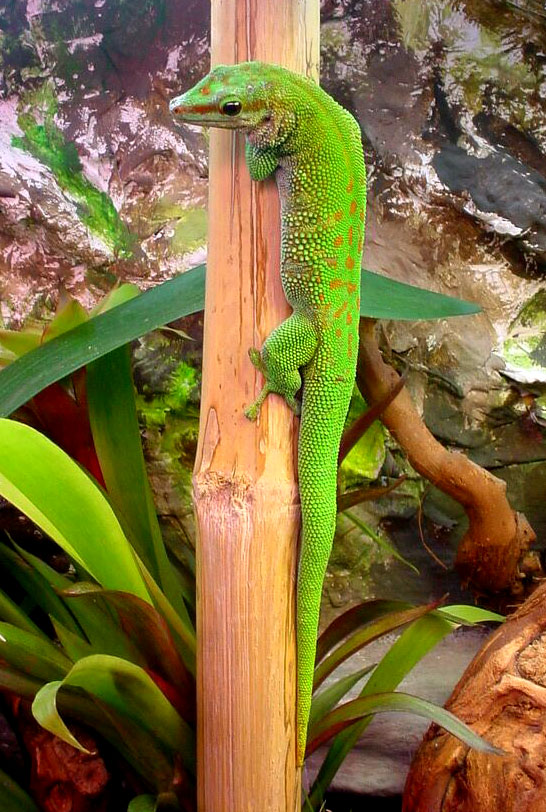
The Comoros Day Gecko is one of the smallest day geckos. The species is endemic to Grande Comore in the Comoros and is known only from that island. Its olive green or pale green body has a rust-coloured stripe from the nostril to the eye and a black lateral stripe extending to the hind leg.
Written 27 November 2026 from the sources listed below. Each statement was checked against the passage it cites; statements that could not be supported were removed.
Appearance
The body is olive green or pale green. A rust-coloured stripe runs from the nostril to the eye, while a black lateral stripe extends from the eye to the hind leg.[1][2][3]
The lower back has brownish or red-brick coloured spots. The legs have dark spots.[4][5]
The species can reach a maximum length of approximately 12 centimetres.[6]
Habitat
The Comoros Day Gecko is endemic to Grande Comore in the Comoros and is known only from Grande Comore.[7][8]
The species typically lives on trees and is often found on various pantropic vegetation. It occurs at elevations of 600 metres and above.[9][10][11]
Diet
The species feeds on various insects and other invertebrates. Its diet also includes soft, sweet fruit, pollen and nectar.[12][13][14][15]
Reproduction and life cycle
Females can lay up to eight pairs of eggs annually. Juveniles reach sexual maturity at approximately four to five months of age.[16][17]
Conservation
The species was reported as not currently endangered. It was most recently assessed for the IUCN Red List in 2020.[18][19]
Classification of the Comoros Day Gecko
| Kingdom | Animalia |
|---|---|
| Phylum | Chordata |
| Subphylum | Vertebrata |
| Infraphylum | Gnathostomata |
| Parvphylum | Osteichthyes |
| Megaclass | Tetrapoda |
| Class | Reptilia (Reptile) |
| Order | Squamata (Snakes) |
| Suborder | Gekkota |
| Family | Gekkonidae (Geckos) |
| Genus | Phelsuma (Day Geckos) |
| Species | Phelsuma comorensis Boettger, 1913 |
Where the Comoros Day Gecko is found
Checklists and occurrence records place Phelsuma comorensis in 1 country. GBIF holds 40 georeferenced records of it.
Countries
Regions and cities with the most records
Range as the checklists state it
Comoro Islands (Grande Comore)
A number beside a place is its count of GBIF occurrence records. A place without a number comes from a checklist alone. Records show where a species has been observed or collected, which can include escapes and vagrants.
Common names
English
- Comoros Day Gecko
- Comoro Day Gecko
Names in 6 other languages
- Chinese
- 葛摩日行守宮
- Danish
- Comorisk Daggekko
- French
- Gecko diurne des Comores, Phelsume des Comores
- German
- Komorentaggecko
- Russian
- Коморская фельзума
- Spanish
- Geco Diurno de las Comores
Synonyms
2 other scientific names have been used for this species and are now treated as synonyms of Phelsuma comorensis.
- Phelsuma dubia comorensis Boettger, 1913
- Phelsuma laticauda var. comorensis Boettger, 1913
Related species
-
 Gold Dust Day GeckoPhelsuma laticauda
-
 Madagascar Giant Day GeckoPhelsuma grandis
-
 Mauritius Ornate Day GeckoPhelsuma ornata
-
 Yellow-headed Day GeckoPhelsuma klemmeri
-
 Blue-tailed Day GeckoPhelsuma cepediana
-
 Madagascar Day GeckoPhelsuma madagascariensis
-
 Standing's Day GeckoPhelsuma standingi
-
 Rodrigues Giant Day GeckoPhelsuma gigas
Compare
Questions and answers
What is the scientific name of the Comoros Day Gecko?
The scientific name of the Comoros Day Gecko is Phelsuma comorensis. Written with its author, the full name is Phelsuma comorensis Boettger, 1913.
Which family does the Comoros Day Gecko belong to?
Phelsuma comorensis belongs to the family Gekkonidae, in the order Squamata and the class Reptilia.
Where is the Comoros Day Gecko found?
Checklists and occurrence records place Phelsuma comorensis in 1 country: Comoros.
What is the conservation status of the Comoros Day Gecko?
The IUCN Red List category recorded for Phelsuma comorensis is Near Threatened (NT).
What other names does the Comoros Day Gecko have?
Phelsuma comorensis is also known in English as Comoro Day Gecko.
Sources
Passages the profile rests on
- The body is olive green or pale green. Source passage: “The body colour is olive green or pale green.” — English Wikipedia
- A rust-coloured stripe runs from the nostril to the eye. Source passage: “A rost-coloured stripe extends from the nostril to the eye.” — English Wikipedia
- A black lateral stripe extends from the eye to the hind leg. Source passage: “A black lateral stripe extends from the eye to the hind leg.” — English Wikipedia
- The lower back has brownish or red-brick coloured spots. Source passage: “On the lower back there are brownish or red-brick coloured dots.” — English Wikipedia
- The legs have dark spots. Source passage: “The legs have dark spots.” — English Wikipedia
- The species can reach a maximum length of approximately 12 centimetres. Source passage: “It can reach a maximum length of about 12 centimetres (4.7 in).” — English Wikipedia
- The Comoros Day Gecko is endemic to Grande Comore in the Comoros. Source passage: “commonly known as the Comoros day gecko, is a species of gecko endemic to the island of Grande Comore, Comoros.” — English Wikipedia
- The species is known only from Grande Comore. Source passage: “This species is only known from the island Grande Comore.” — English Wikipedia
- The species typically lives on trees. Source passage: “It typically dwells on trees” — English Wikipedia
- The species occurs at elevations of 600 metres and above. Source passage: “It is found in higher areas (600 meters and upwards).” — English Wikipedia
- The species is often found on various pantropic vegetation. Source passage: “P. comorensis is often found on a variety of pantropic vegetation.” — English Wikipedia
- The species feeds on various insects and other invertebrates. Source passage: “These day geckos feed on various insects and other invertebrates.” — English Wikipedia
- The species consumes soft, sweet fruit. Source passage: “They also like to lick soft, sweet fruit, pollen and nectar.” — English Wikipedia
- The species consumes pollen. Source passage: “They also like to lick soft, sweet fruit, pollen and nectar.” — English Wikipedia
- The species consumes nectar. Source passage: “They also like to lick soft, sweet fruit, pollen and nectar.” — English Wikipedia
- Females can lay up to eight pairs of eggs annually. Source passage: “The females are very productive and lay up to 8 pairs of eggs per year.” — English Wikipedia
- Juveniles reach sexual maturity at approximately four to five months of age. Source passage: “Juveniles reach sexual maturity after only 4–5 months.” — English Wikipedia
- The species was reported as not currently endangered in the document. Source passage: “It is not currently endangered.” — English Wikipedia
- The Comoros Day Gecko was most recently assessed for the IUCN Red List in 2020. Source passage: “Comoros Day Gecko Phelsuma comorensis has most recently been assessed for The IUCN Red List of Threatened Species in 2020.” — iucnredlist.org
Data
- Catalogue of Life, 2026-10-16 XR cc by
- Global Biodiversity Information Facility CC BY 4.0
- Wikidata CC0
- GeoNames CC BY 4.0
- Within the Catalogue of Life, this name comes from The Reptile Database cc by
References
- Boettger, O. (1913). Reptilien und Amphibien von Madagascar, den Inseln und dem Festland Ostafrikas. Pp. 269-375. In: Voeltzkow, A. Reise in Ostafrika in den Jahren 1903-1905. Wissenschaftliche Ergebnisse. Vol. 3. Systematische Arbeiten. Schweizerbart’ Sche Verlagsbuchhandlung, Nägele Und Sproesser, Stuttgart.
- Loveridge, A. R. (1942). Revision of the Afro-Oriental geckos of the genus Phelsuma. Bull. Mus. Comp. Zool. Harvard 89: 439-482.
- Mertens, R. (1962). Die Arten und Unterarten der Geckonengattung Phelsuma. Senckenbergiana Biologica 43: 81-127.
- Meier H. (1980). Zur Taxonomie und Okologie der Gattung Phelsuma (Reptilia: Sauria: Gekkonidae) auf den Komoren, mit Beschreibung einer neuen Art. Bonner Zoologische Beiträge 31 (3-4): 323-332.
- Greckhamer, A. (1995). Bemerkungen zur Haltung und Zucht sowie zum Verhalten von Phelsuma comorensis Boettger, 1913 im Terrarium. Herpetofauna 17 (95): 06-16.
- Rösler, H. (2000). Kommentierte Liste der rezent, subrezent und fossil bekannten Geckotaxa (Reptilia: Gekkonomorpha). Gekkota 2: 28-153.
- Rösler, & Herbert. (2001). Zur Rumpfbeschuppung der Gattung Phelsuma GRAY 1825: zoogeographische Aspekte (Sauria: Gekkonidae). Gekkota 3: 47-73.
- Carretero, M.A.; Harris, J.D. & Rocha, S. (2005). Recent observation of reptiles in the Comoro islands (Western Indian Ocean). Herpetological Bulletin (91): 19-28.
- Berghof, H.-P. (2005). Taggeckos. Natur Und Tier Verlag, Münster, 144 Pp.
- Sound, P., Joachim Kosuch, Miguel Vences, & Alfred Seitz and Michael Veith. (2006). Preliminary molecular relationships of Comoran day geckos (Phelsuma). Herpetologica Bonnensis II: 175-179.
- Rocha, Sara; David Posada, Miguel A. Carretero and D. James Harris. (2007). Phylogenetic affinities of Comoroan and East African day geckos (genus Phelsuma): Multiple natural colonisations, introductions and island radiations. Molecular Phylogenetics and Evolution 43 (2): 685-692.
- Hallmann, G.; Krüger, J. & Trautmann, G. (2008). Faszinierende Taggeckos. Die Gattung Phelsuma. 2. Aufl. Natur Und Tier Verlag, Münster, 253 Pp.
- ROCHA, SARA; HERBERT RÖSLER, PHILIP-SEBASTIAN GEHRING, FRANK GLAW, DAVID POSADA, D. JAMES HARRIS & MIGUEL VENCES. (2010). Phylogenetic systematics of day geckos, genus Phelsuma, based on molecular and morphological data (Squamata: Gekkonidae). Zootaxa 2429: 1–28.
- Hawlitschek, Oliver; Boris Brückmann, Johannes Berger, Katie Green, Frank Glaw. (2011). Integrating field surveys and remote sensing data to study distribution, habitat use and conservation status of the herpetofauna of the Comoro Islands. ZooKeys 144: 21-79.
- Kwet, & Axel. (2013). 100 Jahre Madagaskar-Forschung. Oscar Boettger und die Reisen des Alfred Voeltzkow. Terraria-Elaphe 2013 (5): 91-95.
- Gehring, Philip-Sebastian; Frank Glaw, Marcelo Gehara, Fanomezana Mihaja Ratsoavina, Miguel Vences. (2013). Northern origin and diversification in the central lowlands? – Complex phylogeography and taxonomy of widespread day geckos (Phelsuma) from Madagascar. Organisms Diversity & Evolution DOI:10.1007/S13127-013-0143-5.
- Böhme, & Wolfgang. (2014). Herpetology in Bonn. Mertensiella 21. Vi + 256 Pp.
- Glaw, F., & Rösler, H. (2015). Taxonomic checklist of the day geckos of the genera Phelsuma Gray,1825 and Rhoptropella Hewitt,1937 (Squamata: Gekkonidae). Vertebrate Zoology 65 (2):
- Hawlitschek, O., Brückmann, B. and Glaw, F. (2017). Causal or spurious relationship? Climate and the distribution of Phelsuma geckos on Grand Comoro Island. Afr. J. Ecol.. Doi:10.1111/Aje.12380.
- Augros, S., M. D. Scherz, C. Y. Wang-Claypool, L. Montfort, F. Glaw & O. Hawlitschek. (2018). Comparative perch heights and habitat plant usage of day geckos (Phelsuma) in the Comoros Archipelago (Squamata: Gekkonidae). Salamandra 54 (1): 71-74.
This species in other databases
Page built on 27 November 2026. See how the catalog is made and all sources and licences.
Cite this page
ScientificNames.org. (2026). Phelsuma comorensis (Comoros Day Gecko). Retrieved November 27, 2026, from https://scientificnames.org/species/phelsuma-comorensis
“Phelsuma comorensis (Comoros Day Gecko).” ScientificNames.org, 2026, scientificnames.org/species/phelsuma-comorensis. Accessed 27 Nov. 2026.
ScientificNames.org. “Phelsuma comorensis (Comoros Day Gecko).” Accessed November 27, 2026. https://scientificnames.org/species/phelsuma-comorensis.
@misc{scientificnames_phelsuma_comorensis_comoros_day_gecko,
  author = {{ScientificNames.org}},
  title = {Phelsuma comorensis (Comoros Day Gecko)},
  year = {2026},
  url = {https://scientificnames.org/species/phelsuma-comorensis},
  note = {Accessed 2026-11-27}
}