Species · Reptiles
Dull Day Gecko Phelsuma dubia
The scientific name of the Dull Day Gecko is Phelsuma dubia. It is a species of reptile in the family Gekkonidae (geckos), order Squamata. The name dates from 1881.
- Scientific name
- Phelsuma dubia (Boettger, 1881)
- Common name
- Dull Day Gecko
- Genus
- Phelsuma
- Family
- Gekkonidae (Geckos)
- Order
- Squamata
- Class
- Reptilia
- Red List category
- LC Least Concern
- Recorded in
- 6 countries
- Name status
- accepted in the Catalogue of Life
Overview
Phelsuma dubia occurs along the western coast of Madagascar, particularly around Majunga, in the Comoros, Zanzibar, and some coastal areas of mainland Tanzania. Its coloration ranges from grayish green and grayish brown to bluish green, and its markings include a rust-coloured stripe from the nostril to the eye and a red V-shaped marking on the snout.
Written 26 November 2026 from the sources listed below. Each statement was checked against the passage it cites; statements that could not be supported were removed.
Appearance
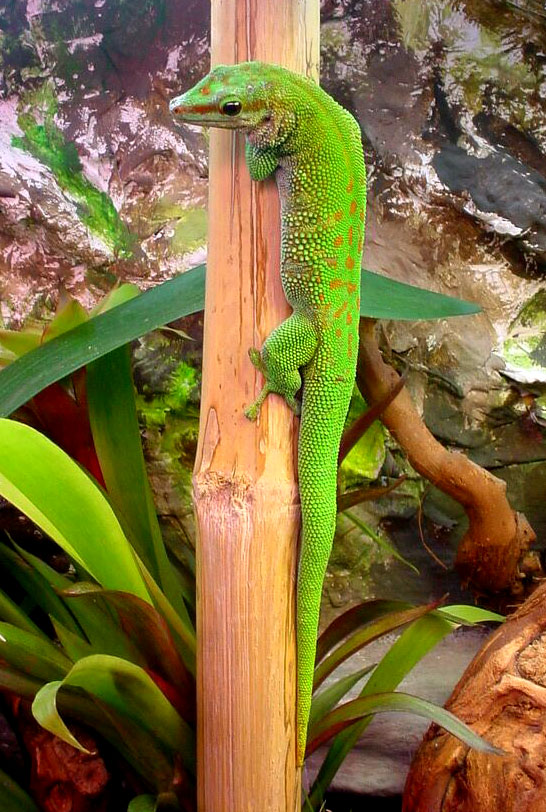
The dull day gecko has body coloration ranging from grayish green and grayish brown to bluish green. Its tail may be bright blue, and a rust-coloured stripe runs from the nostril to the eye.[1][2][3]
The snout has a red V-shaped marking, and the back often bears brownish or red-brick coloured dots. A gray lateral stripe runs from the eye to the hind leg, and the underside is off-white.[4][5][6][7]
Juveniles have light brown dorsal surfaces with small light blue spots. Newly hatched individuals have yellow tails.[8][9]
The species can reach approximately 15 centimetres in maximum length.[10]
Habitat
The dull day gecko commonly inhabits trees and other lowland vegetation. It also inhabits buildings in association with human settlements.[11][12]
The species can adapt to different biotopes.[13]
Diet
The dull day gecko feeds on various insects and other invertebrates. Its diet also includes soft sweet fruit, pollen and nectar.[14][15]
The species has been reported licking balsamic vinegar.[16]
Behaviour
The dull day gecko is diurnal. Individuals often live in small groups consisting of one male and several females.[17][18]
Reproduction and life cycle
Females attach their eggs to surfaces. They often lay their eggs at locations also used by other females.[19][20]
Conservation
The species was described as common and widespread in the captivity-care account. Its capture is regulated because it may have caused population declines.[21][22]
Classification of the Dull Day Gecko
| Kingdom | Animalia |
|---|---|
| Phylum | Chordata |
| Subphylum | Vertebrata |
| Infraphylum | Gnathostomata |
| Parvphylum | Osteichthyes |
| Megaclass | Tetrapoda |
| Class | Reptilia (Reptile) |
| Order | Squamata (Snakes) |
| Suborder | Gekkota |
| Family | Gekkonidae (Geckos) |
| Genus | Phelsuma (Day Geckos) |
| Species | Phelsuma dubia (Boettger, 1881) |
Where the Dull Day Gecko is found
Checklists and occurrence records place Phelsuma dubia in 6 countries across Africa. GBIF holds 421 georeferenced records of it.
Countries
Regions and cities with the most records
- Dzaoudzi, Mayotte 102
- Kaouéni, Mayotte 102
- Mamoudzou, Mayotte 102
- Chirongui, Mayotte 55
- Koungou, Mayotte 46
- Labattoir, Mayotte 40
- Zanzibar, Tanzania 29
- Dar es Salaam, Tanzania 25
- Dar es Salaam Region, Tanzania 24
- Grande Comore, Comoros 24
- Zanzibar North, Tanzania 24
- Nungwi, Tanzania 18
- Moroni, Comoros 15
- Dzaoudzi, Mayotte 14
- Antsiranana, Madagascar 10
- Hell-Ville, Madagascar 10
- Mahajanga, Madagascar 10
- Sokoni, Tanzania 10
- Mamoudzou, Mayotte 9
- Bagamoyo, Tanzania 8
- Pwani, Tanzania 8
- Ambanja, Madagascar 7
- M'Tsangamouji, Mayotte 7
- Dembeni, Mayotte 6
- Mossuril, Mozambique 6
- Mozambique, Mozambique 6
- Mwandege, Tanzania 6
- Nampula, Mozambique 6
- Anjouan, Comoros 5
- Moutsamoudou, Comoros 5
- Morogoro, Tanzania 4
- Morogoro, Tanzania 4
- Vikindu, Tanzania 4
- Ambato Boeny, Madagascar 3
- Bandrele, Mayotte 3
- Bouéni, Mayotte 3
2 more countries have a few records outside this range
These countries hold a few records of Phelsuma dubia but lie outside the range the checklists give for it. Such records are often zoo or garden specimens, museum material or vagrants, so the species is not counted as occurring there.
Range as the checklists state it
Madagascar, Tanzania, Kenya, Comores (Mayotte, Grande Comore = Comoro Island, Anjouan, Moheli), Nossi Be = Nosy Bé, (Majunga), Nosy Komba, Zanzibar, Mozambique Island
A number beside a place is its count of GBIF occurrence records. A place without a number comes from a checklist alone. Records show where a species has been observed or collected, which can include escapes and vagrants.
Common names
English
- Dull Day Gecko
- Green Day Gecko
- Olive Day Gecko
- Zanzibar Day Gecko
Names in 6 other languages
- Chinese
- 疑惑日行守宮
- Danish
- Mørkegrøn Daggekko
- French
- Gecko diurne sombre, Gecko sombre
- German
- Palmen-Taggecko, Sansibartaggecko
- Italian
- Geco diurno insulare
- Russian
- Занзибарский дневной геккон
Synonyms
One other scientific name has been used for this species and is now treated as a synonym of Phelsuma dubia.
- Pachydactylus dubius Boettger, 1881
Related species
-
 Gold Dust Day GeckoPhelsuma laticauda
-
 Madagascar Giant Day GeckoPhelsuma grandis
-
 Mauritius Ornate Day GeckoPhelsuma ornata
-
 Yellow-headed Day GeckoPhelsuma klemmeri
-
 Blue-tailed Day GeckoPhelsuma cepediana
-
 Madagascar Day GeckoPhelsuma madagascariensis
-
 Standing's Day GeckoPhelsuma standingi
-
 Rodrigues Giant Day GeckoPhelsuma gigas
Compare
Questions and answers
What is the scientific name of the Dull Day Gecko?
The scientific name of the Dull Day Gecko is Phelsuma dubia. Written with its author, the full name is Phelsuma dubia (Boettger, 1881).
Which family does the Dull Day Gecko belong to?
Phelsuma dubia belongs to the family Gekkonidae, in the order Squamata and the class Reptilia.
Where is the Dull Day Gecko found?
Checklists and occurrence records place Phelsuma dubia in 6 countries: Tanzania, Madagascar, Mayotte, Comoros, Mozambique and Kenya.
What is the conservation status of the Dull Day Gecko?
The IUCN Red List category recorded for Phelsuma dubia is Least Concern (LC).
What other names does the Dull Day Gecko have?
Phelsuma dubia is also known in English as Green Day Gecko, Olive Day Gecko and Zanzibar Day Gecko.
Sources
Passages the profile rests on
- The species has body coloration ranging from grayish green and grayish brown to bluish green. Source passage: “The body colour varies between grayish green, grayish brown and bluish green.” — English Wikipedia
- Its tail may be bright blue. Source passage: “The tail may be bright blue.” — English Wikipedia
- A rust-coloured stripe runs from the nostril to the eye. Source passage: “A rust-coloured stripe extends from the nostril to the eye.” — English Wikipedia
- The snout has a red V-shaped marking. Source passage: “There is a red v-shaped stripe on the snout.” — English Wikipedia
- Its back often bears brownish or red-brick coloured dots. Source passage: “On the back there often are brownish or red-brick coloured dots.” — English Wikipedia
- A gray lateral stripe runs from the eye to the hind leg. Source passage: “A gray lateral stripe extends from the eye to the hind leg.” — English Wikipedia
- The underside is off-white. Source passage: “The ventral side is off-white coloured.” — English Wikipedia
- Juveniles have light brown dorsal surfaces with small light blue spots. Source passage: “Juveniles have a light brown dorsal surface with little light blue spots.” — English Wikipedia
- Newly hatched individuals have yellow tails. Source passage: “The tail of neonates is yellow.” — English Wikipedia
- The species can reach approximately 15 centimetres in maximum length. Source passage: “It can reach a maximum length of approximately 15 cm.” — English Wikipedia
- The species commonly inhabits trees and other lowland vegetation. Source passage: “These day geckos are often found on different trees and other lowland vegetation.” — English Wikipedia
- The species also inhabits buildings in association with human settlements. Source passage: “They also inhabit buildings as a human commensal.” — English Wikipedia
- The species can adapt to different biotopes. Source passage: “P. dubia can easily adapt to different biotopes.” — English Wikipedia
- The species feeds on various insects and other invertebrates. Source passage: “These day geckos feed on various insects and other invertebrates.” — English Wikipedia
- Its diet also includes soft sweet fruit, pollen and nectar. Source passage: “They also like to lick soft, sweet fruit, pollen, nectar and balsamic vinegar.” — English Wikipedia
- The species has been reported licking balsamic vinegar. Source passage: “They also like to lick soft, sweet fruit, pollen, nectar and balsamic vinegar.” — English Wikipedia
- The species is diurnal. Source passage: “is a diurnal species of gecko.” — English Wikipedia
- Individuals often live in small groups consisting of one male and several females. Source passage: “P. dubia often lives in small groups with one male and several females.” — English Wikipedia
- Females attach their eggs to surfaces. Source passage: “The females are egg gluers.” — English Wikipedia
- Females often lay their eggs at locations also used by other females. Source passage: “They often lay their eggs in the same location as other females.” — English Wikipedia
- The species was described as common and widespread in the captivity-care account. Source passage: “Phelsuma dubia is currently common and widespread.” — English Wikipedia
- Capture of the species is regulated because it may have caused population declines. Source passage: “capture of these geckos is regulated, as it may have caused population declines” — English Wikipedia
Data
- Catalogue of Life, 2026-10-16 XR cc by
- Global Biodiversity Information Facility CC BY 4.0
- Wikidata CC0
- GeoNames CC BY 4.0
- Within the Catalogue of Life, this name comes from The Reptile Database cc by
References
- Boettger, O. (1881). Diagnoses reptilium et batrachiorum novorum ab ill. Dr. Christ. Rutenberg in insula Madagascar collectorum. Zool. Anz. 4: 46—48.
- Boulenger, G. A. (1885). Catalogue of the lizards in the British Museum (Nat. Hist.) I. Geckonidae, Eublepharidae, Uroplatidae, Pygopodidae, Agamidae. London: 450 Pp.
- Tornier, G. (1902). Herpetologisch Neues aus Deutsch-Ostafrika. Zool. Jahrb. Syst. 15: 578-590.
- Loveridge, A. (1947). Revision of the African lizards of the family Gekkondiae. Bull. Mus. Comp. Zool. Harvard 98: 1-469.
- Mertens, R. (1962). Die Arten und Unterarten der Geckonengattung Phelsuma. Senckenbergiana Biologica 43: 81-127.
- Mertens, R. (1967). Die herpetologische Sektion des Natur-Museums und Forschungs-Institutes Senckenberg in Frankfurt am Main nebst einem Verzeichnis ihrer Typen. Senckenbergiana Biologica 48: 1-106.
- Mertens, R. (1973). Der typische Fundort von Phelsuma dubia (Sauria, Gekkonidae). Salamandra 9 (2): 75-77.
- Meier H. (1980). Zur Taxonomie und Okologie der Gattung Phelsuma (Reptilia: Sauria: Gekkonidae) auf den Komoren, mit Beschreibung einer neuen Art. Bonner Zoologische Beiträge 31 (3-4): 323-332.
- Meier, H. (1982). Ergebnisse zur Taxonomie und Ökologie einiger Arten und Unterarten der Gattung Phelsuma auf Madagaskar, gesammelt in den Jahren 1972 bis 1981, mit Beschreibung einer neuen Form (Reptilia: Sauria: Gekkonidae). Salamandra 18 (3-4): 168—190.
- Broadley, D. G. (1987). Geographical Distribution - Phelsuma dubia dubia. J. Herp. Assoc. Africa (33): 29-29.
- Broadley, D. G., & HOWELL, K. M. (1991). A check list of the reptiles of Tanzania, with synoptic keys. Syntarsus 1: 1—70.
- Glaw, F., & Vences, M. (1994). A Fieldguide to the Amphibians and Reptiles of Madagascar. Vences & Glaw Verlag, Köln (ISBN 3-929449-01-3).
- Spawls, S., & Rotich, D. (1997). An annotated checklist of the lizards of Kenya. J. East African Nat. Hist. 86: 61-83.
- Glaw, Frank, Miguel Vences and Thomas Ziegler. (1999). Bemerkungen zu Phelsuma dubia (Boettger, 1881): Wiederentdeckung des Holotypus, Verwandtschaftsbeziehungen und Daten zur Fortpflanzung. Salamandra 35 (4): 267-278.
- Meirte, D. (1999). In: Louette,M., La faune terrestre de Mayotte. Annales Sciences Zoologiques, Musée Royal de l’Afrique Centrale, Tervuren, Belgique 284: 247 Pp.
- Rösler, H. (2000). Kommentierte Liste der rezent, subrezent und fossil bekannten Geckotaxa (Reptilia: Gekkonomorpha). Gekkota 2: 28-153.
- Rösler, & Herbert. (2001). Zur Rumpfbeschuppung der Gattung Phelsuma GRAY 1825: zoogeographische Aspekte (Sauria: Gekkonidae). Gekkota 3: 47-73.
- Berghof, & Hans-Peter. (2001). Neue Angaben zum Verbreitungsgebiet von Phelsuma dubia (BOETTGER 1881) sowie einige Bemerkungen zu Phelsuma hielscheri RÖSLER, OBST & SEIPP 2001. Herpetofauna 23 (133): 11-18.
- Röll, B., & Henkel, F. W. (2002). Are pygopods just legless geckos? Evidence from retinal structures. Salamandra 38 (2): 73-84.
- Spawls, S.; Howell, K.; Drewes, R.C. & Ashe, J. (2002). A field guide to the reptiles of East Africa. Academic Press, 543 Pp. [Reviews in HR 34: 396 and Afr. J. Herp. 51; 147].
- ANDREONE F., F. GLAW, R. A. NUSSBAUM, C. J. RAXWORTHY, M. VENCES, and J. E. RANDRIANIRINA. (2003). The amphibians and reptiles of Nosy Be (NW Madagascar) and nearby islands: a case study of diversity and conservation of an insular fauna. Journal of Natural History 37 (17): 2119–2149.
- Forsberg, M. (2004). Phelsuma dubia - captive care of the forgotten day gecko. Reptilia (GB) (36): 43-47.
- Heygen, E.v. (2004). The genus Phelsuma GRAY, 1825 on the Ampasindava peninsula, Madagascar. Phelsuma 12: 99-117.
- Carretero, M.A.; Harris, J.D. & Rocha, S. (2005). Recent observation of reptiles in the Comoro islands (Western Indian Ocean). Herpetological Bulletin (91): 19-28.
- Berghof, H.-P. (2005). Taggeckos. Natur Und Tier Verlag, Münster, 144 Pp.
This species in other databases
Page built on 29 November 2026. See how the catalog is made and all sources and licences.
Cite this page
ScientificNames.org. (2026). Phelsuma dubia (Dull Day Gecko). Retrieved November 29, 2026, from https://scientificnames.org/species/phelsuma-dubia
“Phelsuma dubia (Dull Day Gecko).” ScientificNames.org, 2026, scientificnames.org/species/phelsuma-dubia. Accessed 29 Nov. 2026.
ScientificNames.org. “Phelsuma dubia (Dull Day Gecko).” Accessed November 29, 2026. https://scientificnames.org/species/phelsuma-dubia.
@misc{scientificnames_phelsuma_dubia_dull_day_gecko,
  author = {{ScientificNames.org}},
  title = {Phelsuma dubia (Dull Day Gecko)},
  year = {2026},
  url = {https://scientificnames.org/species/phelsuma-dubia},
  note = {Accessed 2026-11-29}
}