Species · Reptiles
Speckled Day Gecko Phelsuma guttata
The scientific name of the Speckled Day Gecko is Phelsuma guttata. It is a species of reptile in the family Gekkonidae (geckos), order Squamata. The name dates from 1922.
- Scientific name
- Phelsuma guttata Kaudern, 1922
- Common name
- Speckled Day Gecko
- Genus
- Phelsuma
- Family
- Gekkonidae (Geckos)
- Order
- Squamata
- Class
- Reptilia
- Red List category
- LC Least Concern
- Recorded in
- 1 country
- Name status
- accepted in the Catalogue of Life

Overview
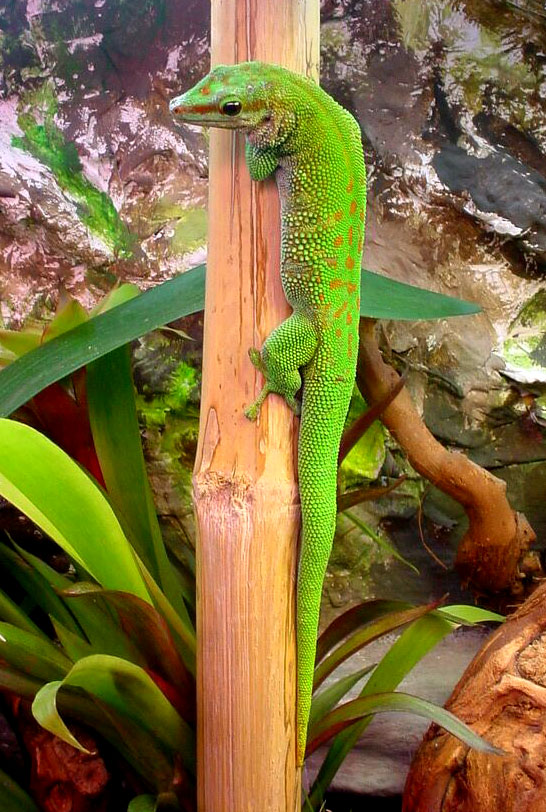
The Speckled Day Gecko is Phelsuma guttata, a species in the genus Phelsuma. It occurs along the coast of north-eastern Madagascar and on nearby islets. It has a dark green body with small orange spots, a black stripe from the nostril to above the ear opening, and white speckling on the flanks, legs and toes.
Written 27 November 2026 from the sources listed below. Each statement was checked against the passage it cites; statements that could not be supported were removed.
Appearance
The Speckled Day Gecko has a slender body and a long snout. Its body is dark green, with several small orange spots on the middle and lower parts of its back.[1][2][3]
A black stripe runs from the nostril to above the ear opening, and the throat has several V-shaped stripes. The flanks, legs and toes have white speckling.[4][5][6]
Some populations have blue spots in the neck region. The underside is grayish white.[7][8]
Habitat
The typical habitat of the Speckled Day Gecko is rainforest. It typically lives on trees in rainforest environments and avoids bright sunlight.[9][10][11]
Following the clearance of primary rainforest, the species also inhabits bushes and introduced banana trees.[12]
Diet
The Speckled Day Gecko feeds on various insects and other invertebrates.[13][14]
Its diet also includes soft, sweet fruit, pollen and nectar.[15][16][17]
Behaviour
The Speckled Day Gecko is active during the daytime. Individuals are often found in pairs on trees.[18][19]
Juveniles mainly occupy low shrubs surrounding their habitat.[20]
Reproduction and life cycle
Females lay two eggs per clutch. They may deposit their eggs on the ground beneath foliage or wood, or on trees beneath loose bark.[21][22][23]
Eggs hatch after approximately 40–45 days at 28 °C.[24]
Classification of the Speckled Day Gecko
| Kingdom | Animalia |
|---|---|
| Phylum | Chordata |
| Subphylum | Vertebrata |
| Infraphylum | Gnathostomata |
| Parvphylum | Osteichthyes |
| Megaclass | Tetrapoda |
| Class | Reptilia (Reptile) |
| Order | Squamata (Snakes) |
| Suborder | Gekkota |
| Family | Gekkonidae (Geckos) |
| Genus | Phelsuma (Day Geckos) |
| Species | Phelsuma guttata Kaudern, 1922 |
Where the Speckled Day Gecko is found
Checklists and occurrence records place Phelsuma guttata in 1 country. GBIF holds 245 georeferenced records of it.
Countries
Regions and cities with the most records
- Maroantsetra, Madagascar 16
- Fenoarivo Atsinanana, Madagascar 5
- Ambanja, Madagascar 4
- Andapa, Madagascar 3
- Soavinandriana, Madagascar 3
Range as the checklists state it
NE, E, S Madagascar (Fandrarazana, Nosy Boraha), Ste. Marie, Mamoko.
A number beside a place is its count of GBIF occurrence records. A place without a number comes from a checklist alone. Records show where a species has been observed or collected, which can include escapes and vagrants.
Common names
English
- Speckled Day Gecko
Names in 4 other languages
- Chinese
- 斑點日行守宮
- Danish
- Spættet Daggekko
- German
- Tropfentaggecko
- Russian
- Мамокский дневной геккон, Пятнистая фельзума
Related species
-
 Gold Dust Day GeckoPhelsuma laticauda
-
 Madagascar Giant Day GeckoPhelsuma grandis
-
 Mauritius Ornate Day GeckoPhelsuma ornata
-
 Yellow-headed Day GeckoPhelsuma klemmeri
-
 Blue-tailed Day GeckoPhelsuma cepediana
-
 Madagascar Day GeckoPhelsuma madagascariensis
-
 Standing's Day GeckoPhelsuma standingi
-
 Rodrigues Giant Day GeckoPhelsuma gigas
Compare
Questions and answers
What is the scientific name of the Speckled Day Gecko?
The scientific name of the Speckled Day Gecko is Phelsuma guttata. Written with its author, the full name is Phelsuma guttata Kaudern, 1922.
Which family does the Speckled Day Gecko belong to?
Phelsuma guttata belongs to the family Gekkonidae, in the order Squamata and the class Reptilia.
Where is the Speckled Day Gecko found?
Checklists and occurrence records place Phelsuma guttata in 1 country: Madagascar.
What is the conservation status of the Speckled Day Gecko?
The IUCN Red List category recorded for Phelsuma guttata is Least Concern (LC).
Sources
Passages the profile rests on
- The species has a slender body and a long snout. Source passage: “This lizard belongs to the medium-sized day geckos. It can reach a total length of about 13 cm. The body colour of this slender and long-snouted gecko is dark green.” — English Wikipedia
- Its body is dark green. Source passage: “The body colour of this slender and long-snouted gecko is dark green.” — English Wikipedia
- Several small orange spots occur on the middle and lower parts of its back. Source passage: “There are several small orange spots on the middle and lower portion of the back.” — English Wikipedia
- A black stripe runs from the nostril to above the ear opening. Source passage: “A black eye stripe extends from the nostril to above the ear opening.” — English Wikipedia
- The throat has several V-shaped stripes. Source passage: “Typical for this species are several v-shaped stripes on the throat.” — English Wikipedia
- The flanks, legs and toes have white speckling. Source passage: “The flanks, legs and toes are white speckled.” — English Wikipedia
- Some populations have blue spots in the neck region. Source passage: “Some populations have some blue spots in the neck region.” — English Wikipedia
- The underside is grayish white. Source passage: “The ventral side is grayish white.” — English Wikipedia
- Its typical habitat is rainforest. Source passage: “P. guttata typically lives in rainforests where they live on trees and avoid bright sun light.” — English Wikipedia
- The species typically lives on trees in rainforest environments. Source passage: “P. guttata typically lives in rainforests where they live on trees and avoid bright sun light.” — English Wikipedia
- The species avoids bright sunlight. Source passage: “P. guttata typically lives in rainforests where they live on trees and avoid bright sun light.” — English Wikipedia
- Following the clearance of primary rainforest, the species also inhabits bushes and introduced banana trees. Source passage: “Since much of the primary rainforest has been cleared, this species is also found on bushes and introduced banana trees.” — English Wikipedia
- The species feeds on various insects. Source passage: “These day geckos feed on various insects and other invertebrates.” — English Wikipedia
- The species also consumes other invertebrates. Source passage: “These day geckos feed on various insects and other invertebrates.” — English Wikipedia
- The species consumes soft, sweet fruit. Source passage: “They also like to lick soft, sweet fruit, pollen and nectar.” — English Wikipedia
- The species consumes pollen. Source passage: “They also like to lick soft, sweet fruit, pollen and nectar.” — English Wikipedia
- The species feeds on nectar. Source passage: “They also like to lick soft, sweet fruit, pollen and nectar.” — English Wikipedia
- The speckled day gecko is active during the daytime. Source passage: “The speckled day gecko (Phelsuma guttata) is a diurnal species of geckos.” — English Wikipedia
- Individuals are often found in pairs on trees. Source passage: “This Phelsuma species is often found in pairs on a tree.” — English Wikipedia
- Juveniles mainly occupy low shrubs surrounding their habitat. Source passage: “Juveniles mainly inhabit surrounding low shrubs.” — English Wikipedia
- Females lay two eggs per clutch. Source passage: “The females lay a pair of eggs” — English Wikipedia
- Females may deposit their eggs on the ground beneath foliage or wood. Source passage: “hide them on the ground under foliage or wood” — English Wikipedia
- Females may deposit their eggs on trees beneath loose bark. Source passage: “or they may lay their eggs on trees under loose bark.” — English Wikipedia
- Eggs hatch after approximately 40–45 days at 28 °C. Source passage: “At a temperature of 28 °C, the young will hatch after approximately 40–45 days.” — English Wikipedia
- The species occurs in north-eastern Madagascar along the coast. Source passage: “This species inhabits north-east Madagascar, along the coast.” — English Wikipedia
- The species also occurs on nearby islets. Source passage: “It can also be found on some nearby islets.” — English Wikipedia
Data
- Catalogue of Life, 2026-10-16 XR cc by
- Global Biodiversity Information Facility CC BY 4.0
- Wikidata CC0
- GeoNames CC BY 4.0
- Wikimedia Commons per image; credit shown with each image
- Within the Catalogue of Life, this name comes from The Reptile Database cc by
References
- Kaudern, W. (1922). Sauropsiden aus Madagascar. Zool. Jahrb. Syst. 45: 395-458.
- Mertens, R. (1962). Die Arten und Unterarten der Geckonengattung Phelsuma. Senckenbergiana Biologica 43: 81-127.
- Meier, H. (1980). Zur Lebendfärbung, Lebensweise und Verbreitungsgebiet von Phelsuma guttata. Salamandra 16 (2): 82-88.
- Meier, H. (1987). Vorläufige Beschreibung einer neuen Art der Gattung Phelsuma von Madagascar. Salamandra 23: 204-211.
- Meier, H. (1989). Zur Faunistik madagassischer Taggeckos der gattung Phelsuma östlich von Fianarantsoa, bei Tamatave und auf der Insel Ste. Marie. Salamandra 25 (3-4): 224-229.
- Glaw, F., & Vences, M. (1994). A Fieldguide to the Amphibians and Reptiles of Madagascar. Vences & Glaw Verlag, Köln (ISBN 3-929449-01-3).
- Andreone, F., Randrianirina, J., Jenkins, P. D., & Aprea, G. (2000). Species diversity of Amphibia, Reptilia and Lipotyphla (Mammalia) at Ambolokopatrika, a rainforest between the Anjanaharibe-Sud and Marojejy massifs, NE Madagascar. Biodiversity and Conservation 9: 1587–1622.
- Rösler, H. (2000). Kommentierte Liste der rezent, subrezent und fossil bekannten Geckotaxa (Reptilia: Gekkonomorpha). Gekkota 2: 28-153.
- Rösler, & Herbert. (2001). Zur Rumpfbeschuppung der Gattung Phelsuma GRAY 1825: zoogeographische Aspekte (Sauria: Gekkonidae). Gekkota 3: 47-73.
- Berghof, H.-P. (2003). Phelsuma guttata KAUDERN 1922 - Ein sehr angenehmer Pflegling. Draco 4 (15): 59-63.
- Austin, J.J.; E. N. Arnold and C. G. Jones. (2004). Reconstructing an island radiation using ancient and recent DNA: the extinct and living day geckos (Phelsuma) of the Mascarene islands. Molecular Phylogenetics and Evolution 31 (1): 109-122.
- Berghof, H.-P. (2005). Taggeckos. Natur Und Tier Verlag, Münster, 144 Pp.
- Hartig, A. (2007). Madagaskar im Wohnzimmer. Reptilia (Münster) 12 (66): 64-67.
- Gehring, P. S. (2007). Verhaltensbeobachtungen an Taggeckos der Gattung Phelsuma im Nordosten Madagaskars mit einem neuen Verbreitungsnachweis für Phelsuma quadriocellata lepida KRÜGER, 1993. Sauria 29 (2): 27-34.
- Hallmann, G.; Krüger, J. & Trautmann, G. (2008). Faszinierende Taggeckos. Die Gattung Phelsuma. 2. Aufl. Natur Und Tier Verlag, Münster, 253 Pp.
- Berghof, & Hans-Peter. (2010). A Very Pleasant Terrarium Gecko: Phelsuma guttata Kaudern, 1922. Gekko 6 (1): 30-36.
- Gehring, P. S. (2010). Fady, Tavy und Aye-Aye - unterwegs im Nordosten Madagaskars. Elaphe 18 (2): 62-71.
- Gehring, P. S., & Glaw, F. (2010). Bunte Vielfalt in modernem Licht: Taggeckos der Gattung Phelsuma. Draco 11 (43): 4-21.
- Schönecker, P., & Schönecker, S. (2010). Phelsumensuche in Madagaskar - empfehlenswerte Ziele für Naturerlebnisse mit Taggeckos. Draco 11 (43): 65-76.
- ROCHA, SARA; HERBERT RÖSLER, PHILIP-SEBASTIAN GEHRING, FRANK GLAW, DAVID POSADA, D. JAMES HARRIS & MIGUEL VENCES. (2010). Phylogenetic systematics of day geckos, genus Phelsuma, based on molecular and morphological data (Squamata: Gekkonidae). Zootaxa 2429: 1–28.
- Gehring, P.-S., F. M. Ratsoavina & M. Vences. (2010). Filling the gaps – amphibian and reptile records from lowland rainforests in eastern Madagascar. Salamandra 46 (4): 214-234.
- Berghof, P. (2014). Phelsumenhaltung im Terrarium. Eine Erfolgsstory? Reptilia (Münster) 19 (105): 18-26.
- Glaw, F., & Rösler, H. (2015). Taxonomic checklist of the day geckos of the genera Phelsuma Gray,1825 and Rhoptropella Hewitt,1937 (Squamata: Gekkonidae). Vertebrate Zoology 65 (2):
- Mohan, A. V., P.-S. Gehring, M. D. Scherz, F. Glaw, F. M. Ratsoavina & M. Vences. (2019). Comparative phylogeography and patterns of deep genetic differentiation of two gecko species, Paroedura gracilis and Phelsuma guttata, across north-eastern Madagascar. Salamandra 55 (3): 211-220.
- RÖSLER, H. (2020). Hommage an Murk van Phelsum. Sauria 42 (2): 3-27.
This species in other databases
Page built on 29 November 2026. See how the catalog is made and all sources and licences.
Cite this page
ScientificNames.org. (2026). Phelsuma guttata (Speckled Day Gecko). Retrieved November 29, 2026, from https://scientificnames.org/species/phelsuma-guttata
“Phelsuma guttata (Speckled Day Gecko).” ScientificNames.org, 2026, scientificnames.org/species/phelsuma-guttata. Accessed 29 Nov. 2026.
ScientificNames.org. “Phelsuma guttata (Speckled Day Gecko).” Accessed November 29, 2026. https://scientificnames.org/species/phelsuma-guttata.
@misc{scientificnames_phelsuma_guttata_speckled_day_gecko,
  author = {{ScientificNames.org}},
  title = {Phelsuma guttata (Speckled Day Gecko)},
  year = {2026},
  url = {https://scientificnames.org/species/phelsuma-guttata},
  note = {Accessed 2026-11-29}
}