Species · Reptiles
Lake Ampitabe Day Gecko Phelsuma kely
The scientific name of the Lake Ampitabe Day Gecko is Phelsuma kely. It is a species of reptile in the family Gekkonidae (geckos), order Squamata. The name dates from 2004.
- Scientific name
- Phelsuma kely Schönecker, Bach & Glaw, 2004
- Common name
- Lake Ampitabe Day Gecko
- Genus
- Phelsuma
- Family
- Gekkonidae (Geckos)
- Order
- Squamata
- Class
- Reptilia
- Red List category
- DD Data Deficient
- Recorded in
- 1 country
- Name status
- accepted in the Catalogue of Life
Overview
Phelsuma kely is endemic to Madagascar and is known only from the area surrounding Lac Ampitabe. Its variable body colour changes with its mood and is white-gray with a black dorsal pattern during activity.
Written 27 November 2026 from the sources listed below. Each statement was checked against the passage it cites; statements that could not be supported were removed.
Appearance
The species has a variable body colour that changes depending on its mood. During activity, its basic body colour is white-gray with a black dorsal pattern, although its body colour can also become dark.[1][2][3]
A black lateral stripe runs from the eye to the tail. Its ventral surface is grayish-white.[4][5]
The species reaches approximately 7.1 cm in total length.[6]
Habitat
The species typically inhabits dragon trees and is found on them.[7][8]
In March, daytime temperatures in its habitat are approximately 27 °C, while nighttime temperatures fall to approximately 23 °C. Relative humidity ranges from 80 to 90%.[9][10][11]
Diet
The species feeds on various insects and other invertebrates. It might also consume pollen and nectar.[12][13][14]
Behaviour
Reproduction and life cycle
In captivity, females lay eggs in pairs. The eggs measure approximately 7 × 6 mm.[17][18]
At an incubation temperature of 28 °C during the day and 22 °C at night, hatchlings emerge after approximately 60 days. Newly hatched juveniles have a total length of approximately 25–28 mm.[19][20]
Uses
The species has been commercially traded. Commercially traded individuals have sometimes been misidentified as members of the genus Lygodactylus.[21][22]
Similar species
The species shares its habitat with Phelsuma seippi, Phelsuma guttata, Phelsuma lineata, Phelsuma madagascariensis madagascariensis, Phelsuma quadriocellata, Phelsuma abbotti chekei, Phelsuma dubia, Phelsuma laticauda laticauda, and Phelsuma madagascariensis grandis. It occurs sympatrically and partly syntopically with these other Phelsuma species.[23][24]
Classification of the Lake Ampitabe Day Gecko
| Kingdom | Animalia |
|---|---|
| Phylum | Chordata |
| Subphylum | Vertebrata |
| Infraphylum | Gnathostomata |
| Parvphylum | Osteichthyes |
| Megaclass | Tetrapoda |
| Class | Reptilia (Reptile) |
| Order | Squamata (Snakes) |
| Suborder | Gekkota |
| Family | Gekkonidae (Geckos) |
| Genus | Phelsuma (Day Geckos) |
| Species | Phelsuma kely Schönecker, Bach & Glaw, 2004 |
Where the Lake Ampitabe Day Gecko is found
Checklists and occurrence records place Phelsuma kely in 1 country. GBIF holds 7 georeferenced records of it.
Countries
Range as the checklists state it
E Madagascar
A number beside a place is its count of GBIF occurrence records. A place without a number comes from a checklist alone. Records show where a species has been observed or collected, which can include escapes and vagrants.
Common names
English
- Lake Ampitabe Day Gecko
Names in 1 other language
- Chinese
- 小日行守宮
Related species
-
 Gold Dust Day GeckoPhelsuma laticauda
-
 Madagascar Giant Day GeckoPhelsuma grandis
-
 Mauritius Ornate Day GeckoPhelsuma ornata
-
 Yellow-headed Day GeckoPhelsuma klemmeri
-
 Blue-tailed Day GeckoPhelsuma cepediana
-
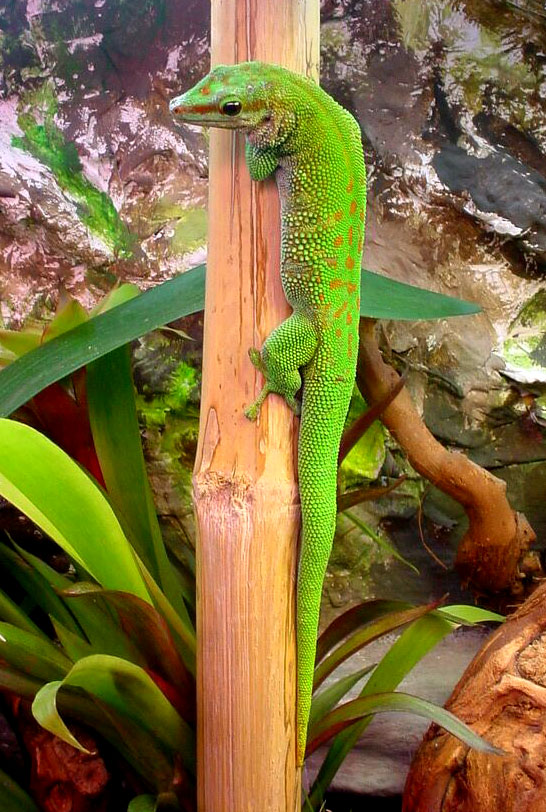 Madagascar Day GeckoPhelsuma madagascariensis
-
 Standing's Day GeckoPhelsuma standingi
-
 Rodrigues Giant Day GeckoPhelsuma gigas
Compare
Questions and answers
What is the scientific name of the Lake Ampitabe Day Gecko?
The scientific name of the Lake Ampitabe Day Gecko is Phelsuma kely. Written with its author, the full name is Phelsuma kely Schönecker, Bach & Glaw, 2004.
Which family does the Lake Ampitabe Day Gecko belong to?
Phelsuma kely belongs to the family Gekkonidae, in the order Squamata and the class Reptilia.
Where is the Lake Ampitabe Day Gecko found?
Checklists and occurrence records place Phelsuma kely in 1 country: Madagascar.
What is the conservation status of the Lake Ampitabe Day Gecko?
The IUCN Red List category recorded for Phelsuma kely is Data Deficient (DD).
Where are day geckos native to?
The Lake Ampitabe Day Gecko is endemic to Madagascar. It is known only from the area surrounding Lac Ampitabe.[25][26]
Sources
Passages the profile rests on
- The species has a variable body colour that changes depending on its mood. Source passage: “Its body colour is variable and dependent on the mood of the animal.” — English Wikipedia
- During activity, its basic body colour is white-gray with a black dorsal pattern. Source passage: “During activity, the basic body colour is white-gray with a black pattern on the back.” — English Wikipedia
- Its body colour can also become dark. Source passage: “However, the body colour can turn dark also.” — English Wikipedia
- A black lateral stripe runs from the eye to the tail. Source passage: “A black lateral stripe extends from the eye to the tail.” — English Wikipedia
- Its ventral surface is grayish-white. Source passage: “The ventral side is grayish-white.” — English Wikipedia
- The species reaches approximately 7.1 cm in total length. Source passage: “It is the smallest known day gecko, reaching a total length of about 7.1 cm.” — English Wikipedia
- The species typically inhabits dragon trees. Source passage: “It typically inhabits dragon trees.” — English Wikipedia
- The species is found on dragon trees. Source passage: “P. kely is found on dragon trees.” — English Wikipedia
- In March, daytime temperatures in its habitat are approximately 27 °C. Source passage: “In March, the daytime temperature is around 27 °C” — English Wikipedia
- In March, nighttime temperatures in its habitat fall to approximately 23 °C. Source passage: “drops to around 23 °C at nighttime.” — English Wikipedia
- Relative humidity in its habitat ranges from 80 to 90%. Source passage: “The relative humidity is between 80 and 90%.” — English Wikipedia
- The species feeds on insects. Source passage: “The gecko feeds on insects and probably nectar.” — English Wikipedia
- Its diet includes various insects and other invertebrates. Source passage: “These day geckos feed on various insects and other invertebrates.” — English Wikipedia
- The species might also consume pollen and nectar. Source passage: “Like many members of the genus Phelsuma, this species might also feed on pollen and nectar.” — English Wikipedia
- The species is diurnal. Source passage: “Phelsuma kely is a species of diurnal gecko.” — English Wikipedia
- The species is very shy. Source passage: “This Phelsuma species is very shy.” — English Wikipedia
- In captivity, females lay eggs in pairs. Source passage: “In captivity, the females lay a pair of eggs” — English Wikipedia
- The eggs measure approximately 7 × 6 mm. Source passage: “which measure about 7 x 6 mm.” — English Wikipedia
- At an incubation temperature of 28 °C during the day and 22 °C at night, hatchlings emerge after approximately 60 days. Source passage: “At a temperature of 28 °C during the day and 22 °C at night, the young will hatch after approximately 60 days.” — English Wikipedia
- Newly hatched juveniles have a total length of approximately 25–28 mm. Source passage: “The juveniles have a total length of about 25–28 mm.” — English Wikipedia
- The species has been commercially traded. Source passage: “These geckos have been commercially traded,” — English Wikipedia
- Commercially traded individuals have sometimes been misidentified as members of the genus Lygodactylus. Source passage: “sometimes misidentified as Lygodactylus spp.” — English Wikipedia
- The species shares its habitat with Phelsuma seippi, Phelsuma guttata, Phelsuma lineata, Phelsuma madagascariensis madagascariensis, Phelsuma quadriocellata, Phelsuma abbotti chekei, Phelsuma dubia, Phelsuma laticauda laticauda, and Phelsuma madagascariensis grandis. Source passage: “It shares its habitat with Phelsuma seippi, Phelsuma guttata, Phelsuma lineata, Phelsuma madagascariensis madagascariensis, Phelsuma quadriocellata, Phelsuma abbotti chekei, Phelsuma dubia, Phelsuma laticauda laticauda and Phelsuma madagascariensis grandis.” — English Wikipedia
- The species occurs sympatrically and partly syntopically with the other listed Phelsuma species. Source passage: “All these species live sympatrically and partly syntopically.” — English Wikipedia
- The species is endemic to Madagascar. Source passage: “It is endemic to Madagascar” — English Wikipedia
- The species is known only from the area surrounding Lac Ampitabe. Source passage: “It is only known from the area around Lac Ampitabe.” — English Wikipedia
Data
- Catalogue of Life, 2026-10-16 XR cc by
- Global Biodiversity Information Facility CC BY 4.0
- Wikidata CC0
- GeoNames CC BY 4.0
- Within the Catalogue of Life, this name comes from The Reptile Database cc by
References
- Schönecker, P.; Bach, S. & Glaw, F. (2004). Eine neue Taggecko-Art der Gattung Phelsuma aus Ost-Madagaskar (Reptilia: Squamata: Gekkonidae). Salamandra 40 (2): 105-112.
- Berghof, H.-P. (2005). Taggeckos. Natur Und Tier Verlag, Münster, 144 Pp.
- Hallmann, G.; Krüger, J. & Trautmann, G. (2008). Faszinierende Taggeckos. Die Gattung Phelsuma. 2. Aufl. Natur Und Tier Verlag, Münster, 253 Pp.
- Berghof, H. P., & Trautmann, G. (2009). Eine neue Art der Gattung Phelsuma GRAY, 1825 (Sauria: Gekkonidae) von der Ostküste Madagaskars. Sauria 31 (1): 5–14.
- ROCHA, SARA; HERBERT RÖSLER, PHILIP-SEBASTIAN GEHRING, FRANK GLAW, DAVID POSADA, D. JAMES HARRIS & MIGUEL VENCES. (2010). Phylogenetic systematics of day geckos, genus Phelsuma, based on molecular and morphological data (Squamata: Gekkonidae). Zootaxa 2429: 1–28.
- Gehring, Philip-Sebastian; Frank Glaw, Marcelo Gehara, Fanomezana Mihaja Ratsoavina, Miguel Vences. (2013). Northern origin and diversification in the central lowlands? – Complex phylogeography and taxonomy of widespread day geckos (Phelsuma) from Madagascar. Organisms Diversity & Evolution DOI:10.1007/S13127-013-0143-5.
- Glaw, F., & Rösler, H. (2015). Taxonomic checklist of the day geckos of the genera Phelsuma Gray,1825 and Rhoptropella Hewitt,1937 (Squamata: Gekkonidae). Vertebrate Zoology 65 (2):
- Meiri, Shai; Aaron M. Bauer, Allen Allison, Fernando Castro-Herrera, Laurent Chirio, Guarino Colli, Indraneil Das, Tiffany M. Doan, Frank Glaw, Lee L. Grismer, Marinus Hoogmoed, Fred Kraus, Matthew LeBreton, Danny Meirte, Zoltán T. Nagy, Cristiano de C. Nogueira, Paul Oliver, Olivier S. G. Pauwels, Daniel Pincheira-Donoso, Glenn Shea, Roberto Sindaco, Oliver J. S. Tallowin, Omar Torres-Carvajal, Jean-Francois Trape, Peter Uetz, Philipp Wagner, Yuezhao Wang, Thomas Ziegler, and Uri Roll. (2017). Extinct, obscure or imaginary: the lizard species with the smallest ranges. Diversity and Distributions 24 (2): 262-273.
This species in other databases
Page built on 28 November 2026. See how the catalog is made and all sources and licences.
Cite this page
ScientificNames.org. (2026). Phelsuma kely (Lake Ampitabe Day Gecko). Retrieved November 28, 2026, from https://scientificnames.org/species/phelsuma-kely
“Phelsuma kely (Lake Ampitabe Day Gecko).” ScientificNames.org, 2026, scientificnames.org/species/phelsuma-kely. Accessed 28 Nov. 2026.
ScientificNames.org. “Phelsuma kely (Lake Ampitabe Day Gecko).” Accessed November 28, 2026. https://scientificnames.org/species/phelsuma-kely.
@misc{scientificnames_phelsuma_kely_lake_ampitabe_day_gecko,
  author = {{ScientificNames.org}},
  title = {Phelsuma kely (Lake Ampitabe Day Gecko)},
  year = {2026},
  url = {https://scientificnames.org/species/phelsuma-kely},
  note = {Accessed 2026-11-28}
}