Species · Reptiles
Koch's Giant Day Gecko Phelsuma kochi
The scientific name of the Koch's Giant Day Gecko is Phelsuma kochi. It is a species of reptile in the family Gekkonidae (geckos), order Squamata. The name dates from 1954.
- Scientific name
- Phelsuma kochi Mertens, 1954
- Common name
- Koch's Giant Day Gecko
- Genus
- Phelsuma
- Family
- Gekkonidae (Geckos)
- Order
- Squamata
- Class
- Reptilia
- Red List category
- LC Least Concern
- Recorded in
- 1 country
- Name status
- accepted in the Catalogue of Life

Overview
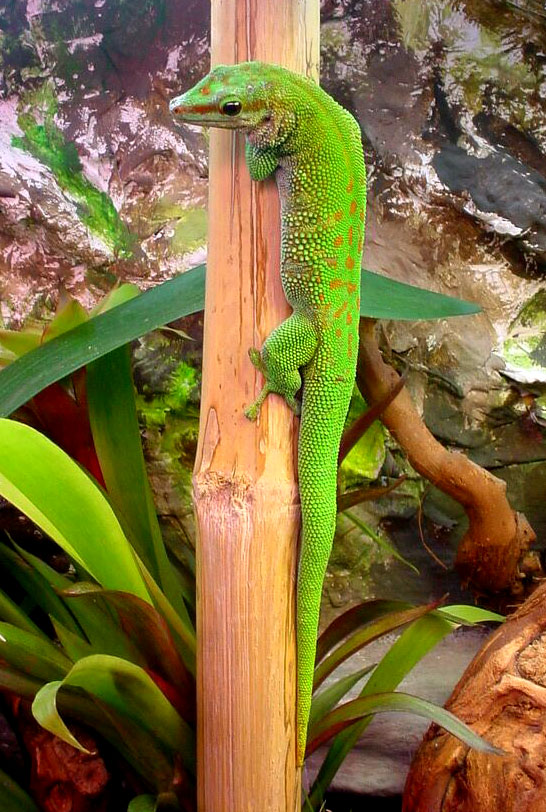
Phelsuma kochi is distributed across northwestern and western Madagascar. It has a dark, dull green body and can reach a total length of 30.5 centimetres, including its tail.
Written 26 November 2026 from the sources listed below. Each statement was checked against the passage it cites; statements that could not be supported were removed.
Similar species
Phelsuma kochi Mertens, 1954 is often treated as a distinct species rather than a subspecies.[1]
Appearance
Koch's Giant Day Gecko has a dark, dull green body. A faint red stripe extends from the nostril to the eye, and small reddish dots may occur on its back.[2][3][4]
Its neck and flanks are often light grey, and the underside of its body is off-white.[5][6]
It can reach a total length of 30.5 centimetres, including its tail.[7]
Habitat
Koch's Giant Day Gecko typically inhabits trees and is often found on banana trees, where it can bask. It avoids human dwellings.[8][9][10]
Its habitat experiences a very dry climate throughout the year, with temperatures reaching 40 °C.[11]
The species is distributed across northwestern and western Madagascar. It was first discovered in the region around Maevatanana, where the holotype was also collected.[12][13][14]
Diet
Koch's Giant Day Gecko feeds on various insects and other invertebrates. It also consumes soft, sweet fruit, pollen and nectar.[15][16][17]
Behaviour
Koch's Giant Day Gecko is diurnal.[18]
It is less quarrelsome and aggressive than Phelsuma madagascariensis and Phelsuma grandis.[19]
Reproduction and life cycle
The pairing season runs from November through the first weeks of May. Sexually mature females can lay up to six pairs of eggs during this period.[20][21]
Eggs hatch after approximately 63–68 days at an incubation temperature of 28 °C. Newly hatched juveniles measure approximately 65 mm.[22][23]
Juveniles reach sexual maturity after one year.[24]
Classification of the Koch's Giant Day Gecko
| Kingdom | Animalia |
|---|---|
| Phylum | Chordata |
| Subphylum | Vertebrata |
| Infraphylum | Gnathostomata |
| Parvphylum | Osteichthyes |
| Megaclass | Tetrapoda |
| Class | Reptilia (Reptile) |
| Order | Squamata (Snakes) |
| Suborder | Gekkota |
| Family | Gekkonidae (Geckos) |
| Genus | Phelsuma (Day Geckos) |
| Species | Phelsuma kochi Mertens, 1954 |
Where the Koch's Giant Day Gecko is found
Checklists and occurrence records place Phelsuma kochi in 1 country. GBIF holds 392 georeferenced records of it.
Countries
Regions and cities with the most records
Range as the checklists state it
NW Madagascar (Majunga, Tsaramandroso, Ambahanbongo)
A number beside a place is its count of GBIF occurrence records. A place without a number comes from a checklist alone. Records show where a species has been observed or collected, which can include escapes and vagrants.
Common names
English
- Koch's Giant Day Gecko
- Koch's Day Gecko
- Madagascar Day Gecko
- Maevatanana Day Gecko
Names in 5 other languages
- Chinese
- 科氏日行守宮
- Czech
- felsuma Kochova
- Danish
- Maevatanana-daggekko
- German
- Großer Taggecko, Kochs Taggecko, Maevatanana-Taggecko, Riesen-Madagaskar-Taggecko
- Japanese
- クックヒルヤモリ
Synonyms
One other scientific name has been used for this species and is now treated as a synonym of Phelsuma kochi.
- Phelsuma madagascariensis kochi Mertens, 1954
Related species
-
 Gold Dust Day GeckoPhelsuma laticauda
-
 Madagascar Giant Day GeckoPhelsuma grandis
-
 Mauritius Ornate Day GeckoPhelsuma ornata
-
 Yellow-headed Day GeckoPhelsuma klemmeri
-
 Blue-tailed Day GeckoPhelsuma cepediana
-
 Madagascar Day GeckoPhelsuma madagascariensis
-
 Standing's Day GeckoPhelsuma standingi
-
 Rodrigues Giant Day GeckoPhelsuma gigas
Compare
Questions and answers
What is the scientific name of the Koch's Giant Day Gecko?
The scientific name of the Koch's Giant Day Gecko is Phelsuma kochi. Written with its author, the full name is Phelsuma kochi Mertens, 1954.
Which family does the Koch's Giant Day Gecko belong to?
Phelsuma kochi belongs to the family Gekkonidae, in the order Squamata and the class Reptilia.
Where is the Koch's Giant Day Gecko found?
Checklists and occurrence records place Phelsuma kochi in 1 country: Madagascar.
What is the conservation status of the Koch's Giant Day Gecko?
The IUCN Red List category recorded for Phelsuma kochi is Least Concern (LC).
What other names does the Koch's Giant Day Gecko have?
Phelsuma kochi is also known in English as Koch's Day Gecko, Madagascar Day Gecko and Maevatanana Day Gecko.
How big can giant day geckos get?
Koch's Giant Day Gecko can reach a total length of 30.5 centimetres, including its tail.[7]
What do giant day geckos eat?
Koch's Giant Day Gecko feeds on various insects and other invertebrates, soft, sweet fruit, pollen and nectar.[15][16][17]
Where does the giant day gecko live?
Koch's Giant Day Gecko is distributed across northwestern and western Madagascar. It typically inhabits trees and is often found on banana trees.[8][9][12]
Are giant day geckos friendly?
Koch's Giant Day Gecko is less quarrelsome and aggressive than Phelsuma madagascariensis and Phelsuma grandis.[19]
Sources
Passages the profile rests on
- Phelsuma kochi Mertens, 1954 is often treated as a distinct species rather than a subspecies. Source passage: “Koch's giant day gecko is often treated as its own species, Phelsuma kochi Mertens, 1954.” — English Wikipedia
- The gecko has a dark, dull green body. Source passage: “The body colour is a dark, dull green.” — English Wikipedia
- A faint red stripe extends from the nostril to the eye. Source passage: “A faint red stripe extends from the nostril to the eye.” — English Wikipedia
- The gecko may have small reddish dots on its back. Source passage: “On the back there may be little reddish dots present.” — English Wikipedia
- Its neck and flanks are often light grey. Source passage: “The neck and flanks often are light grey.” — English Wikipedia
- The underside of its body is off-white. Source passage: “The ventral side is off-white.” — English Wikipedia
- The gecko can reach a total length of 30.5 centimetres, including its tail. Source passage: “It can reach a total length (including tail) of 30.5 centimetres (12.0 in).” — English Wikipedia
- The gecko typically inhabits trees. Source passage: “typically inhabits trees.” — English Wikipedia
- It is often found on banana trees, where it can bask. Source passage: “often found on different trees such as banana trees where it can be seen basking.” — English Wikipedia
- The gecko avoids human dwellings. Source passage: “It avoids human dwellings.” — English Wikipedia
- Its habitat experiences a very dry climate throughout the year, with temperatures reaching 40 °C. Source passage: “The climate is very dry throughout the year and the temperature can be as high as 40 °C (104 °F).” — English Wikipedia
- The gecko is distributed across northwestern and western Madagascar. Source passage: “P. m. kochi is widely distributed in northwestern and western Madagascar on the coast and in the inland.” — English Wikipedia
- The species was first discovered in the region around Maevatanana. Source passage: “It was first discovered in the region around Maevatanana” — English Wikipedia
- The holotype was collected in the Maevatanana region. Source passage: “where the holotype was collected.” — English Wikipedia
- The gecko feeds on various insects and other invertebrates. Source passage: “Koch's giant day gecko feeds on various insects and other invertebrates.” — English Wikipedia
- It consumes soft, sweet fruit. Source passage: “It also like to lick soft, sweet fruit, pollen and nectar.” — English Wikipedia
- Its diet includes pollen and nectar. Source passage: “It also like to lick soft, sweet fruit, pollen and nectar.” — English Wikipedia
- The gecko is diurnal. Source passage: “is a diurnal subspecies of gecko” — English Wikipedia
- It is less quarrelsome and aggressive than Phelsuma madagascariensis and Phelsuma grandis. Source passage: “This subspecies, P. m. kochi, is not quite as quarrelsome and aggressive as P. m. madagascariensis and P. m. grandis.” — English Wikipedia
- The pairing season runs from November through the first weeks of May. Source passage: “The pairing season for P. m. kochi is between November and the first weeks of May.” — English Wikipedia
- Sexually mature females can lay up to six pairs of eggs during the pairing season. Source passage: “During this period, the sexually mature females lay up to 6 pairs of eggs.” — English Wikipedia
- Eggs hatch after approximately 63–68 days at an incubation temperature of 28 °C. Source passage: “At a temperature of 28 °C (82 °F), the young will hatch after approximately 63–68 days.” — English Wikipedia
- Newly hatched juveniles measure approximately 65 mm. Source passage: “The juveniles measure 65 mm (2.6 in)” — English Wikipedia
- Juveniles reach sexual maturity after one year. Source passage: “reach sexual maturity after one year.” — English Wikipedia
Data
- Catalogue of Life, 2026-10-16 XR cc by
- Global Biodiversity Information Facility CC BY 4.0
- Wikidata CC0
- GeoNames CC BY 4.0
- Wikimedia Commons per image; credit shown with each image
- Within the Catalogue of Life, this name comes from The Reptile Database cc by
References
- Wiegmann, A. F. A. (1834). Herpetologia Mexicana, seu descriptio amphibiorum novae hispaniae , quae itineribus comitis de Sack, Ferdinandi Deppe et Chr. Guil. Schiede im Museum Zoologicum Berolinense Pervenerunt. Pars prima, saurorum species. Berlin, Lüderitz, Iv + 54 Pp.
- Gray, J. E. (1870). Note on a new night-lizard (Phelsuma grandis) from Madagascar. Ann. Mag. Nat. Hist. (4) 6:191.
- Andersson, & Lars Gabriel. (1910). Reptiles and batrachians from the north-west of Madagascar collected by V. Kaudern, 1906-1907. Arkiv För Zoologi 7 (7): 1-15.
- Mertens, R. (1954). Studien über die Reptilienfauna Madagaskars II. Eine neue Rasse von Phelsuma madagascariensis. Senckenbergiana Biologica 35: 13—16.
- Mertens, R. (1962). Die Arten und Unterarten der Geckonengattung Phelsuma. Senckenbergiana Biologica 43: 81-127.
- Mertens, R. (1964). Fünf neue Rassen der Geckonengattung Phelsuma. Senckenbergiana Biologica 45: 99-112.
- Mertens, R. (1970). Neues über einige Taxa der Geckonengattung Phelsuma. Senckenbergiana Biologica 51: 1-13.
- Meier, H. (1982). Ergebnisse zur Taxonomie und Ökologie einiger Arten und Unterarten der Gattung Phelsuma auf Madagaskar, gesammelt in den Jahren 1972 bis 1981, mit Beschreibung einer neuen Form (Reptilia: Sauria: Gekkonidae). Salamandra 18 (3-4): 168—190.
- Börner A M, & Minuth W. (1984). On the taxonomy of the Indian Ocean lizards of the Phelsuma madagascariensis species group (Reptilia, Gekkonidae). J. Bombay Nat. Hist. Soc. 81 (2) 1984: 243-281.
- Packard, M. J., and K. F. Hirsch. (1989). Structure of shells from eggs of the geckos Gekko gecko and Phelsuma madagascariensis. Canadian Journal of Zoology, 67(3): 746-758.
- Meier, H. (1989). Zur Faunistik madagassischer Taggeckos der gattung Phelsuma östlich von Fianarantsoa, bei Tamatave und auf der Insel Ste. Marie. Salamandra 25 (3-4): 224-229.
- Meier, H., & Böhme, W. (1991). Zur Arealkunde von Phelsuma madagascariensis GRAY, 1831, anhand der Museumssammlungen A. Koenig und Senckenberg, mit Bemerkungen zur Variabilität von P.m. kochi MERTENS 1954. Salamandra 27 (3): 143-151.
- Glaw, F., & Vences, M. (1994). A Fieldguide to the Amphibians and Reptiles of Madagascar. Vences & Glaw Verlag, Köln (ISBN 3-929449-01-3).
- Rösler, & Herbert. (1995). Geckos der Welt - Alle Gattungen. Urania, Leipzig, 256 Pp.
- Krüger, & Jens. (1996). Angaben zur Intergradationszone von Phelsuma m. madagascariensis und Phelsuma m. grandis im Nord-Osten Madagaskars. Salamandra 32 (3): 217-222.
- PROBST, J-M. (1997). Animaux de La Réunion - guide d’identification des oiseaux, mammifères, reptiles et amphibiens. Edit. Azalées, 168 Pp.
- Krüger, & Jens. (1999). Neue Erkenntnisse zur Faunistik einiger Reptilien Madagaskars. Salamandra 35 (2): 65-76.
- Zimmermann, H. (2001). Das erste “deutsche” Naturschutzgebiet in Madagaskar, der “Drachenbaum-Regenwald Maromiza bei Andasibe und seine Herpetofauna. Herpetofauna 23 (134): 28-34.
- Rösler, & Herbert. (2001). Zur Rumpfbeschuppung der Gattung Phelsuma GRAY 1825: zoogeographische Aspekte (Sauria: Gekkonidae). Gekkota 3: 47-73.
- Bonetti, & Mathilde. (2002). 100 Sauri. Mondadori (Milano), 192 Pp.
- Krysko, Kenneth L., A. Nichole Hopper, and Coleman M. Sheehy III. (2003). The Madagascar Giant Day Gecko Phelsuma madagascariensis grandis Gray 1870 (Sauria: Gekkonidae): A new established species in Florida. Florida Scientist 66(3): Pp. 222-225.
- Kober, I. (2004). Der grosse Madagaskar-Taggecko - Phelsuma madagascariensis grandis. Natur Und Tier Verlag (Münster), 64 Pp.
- Forsberg, M. (2004). Phelsuma madagascariensis boehmei - the Madagascar Day Gecko. Reptilia (GB) (34): 34-38 [Erratum in 36: 47].
- Heygen, E.v. (2004). The genus Phelsuma GRAY, 1825 on the Ampasindava peninsula, Madagascar. Phelsuma 12: 99-117.
- Ikeuchi, I., Mori, A., & Hasegawa, M. (2005). Natural history of Phelsuma madagascariensis kochi from a dry forest in Madagascar. Amphibia-Reptilia 26 (4): 475-483.
This species in other databases
Page built on 29 November 2026. See how the catalog is made and all sources and licences.
Cite this page
ScientificNames.org. (2026). Phelsuma kochi (Koch's Giant Day Gecko). Retrieved November 29, 2026, from https://scientificnames.org/species/phelsuma-kochi
“Phelsuma kochi (Koch's Giant Day Gecko).” ScientificNames.org, 2026, scientificnames.org/species/phelsuma-kochi. Accessed 29 Nov. 2026.
ScientificNames.org. “Phelsuma kochi (Koch's Giant Day Gecko).” Accessed November 29, 2026. https://scientificnames.org/species/phelsuma-kochi.
@misc{scientificnames_phelsuma_kochi_kochs_giant_day_gecko,
  author = {{ScientificNames.org}},
  title = {Phelsuma kochi (Koch's Giant Day Gecko)},
  year = {2026},
  url = {https://scientificnames.org/species/phelsuma-kochi},
  note = {Accessed 2026-11-29}
}