Species · Reptiles
Parker's Day Gecko Phelsuma parkeri
The scientific name of the Parker's Day Gecko is Phelsuma parkeri. It is a species of reptile in the family Gekkonidae (geckos), order Squamata. The name dates from 1941.
- Scientific name
- Phelsuma parkeri Loveridge, 1941
- Common name
- Parker's Day Gecko
- Genus
- Phelsuma
- Family
- Gekkonidae (Geckos)
- Order
- Squamata
- Class
- Reptilia
- Red List category
- LC Least Concern
- Recorded in
- 1 country
- Name status
- accepted in the Catalogue of Life
Overview
Parker's Day Gecko (Phelsuma parkeri Loveridge, 1941) is a mid-size day gecko with a slender body. It is endemic to Pemba Island in Tanzania. Its bright green body has a faint red stripe from the nostril to the eye, tiny black spots and speckles, yellow eye rings and a white ventral side.
Written 27 November 2026 from the sources listed below. Each statement was checked against the passage it cites; statements that could not be supported were removed.
Appearance
Parker's Day Gecko has a slender, bright green body. A faint red stripe runs from its nostril to its eye, and its back and limbs have tiny black spots and speckles.[1][2][3][4]
Its eye rings are yellow, and its ventral side is white. Its total length, including the tail, can reach approximately 16 cm.[5][6][7]
Habitat
Parker's Day Gecko commonly inhabits large trees, including banana trees and palms. It also lives near or on human dwellings.[8][9][10]
The species is endemic to Pemba Island in Tanzania, where its distribution is restricted to an area covering 1,340 square kilometres. Pemba Island is located 50 km from the Tanzanian mainland.[11][12][13]
Diet
Parker's Day Gecko feeds on various insects and other invertebrates. It also consumes soft, sweet fruit, pollen and nectar by licking them.[14][15]
Behaviour
Parker's Day Gecko is diurnal. It is quite shy, including when kept in captivity.[16][17]
Reproduction and life cycle
Females nest communally in colonies, and multiple eggs can be found at a single nesting location. Newly hatched individuals measure approximately 28 mm.[18][19][20]
Classification of the Parker's Day Gecko
| Kingdom | Animalia |
|---|---|
| Phylum | Chordata |
| Subphylum | Vertebrata |
| Infraphylum | Gnathostomata |
| Parvphylum | Osteichthyes |
| Megaclass | Tetrapoda |
| Class | Reptilia (Reptile) |
| Order | Squamata (Snakes) |
| Suborder | Gekkota |
| Family | Gekkonidae (Geckos) |
| Genus | Phelsuma (Day Geckos) |
| Species | Phelsuma parkeri Loveridge, 1941 |
Where the Parker's Day Gecko is found
Checklists and occurrence records place Phelsuma parkeri in 1 country across Africa. GBIF holds 24 georeferenced records of it.
Countries
Regions and cities with the most records
- Pemba North, Tanzania 15
- Wete, Tanzania 14
- Chake Chake, Tanzania 3
- Mkoani, Tanzania 3
- Pemba South, Tanzania 3
Range as the checklists state it
Tanzania, Pemba Island, Kinowe
A number beside a place is its count of GBIF occurrence records. A place without a number comes from a checklist alone. Records show where a species has been observed or collected, which can include escapes and vagrants.
Common names
English
- Parker's Day Gecko
- Pemba Island Day Gecko
Names in 4 other languages
- Chinese
- 帕氏日行守宮
- Danish
- Pemba-daggekko
- German
- Pemba-Taggecko
- Russian
- Дневной геккон Паркера
Synonyms
One other scientific name has been used for this species and is now treated as a synonym of Phelsuma parkeri.
- Phelsuma madagascariensis parkeri Loveridge, 1941
Related species
-
 Gold Dust Day GeckoPhelsuma laticauda
-
 Madagascar Giant Day GeckoPhelsuma grandis
-
 Mauritius Ornate Day GeckoPhelsuma ornata
-
 Yellow-headed Day GeckoPhelsuma klemmeri
-
 Blue-tailed Day GeckoPhelsuma cepediana
-
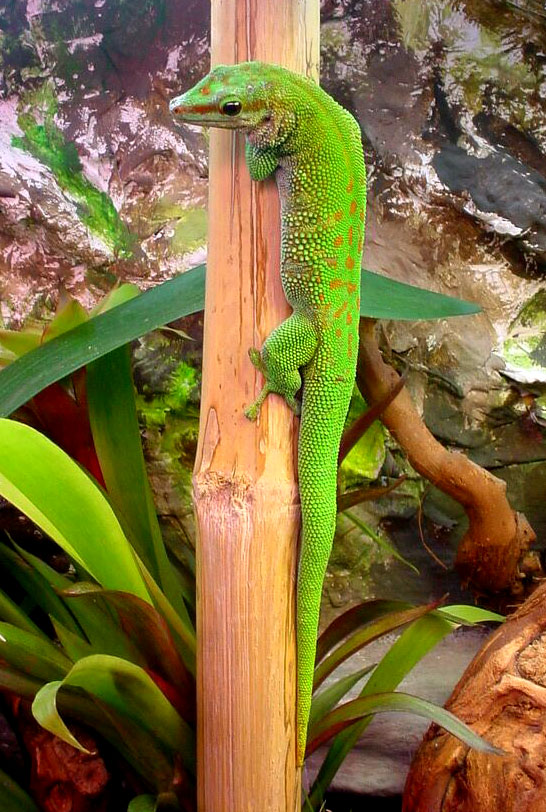 Madagascar Day GeckoPhelsuma madagascariensis
-
 Standing's Day GeckoPhelsuma standingi
-
 Rodrigues Giant Day GeckoPhelsuma gigas
Compare
Questions and answers
What is the scientific name of the Parker's Day Gecko?
The scientific name of the Parker's Day Gecko is Phelsuma parkeri. Written with its author, the full name is Phelsuma parkeri Loveridge, 1941.
Which family does the Parker's Day Gecko belong to?
Phelsuma parkeri belongs to the family Gekkonidae, in the order Squamata and the class Reptilia.
Where is the Parker's Day Gecko found?
Checklists and occurrence records place Phelsuma parkeri in 1 country: Tanzania.
What is the conservation status of the Parker's Day Gecko?
The IUCN Red List category recorded for Phelsuma parkeri is Least Concern (LC).
What other names does the Parker's Day Gecko have?
Phelsuma parkeri is also known in English as Pemba Island Day Gecko.
What food do day geckos eat?
Parker's Day Gecko feeds on various insects and other invertebrates. It also consumes soft, sweet fruit, pollen and nectar by licking them.[14][15]
What is the diet of a gecko?
Parker's Day Gecko feeds on various insects and other invertebrates, as well as soft, sweet fruit, pollen and nectar.[14][15]
Are day geckos friendly?
Parker's Day Gecko is quite shy, including when kept in captivity.[16]
Sources
Passages the profile rests on
- Phelsuma parkeri has a slender body and is classified as a mid-size day gecko. Source passage: “Parker's day gecko is a slender lizard and a mid-size day gecko.” — English Wikipedia
- Its body is bright green. Source passage: “The body colour is bright green.” — English Wikipedia
- A faint red stripe runs from its nostril to its eye. Source passage: “A faint red stripe extends from the nostril to the eye.” — English Wikipedia
- Its back and limbs have tiny black spots and speckles. Source passage: “On the back and limbs tiny black spots and speckles are present.” — English Wikipedia
- Its eye rings are yellow. Source passage: “This species has yellow eye rings.” — English Wikipedia
- Its ventral side is white. Source passage: “The ventral side is white.” — English Wikipedia
- Its total length, including the tail, can reach approximately 16 cm. Source passage: “It can reach a total length (including tail) of about 16 cm (6.3 in).” — English Wikipedia
- It commonly inhabits banana trees and human dwellings. Source passage: “typically inhabits banana trees and dwellings.” — English Wikipedia
- It is often found on large trees, including banana trees and palms. Source passage: “Phelsuma parkeri is often found on different large trees such as banana trees and palms.” — English Wikipedia
- It also lives near or on human dwellings. Source passage: “This species also lives near or on human dwellings.” — English Wikipedia
- The species is endemic to Pemba Island in Tanzania. Source passage: “The species is endemic to Pemba Island, Tanzania” — English Wikipedia
- Its distribution is restricted to Pemba Island, which covers 1,340 square kilometres. Source passage: “found only on 1,340-square-kilometre (517-square-mile) Pemba Island” — English Wikipedia
- Pemba Island is located 50 km from the Tanzanian mainland. Source passage: “which is 50 km (31 mi) from the Tanzanian mainland.” — English Wikipedia
- It feeds on various insects and other invertebrates. Source passage: “Parker's day gecko feeds on various insects and other invertebrates.” — English Wikipedia
- It consumes soft, sweet fruit, pollen and nectar by licking them. Source passage: “It also licks soft, sweet fruit, pollen and nectar.” — English Wikipedia
- It is quite shy, including when kept in captivity. Source passage: “The Pemba Island day gecko is quite shy and stays so, even in captivity.” — English Wikipedia
- The species is diurnal. Source passage: “is a diurnal species of lizard in the family Gekkonidae.” — English Wikipedia
- Females nest communally in colonies. Source passage: “The females of P. parkeri are colony nesters” — English Wikipedia
- Multiple eggs can be found at a single nesting location. Source passage: “many eggs can be found at one location.” — English Wikipedia
- Newly hatched individuals measure approximately 28 mm. Source passage: “The neonates measure about 28 mm (1.1 in).” — English Wikipedia
Data
- Catalogue of Life, 2026-10-16 XR cc by
- Global Biodiversity Information Facility CC BY 4.0
- Wikidata CC0
- GeoNames CC BY 4.0
- Within the Catalogue of Life, this name comes from The Reptile Database cc by
References
- Loveridge, A. (1941). New Geckos (Phelsuma and Lygodactylus), Snake (Lepotyphlops) and Frog (Phrynobarachits) from Pemba Island, East Africa. Proc. Biol. Soc. Washington 54 (8): 175-178.
- Loveridge, A. (1947). Revision of the African lizards of the family Gekkondiae. Bull. Mus. Comp. Zool. Harvard 98: 1-469.
- Broadley, D. G., & HOWELL, K. M. (1991). A check list of the reptiles of Tanzania, with synoptic keys. Syntarsus 1: 1—70.
- Meier, H. & W. BÖHME. (1996). Zum taxonomischen Status des Formenkreises von Phelsuma abbotti STEJNEGER, 1893, mit Bemerkungen über P. masohoala RAXWORTHY & NUSSBAUM, 1994. Salamandra 32 (2): 85-98.
- Rösler, H. (2000). Kommentierte Liste der rezent, subrezent und fossil bekannten Geckotaxa (Reptilia: Gekkonomorpha). Gekkota 2: 28-153.
- Rösler, & Herbert. (2001). Zur Rumpfbeschuppung der Gattung Phelsuma GRAY 1825: zoogeographische Aspekte (Sauria: Gekkonidae). Gekkota 3: 47-73.
- Austin, J.J.; E. N. Arnold and C. G. Jones. (2004). Reconstructing an island radiation using ancient and recent DNA: the extinct and living day geckos (Phelsuma) of the Mascarene islands. Molecular Phylogenetics and Evolution 31 (1): 109-122.
- Berghof, H.-P. (2005). Taggeckos. Natur Und Tier Verlag, Münster, 144 Pp.
- Hallmann, G.; Krüger, J. & Trautmann, G. (2008). Faszinierende Taggeckos. Die Gattung Phelsuma. 2. Aufl. Natur Und Tier Verlag, Münster, 253 Pp.
- ROCHA, SARA; HERBERT RÖSLER, PHILIP-SEBASTIAN GEHRING, FRANK GLAW, DAVID POSADA, D. JAMES HARRIS & MIGUEL VENCES. (2010). Phylogenetic systematics of day geckos, genus Phelsuma, based on molecular and morphological data (Squamata: Gekkonidae). Zootaxa 2429: 1–28.
- Beolens, B., & Michael Watkins, a. M. G. (2011). The Eponym Dictionary of Reptiles. Johns Hopkins University Press, Baltimore, USA.
- Hawlitschek, O.; F. Glaw & D. Rödder. (2012). Pemba – Herpetologische Fundgrube im Indischen Ozean. Reptilia (Münster) 17 (97): 97-109.
- Glaw, F., & Rösler, H. (2015). Taxonomic checklist of the day geckos of the genera Phelsuma Gray,1825 and Rhoptropella Hewitt,1937 (Squamata: Gekkonidae). Vertebrate Zoology 65 (2):
- Hawlitschek, O., Ramírez Garrido, S. and Glaw, F. (2017). How marine currents influenced the widespread natural overseas dispersal of reptiles in the Western Indian Ocean region. J. Biogeogr., 44: 1435–1440. Doi:10.1111/Jbi.12940.
- Spawls, Steve; Kim Howell, Harald Hinkel, Michele Menegon. (2018). Field Guide to East African Reptiles. Bloomsbury, 624 Pp.
This species in other databases
Page built on 29 November 2026. See how the catalog is made and all sources and licences.
Cite this page
ScientificNames.org. (2026). Phelsuma parkeri (Parker's Day Gecko). Retrieved November 29, 2026, from https://scientificnames.org/species/phelsuma-parkeri
“Phelsuma parkeri (Parker's Day Gecko).” ScientificNames.org, 2026, scientificnames.org/species/phelsuma-parkeri. Accessed 29 Nov. 2026.
ScientificNames.org. “Phelsuma parkeri (Parker's Day Gecko).” Accessed November 29, 2026. https://scientificnames.org/species/phelsuma-parkeri.
@misc{scientificnames_phelsuma_parkeri_parkers_day_gecko,
  author = {{ScientificNames.org}},
  title = {Phelsuma parkeri (Parker's Day Gecko)},
  year = {2026},
  url = {https://scientificnames.org/species/phelsuma-parkeri},
  note = {Accessed 2026-11-29}
}