Species · Reptiles
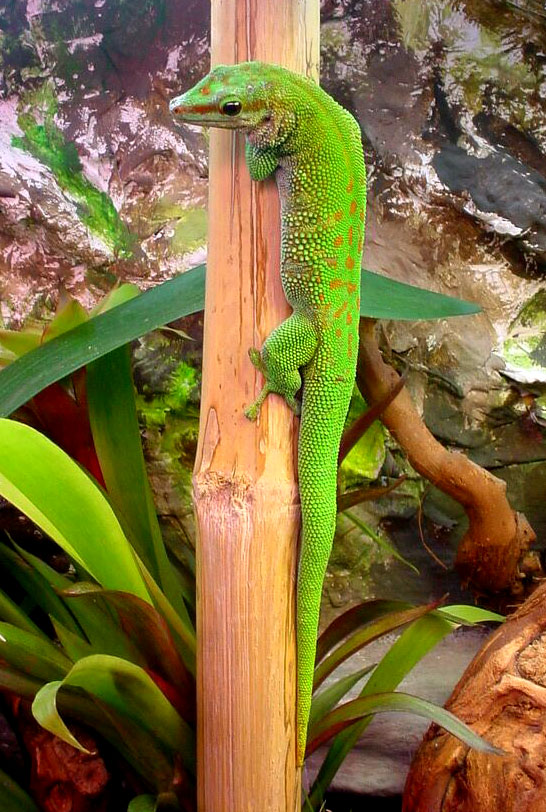
Seychelles Giant Day Gecko Phelsuma sundbergi
The scientific name of the Seychelles Giant Day Gecko is Phelsuma sundbergi. It is a species of reptile in the family Gekkonidae (geckos), order Squamata. The name dates from 1939.
- Scientific name
- Phelsuma sundbergi Rendahl, 1939
- Common name
- Seychelles Giant Day Gecko
- Genus
- Phelsuma
- Family
- Gekkonidae (Geckos)
- Order
- Squamata
- Class
- Reptilia
- Red List category
- LC Least Concern
- Recorded in
- 1 country
- Name status
- accepted in the Catalogue of Life
Overview
The Seychelles giant day gecko is a lizard belonging to the family Gekkonidae. It is endemic to Seychelles. It has three recognized subspecies.
Written 26 November 2026 from the sources listed below. Each statement was checked against the passage it cites; statements that could not be supported were removed.
Habitat
The Seychelles giant day gecko inhabits subtropical or tropical dry forests, subtropical or tropical moist lowland forests, and subtropical or tropical moist montane forests. It also occurs in introduced vegetation.[1][2][3][4]
Reproduction and life cycle
The Seychelles giant day gecko is oviparous.[5]
Conservation
The Seychelles giant day gecko is threatened by habitat loss.[6]
Behaviour
The subspecies Phelsuma sundbergi sundbergi is diurnal.[7]
Classification of the Seychelles Giant Day Gecko
| Kingdom | Animalia |
|---|---|
| Phylum | Chordata |
| Subphylum | Vertebrata |
| Infraphylum | Gnathostomata |
| Parvphylum | Osteichthyes |
| Megaclass | Tetrapoda |
| Class | Reptilia (Reptile) |
| Order | Squamata (Snakes) |
| Suborder | Gekkota |
| Family | Gekkonidae (Geckos) |
| Genus | Phelsuma (Day Geckos) |
| Species | Phelsuma sundbergi Rendahl, 1939 |
Where the Seychelles Giant Day Gecko is found
Checklists and occurrence records place Phelsuma sundbergi in 1 country across Africa. GBIF holds 975 georeferenced records of it.
Countries
Regions and cities with the most records
- La Digue and Inner Islands, Seychelles 264
- Victoria, Seychelles 261
- Baie Sainte Anne, Seychelles 149
- Port Glaud, Seychelles 30
- Glacis, Seychelles 26
- Anse Etoile, Seychelles 22
- Beau Vallon, Seychelles 21
- Cascade, Seychelles 17
- Bel Air, Seychelles 14
- Anse Royale, Seychelles 13
- Mont Fleuri, Seychelles 13
- Les Mamelles, Seychelles 11
- Au Cap, Seychelles 9
- Outer Islands, Seychelles 9
- Baie Lazare, Seychelles 8
- Takamaka, Seychelles 7
- Roche Caiman, Seychelles 5
- Mont Buxton, Seychelles 4
- Anse Boileau, Seychelles 3
Range as the checklists state it
Seychelles (La Digue, Praslin, Curieuse, Desroches)
A number beside a place is its count of GBIF occurrence records. A place without a number comes from a checklist alone. Records show where a species has been observed or collected, which can include escapes and vagrants.
Common names
English
- Seychelles Giant Day Gecko
- La Digue Day Gecko
- Mah
- Mahé Day Gecko
Names in 7 other languages
- Chinese
- 森氏日行守宮
- Danish
- Stor Seychellerdaggekko
- German
- Seychellen-Taggecko
- Italian
- Felsuma gigante delle Seychelles, Geco diurno gigante delle Seychelles
- Japanese
- セーシェルヒルヤモリ
- Polish
- felsuma seszelska
- chm
- Сандберг фельзума
Synonyms
6 other scientific names have been used for this species and are now treated as synonyms of Phelsuma sundbergi.
- Phelsuma cousinense Rendahl, 1939
- Phelsuma madagascariensis ladiguensis Böhme & Meier, 1981
- Phelsuma menaiensis Mertens, 1966
- Phelsuma pulchra Rendahl, 1939
- Phelsuma rubra Börner & Minuth, 1982
- Phelsuma umbrae Börner & Minuth, 1982
Subspecies and varieties
- Phelsuma sundbergi ladiguensis (La Digue Day Gecko) subspecies
- Phelsuma sundbergi longinsulae (Mahé Day Gecko) subspecies
- Phelsuma sundbergi sundbergi (Seychelles Giant Day Gecko) subspecies
Related species
-
 Gold Dust Day GeckoPhelsuma laticauda
-
 Madagascar Giant Day GeckoPhelsuma grandis
-
 Mauritius Ornate Day GeckoPhelsuma ornata
-
 Yellow-headed Day GeckoPhelsuma klemmeri
-
 Blue-tailed Day GeckoPhelsuma cepediana
-
 Madagascar Day GeckoPhelsuma madagascariensis
-
 Standing's Day GeckoPhelsuma standingi
-
 Rodrigues Giant Day GeckoPhelsuma gigas
Compare
Questions and answers
What is the scientific name of the Seychelles Giant Day Gecko?
The scientific name of the Seychelles Giant Day Gecko is Phelsuma sundbergi. Written with its author, the full name is Phelsuma sundbergi Rendahl, 1939.
Which family does the Seychelles Giant Day Gecko belong to?
Phelsuma sundbergi belongs to the family Gekkonidae, in the order Squamata and the class Reptilia.
Where is the Seychelles Giant Day Gecko found?
Checklists and occurrence records place Phelsuma sundbergi in 1 country: Seychelles.
What is the conservation status of the Seychelles Giant Day Gecko?
The IUCN Red List category recorded for Phelsuma sundbergi is Least Concern (LC).
What other names does the Seychelles Giant Day Gecko have?
Phelsuma sundbergi is also known in English as La Digue Day Gecko, Mah and Mahé Day Gecko.
Sources
Passages the profile rests on
- Phelsuma sundbergi inhabits subtropical or tropical dry forests. Source passage: “subtropical or tropical dry forests” — English Wikipedia
- Phelsuma sundbergi inhabits subtropical or tropical moist lowland forests. Source passage: “subtropical or tropical moist lowland forests” — English Wikipedia
- Phelsuma sundbergi inhabits subtropical or tropical moist montane forests. Source passage: “subtropical or tropical moist montane forests” — English Wikipedia
- Phelsuma sundbergi occurs in introduced vegetation. Source passage: “introduced vegetation.” — English Wikipedia
- Phelsuma sundbergi is oviparous. Source passage: “P. sundbergi is oviparous.” — English Wikipedia
- Phelsuma sundbergi is threatened by habitat loss. Source passage: “P. sundbergi is threatened by habitat loss.” — English Wikipedia
- The subspecies Phelsuma sundbergi sundbergi is diurnal. Source passage: “is diurnal subspecies of geckos.” — inaturalist.org
Data
- Catalogue of Life, 2026-10-16 XR cc by
- Global Biodiversity Information Facility CC BY 4.0
- Wikidata CC0
- GeoNames CC BY 4.0
- Within the Catalogue of Life, this name comes from The Reptile Database cc by
References
- Rendahl, H. (1939). Zur Herpetologie der Seychellen. I. Reptilien. Zool. Jb. Syst. 72: 255-328.
- Loveridge, A. R. (1942). Revision of the Afro-Oriental geckos of the genus Phelsuma. Bull. Mus. Comp. Zool. Harvard 89: 439-482.
- Mertens, R. (1962). Die Arten und Unterarten der Geckonengattung Phelsuma. Senckenbergiana Biologica 43: 81-127.
- Mertens, R. (1966). Die nichtmadagassichen Arten und Unterarten der Geckonengattung Phelsuma. Senckenbergiana Biologica 47:85—110.
- Mertens, R. (1967). Die herpetologische Sektion des Natur-Museums und Forschungs-Institutes Senckenberg in Frankfurt am Main nebst einem Verzeichnis ihrer Typen. Senckenbergiana Biologica 48: 1-106.
- Böhme, W., and H. Meier. (1981). Eine neue Form der madagascariensis—Gruppe der Gattung Phelsuma von den Seychellen (Reptilia: Sauna: Gekkonidae). Salamandra 17 (1-2):12-19.
- Cheke, A. S. (1982). Phelsuma GRAY 1825 in the Seychelles and neighbouring islands: A re-appraisal of their taxonomy and description of two new forms (Reptilia: Sauria: Gekkonidae). Senckenbergiana Biologica 62 [1981]:181—198.
- Meier, H. (1982). Zur Taxonomie und Ökologie der Gattung Phelsuma auf den Seychellen, mit Nachträgen zu dieser Gattung auf den Komoren (Reptilia: Sauria: Gekkonidae). Salamandra 18 (1-2): 49-55.
- Börner, A. R., and W. Minuth. (1982). Advance diagnoses of new taxa of the Phelsuma madagascariensis Group. Miscellaneous Articles in Saurology (11):1-4.
- Börner A M, & Minuth W. (1984). On the taxonomy of the Indian Ocean lizards of the Phelsuma madagascariensis species group (Reptilia, Gekkonidae). J. Bombay Nat. Hist. Soc. 81 (2) 1984: 243-281.
- Gardner, A. S. (1985). An identification key to the geckos of the Seychelles, with brief notes on their distributions and habits. The Herpetological Journal 1 (1): 17-19.
- Hofer, D. (1992). Phelsuma sundbergi RENDAHL, 1939 erbeutet Fische, nebst weiteren Beobachtungen auf den Seychellen. Salamandra 28 (2): 153-155.
- Budzinski, R. M. (2000). Phelsumen auf der Amiranteninsel Desroches. Elaphe 8 (2): 87-90.
- Rösler, H. (2000). Kommentierte Liste der rezent, subrezent und fossil bekannten Geckotaxa (Reptilia: Gekkonomorpha). Gekkota 2: 28-153.
- Rösler, & Herbert. (2001). Zur Rumpfbeschuppung der Gattung Phelsuma GRAY 1825: zoogeographische Aspekte (Sauria: Gekkonidae). Gekkota 3: 47-73.
- Austin, J.J.; E. N. Arnold and C. G. Jones. (2004). Reconstructing an island radiation using ancient and recent DNA: the extinct and living day geckos (Phelsuma) of the Mascarene islands. Molecular Phylogenetics and Evolution 31 (1): 109-122.
- Berghof, H.-P. (2005). Taggeckos. Natur Und Tier Verlag, Münster, 144 Pp.
- Pawlowski, S., & Krämer, C. (2006). Herpetologische Eindrücke von den zentralen Sychelleninseln Praslin, Curieuse, La Digue und Cousin. Elaphe 14 (3): 53-61.
- Hallmann, G.; Krüger, J. & Trautmann, G. (2008). Faszinierende Taggeckos. Die Gattung Phelsuma. 2. Aufl. Natur Und Tier Verlag, Münster, 253 Pp.
- Pawlowski, S., & Krämer, C. (2009). Zur Herpetologie des Vallée de Mai auf Praslin, Seychellen. Sauria 30 (4): 19-27 [2008].
- Pawlowski, S., & Krämer, C. (2009). Zur Herpetologie des Flu Catcher National Parks auf La Digue, Seychellen. Sauria 31 (3): 25-33.
- Gehring, P. S., & Glaw, F. (2010). Bunte Vielfalt in modernem Licht: Taggeckos der Gattung Phelsuma. Draco 11 (43): 4-21.
- Wirth, M. (2010). Farbensprühende Schönheiten auf Traumeilanden - die Taggeckos des inneren Seychellen. Draco 11 (43): 29-44.
- ROCHA, SARA; HERBERT RÖSLER, PHILIP-SEBASTIAN GEHRING, FRANK GLAW, DAVID POSADA, D. JAMES HARRIS & MIGUEL VENCES. (2010). Phylogenetic systematics of day geckos, genus Phelsuma, based on molecular and morphological data (Squamata: Gekkonidae). Zootaxa 2429: 1–28.
- PAWLOWSKI, S. (2011). The Day Geckos of the Genus Phelsuma GRAY, 1825, on the Central Seychelles Islands. Sauria, Berlin 33 (2): 31-46.
This species in other databases
Page built on 29 November 2026. See how the catalog is made and all sources and licences.
Cite this page
ScientificNames.org. (2026). Phelsuma sundbergi (Seychelles Giant Day Gecko). Retrieved November 29, 2026, from https://scientificnames.org/species/phelsuma-sundbergi
“Phelsuma sundbergi (Seychelles Giant Day Gecko).” ScientificNames.org, 2026, scientificnames.org/species/phelsuma-sundbergi. Accessed 29 Nov. 2026.
ScientificNames.org. “Phelsuma sundbergi (Seychelles Giant Day Gecko).” Accessed November 29, 2026. https://scientificnames.org/species/phelsuma-sundbergi.
@misc{scientificnames_phelsuma_sundbergi_seychelles_giant_day_gecko,
  author = {{ScientificNames.org}},
  title = {Phelsuma sundbergi (Seychelles Giant Day Gecko)},
  year = {2026},
  url = {https://scientificnames.org/species/phelsuma-sundbergi},
  note = {Accessed 2026-11-29}
}