Species · Reptiles
Ampasindava Day Gecko Phelsuma vanheygeni
The scientific name of the Ampasindava Day Gecko is Phelsuma vanheygeni. It is a species of reptile in the family Gekkonidae (geckos), order Squamata. The name dates from 2004.
- Scientific name
- Phelsuma vanheygeni Lerner, 2004
- Common name
- Ampasindava Day Gecko
- Genus
- Phelsuma
- Family
- Gekkonidae (Geckos)
- Order
- Squamata
- Class
- Reptilia
- Red List category
- EN Endangered
- Recorded in
- 1 country
- Name status
- accepted in the Catalogue of Life
Overview
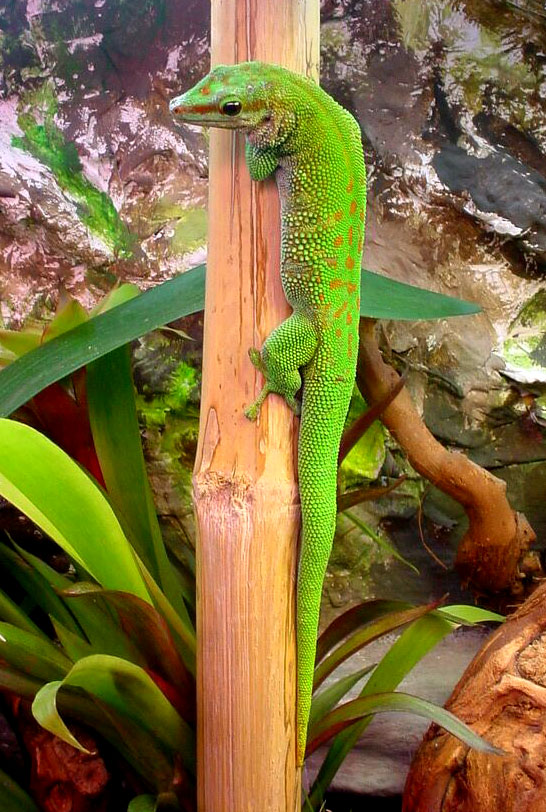
The species is endemic to Madagascar and occurs on the Ampasindava peninsula in northern Madagascar. Living specimens have vivid green dorsal coloration and small red dots on the lower back and upper tail.
Written 27 November 2026 from the sources listed below. Each statement was checked against the passage it cites; statements that could not be supported were removed.
Habitat
The species inhabits patches of bamboo within forests at elevations between 50 and 400 metres.[1][2]
It appears restricted to medium-sized bamboo measuring approximately 5 centimetres in diameter.[3]
The species is endemic to Madagascar and occurs on the Ampasindava peninsula in northern Madagascar.[4][5]
Appearance
The species has a somewhat slender and relatively flattened body. Its snout–vent length is 31–35 millimetres, and its total length is 75–80 millimetres.[6][7][8]
Living specimens have vivid green dorsal coloration covering the head, neck, limbs and tail. The lower back and upper tail bear irregularly positioned small red dots, which are usually slightly larger in males than in other specimens.[9][10][11]
A yellowish stripe separates the green dorsal coloration from the surrounding coloration. It begins at the rostral scale, passes backward over the supralabial scales and beneath the ear opening, and widens at the axilla.[12][13]
The ventral coloration is dirty white, and the tips of the subcaudal scales have brown to black pigmentation. The ventral and subcaudal scales are smooth rather than keeled.[14][15][16]
Reproduction and life cycle
The species is oviparous and attaches its eggs to the inside of bamboo stems.[17][18]
Classification of the Ampasindava Day Gecko
| Kingdom | Animalia |
|---|---|
| Phylum | Chordata |
| Subphylum | Vertebrata |
| Infraphylum | Gnathostomata |
| Parvphylum | Osteichthyes |
| Megaclass | Tetrapoda |
| Class | Reptilia (Reptile) |
| Order | Squamata (Snakes) |
| Suborder | Gekkota |
| Family | Gekkonidae (Geckos) |
| Genus | Phelsuma (Day Geckos) |
| Species | Phelsuma vanheygeni Lerner, 2004 |
Where the Ampasindava Day Gecko is found
Checklists and occurrence records place Phelsuma vanheygeni in 1 country across Africa. GBIF holds 2 georeferenced records of it.
Countries
Range as the checklists state it
Madagascar (Ampasindava peninsula)
A number beside a place is its count of GBIF occurrence records. A place without a number comes from a checklist alone. Records show where a species has been observed or collected, which can include escapes and vagrants.
Common names
English
- Ampasindava Day Gecko
Names in 2 other languages
- Chinese
- 范氏日行守宮
- German
- Van-Heygen-Taggecko
Related species
-
 Gold Dust Day GeckoPhelsuma laticauda
-
 Madagascar Giant Day GeckoPhelsuma grandis
-
 Mauritius Ornate Day GeckoPhelsuma ornata
-
 Yellow-headed Day GeckoPhelsuma klemmeri
-
 Blue-tailed Day GeckoPhelsuma cepediana
-
 Madagascar Day GeckoPhelsuma madagascariensis
-
 Standing's Day GeckoPhelsuma standingi
-
 Rodrigues Giant Day GeckoPhelsuma gigas
Compare
Questions and answers
What is the scientific name of the Ampasindava Day Gecko?
The scientific name of the Ampasindava Day Gecko is Phelsuma vanheygeni. Written with its author, the full name is Phelsuma vanheygeni Lerner, 2004.
Which family does the Ampasindava Day Gecko belong to?
Phelsuma vanheygeni belongs to the family Gekkonidae, in the order Squamata and the class Reptilia.
Where is the Ampasindava Day Gecko found?
Checklists and occurrence records place Phelsuma vanheygeni in 1 country: Madagascar.
What is the conservation status of the Ampasindava Day Gecko?
The IUCN Red List category recorded for Phelsuma vanheygeni is Endangered (EN).
Sources
Passages the profile rests on
- The species inhabits patches of bamboo within forests. Source passage: “The natural habitat of P. vanheygeni is patches of bamboo in forest” — English Wikipedia
- The species occurs at elevations between 50 and 400 metres. Source passage: “at altitudes of 50–400 m (160–1,310 ft).” — English Wikipedia
- The species appears restricted to medium-sized bamboo measuring approximately 5 centimetres in diameter. Source passage: “It appears to be confined to medium-sized bamboo (about 5 cm (2 in) in diameter).” — English Wikipedia
- The species is endemic to Madagascar. Source passage: “The species is endemic to Madagascar.” — English Wikipedia
- The species occurs on the Ampasindava peninsula in northern Madagascar. Source passage: “P. vanheygeni is found on the Ampasindava peninsula in northern Madagascar.” — English Wikipedia
- The species has a snout–vent length of 31–35 millimetres. Source passage: “P. vanheygeni measure 31–35 mm (1.2–1.4 in) in snout–vent length” — English Wikipedia
- The species reaches a total length of 75–80 millimetres. Source passage: “and 75–80 mm (3.0–3.1 in) in total length.” — English Wikipedia
- The species has a somewhat slender and relatively flattened body. Source passage: “It is somewhat slender and rather flattened.” — English Wikipedia
- Living specimens have vivid green dorsal coloration covering the head, neck, limbs and tail. Source passage: “The dorsal coloration of living specimens (including the head, neck, limbs and tail) is vivid green.” — English Wikipedia
- The lower back and upper tail bear irregularly positioned small red dots. Source passage: “There are some small red dots irregularly positioned on the lower back and upper tail;” — English Wikipedia
- Males usually have slightly larger red dots than other specimens. Source passage: “males have usually slightly bigger red dots.” — English Wikipedia
- A yellowish stripe separates the green dorsal coloration from the surrounding coloration. Source passage: “The green dorsal coloration is delimited by a yellowish stripe” — English Wikipedia
- The yellowish stripe begins at the rostral scale, passes backward over the supralabial scales and beneath the ear opening, and widens at the axilla. Source passage: “begins at the rostral scale, continues backwards over the supralabial scales, under the ear opening, and widens at the axilla.” — English Wikipedia
- The ventral coloration is dirty white. Source passage: “The ventral coloration is dirty white;” — English Wikipedia
- The tips of the subcaudal scales have brown to black pigmentation. Source passage: “the subcaudal scales have a brown to black pigmentation at their tips.” — English Wikipedia
- The ventral and subcaudal scales are smooth rather than keeled. Source passage: “The Ventral and subcaudal scales are smooth (not keeled).” — English Wikipedia
- The species is oviparous. Source passage: “P. vanheygeni is oviparous” — English Wikipedia
- The species attaches its eggs to the inside of bamboo stems. Source passage: “glues its eggs to the inside of bamboo stems.” — English Wikipedia
Data
- Catalogue of Life, 2026-10-16 XR cc by
- Global Biodiversity Information Facility CC BY 4.0
- Wikidata CC0
- GeoNames CC BY 4.0
- Within the Catalogue of Life, this name comes from The Reptile Database cc by
References
- Lerner, A. (2004). A new taxonomically isolated species of the genus Phelsuma GRAY, 1825 from the Ampasindava peninsula, Madagascar. Phelsuma 12: 91-98.
- Heygen, E.v. (2004). The genus Phelsuma GRAY, 1825 on the Ampasindava peninsula, Madagascar. Phelsuma 12: 99-117.
- Berghof, H.-P. (2005). Taggeckos. Natur Und Tier Verlag, Münster, 144 Pp.
- Hallmann, G.; Krüger, J. & Trautmann, G. (2008). Faszinierende Taggeckos. Die Gattung Phelsuma. 2. Aufl. Natur Und Tier Verlag, Münster, 253 Pp.
- ROCHA, SARA; HERBERT RÖSLER, PHILIP-SEBASTIAN GEHRING, FRANK GLAW, DAVID POSADA, D. JAMES HARRIS & MIGUEL VENCES. (2010). Phylogenetic systematics of day geckos, genus Phelsuma, based on molecular and morphological data (Squamata: Gekkonidae). Zootaxa 2429: 1–28.
- Beolens, B., & Michael Watkins, a. M. G. (2011). The Eponym Dictionary of Reptiles. Johns Hopkins University Press, Baltimore, USA.
- Wohler, Josua. (2013). Unterschiede in der Pupillenform bei einigen Arten der Gattung Phelsuma. Sauria 35 (4): 15-22.
- Berghof, H.-P. (2014). Pflege und Vermehrung von Phelsuma pronki Seipp, 1994 und Phelsuma vanheygeni Lerner, 2004. Reptilia (Münster) 19 (105): 38-43.
- Glaw, F., & Rösler, H. (2015). Taxonomic checklist of the day geckos of the genera Phelsuma Gray,1825 and Rhoptropella Hewitt,1937 (Squamata: Gekkonidae). Vertebrate Zoology 65 (2):
- RÖSLER, H. (2020). Hommage an Murk van Phelsum. Sauria 42 (2): 3-27.
This species in other databases
Page built on 29 November 2026. See how the catalog is made and all sources and licences.
Cite this page
ScientificNames.org. (2026). Phelsuma vanheygeni (Ampasindava Day Gecko). Retrieved November 29, 2026, from https://scientificnames.org/species/phelsuma-vanheygeni
“Phelsuma vanheygeni (Ampasindava Day Gecko).” ScientificNames.org, 2026, scientificnames.org/species/phelsuma-vanheygeni. Accessed 29 Nov. 2026.
ScientificNames.org. “Phelsuma vanheygeni (Ampasindava Day Gecko).” Accessed November 29, 2026. https://scientificnames.org/species/phelsuma-vanheygeni.
@misc{scientificnames_phelsuma_vanheygeni_ampasindava_day_gecko,
  author = {{ScientificNames.org}},
  title = {Phelsuma vanheygeni (Ampasindava Day Gecko)},
  year = {2026},
  url = {https://scientificnames.org/species/phelsuma-vanheygeni},
  note = {Accessed 2026-11-29}
}